

An ideator is a person who generates ideas — consistently, deliberately, and often in ways that lead to real outcomes. The word comes from the verb ideate, which Merriam-Webster defines as "to form an idea or mental image of." In practice, an ideator isn’t just someone who occasionally has good ideas; it’s someone for whom idea generation is a defining strength and, in many cases, a professional role.
This guide explains what the term means, the characteristics that distinguish strong ideators, how ideation shows up in different professional contexts, and how anyone can develop their ideation skills.
Ideator Meaning: What the Word Actually Means
The term ideator is derived from ideate (verb) and ideation (noun). All three words share the same Latin root: idea, meaning form or concept.
-
Ideate — to form or conceive an idea; the act of generating ideas
-
Ideation — the process of forming ideas, particularly in a structured or creative context
-
Ideator — a person who engages in ideation; someone whose primary contribution is the generation and development of new ideas
The word is used across design, business, marketing, innovation management, and education. In the Design Thinking process developed by IDEO, "Ideate" is the third phase — following Empathize and Define — in which teams generate as many potential solutions as possible before narrowing down to prototyping and testing.
In everyday use, someone might refer to a colleague as "the ideator on the team" to mean the person who consistently brings new concepts to the table, even when their formal job title doesn’t say so.
Is "Ideator" a Real Word?
Yes. Ideate appears in Merriam-Webster, and ideator is its agent noun — meaning it follows the same grammatical pattern as words like "creator," "narrator," or "operator." While ideator is not yet in Merriam-Webster’s main dictionary as a standalone entry, it is in common use in business, UX design, and organizational development literature, and is widely understood in professional contexts.
The related term ideation is fully established and appears frequently in job descriptions, product development frameworks, and innovation literature.
The 5 Key Traits of a Strong Ideator
Gallup’s CliftonStrengths assessment identifies "Ideation" as one of 34 talent themes, describing people with this strength as individuals fascinated by ideas who are able to find connections between seemingly disparate phenomena. Beyond the Gallup framework, strong ideators tend to share the following characteristics.
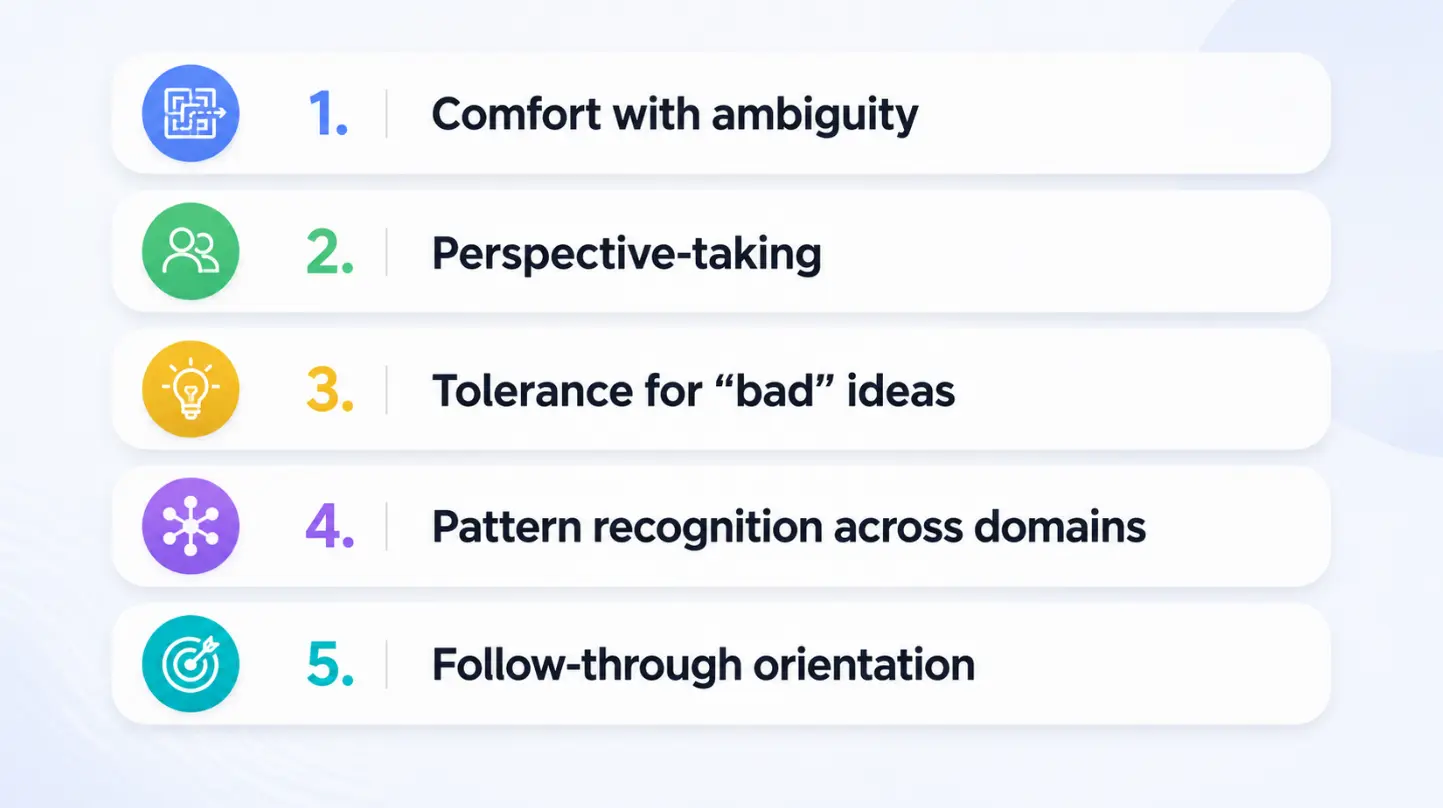 The 5 key traits of a strong ideator
1. Comfort with ambiguity
Ideators are at ease when problems aren’t fully defined. Where others need clarity before they can begin, ideators often do their best thinking in the exploratory phase — when the problem space is still open and constraints haven’t been set. This comfort with ambiguity is what allows them to generate a wide range of options before converging on solutions.
2. Perspective-taking
Strong ideators don’t generate ideas from a single point of view. They habitually ask: "How does this look from the customer’s perspective? From a competitor’s? From someone who has never heard of this industry?" The ability to shift frames is what allows ideators to surface non-obvious solutions that others miss.
3. Tolerance for "bad" ideas
Ideators understand that generating a large volume of ideas — including weak ones — is necessary to surface strong ones. They don’t self-censor early. This is why structured ideation methods like brainstorming and brainwriting explicitly suspend judgment during the generation phase: it’s a design feature, not an oversight. Ideators internalize this principle naturally.
4. Pattern recognition across domains
Many of the most valuable ideas come from applying a concept from one field to a problem in another. Ideators tend to read widely, maintain curiosity across disciplines, and notice structural similarities between seemingly unrelated things. This cross-domain thinking is one of the hardest ideation traits to teach directly, but one of the most consistently observed in people who generate breakthrough ideas.
5. Follow-through orientation
The stereotype of the "ideas person" who never executes is real, but it doesn’t describe the most effective ideators. The best ideators pair generative thinking with a concern for viability — they’re interested not just in what’s possible, but in what’s actually buildable, sellable, or implementable given real constraints. An idea that can’t survive contact with reality is incomplete.
Ideator vs. Innovator vs. Creative: What’s the Difference?
These terms overlap but aren’t interchangeable.
|
Term |
Core meaning |
Scope |
|---|---|---|
|
Ideator |
Someone who generates and develops ideas |
The generation phase; idea quantity and quality |
|
Innovator |
Someone who turns ideas into implemented change |
The full cycle: idea → execution → adoption |
|
Creative |
Someone with artistic or inventive ability |
Broad; can apply to aesthetics, expression, or problem-solving |
Ideation is a subset of innovation. You can be an effective ideator without completing the innovation cycle, and you can be an innovator who relies heavily on others for the ideation phase. In team settings, ideators often work alongside implementers and evaluators — people whose strengths complement the generation of ideas rather than duplicate it.
What Does an Ideator Do in a Professional Context?
Ideator appears in a growing number of job titles, particularly in content, marketing, product, and design roles. Some examples of how the term is used professionally:
-
Content Ideator — responsible for generating topic concepts, content angles, and campaign ideas; often sits within a content strategy or editorial team
-
Creative Ideator — a role focused on developing creative concepts for advertising, brand campaigns, or product experiences; common in agencies
-
Innovation Ideator — a participant or facilitator in structured innovation programs; often works within corporate R&D or strategy teams to generate and vet new product or service concepts
-
UX Ideator — a practitioner who leads the ideation phase of design sprints, generating interface solutions and user flow concepts in response to research findings
In many organizations, "ideator" is less a formal title than a functional role that people fill regardless of what their business card says. The product manager who always comes to meetings with three alternative approaches, the marketing coordinator who generates fifty campaign angles before settling on one, the engineer who proposes entirely new architectural patterns — these are ideators in practice.
How to Develop Your Ideation Skills
Ideation ability is not fixed. Like any cognitive skill, it improves with deliberate practice and the right conditions. The following approaches are drawn from established ideation research and design practice.
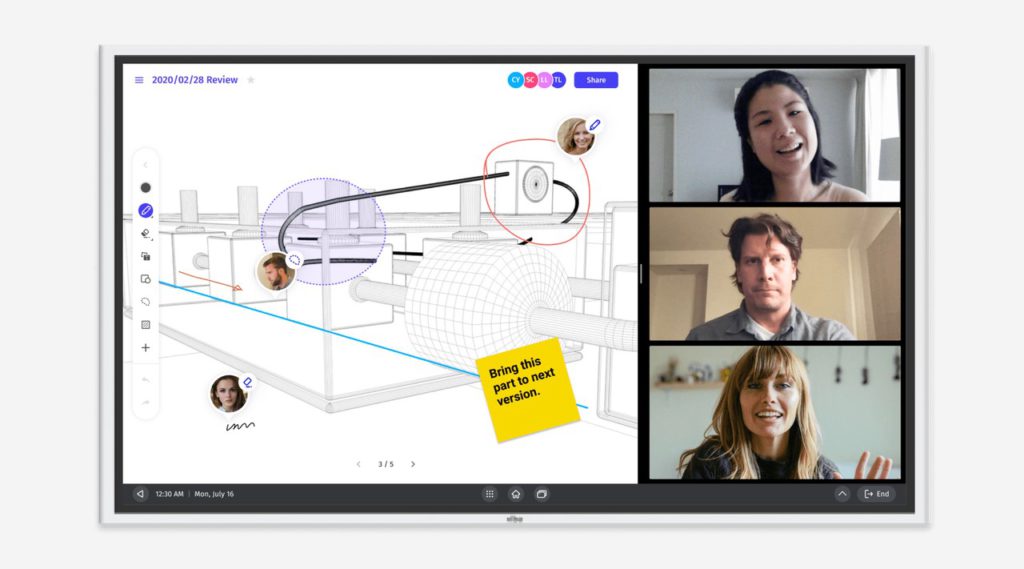 Team ideating together over a video call
Build idea volume before evaluating quality
The most consistent finding in ideation research is that quality correlates with quantity: the more ideas generated, the higher the likelihood that strong ones emerge. This means training yourself to defer judgment — to generate first and evaluate second, even when your instinct is to critique ideas as they arise. Start any ideation session with a quantity target: 20 ideas before you evaluate any of them.
Use structured ideation methods
Unstructured "just think of ideas" sessions produce less than structured approaches. Methods like SCAMPER (Substitute, Combine, Adapt, Modify, Put to another use, Eliminate, Rearrange), brainwriting, and worst-possible-idea are designed to force cognitive variety — to get you out of the grooves of familiar thinking. Each method provides a different constraint that pushes ideation in a different direction.
Diversify your inputs
Ideas are recombinations of existing concepts. The broader your input base — the industries you’ve studied, the problems you’ve encountered, the perspectives you’ve been exposed to — the larger your raw material for ideation. This is why ideators tend to be voracious readers and curious observers: they’re continuously expanding the library they draw from when generating new ideas.
Collaborate across different perspectives
Solo ideation has a ceiling. Group brainstorming with people from different functions, backgrounds, and expertise levels consistently produces more novel combinations than any individual working alone. The key is structuring the session to prevent groupthink — silent individual generation before group discussion is the most reliable way to ensure that diverse perspectives actually influence the output rather than converging prematurely on the first idea voiced.
Create conditions for incubation
Some of the most useful ideation happens away from the task itself — during a walk, in the shower, while doing something unrelated. This is not mystical; it reflects how the brain processes problems during rest. Deliberately stepping away from a problem after an intensive generation session, and returning to it after a break, consistently surfaces ideas that didn’t emerge during the focused session.
Practice in structured sessions
Regular ideation practice — even 15 minutes a day generating ideas on a given topic — builds the skill over time. Innovation workshops and whiteboarding sessions provide structured environments for this kind of deliberate practice with a team.
Ideation in the Design Thinking Process
Design Thinking is a five-phase problem-solving framework developed and popularized by IDEO and the Stanford d.school. The phases are: Empathize, Define, Ideate, Prototype, and Test. Ideation is the third phase, and it occupies a specific role in the process: after the team has developed empathy for users and defined the core problem, the Ideate phase generates as many potential solutions as possible — before any evaluation or filtering begins.
The Ideate phase typically uses multiple methods in sequence: a rapid brainstorm to generate volume, followed by brainwriting or SCAMPER to push beyond the obvious, followed by dot-voting or an impact effort matrix to prioritize which ideas to carry forward into prototyping.
For teams running Design Thinking sessions in hybrid or remote settings, a shared digital canvas is essential — it allows all participants to contribute simultaneously and ensures that ideas generated during the session are captured and accessible to everyone afterward. See how teams use Vibe Canvas for brainstorming and ideation sessions.
How to Run an Effective Ideation Session
Whether you’re a solo ideator or facilitating a team session, the following structure produces more and better ideas than an unstructured approach.
-
Define the problem clearly before generating solutions. The most common ideation failure is starting generation before the problem is well-defined. Spend time on the Define phase first: who has the problem, what does it feel like from their perspective, and what would a good solution need to accomplish?
-
Set a quantity target and a time limit. "Generate 30 ideas in 20 minutes" produces more useful output than an open-ended session. The constraint forces fluency and prevents overthinking.
-
Separate generation from evaluation. No critiquing during the generation phase — not even mild skepticism. Evaluation comes after the generation phase is complete.
-
Use at least two different methods. A brainstorm followed by a SCAMPER pass, or individual silent generation followed by group sharing, will surface different ideas than a single method alone.
-
Capture everything. Every idea goes on the board — including the ones that seem obviously wrong. The worst idea of the session is sometimes the one that, when combined with something else or inverted, produces the best idea.
-
Prioritize before leaving the session. Use dot-voting or a quick impact/effort sort to identify which ideas are worth developing further. Leaving prioritization for later usually means the output sits in a document and goes nowhere.
Ideator FAQs
What is an ideator?
An ideator is a person who generates and develops ideas, particularly in a professional or creative context. The term comes from the verb "ideate," meaning to form an idea or concept. In business and design, ideators are valued for their ability to produce novel solutions, challenge existing assumptions, and generate a high volume of concepts during the early phases of problem-solving.
Is "ideator" a real word?
Yes. "Ideate" appears in Merriam-Webster, and "ideator" is its standard agent noun form (following the same pattern as creator, narrator, operator). While the standalone entry for "ideator" hasn’t yet made it into all major dictionaries, the word is in common professional use in design, marketing, product development, and innovation management.
What does "ideating" mean?
Ideating is the present participle of "ideate" — meaning the active process of forming or generating ideas. "We spent the afternoon ideating on new product concepts" means the team was engaged in idea generation during that time. In Design Thinking, "ideating" specifically refers to the third phase of the process, in which teams generate potential solutions before moving to prototyping.
What do you call someone who comes up with ideas?
Several terms are used, depending on context: ideator (the most precise term for someone whose defining contribution is idea generation), innovator (broader, implies seeing ideas through to implementation), creative (common in agency and design contexts), and concept developer (used in advertising and product development). In casual usage, "ideas person" or "the creative one on the team" serve the same function.
What is a content ideator?
A content ideator is a professional role focused on generating topics, angles, formats, and campaign concepts for content teams. The role typically involves researching audience needs and search intent, identifying content gaps, and producing a pipeline of ideas for writers, designers, and videographers to execute. Content ideators often sit within editorial, SEO, or brand teams.
What is the difference between ideation and brainstorming?
Brainstorming is one specific ideation technique — a group activity in which participants generate ideas freely without immediate evaluation. Ideation is the broader category: it encompasses brainstorming, brainwriting, SCAMPER, mind mapping, worst-possible-idea, and any other method used to generate and develop ideas. Brainstorming is to ideation what jogging is to exercise — one method among many.
How do you become a better ideator?
The most evidence-backed approaches: practice generating ideas in volume (quantity before quality), use structured methods rather than unstructured "just think of ideas" sessions, diversify your inputs by reading and exploring outside your domain, collaborate with people from different backgrounds, and allow time for incubation between generation sessions. Ideation is a skill that improves with deliberate practice.