
Coaching is one of the highest-leverage things a manager can do—and one of the most consistently underdone. Research from Gallup shows that managers account for at least 70% of the variance in employee engagement, yet most report spending less than 20% of their time on actual coaching conversations. The gap between knowing coaching matters and running sessions that produce measurable change is where most managers get stuck.
This guide covers seven practical ways to run coaching sessions that lead to real behavior change—for managers, team leads, and consultants working with individuals or groups, in-person or remotely.
What Makes a Coaching Session Effective?
Before the tactics, a framing point: coaching is not the same as feedback, training, or performance review. A coaching session is a structured conversation designed to help the other person think more clearly, identify their own solutions, and commit to specific next steps. The coach’s job is to ask better questions, not to deliver better answers.
The most widely used framework for this is the GROW model:
-
Goal — What does the person want to achieve in this session and beyond?
-
Reality — What’s the current situation? What’s actually happening?
-
Options — What could they do? What haven’t they considered?
-
Will — What will they commit to? By when?
The seven tips below build on this foundation with practical, session-level improvements.
7 Tips for More Effective Coaching Sessions
1. Set a Clear Focus Before You Start
The most common coaching failure mode is diffuse sessions that cover too much ground and change nothing. Effective coaching sessions have one focus: one skill, one behavioral pattern, one decision, one relationship.
Before each session, identify the specific "why" behind it. What performance data, observed behavior, or stated goal is this session grounded in? The clearer the focus going in, the more useful the conversation will be.
A simple pre-session checklist:
-
What is the one thing we’re working on today?
-
What does success look like at the end of this session?
-
What do I already know about this person’s context that’s relevant?
For managers running regular 1:1s, separating coaching sessions from deal or status reviews matters here too. When coaching gets folded into a weekly check-in, it tends to disappear under more urgent operational topics.
2. Ask More, Tell Less
The research on coaching effectiveness consistently points in the same direction: the best coaching sessions involve far more listening than talking. A session where the manager talks for 70% of the time is a lecture. A session where the coachee talks for 70% is closer to coaching.
This requires resisting the instinct to fix problems directly—and developing a repertoire of questions that help the other person arrive at their own answers:
-
"What have you already tried?"
-
"What’s getting in the way?"
-
"What would you do if you weren’t worried about X?"
-
"What does the situation look like from their perspective?"
-
"What are you not saying that might be relevant?"
Silence is a tool here. Letting a question sit for five or ten seconds before filling the gap often produces more insight than a follow-up prompt.
3. Make It Visual
Coaching conversations that stay entirely verbal are harder to act on afterward. When the discussion involves goals, progress, competing priorities, or a plan of action, making it visible changes the dynamic—both people are looking at the same thing together rather than having parallel internal conversations.
A shared visual surface—a whiteboard, a shared document, or a canvas—does several things at once: it captures ideas as they surface, creates a reference both parties can refer back to, and makes patterns and gaps easier to spot. Frameworks like the GROW model, a simple 2×2, or a timeline drawn in real time are often more useful than a polished slide deck prepared in advance
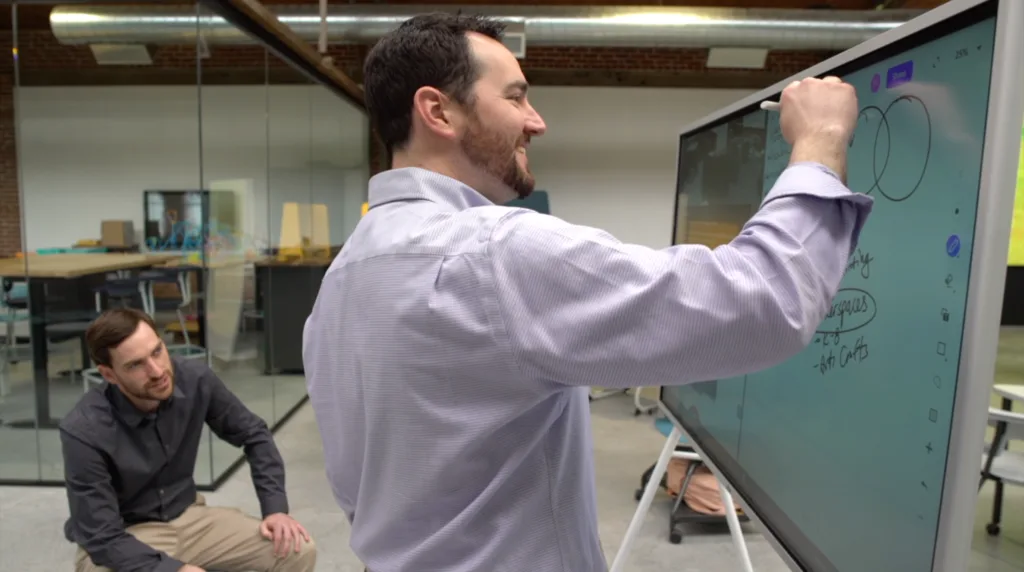
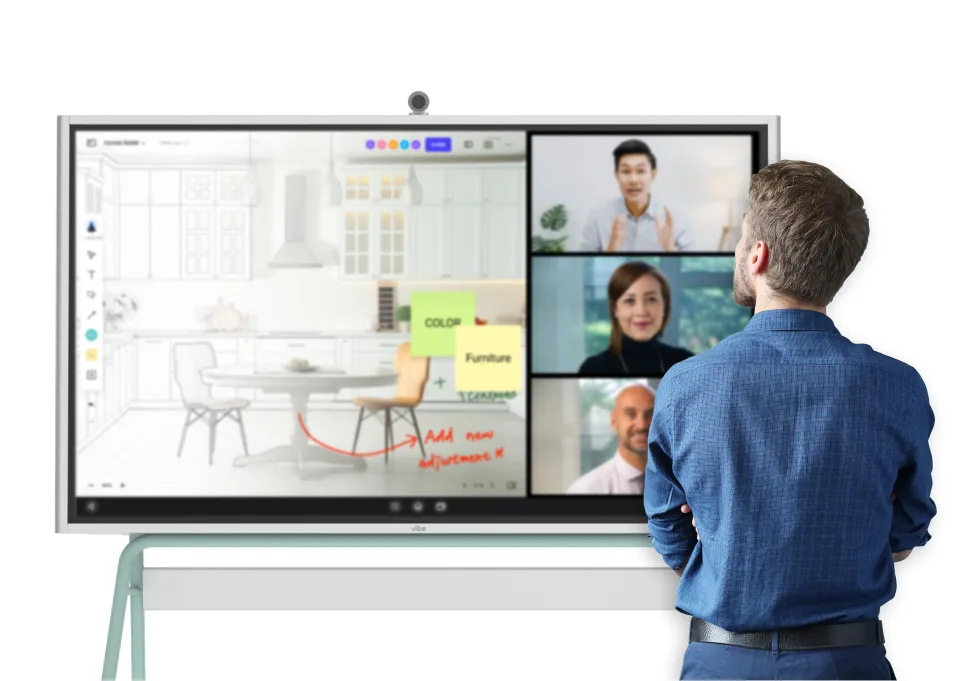
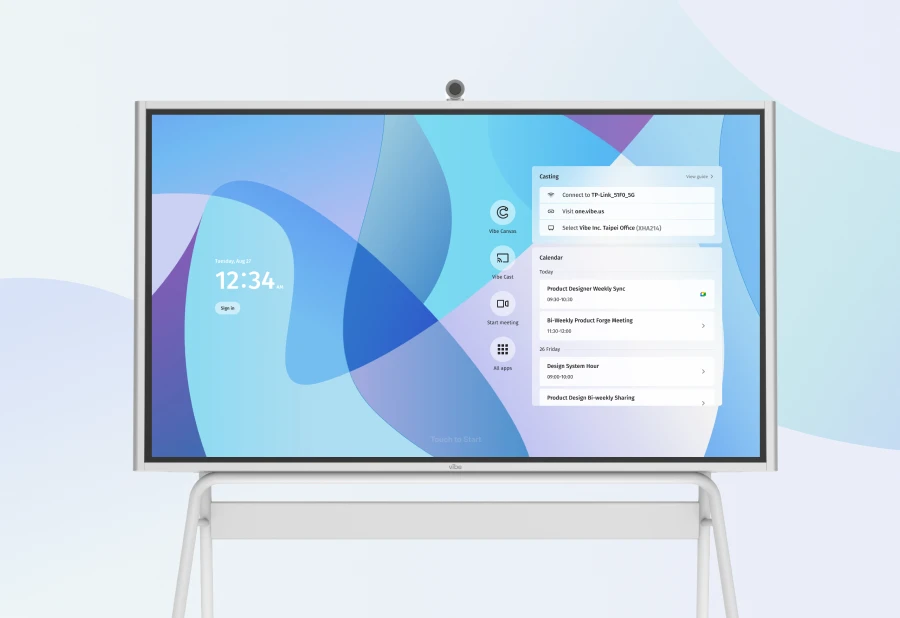
Vibe Board S1 is particularly well-suited for this: its touchscreen canvas lets you sketch frameworks, annotate together, and save the session automatically to the cloud so both parties have access to the same notes afterward. Vibe Canvas extends this to any device—if the session is remote, the coachee can contribute directly to the same canvas from their browser without installing anything.
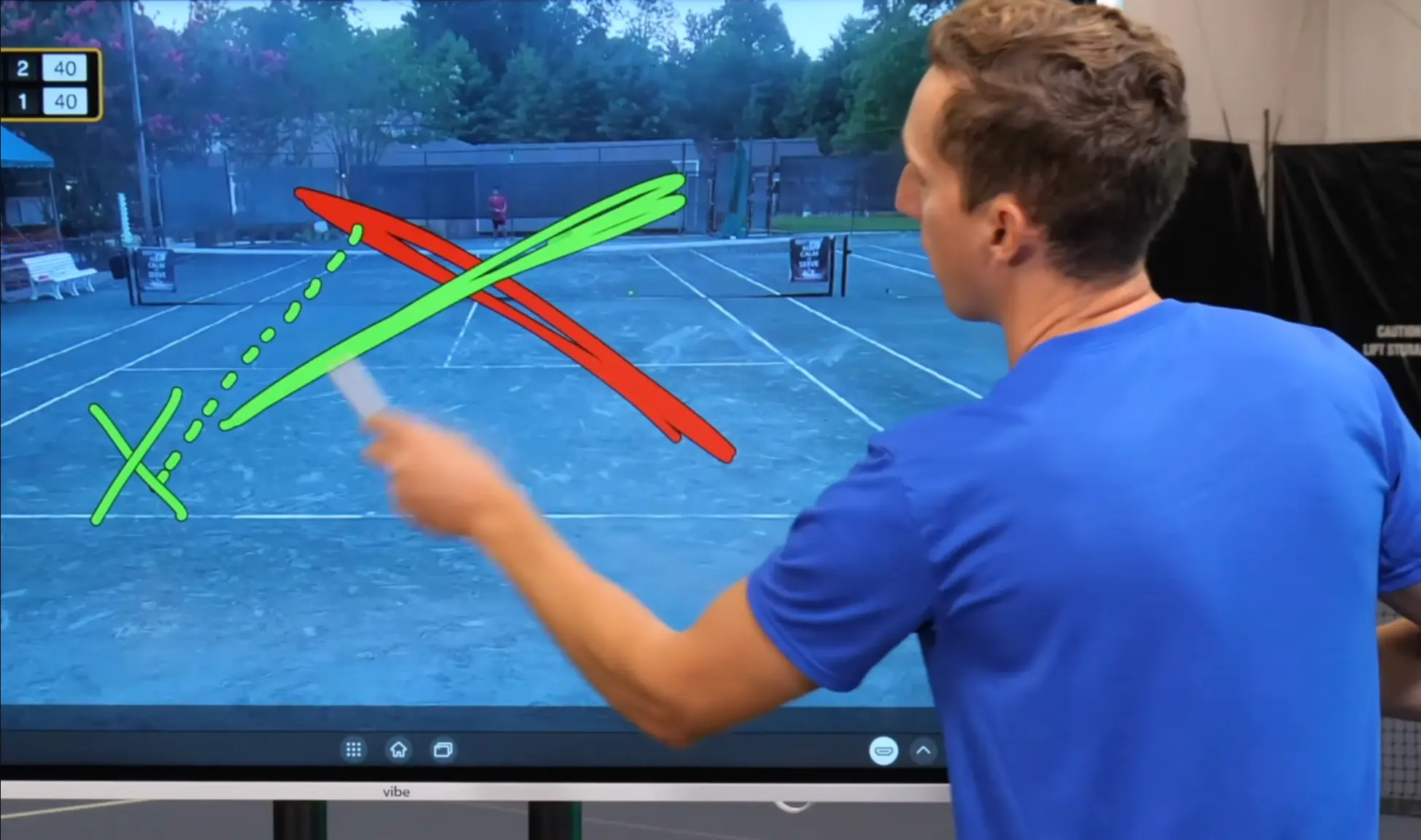 Tennis coach drawing play diagrams on a Vibe Board with a stylus, displaying court footage with annotation overlay
Coaches in other fields have found this particularly powerful. Ian Westermann, founder of Essential Tennis—the top tennis instruction channel on YouTube—sets up the Vibe Board courtside during student lessons to annotate their technique on video in real time, then saves and shares the session notes instantly. Victor Antonio of the Sellinger Group, a sales training consultant, describes the board as "the ultimate pattern interrupt": he plans a shift in what’s visible on screen every three to five minutes to keep audience attention high. The same principle applies in one-on-one coaching sessions—when the visual surface changes, engagement follows.
4. Follow Up on Previous Sessions
One of the fastest ways to erode coaching effectiveness is to start each session fresh, as if the previous conversation didn’t happen. Continuity is what separates coaching from a series of disconnected conversations.
This means reviewing commitments from the last session before opening new topics, tracking which skills or goals are improving over time, and explicitly connecting this session’s focus to the longer arc of development.
In practice, this requires a system—whether that’s shared notes, a tracker, or a consistent template—that both parties can access between sessions. The goal is to spend the first five minutes of each session on "what happened since we last spoke" rather than spending ten minutes reconstructing context.
Vibe AI, accessible through Vibe Dot, makes this easier for managers who run multiple coaching relationships. Vibe Dot captures the conversation, generates a transcript and AI summary, and tracks action items automatically—so before the next session, the manager can review exactly what was agreed, what’s been completed, and what needs to be revisited. The Memory Graph connects context across sessions, so asking "what did we commit to last month with this person?" returns a sourced answer rather than requiring a search through old notes.
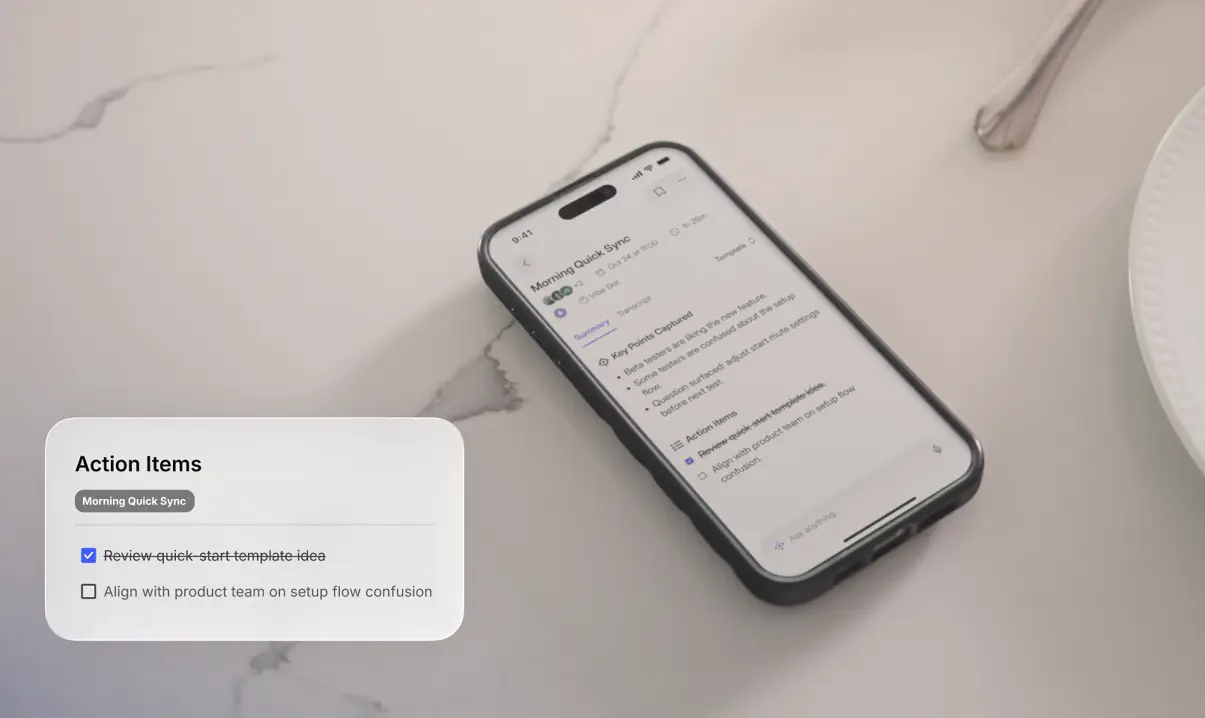 Vibe AI mobile app showing a meeting summary with action items extracted from a "Morning Quick Sync" session
5. End Every Session with Explicit Commitments
Coaching sessions that end without a clear commitment tend to produce goodwill but not behavior change. Before closing, both parties should be able to answer: "What specifically will you do differently, and by when?"
The commitment should be:
-
Behavioral—a specific action, not a vague intention ("I will ask one clarifying question before responding in project reviews" rather than "I will work on my communication")
-
Time-bound—attached to a deadline or a specific situation
-
Written down—captured somewhere both parties can access before the next session
One useful closing structure: ask the coachee to state the commitment in their own words, then confirm it. What gets articulated clearly at the end of a session is far more likely to be acted on.
Sam Silverstein, founder of the Accountability Institute and a speaker who has worked with leadership teams globally on accountability culture, uses the Vibe Board’s infinite canvas to capture commitments and structure in real time—both in virtual keynotes and in consulting sessions. What he’s found: making the commitment visible on a shared canvas, rather than leaving it in someone’s notes, is what creates the follow-through.
6. Use Templates and Structures—But Don’t Let Them Run the Session
Templates and frameworks are scaffolding, not scripts. A GROW model walkthrough, a pre-session agenda, or a coaching scorecard helps structure time and ensure nothing important gets skipped—but the best coaching conversations are responsive to what actually surfaces in the room.
Vibe Canvas includes templates for common coaching formats—flowcharts, priority matrices, action planning boards, and org charts—that can be pulled up at the start of a session and adapted in real time. The value isn’t the template itself but having a starting structure that can be built on together, rather than starting from a blank page every time.
For managers coaching multiple team members, developing a consistent session template saves preparation time and makes it easier to compare progress across individuals over time.
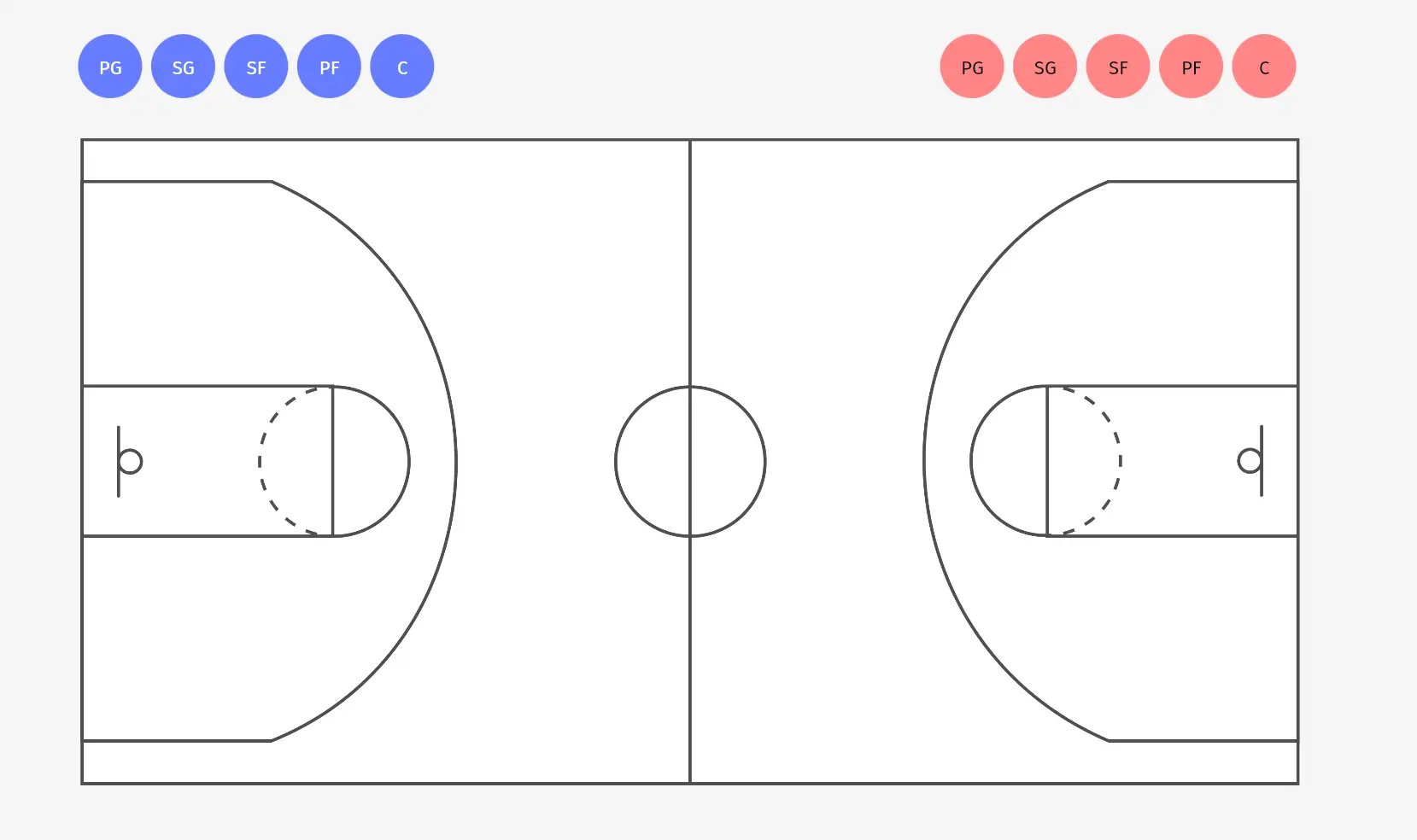 Vibe Canvas basketball court diagram template with blue and red player position tokens for coaches to draw up plays
7. Keep the Cadence Consistent
Coaching that happens only when something goes wrong is corrective, not developmental. The highest-impact coaching relationships run on a consistent cadence—typically biweekly for active development goals—independent of whether there’s a problem to address.
Consistent cadence also makes continuity easier. When sessions happen regularly, follow-up on previous commitments becomes natural, patterns become visible earlier, and the relationship itself builds enough trust that harder conversations become easier to have.
For managers who find it difficult to protect coaching time from operational demands, treating it as a standing commitment—scheduled, blocked, and not deprioritized—is the most reliable solution.
Making Coaching Stick: The Role of Tools
The best coaching techniques are only as effective as the systems supporting them. A few recurring failure modes:
-
No shared record: insights from the session stay in one person’s head and fade before the next meeting
-
No continuity: each session starts over rather than building on the last
-
No follow-through tracking: commitments are made but not revisited
The combination of a visual collaborative surface (Vibe Board S1 for in-room sessions, Vibe Canvas for remote), automatic session capture (Vibe Dot for personal 1:1s, Vibe Bot for group sessions), and AI-powered memory (Vibe AI tracking action items and connecting context across sessions) addresses each of these directly—without adding administrative overhead to the manager’s workflow.
Frequently Asked Questions
What is the GROW model and how do I use it in a coaching session?
GROW stands for Goal, Reality, Options, and Will. It’s the most widely used framework for structuring coaching conversations. Start by establishing what the coachee wants to achieve (Goal), explore the current situation honestly (Reality), generate possible approaches without committing to any (Options), then close by agreeing on specific actions and a timeline (Will). The model works best as a loose guide rather than a rigid script—skilled coaches move between stages as the conversation requires.
How long should a coaching session be?
Most effective coaching sessions run 30 to 60 minutes. Shorter than 30 minutes doesn’t leave enough time to get past surface-level discussion; longer than 60 minutes tends to reduce focus. For skill-building sessions, 45 minutes with a defined agenda is often the most productive format. Deal coaching or operational check-ins can be shorter, but these are distinct from developmental coaching.
How often should managers hold coaching sessions?
Biweekly 1:1 sessions dedicated to coaching (separate from status or project updates) is the most commonly recommended cadence for active development goals. Monthly sessions are better than nothing but don’t create enough continuity. More frequent than weekly tends to feel pressured and doesn’t leave enough time for the coachee to act on commitments between sessions.
What’s the difference between coaching and feedback?
Feedback is information about past performance—what happened and how it compared to expectations. Coaching is forward-looking—it’s a conversation designed to help someone develop capability and make better decisions going forward. Both are valuable, but they work differently: feedback informs, coaching develops. Conflating the two often produces sessions that feel like evaluations rather than growth conversations.
How do I track progress across multiple coaching relationships?
The most practical approach combines a consistent session template (so you’re capturing the same information each time), a shared record accessible to both parties, and a mechanism for reviewing commitments before the next session. For managers handling multiple coaching relationships, AI tools like Vibe AI can automatically capture and organize session content, surface action items, and connect what was discussed across sessions—reducing the administrative load of maintaining continuity at scale.
Can coaching sessions work remotely?
Yes, with the right setup. The main challenges of remote coaching are the loss of shared physical space and the tendency for video calls to feel more transactional than in-person conversations. Using a shared visual canvas (both people contributing to the same document or whiteboard in real time), a consistent session structure, and reliable audio capture addresses most of these gaps. The fundamentals—clear focus, good questions, explicit commitments—are the same regardless of setting.