
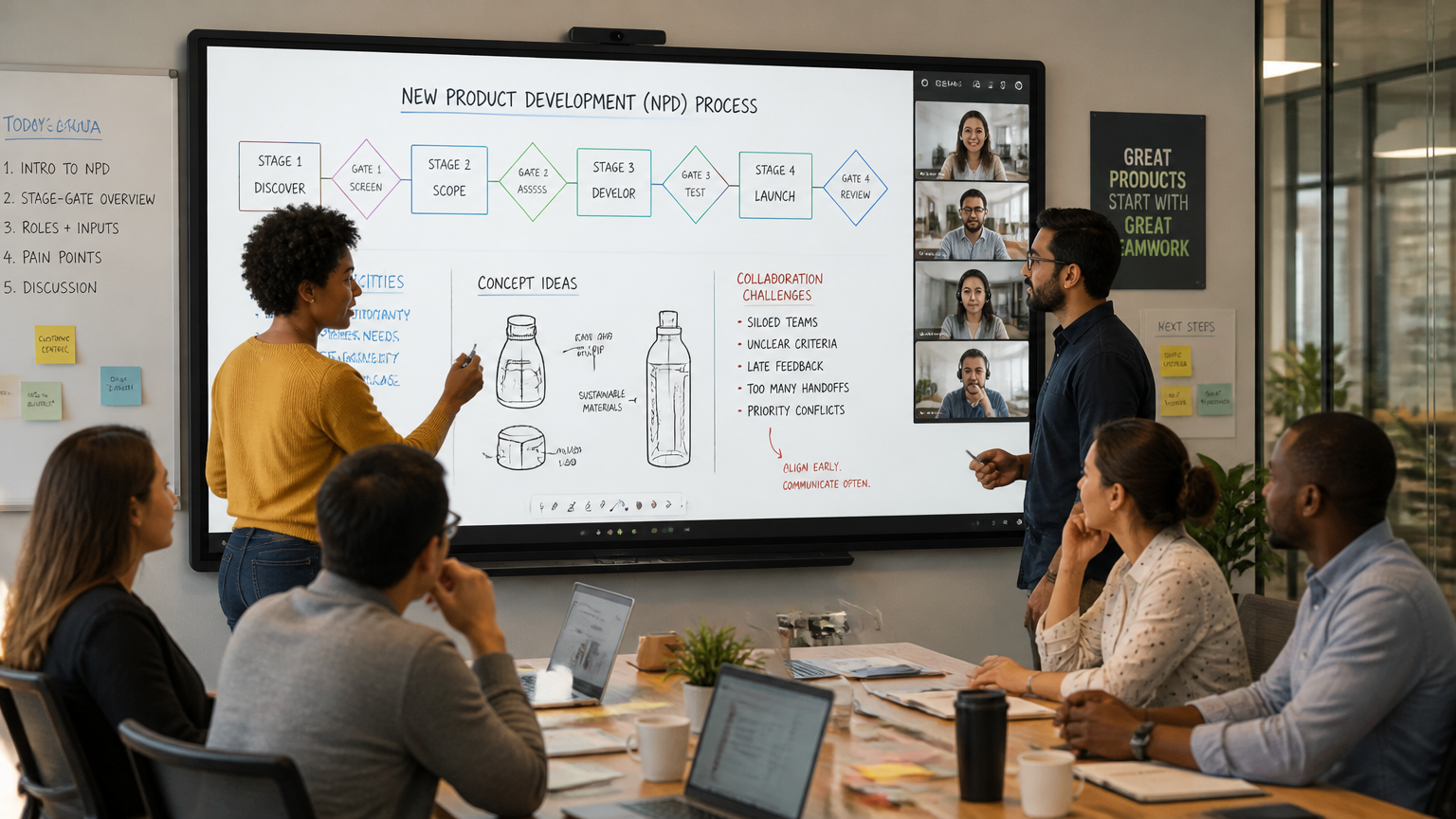
 A cross-functional team gathered around a large interactive whiteboard in a modern conference room, sketching product concepts and reviewing a stage-gate diagram. Mix of in-room and remote participants visible on the board's video tile.
New product development sits at the heart of competitive strategy. The majority of new products that enter development never reach commercial success, and of those that launch, many fold within the first two years. The gap is rarely the process framework itself. Teams lose alignment when decisions made in meetings evaporate before the next stage handoff. This guide covers the 7 stages of NPD, the stage-gate model, the templates that keep teams aligned, and the practices that prevent knowledge loss.
- The NPD process runs 7 stages from idea generation to commercialization, each with a distinct go/no-go decision gate.
- New products fail more often than they succeed; structured stage-gate reviews are the mechanism that separates teams that catch weak concepts early from those that don't.
- The largest gap in NPD execution is knowledge loss between stages when decisions made in meetings do not survive the handoff.
- Each stage maps to a practical template: ideation canvas, RACI matrix, concept scorecard, and go/no-go decision log.
- Modern NPD tool stacks pair project tracking with visual ideation and AI meeting memory to close the knowledge-loss gap.
What Is New Product Development (NPD)?
New product development is the end-to-end process of bringing a product that has never existed to market. It differs from ongoing product development, which improves existing products incrementally. NPD covers the full arc: spotting an opportunity, validating it, building the first version, testing it with real users, and launching it to customers.
New products are a primary driver of competitive advantage and revenue growth. Companies that treat NPD as a structured discipline, not an ad hoc exercise, consistently outperform those that don’t. A formal process channels resources toward ideas with real commercial potential, instead of concepts that stall or fail.
Why NPD Matters in 2026
For companies competing on product innovation, NPD is not optional. New products drive a substantial share of profit for innovation-focused companies.
In 2026, three shifts raise the stakes. Product cycle compression means teams ship faster or cede the market to competitors who do. Distributed teams now span time zones and continents, making the handoff problem acute when decisions happen in meetings that some stakeholders cannot attend. AI-generated competitive alternatives can appear in weeks rather than months, shortening the window where first-mover advantage matters. These pressures compound: faster cycles with distributed teams and faster-moving competitors create more handoffs, more context fragmentation, and more opportunities for alignment to break.
The hidden cost shows up in meeting time. NPD teams carry a heavy meeting load, stage-gate reviews, cross-functional kickoffs, design reviews, and launch readiness checks fill the calendar. When those meetings produce no durable record, the cost shows up in re-work.
The 7 Stages of New Product Development
The NPD process moves through seven stages. Each stage narrows the field of candidates and increases investment in the survivors. Most ideas that enter development do not reach commercial launch, the funnel narrows sharply at each gate. Teams with structured NPD processes produce a higher ratio of successful launches per idea reviewed.
Stage 1: Idea Generation
Idea generation gathers concepts from multiple sources: customer feedback, competitive analysis, R&D exploration, and internal brainstorming. The goal is volume. At this stage, no idea is rejected. Instead, teams capture everything and sort later.
Cross-functional input matters here. Engineering, marketing, sales, and customer success each see different problems worth solving. A structured ideation session with representatives from each function surfaces ideas that no single department would reach alone.
Stage 2: Idea Screening
Idea screening filters the initial list against strategic fit, market potential, and technical feasibility. This is the first go/no-go decision. Teams use a simple matrix to score each idea against defined criteria. Then, they cut concepts that do not align with company direction or available resources.
The discipline is saying no early. Resources spent evaluating weak concepts divert effort from stronger candidates. Teams that screen rigorously protect downstream stages from becoming clogged with low-potential ideas.
Stage 3: Concept Development and Testing
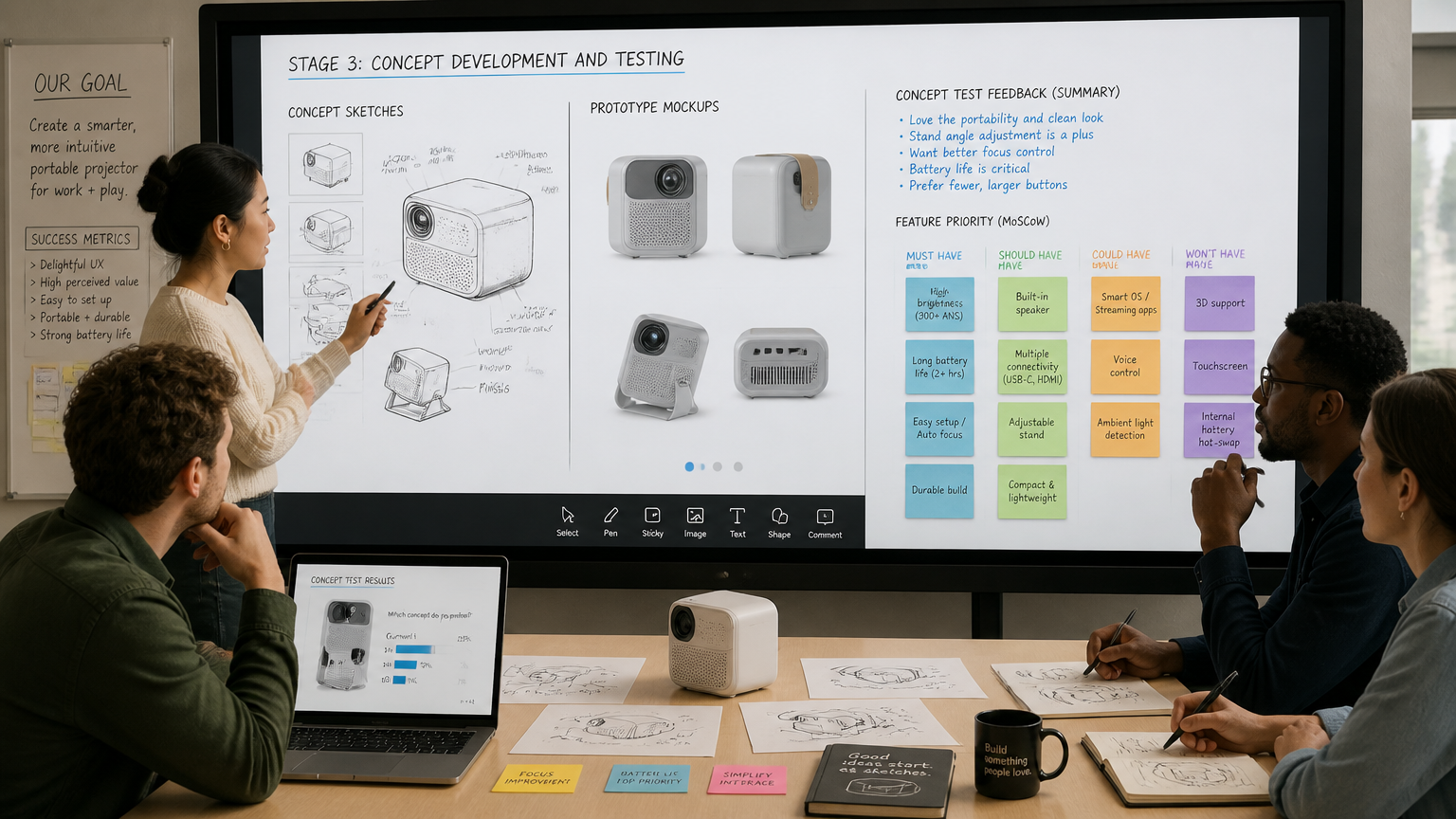 Product development team reviewing concept sketches and prototype mockups on an interactive display, sticky notes with feature priorities arranged in columns.
Concept development takes screened ideas and expands them into detailed product concepts. A concept statement describes the target customer, the problem, the proposed solution, and the benefit. Testing puts those concepts in front of potential customers through surveys, interviews, or prototypes.
The output is a validated concept that customers recognize as solving a real problem. Teams learn which features matter, which language resonates, and which positioning connects. That learning then shapes the business case in the next stage.
Stage 4: Business Analysis
Business analysis builds the financial and operational case for the product. Teams estimate development cost, projected revenue, pricing, and break-even timeline. They also map the competitive landscape and identify delivery risks.
This stage produces a business plan that stakeholders use to decide whether to commit development resources. The analysis must be rigorous enough to justify the investment and honest enough to surface risks before they become expensive surprises.
Stage 5: Product Development
Product development turns the approved concept into a working prototype or minimum viable product. Engineering, design, and manufacturing work together to build the first version. The output is a testable product that demonstrates core functionality.
Collaboration intensity peaks here. Daily standups, design reviews, and prototype demos fill the calendar. Teams need a way to capture decisions as they happen so later stages inherit the context built during development. For teams exploring collaborative decision-making practices, this stage is where those methods get tested.
What good looks like at this stage: engineering and product managers maintain a shared understanding of scope through regular syncs and visible documentation. Requirements remain stable once development is underway, or changes go through an explicit trade-off process. Key artifacts include functional specifications, design files, and a prototype with defined acceptance criteria. Common failure modes include scope creep from unchecked requirement additions, siloed teams that discover integration problems late, and documentation that falls out of sync with the actual build.
Stage 6: Test Marketing and Validation
Test marketing puts the product in front of real users in controlled conditions. Pilots, beta programs, and limited launches reveal adoption patterns, usability issues, and messaging effectiveness. The goal is to validate assumptions before committing to full-scale production.
Feedback loops matter here. Teams need a mechanism to collect, prioritize, and act on user input. As a result, the product that launches may look different from the prototype that entered this stage.
What good looks like at this stage: test marketing measures specific hypotheses, whether users complete core workflows, whether messaging drives intended actions, whether pricing matches perceived value. Success criteria are defined before the test begins, not retrofitted to the results. A go signal requires hitting predefined thresholds for user satisfaction, task completion, and willingness to recommend, plus a clear understanding of what the product team will change before full launch. Common failure modes include testing too late to make meaningful changes, measuring vanity metrics that do not predict market success, and ignoring negative signals from early users.
Stage 7: Commercialization
Commercialization scales the product for market launch. Manufacturing ramps up, marketing executes the launch plan, sales enables the field, and support prepares for customer inquiries. The decisions made in every prior stage converge here.
Success depends on whether the accumulated context survives the transition. If the rationale for a feature, the reasoning behind a pricing decision, or the history of a design trade-off is lost, the launch team operates with partial information.
The Stage-Gate Process
The stage-gate process structures the transition between NPD stages as formal reviews. Each gate is a decision point where cross-functional stakeholders review progress against defined criteria and decide: go, hold, or kill. The process was developed by Robert Cooper and has become the dominant NPD framework across industries.
A gate review covers three questions. First, does the project still align with strategy? Second, does the business case still hold? Third, are the resources available to proceed?
Reviewers examine the work completed in the prior stage, the plan for the next stage, and the risk profile.
The discipline is explicit decision-making. Without a gate, projects tend to continue through momentum even when the case has weakened. Sunk-cost bias keeps weak concepts alive. Therefore, stage-gate forces a pause and a choice.
Research consistently shows that companies with more rigorous stage-gate discipline outperform those without it. The gate is only as good as the consistency with which teams apply it.
The gate is only as good as the record it produces. When decisions are made verbally and captured in scattered notes, the next stage inherits ambiguity. Teams increasingly use meeting intelligence tools to capture gate reviews completely. For organizations exploring hybrid collaboration solutions, the stage-gate review is a use case that benefits immediately from better capture.
NPD Templates That Keep Teams Aligned
Each NPD stage benefits from a structured template. Templates standardize the questions teams answer, the artifacts they produce, and the criteria stakeholders use to evaluate progress. Templates only close the gap when teams use them consistently. The barrier is rarely the template itself, it is the friction of maintaining it when the team is moving fast.
Stage-Gate Checklist
A stage-gate checklist defines the criteria reviewers apply at each gate. It covers deliverables required, risks to assess, and the threshold for go/no-go, ensuring every gate applies the same rigor regardless of which stakeholders are in the room. Strong checklists distinguish deliverable state (complete, in-progress, not started) from deliverable quality (meets criteria, needs revision, insufficient). One owner per criterion prevents ambiguity about who carries an open item into the next stage.
Ideation Canvas
An ideation canvas captures the problem, the customer, the proposed solution, and the differentiating insight. It structures brainstorming output into comparable units that screening can evaluate. Teams rank canvases rather than debating abstract concepts. Typically, a product manager or innovation lead facilitates the canvas session, gathering input from engineering, marketing, and customer-facing roles. A completed canvas includes a clearly articulated problem statement, a defined user persona, a proposed solution sketch, and a hypothesis for why this concept will win. Done means each canvas has sufficient detail that a reviewer unfamiliar with the discussion can evaluate it independently.
RACI Matrix
A RACI matrix defines who is Responsible, Accountable, Consulted, and Informed for each deliverable in a stage. By clarifying roles, it prevents gaps where no one owns an outcome and bottlenecks where everyone waits on a single overloaded stakeholder. The project manager or program lead typically drafts the matrix before a stage kicks off, then validates assignments with functional leads. Each cell names a specific person or role, leaving no ambiguity about who owns what. Done means the matrix is reviewed and agreed upon by all named stakeholders, with a single accountable owner for every deliverable.
Concept Scoring Scorecard
A concept scoring scorecard applies weights to evaluation criteria. Strategic fit, market size, technical feasibility, and competitive risk each receive a score. The weighted total then ranks concepts objectively, reducing the influence of the loudest voice in the room. Product leadership typically defines the criteria and weights in advance, then a cross-functional panel scores each concept independently before comparing results. The scorecard includes space for written rationale on each score, creating a record of trade-offs. Done means all concepts have complete scores, the panel has reviewed outliers or disagreements, and the ranked list reflects a consensus view of relative strength.
Go/No-Go Decision Log
A go/no-go decision log records the gate decision, the rationale, the conditions attached, and the follow-up owners. It becomes the reference for the next stage and the audit trail for later reflection. The gate facilitator or project manager captures the log during or immediately after the review, ensuring the record reflects the actual discussion. Each entry includes the decision (go, hold, kill), the key factors that determined the outcome, any conditions or contingencies attached, and named owners for follow-up items. Done means the log is shared with all stakeholders within 24 hours of the gate, giving the next stage a clear starting point.
Templates only work when teams use them consistently. The barrier is usually not the template itself but the friction of maintaining it. When decisions happen in meetings and someone must transcribe notes into a template afterward, the work often gets deferred or skipped. Therefore, integrating meeting capture with template population reduces that friction.
Where NPD Teams Lose Alignment
The single biggest predictor of NPD breakdown is not process ignorance. It is knowledge loss. Decisions made in stage-gate reviews are rarely documented in a way that survives personnel change or sprint transitions. Context decays between stages.
In 2026, Project.co’s Communication Statistics report found that 56% of people feel they waste time in meetings, and 53% have personally lost time due to communication issues at work. NPD teams feel this acutely. Poorly run stage-gate reviews and kickoff meetings waste hours. More damaging is the meeting that runs well and reaches clear decisions but leaves no durable record.
The problem is not that teams lack a seven-stage model. Rather, the problem is that the reasoning behind key choices, the context that shaped a decision, and the alternatives considered do not travel forward. In short, the next stage inherits a decision but not the thinking that produced it.
This composite example illustrates a gap many product teams recognize: a cross-functional team conducts a Stage 3 concept review and makes a clear go decision, documenting the strategic rationale for prioritizing speed-to-market over feature completeness. By the time Stage 5 development kicks off six weeks later, the original stakeholders have moved to other projects. The new engineering lead, working from the decision log alone, builds toward feature parity with a competitor instead. The misalignment surfaces late in development, requiring re-work that costs weeks of schedule, all because the reasoning behind the original trade-off did not survive the handoff.
Teams that recognize this gap invest in meeting capture. When a stage-gate review is recorded, transcribed, and summarized, the next team can return to the source. Questions about why a feature was cut or why a pricing model changed have answers beyond what someone remembers.
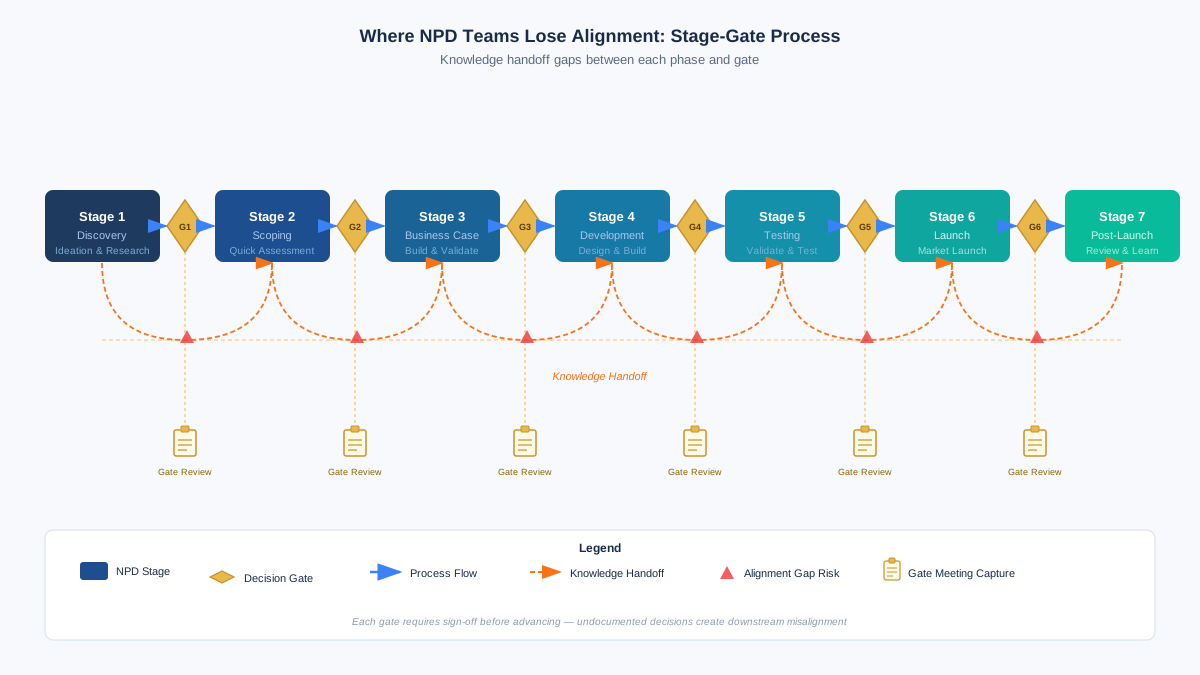 Stage-gate diagram showing seven NPD stages connected by decision gates, with knowledge handoff arrows between each phase and meeting capture icons at each gate.
For organizations evaluating collaboration tools for remote teams, NPD handoff is a use case that benefits from tools designed for memory, not just communication.
Tools That Support NPD Collaboration
The modern NPD stack combines purpose-specific tools for each stage. Visual ideation platforms support brainstorming. Project tracking manages the flow through stages. Prototyping tools accelerate concept testing.
AI-powered meeting intelligence is a newer addition, and increasingly a critical one for preventing knowledge loss between stages.
Visual Ideation Platforms
Tools like Miro and FigJam support distributed brainstorming. Teams capture ideas on shared canvases, cluster themes, and vote on priorities. Adoption of visual collaboration platforms has accelerated as hybrid teams standardize on digital surfaces for whiteboarding that persist across sessions and time zones.
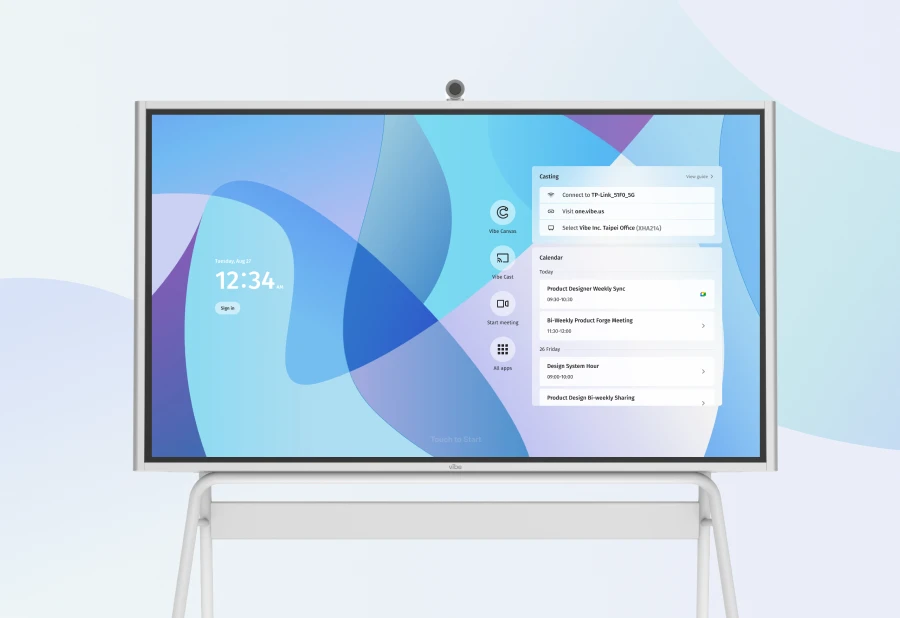
Physical interactive whiteboards bridge in-room and remote participants. The Vibe Board S1 combines a 4K touchscreen with a shared canvas that persists after the meeting ends. Teams can return to the board state, add comments, and continue the conversation asynchronously.
Project Tracking
Jira, Linear, and Asana manage the work items that flow through stages. Features, bugs, and tasks live in a shared system visible to all stakeholders. Integrations connect project tracking to meeting output so decisions surface where the work happens.
Prototyping and Design
Figma and Sketch support concept development and testing. Teams iterate on designs, share prototypes with users, and validate assumptions before committing to development. The design file then becomes an artifact that later stages reference.
Visual Whiteboarding
Vibe Canvas is Vibe’s cloud-based whiteboarding software, available on desktop, tablet, and phone, and built into the Vibe Board S1. NPD teams use it for structured ideation sessions, concept sketching, and sprint planning. Because the canvas persists in the cloud, stakeholders who missed a session can review the board state, add annotations, and continue the conversation asynchronously. That continuity matters most at the stages where cross-functional input is highest: ideation, concept development, and design review.
AI Meeting Intelligence
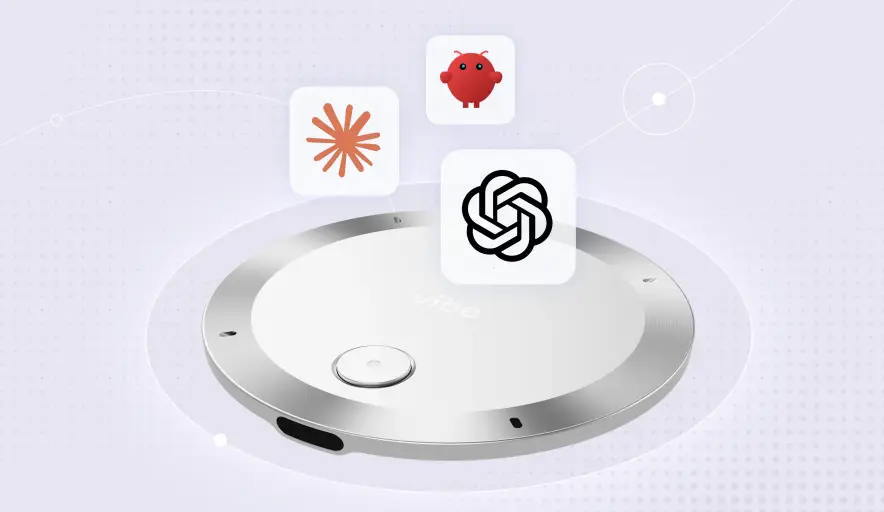
Meeting capture and transcription tools create a searchable record of NPD discussions. Vibe Dot is a wearable AI assistant that records, transcribes, and summarizes conversations, turning stage-gate reviews and kickoff meetings into persistent artifacts.
The device snaps to a phone, clips to clothing, or sits on a desk. It captures context wherever discussions happen. Combined with Vibe AI, teams get a memory thread that carries decisions forward, even when personnel change between stages.
The value is continuity. When the question arises in Stage 6 about a decision made in Stage 3, the team can retrieve the meeting record rather than relying on memory. For organizations exploring AI collaboration tools, meeting memory addresses a failure mode that generic project tracking does not solve.
Vibe AI is the software layer that compounds this capture over time. It links recordings, documents, and messages into continuous memory threads, so the context from a Stage 2 discovery session is still accessible when Stage 6 questions arise months later.
Conclusion
A structured NPD process and the right collaboration infrastructure give cross-functional teams the foundation to move ideas through the funnel without losing the decisions that hold the work together. The seven stages and stage-gate framework provide the structure. Templates standardize the artifacts. But the gap between process knowledge and execution is where most launches break down.
Teams that recognize the handoff problem invest in meeting capture and memory tools. When stage-gate reviews leave a durable record, the next stage inherits both the decision and the reasoning behind it.
Vibe Dot captures that context wherever discussions happen. Vibe Board S1 provides the visual surface for collaborative stages. Together with Vibe AI, they give NPD teams the continuity that process frameworks alone cannot provide.

FAQs
What are the stages of new product development?
New product development runs through seven stages: idea generation, idea screening, concept development, business analysis, product development, test marketing, and commercialization. Most ideas that enter development do not reach commercial launch. Each stage narrows the field through go/no-go decisions.
What templates are used in the NPD process?
Common NPD templates include the stage-gate checklist, ideation canvas, RACI matrix, concept scoring scorecard, and go/no-go decision log. Templates standardize the questions and artifacts each stage produces, but many teams still coordinate NPD work through spreadsheets, email threads, and ad-hoc documents rather than shared stage-specific templates.
How do teams collaborate in new product development?
NPD collaboration involves cross-functional teams from engineering, marketing, sales, and customer success working together across stages. In 2026, Project.co’s Communication Statistics report found that 53% of workers have personally wasted time due to communication issues at their organization. Teams increasingly use meeting intelligence tools to capture decisions so context survives the handoff between stages.
What is a stage-gate process in NPD?
The stage-gate process structures NPD as a series of formal review gates where stakeholders make go/no-go decisions. The stage-gate framework has become the dominant approach for managing NPD decisions. The discipline prevents weak concepts from continuing through momentum and sunk-cost bias.
Why do new products fail?
New products fail more often than they succeed. Common causes include weak problem validation, insufficient market research, poor execution, and knowledge loss between stages. Teams with structured NPD processes and strong cross-functional collaboration consistently outperform those without them.