
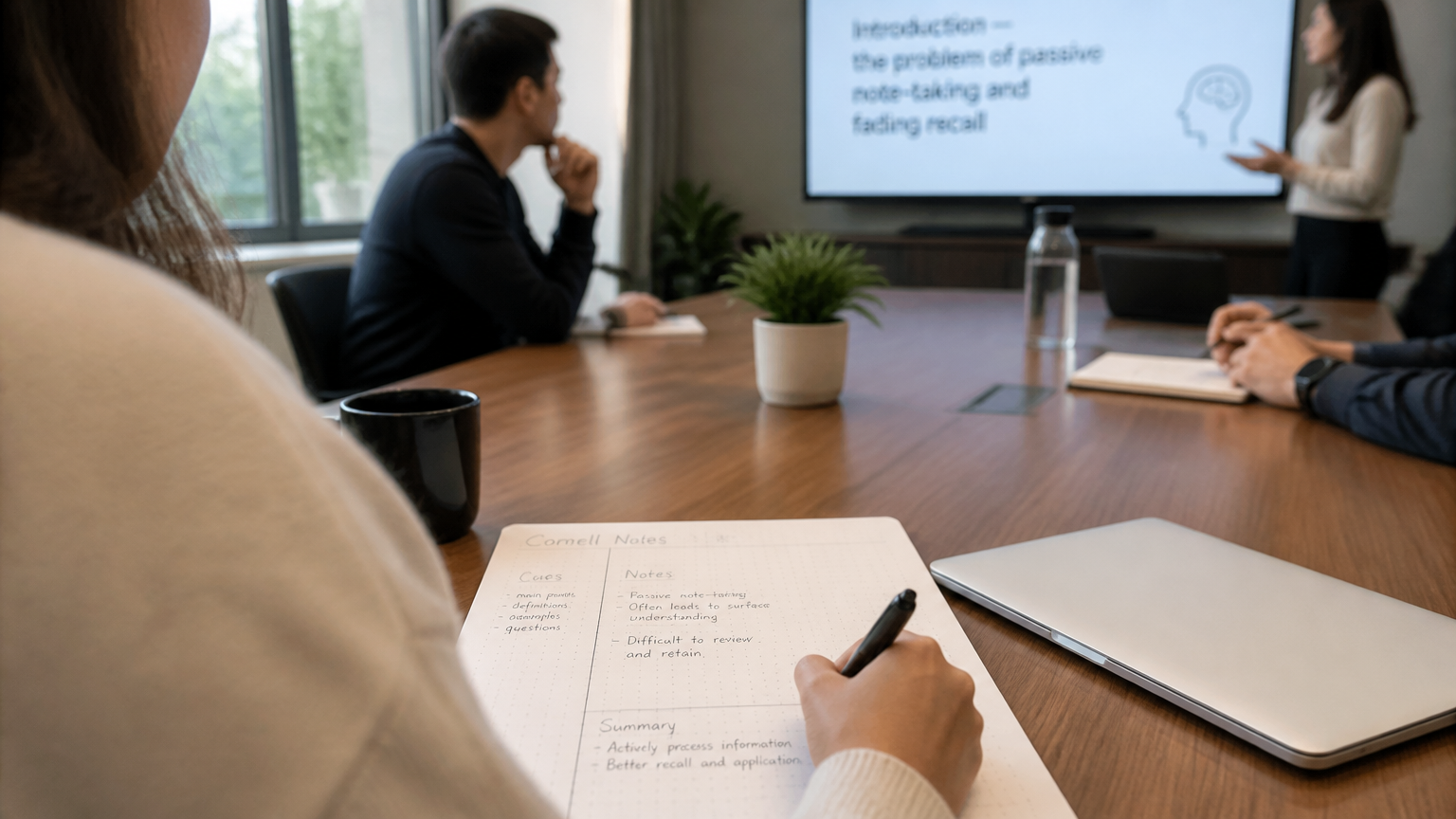
 Person taking notes in a meeting with a Cornell-style page visible on the desk, clean professional environment, natural lighting
A student sits in a lecture hall, pen moving across a lined notebook. By evening, most of what they heard has already begun to fade. A manager finishes back-to-back meetings, task list in hand, only to realize the key decision from the 9 a.m. call is already blurry.
The problem is not attention. Passive note-taking never triggers the retrieval process that moves information into long-term memory.
The Cornell note-taking method offers a structural solution. Developed by Walter Pauk at Cornell University in the 1950s, the system divides a page into three purposeful zones that force the brain to process information at three levels: capture, synthesis, and consolidation.
Research confirms the approach works. A 2015 replication of the Ebbinghaus forgetting curve published in PLOS ONE (Murre & Dros, 2015) found that 67% of learned material is forgotten within 24 hours without structured review. The Cornell method addresses this decay directly.
- The Cornell method divides a page into three zones: Notes (capture), Cues (keywords/questions), and Summary (consolidation).
- The 5 R's — Record, Reduce, Recite, Reflect, Review — are the review cycle that makes the layout work for retention.
- 67% of learned material is forgotten within 24 hours without structured review (Murre & Dros, 2015).
- Cornell applies equally well to professional meetings: the Cues zone becomes action items; the Summary zone becomes the decision record.
- AI tools now automate Record and Reduce — freeing the human to focus on the three high-value R's: Recite, Reflect, Review.
The Hidden Cost of Unstructured Notes
Most note-taking fails not because people write too little, but because they never return to what they wrote. Fellow’s Meetings Statistics shows that the average manager spends over 20% of their workweek in meetings, and research on memory decay suggests a large proportion of that investment evaporates within 24 hours without structured review.
The meeting itself is not the problem. The problem is the gap between hearing and retaining.
This gap carries a measurable cost. In 2026, Pumble’s Meeting Statistics found that 71% of all meetings are considered unproductive by attendees — and that unproductive meeting time costs US professionals $259 billion annually (London School of Economics, via Pumble).
The Cornell method was designed specifically to close this gap.
The system originated at Cornell University, where education professor Walter Pauk observed that students who simply transcribed lectures retained far less than those who engaged with their notes after class. His solution was not a new way to write but a new way to organize what was written, and, critically, when to return to it.
The PLOS ONE replication confirms the pattern: without a deliberate review process, most of what was heard fades before it can be applied. The Cornell method addresses this directly.
What Is the Cornell Note-Taking System?
The Cornell note-taking system is a structured page layout paired with a five-step review process. The layout divides the page into three zones, each with a distinct cognitive function. The process (the 5 R’s) determines when and how each zone is used.
The Three-Zone Layout
Setting up a Cornell page takes under a minute. Per Michigan State University College of Natural Science, the standard template uses three zones:
-
Notes column (6 inches, right side): The largest zone. This is where raw capture happens during the lecture or meeting. Write what you hear, see, or want to remember. Full sentences are fine; abbreviations are encouraged. The goal is comprehensive capture without stopping to organize.
-
Cue column (2.5 inches, left side): This column stays empty during the initial capture. After the session, the learner returns to populate it with keywords, questions, or prompts that summarize the Notes content. Think of it as the retrieval trigger, each cue should prompt recall of the material beside it.
-
Summary band (2 inches, bottom): After filling the Cues column, the learner writes a concise paragraph that synthesizes the entire page. This is not a restatement. It is a consolidation: what mattered, what connects, what to carry forward.
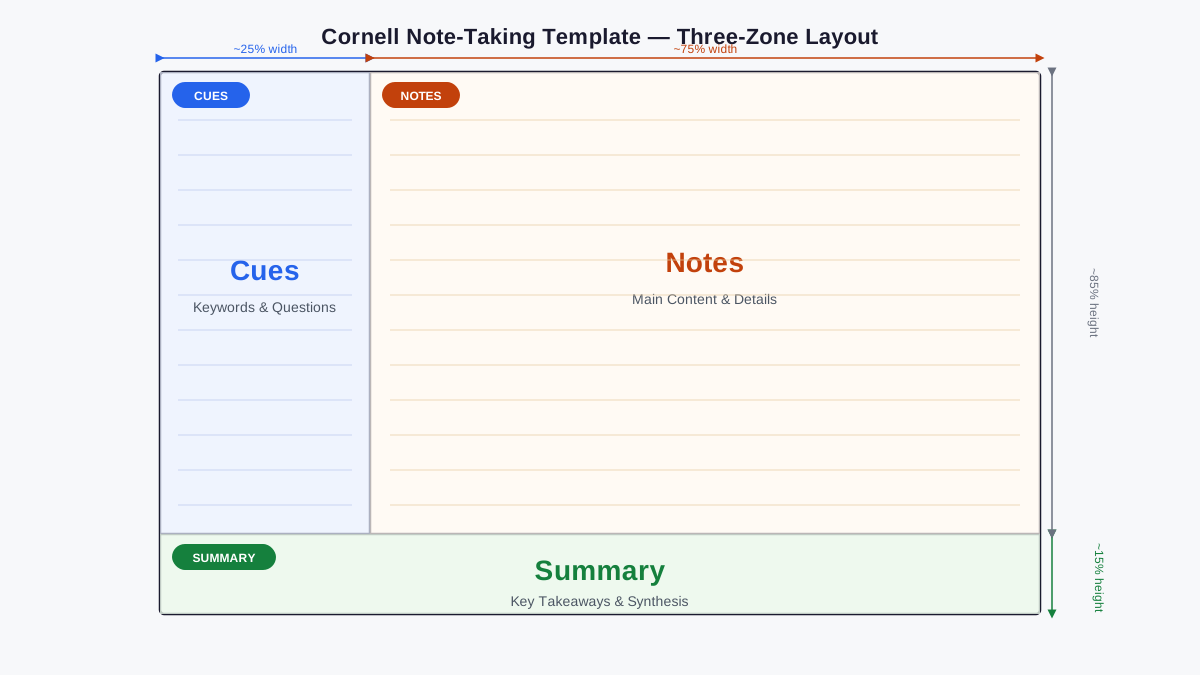 Cornell template diagram showing the three labeled zones: a 2.5-inch Cues column on the left, a 6-inch Notes column on the right, and a 2-inch Summary band at the bottom, with vertical and horizontal dividing lines
The layout is deliberately simple. A vertical line separates Notes from Cues. A horizontal line creates the Summary band at the bottom. The blank template takes under a minute to draw by hand, and several digital tools now offer pre-built Cornell templates.
The power is not in the lines. The power is in what those lines demand: three passes at the same material, three levels of cognitive processing, one integrated memory trace.
The 5 R’s framework (Record, Reduce, Recite, Reflect, Review) is an explicit bridge to AI automation. AI handles Record and Reduce automatically. The human’s cognitive work shifts entirely to Recite, Reflect, and Review, the steps that actually build understanding and memory.
The 5 R’s of Cornell Note-Taking
The Cornell layout is the map. The 5 R’s are the route. Each R represents a distinct cognitive action, and together they form the review cycle that converts raw capture into lasting memory. Cornell is not the only structured approach, concept mapping offers a visual alternative for non-linear topics, but it is the most research-backed method for sequential material like lectures and meetings.
1. Record
During the lecture or meeting, write in the Notes column. Capture the main ideas, supporting details, diagrams, and anything that seems significant. Do not stop to organize or evaluate. The goal is comprehensive capture while the information is live.
In a professional meeting, this includes decisions made, rationales given, and commitments expressed.
2. Reduce
As soon as possible after the session (ideally within minutes), return to the Notes column and populate the Cues column. Write questions that the notes answer, keywords that summarize key points, or labels that group related content.
This step is called "Reduce" because it condenses raw material into retrievable prompts. Each cue becomes a flashcard for later self-testing.
3. Recite
Cover the Notes column with a sheet of paper. Looking only at the Cues column, try to recite aloud or write from memory what each cue prompts.
This is retrieval practice, the active recall that research shows is far more effective than re-reading. If you cannot recall what a cue refers to, uncover the notes, review, and try again.
4. Reflect
After successful recitation, step back and ask: How does this material connect to what I already know? What are the implications? What questions remain?
Reflective thinking is where understanding deepens. This is also where the Summary paragraph is written, synthesizing the page into a single cohesive statement.
5. Review
Briefly review your Cornell notes periodically, weekly for ongoing courses, or before exams and key meetings. The structure makes review efficient: read the Cues, test recall, and check the Summary for pages that need deeper reinforcement.
Spaced repetition maximizes retention with minimal time investment.
|
Step |
When |
What You Do |
Why It Works |
|---|---|---|---|
|
Record |
During session |
Capture everything in Notes column |
Raw material for later processing |
|
Reduce |
Minutes after |
Fill Cues column with keywords/questions |
Creates retrieval prompts |
|
Recite |
After reducing |
Test recall from cues alone |
Active retrieval strengthens memory |
|
Reflect |
After reciting |
Connect to prior knowledge; write Summary |
Deepens understanding |
|
Review |
Periodically |
Revisit Cues and Summaries |
Spaced repetition prevents decay |
The structure is not decorative, it is functional. A 2025 study published in Frontiers in Psychology found that students using the Cornell method showed a statistically significant retention advantage over those using sentence-based note-taking (p < 0.05). They also reported significantly higher learning motivation (t(31) = -3.57, p = 0.001).
Applying Cornell to Professional Meetings
Cornell is presented universally as a student tool. But managers spend 13 hours per week in meetings, a statistically identical information-retention challenge to the lecture hall.
Fellow’s Meetings Statistics shows that managers and directors spend an average of 13 hours per week in meetings, more than 20% of a standard workweek. The information load is nearly identical to a full-time lecture schedule. Consider a product manager who uses Cornell structure for weekly standups: the Notes column captures the discussion as it unfolds, the Cues column becomes a prioritized action-item list, and the Summary band becomes the decision paragraph emailed to stakeholders at day’s end.
Yet most professionals capture meeting notes in unstructured bullet lists. Or, worse, they rely entirely on memory.
The Cornell method adapts directly to the professional context. Three zones map cleanly to meeting needs:
-
Notes column: Capture the discussion, decisions made, rationales, concerns raised, who said what. This is the meeting record.
-
Cue column: Populate immediately after the meeting with action items, follow-ups, and key commitments. This becomes the task list.
-
Summary band: Write a single paragraph: what was decided, why, and what happens next. This becomes the decision record and the basis for stakeholder communication.
The cost of unstructured meeting notes compounds. Fellow’s Meetings Statistics estimates that unproductive meetings cost businesses $375 billion globally in lost productivity annually.
Much of that waste traces to the same root cause identified in lecture halls: information captured but never consolidated.

Where Cornell Breaks Down
Cornell’s effectiveness depends on executing the Reduce and Summary steps within minutes of a session, exactly when cognitive load is highest.
This is where most people abandon structured methods.
The Cornell method is sound. But the execution gap is real. After a lecture, students rush to the next class. After a meeting, professionals have another meeting in five minutes. The Reduce and Summary steps, where retention actually happens, are precisely when fatigue, urgency, and competing demands converge.
This bottleneck has two components:
-
Time pressure: The method asks for a second pass immediately after the first. In practice, the second pass gets deferred, then forgotten.
-
Cognitive load: Converting raw notes into structured cues requires mental effort. After hours of meetings, that effort is in short supply.

The result: a shelf full of un-annotated notebooks. A hard drive full of unstructured notes. The intent was good. The system worked. The execution failed at the point of friction.
This is where AI enters the conversation.
AI Tools That Automate the Hardest Steps
According to the Laxis State of Meeting Note-Taking 2026, 75% of professionals now use an AI note-taker in their work meetings, and that share continues to grow. The AI meeting assistant market is forecast to grow from $4.3 billion in 2026 to $21.5 billion by 2033 at a 25.8% CAGR, per Grand View Research, a signal of how rapidly the industry is scaling. For teams evaluating these tools, AI meeting assistants now cover the full workflow from capture to action-item delivery.
The infrastructure for automated note-taking now exists.
Several tools have established themselves in this space.
For a broader comparison of options, the best AI note-takers guide covers the leading platforms:
-
Vibe Dot: A wearable AI recorder that captures any conversation, automatically generating transcripts, structured summaries, and action items, covering Cornell’s Record and Reduce steps without any manual effort.
-
Otter.ai: Real-time transcription with speaker identification, automatic summaries, and keyword extraction. Popular for meetings and interviews.
-
Goodnotes: Digital handwriting app with Cornell template support, allowing handwritten notes on a tablet with the three-zone structure preserved.
Each of these tools addresses part of the Cornell workflow. But the Record step (transcription) is only half the battle.
The harder step is Reduce: condensing raw transcript into structured, retrievable prompts.
Automated capture of meeting content is now standard practice, not an edge case.
How Vibe Dot and Vibe AI Map to Cornell
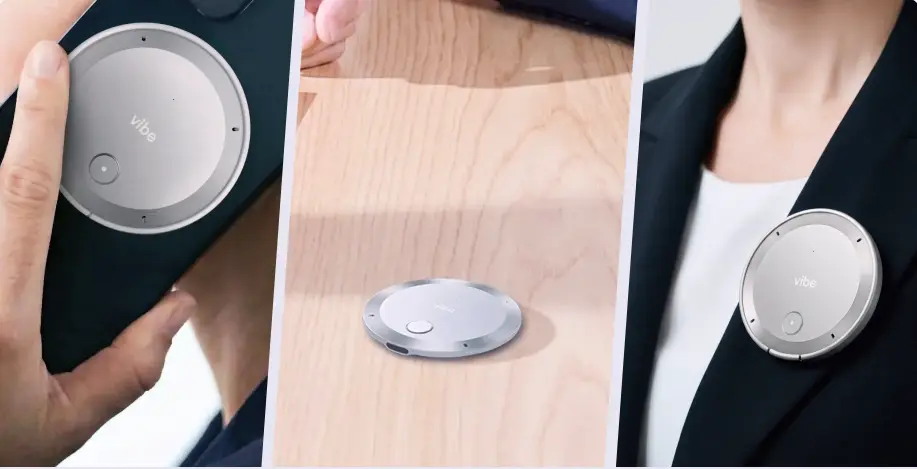
Vibe Dot is a wearable AI recorder the size of a clip-on badge. It sits on a lapel or on a desk and captures conversation without requiring a phone, laptop, or dial-in number. The microphone array is built for voice clarity in meeting rooms, four MEMS microphones and a voice-processing unit work together to separate the speaker from background noise. A single charge covers a full day of back-to-back sessions, and audio stays on the device in encrypted storage until sync.
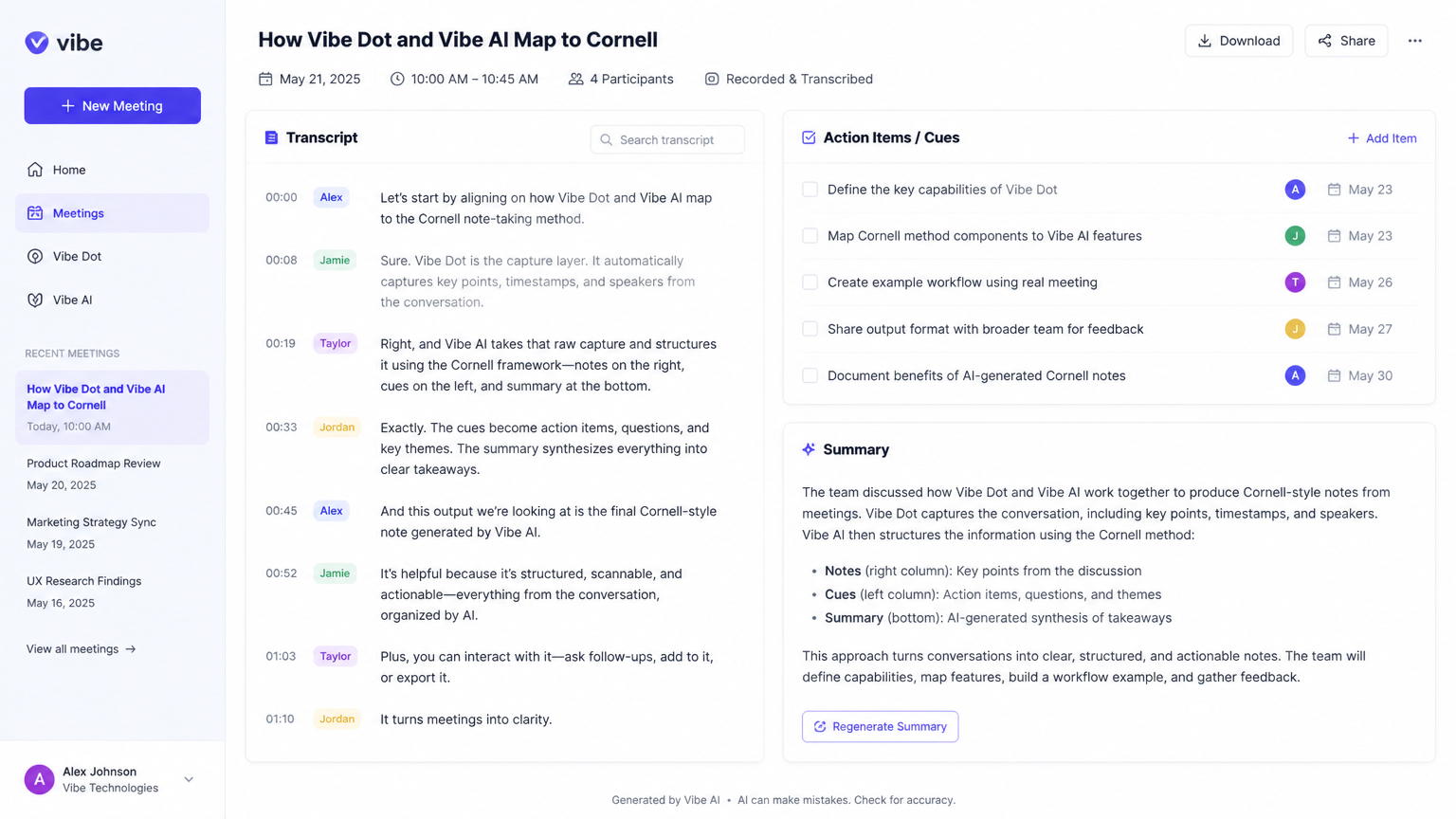 Clean digital interface showing AI-generated structured notes with sections for transcript, action items, and summary, a modern take onCornell's three zones
Vibe AI is the software layer that processes what Vibe Dot captures. It performs the entire Record-Reduce sequence automatically: raw audio becomes transcript; transcript becomes structured summary with industry-specific templates; summary surfaces action items, decisions, and key points.
The output maps directly to Cornell’s three zones:
-
Notes zone equivalent: The full transcript, searchable and time-stamped.
-
Cues zone equivalent: Auto-generated action items, keyword tags, and topic headers.
-
Summary zone equivalent: A concise synthesis paragraph for each meeting, customizable by template.
The human’s role shifts to the three cognitively valuable R’s: Recite (test recall), Reflect (connect to broader goals), and Review (periodic retrieval to cement memory). The bottleneck, Reduce, right after the session, when cognitive load is highest, is removed.
For professionals exploring wearable capture options, the best wearable AI recorders guide offers a comparison of devices designed for meeting and conversation capture.
Vibe AI, the cloud-based processing layer, operates on a Pro plan at $9 per seat per month, with a free starter plan for individuals. Together, Vibe Dot and Vibe AI handle the Record and Reduce steps automatically, delivering Cornell-style structured notes without manual overhead.
Final Thoughts
The Cornell note-taking method works because it demands cognitive engagement at multiple levels. The three-zone layout forces synthesis. The 5 R’s schedule retrieval.
But the method’s weakness has always been execution: the Reduce step that happens right after a session, when cognitive resources are depleted.
AI tools now automate that bottleneck. Vibe Dot captures. Vibe AI structures. The human work shifts to Recite, Reflect, and Review, where understanding lives. For professionals who want structured notes without manual overhead, this combination offers a practical upgrade to a proven method.
Next steps:
-
Set up a Cornell template and test the 5 R’s on your next meeting or lecture
-
Explore how Vibe Dot turns conversation into structured, searchable notes automatically
-
Discover wearable AI recorders for capture-first workflows that feed directly into the Cornell review cycle
FAQs
How do you use the Cornell method of note taking?
Divide your page into three zones: a 6-inch Notes column on the right for live capture, a 2.5-inch Cue column on the left for post-session prompts, and a 2-inch Summary band at the bottom for synthesis.
Then follow the 5 R’s: Record during the session, Reduce by filling the Cues column, Recite from memory, Reflect on connections, and Review periodically. Research shows this structure produces a statistically significant retention advantage over linear note-taking (Yıldırım, Frontiers in Psychology, 2025).
What is the Cornell method of note taking?
The Cornell method is a structured note-taking system developed by Walter Pauk at Cornell University in the 1950s. It divides a page into three zones, Notes, Cues, and Summary, paired with a five-step review cycle called the 5 R’s (Record, Reduce, Recite, Reflect, Review).
The method is designed to improve retention by forcing multiple passes at the same material, each pass engaging a different level of processing.
Does the Cornell note taking method work?
Yes. A 2025 study published in Frontiers in Psychology found that students using the Cornell method showed a statistically significant retention advantage over sentence-based note-taking (p < 0.05). They also reported significantly higher learning motivation.
The method’s effectiveness comes from the structured review cycle, which implements the retrieval practice known to improve memory. However, the method only works when the Reduce, Recite, and Review steps are actually executed.
How do you take Cornell notes for meetings?
Apply the same three-zone structure. Use the Notes column to capture the discussion. Use the Cues column to list action items and follow-ups (filled in immediately after the meeting). Use the Summary band to write the decision paragraph, what was decided and why.
Managers spend an average of 13 hours per week in meetings, per Fellow’s Meetings Statistics. The same retention challenges from lectures apply at professional scale.
What are the 5 R’s of Cornell note taking?
The 5 R’s are Record, Reduce, Recite, Reflect, and Review, the five-step process that makes Cornell effective.
Record is live capture during the session. Reduce condenses notes into cues and keywords. Recite is retrieval practice from cues alone. Reflect connects material to prior knowledge. Review is periodic spaced repetition.
These five steps implement the retrieval practice principle: active recall from memory produces stronger retention than passive re-reading of notes.