

Have you ever engaged in a heated discussion with somebody who simply refused to see things from your perspective? They’re so confident in their rightness that they fail to examine any evidence to the contrary.
Frustrating, right?
That’s because it’s often difficult to decide among available options. The world we live in is filled with ambiguity, where only a few questions have simple yes or no solutions. Therefore, the ability to assess nuances is essential.
If you ever find yourself in such a situation where you’re simply not able to decide what’s the best solution, think about the benefits as well as the drawbacks of your choice. Making a list of the pros and cons might help you evaluate the problem more thoroughly. If you do this, you’ll have more information to work with when you make your choice.
What Is a Pros and Cons List?

A pros and cons list is a simple decision-making tool that organizes the advantages (pros) and disadvantages (cons) of a choice into two columns, allowing you to compare them side by side before deciding. Pros are the positive outcomes or benefits of a decision; cons are the negative outcomes or drawbacks. The column with stronger or more numerous points typically guides the final choice.
It is one of the simplest but most effective problem-solving tools available, whether for professional or personal purposes.
It involves a simple procedure. We begin by listing potential solutions to the problem. This may come from brainstorming, strategy meetings, introspection, and so on. You can use an interactive whiteboard device to effectively examine each potential solution from both positive and negative angles, taking into account all possible outcomes.
Are Pros Good and Cons Bad?
Yes — by definition, pros are the positive aspects of a decision, and cons are the negative aspects. "Pros" comes from the Latin pro, meaning "for" or "in favor of." "Cons" comes from the Latin contra, meaning "against."
In everyday use:
-
Pros = benefits, advantages, upsides, reasons to do something
-
Cons = drawbacks, disadvantages, downsides, reasons not to do something
Neither pros nor cons are inherently more important than the other — what matters is how much weight you assign to each point in the context of your specific decision.
How Does a Pros and Cons List Work?

Making a pros and cons list is both easy and effective. You need to consider the big and small things, as well as the things in between, that will be impacted by your choice. You put an item in the ‘pro’ column if the outcome is positive. The negative outcome is included in the list of ‘cons.’ It helps you picture the many factors at play and makes it easier to make an informed decision. Usually, the column with the most items will likely be the deciding factor.
The method enables you to analyze each variable and perspective separately. This keeps you from looking at a major choice and being in a state of "analysis paralysis." You only have to weigh the pros against the cons and vice versa.
What Are Pros and Cons Lists Used For?

A pros and cons list can help guide your decision-making. It’s a great streamlined tool for choosing between options and making final decisions, both big and small.
Once you’ve tallied up the pros and cons, making a decision will be much easier. Your choice can now be well-informed and prudent, especially so for more nuanced choices. Every argument can be scored on a number of criteria to get a helpful list.
Because of its ease of use, the list may be used in a wide variety of decision-making scenarios. That’s because it’s less susceptible to the effects of prejudice and emotion. You’ll evaluate the merits of each argument against the available evidence. This may serve as supporting evidence for a decision.

Benefits of Pros and Cons Lists

Rigor
Taking the time to list the benefits and drawbacks of a potential course of action reduces the risk of overlooking important considerations. Giving each of the pros and cons a value is an extra exercise that prompts more in-depth thinking and, eventually, results in better decisions.
No Emotional Attachment
Strong emotions are often triggered by making major life choices. Making a pros and cons list of a potential action may lead to what psychologists Ozlem Ayduk and Ethan Kross call a "self-distanced viewpoint," in which the choice is seen as an ‘external’ issue to be solved, hence reducing the depth of the associated emotions. By postponing the decision until after the pros and cons have been weighed, you give yourself more time for your emotions to settle, which lowers the likelihood of acting impulsively and making the wrong choices.
Intuitive and Uncomplicated
The pros and cons list is appealing because it’s easy to understand, doesn’t need any advanced knowledge of computing or analysis, and is simple to implement.
How to Do a Pros and Cons List: 4 Steps

Step 1: Create Your Template
The first step in creating a pros and cons template is outlining its structure. The T-chart is the most conventional layout, with a horizontal line across the center of the page and a vertical line down the middle. Put "Pros" on one arm of the "T." Write "Cons" on the opposite side. Then jot down the possibilities you’re thinking about.
You might also split the list in half. The benefits of the choices will go on one list, while the drawbacks will go on another. Make sure you mark the same choice across the top of each list.
Step 2: Make a List of the Pros
The next step is to consider all the benefits of going with the choice and record them on the appropriate list or column of the chart. Consider the results very carefully as you proceed. Certain advantages may pop into your head right away, while others will need some thought and consideration. Try peppering your brainstorming session with questions like:
-
What is the primary benefit of this decision?
-
Are there any additional benefits that you don’t currently get?
-
What could you achieve with this decision?
-
To what extent does this help you advance in your field?
-
In what ways does it affect the people close to you?
Step 3: Make a List of the Cons
Write down the drawbacks of this plan of action on a separate sheet of paper or a list. Once again, certain drawbacks may be readily apparent, while others may need more analysis. To help you think of potential drawbacks, try asking yourself the following questions:
-
What are you leaving behind?
-
What potential consequences may arise from this choice?
-
How would you handle the difficulties you’d face?
-
How would this prevent you from moving on with your plans?
Step 4: Incorporate the Pros and Cons Provided by Third Parties
When making a choice, it’s important to think about the consequences for others. Add the names of any potential beneficiaries of your decision at the end of the list. They could be anyone from members of the family, close friends, teachers, coworkers, or superiors. Consider how someone could react to your choice, whether it’s positive or negative, and how it might affect them.
Pros and Cons List Examples
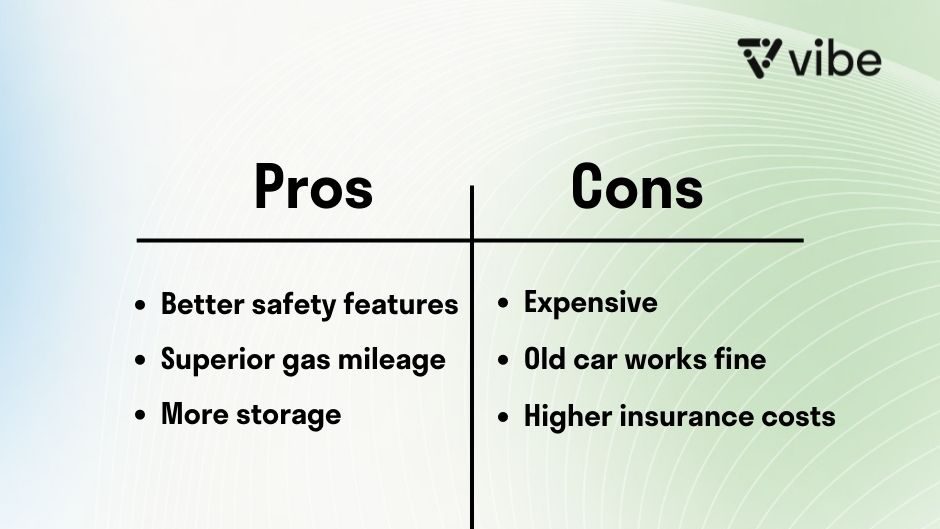
Here are three common scenarios where a pros and cons list helps clarify the decision.
Example 1: Buying a New Car
Decision: Should I buy a new car?
|
Pros |
Cons |
|---|---|
|
Enhanced safety features |
Higher monthly payment |
|
Better fuel economy |
Current car still runs well |
|
More storage space |
Higher insurance premiums |
|
New car warranty |
Depreciation in first year |
Verdict: If safety and reliability are priorities and the monthly cost is manageable, the pros outweigh the cons.
Example 2: Job Relocation Decision
|
Pros |
Cons |
|---|---|
|
30% salary increase |
Far from family and friends |
|
Career advancement opportunity |
High cost of living in new city |
|
New professional network |
Disrupts partner’s career |
|
Fresh start in a new place |
Moving costs and logistics |
Verdict: Assign a weight to each item. If the salary increase covers the cost of living difference and career growth is a top priority, the move may make sense.
Example 3: Evaluating a Person (Relationship Pros and Cons List)
Decision: Should I continue this relationship?
|
Pros |
Cons |
|---|---|
|
Shared values and goals |
Different communication styles |
|
Mutual respect |
Long-distance logistics |
|
Strong emotional connection |
Conflicting schedules |
Note: For relationship decisions, a pros and cons list works best alongside honest conversation — the list surfaces patterns you might not have articulated, but it shouldn’t replace direct communication.
Building Your Pros and Cons List With Vibe

Vibe is a collaborative digital whiteboard tool that allows hybrid teams to collaborate on team challenges and solutions—perfect for creating a pros and cons list that you can easily share with the team and brainstorm on together. Using an interactive whiteboard to brainstorm your outcomes can help you lay out your canvas for future pros and cons.
With Vibe, you can share your list with your teammates and have them add their thoughts, comments, or questions from anywhere—whether they’re in the same meeting room as you or at their home office. History tracking makes it easy to examine past changes and proposed modifications in detail. Annotation makes adding extra notes and illustrating your ideas straightforward. Import any relevant tables, images, videos, or other resources into your Vibe Canvas as supporting evidence that everyone can see. Or, import your evidence into your Canvas directly from the web. With a smart whiteboard like Vibe, making your own pros and cons list is easier than ever.
FAQ
Are pros and cons lists easy to make?
Creating a pros and cons list is a fairly simple process. First, make a note of the choice that prompted you to start creating the list in the first place. After that, you can create two columns, one for the pros and another for the cons. After making a list of the benefits and drawbacks, you can assign a value to each and then weigh them both before making a choice.
What do pros stand for in a pros and cons list?
In a pros and cons list, the pros stand for the positive aspects of a decision-making process. The pros allow you to weigh in on all the good that can happen when you make a decision. For example, suppose you’re applying for a new job in a different city. A pro list will allow you to examine all the positive things you will achieve if you get the job and move.
What does "pros and cons" mean?
"Pros and cons" is an expression meaning the advantages and disadvantages of something. It comes from the Latin phrases pro (for) and contra (against). When you evaluate the pros and cons of a decision, you are listing the reasons for and against a particular course of action in order to make a more informed choice.
How do you write a pros and cons list for a decision at work?
For work decisions — such as choosing between two vendors, evaluating a process change, or deciding whether to hire — follow the same four steps above, but add one additional layer: assign a weight (1–5) to each item based on how much it matters to the business outcome. A vendor with slightly higher cost (con, weight 2) but significantly better support (pro, weight 5) may still be the right choice once weights are factored in. This weighted version is sometimes called a decision matrix.