
Over the past few years, organizations across the globe have had to reevaluate the environment of their workplace and put new job practices—like exploring the benefits of a hybrid work model—to the test.
Today, the hybrid model has replaced the traditional full-time office approach in many workplaces, resulting in a significant shift in how organizations manage their operations, employees, and customers.
Let’s explore 15 benefits of hybrid work and actionable steps you can take to mitigate any associated risks.
- Hybrid work, when designed intentionally, measurably improves productivity, retention, and employee well-being.
- Hybrid works best when it flexes by role, task, and person—not as a rigid, one-size-fits-all model.
- Hybrid isn’t automatically better than remote or in-office; its impact depends on how clearly it’s designed and managed.
What Is a Hybrid Work Model?
Before we dive in, let’s take a look at what this model looks like. Hybrid work is a flexible model where employees split their time between remote locations and the office over the course of a week. Instead of a rigid, one-size-fits-all structure, it’s designed to adapt to different roles, preferences, and work styles. Some teammates may be fully remote, others fully on-site, and many will blend home and office based on team needs and personal productivity.
Some organizations may set guidelines—like minimum in-office days or anchor days for collaboration—, but the balance between home and office can vary widely by company, team, and even individual. What matters most is aligning location with the type of work being done: deep-focus tasks in quiet environments, and collaborative decision sessions when people are co-located or connecting via shared digital workspaces.

Benefits of Hybrid Work Models
Hybrid work isn’t just a nice perk for employees anymore—it’s a proven performance driver. The latest 2025 data shows that flexible, mixed-location work models drive extremely real gains in productivity, well-being, and business outcomes, not just feel-good stories.
1. Productivity That Actually Moves the Needle
Hybrid work is no longer a gamble—it’s the clear advantage. In the 2025 Cisco Global Hybrid Work Study, 73% of respondents said they are more productive in a hybrid model, reporting an average productivity boost of 19%, or roughly 7.6 additional productive hours per week. Flexible schedules and the ability to choose where to focus-heavy work happens translate directly into more high-value output, not more time online.
2. Retention That Protects Your Top Talent
When people can choose how and where they work, they are far less likely to leave. The same study shows 69% of employers report improved employee retention after introducing hybrid options, with average retention up 34%. A Stanford-led study tracking hybrid arrangements over two years found that offering two days at home reduced quit rates by about a third without any drop in performance. In other words, flexibility keeps your best people—and protects you from expensive churn.
3. Shrunk Operating Costs
Organizations implementing hybrid models can achieve real estate savings in the range of 10–50% by right-sizing space to actual utilization, according to CBRE’s 2026 Global Workplace & Occupancy Insights, which draws on benchmarking data from 303 million square feet of office portfolios globally. CBRE’s workplace intelligence data shows companies implementing proper occupancy tracking reduce real estate costs by an average of 35% within 18 months. With global average office utilization still sitting at 54%—well below the 65%+ most organizations target—the gap between what companies pay for and what they actually use remains a significant lever for cost reduction under hybrid models.
4. Daily Cost Savings That Matter to Employees
Hybrid work also shows up in your employees’ wallets. The daily savings from reduced commuting are meaningful and well-documented. Global Workplace Analytics, which tracks remote and hybrid work economics, estimates that employees working from home two to three days per week save between $600 and $6,000 annually on transportation, meals, and incidental costs — a significant benefit that compounds over a career without requiring any additional compensation budget from employers. For many employees, that’s the equivalent of a meaningful raise—without any extra compensation budget.
5. Work-Life Balance That Employees Actually Feel
Flexibility isn’t just a talking point; it’s the top benefit employees feel from hybrid work. In 2025, guides and surveys on hybrid workplaces, 76% of respondents named improved work-life balance as the primary advantage of a hybrid model. When people can shift deep work to home and reserve the office for collaboration, they gain more control over family time, focus time, and recovery—without sacrificing performance.
6. Commute Time Workers Get Back
Every day, employees aren’t required to commute is time they can put back into work or life. Hybrid workers consistently report saving 40–50 minutes of commuting on days they work from home — time that flows back into focus work, rest, or family. JLL’s 2025 Workforce Preference Barometer, covering 8,700 office workers across 31 countries, found an 8-percentage-point decrease in employees feeling overwhelmed or exhausted since 2022, a trend researchers attribute in part to reduced commuting burden. At a systems level, Monday and Friday office occupancy globally averages just 35–46%, confirming that most hybrid employees are already capturing the commute-free benefit multiple days per week. That reclaimed time becomes a mix of extra focus, rest, and family time—and it shows up in energy and engagement.
7. Wellbeing Scores That Trend Up
Wellbeing is now a core KPI, and hybrid work is a positive driver. The CIPD’s "Health and Wellbeing at Work 2025" report found that 66% of hybrid workers rate their mental health as good, compared with 59% of employees who have no access to homeworking. Studies of hybrid and remote work patterns in 2025 add that giving people autonomy over where they work is associated with lower mental distress and better psychological outcomes.
For practical guidance on making hybrid meetings less draining for both in-room and remote participants, see the complete hybrid meeting guide.
8. Lower Burnout Across Teams
Burnout is a business risk, not just a personal problem—and hybrid work helps mitigate it. Updated workplace stress data for 2025 shows burnout rates at just 8% among hybrid workers, compared to 10% for fully remote employees and a steep 20% for office-only teams. The combination of face time, flexibility, and reduced commuting appears to hit the sweet spot: people stay connected enough to feel part of a team, but not so constrained that work overwhelms life.
9. A Bigger, Better Talent Pool
If your roles aren’t hybrid or remote, you’re losing candidates before the first conversation. Recent 2025 roundups of hybrid work statistics report that 87% of job seekers now prefer roles with hybrid or remote options, and job postings that advertise flexibility attract up to 2x more applicants than in-office-only roles. That gives hybrid-friendly companies a structural advantage in hard-to-fill disciplines, niche markets, and senior roles.
10. Higher Satisfaction and Stronger Loyalty
Flexible work isn’t just about attraction—it’s about long-term satisfaction. According to 2025 reporting that cites SHRM data, 83% of employees say that flexibility makes them happier and more likely to stay with their current employer. The Stanford-controlled hybrid study reinforces this picture: employees given two days at home reported higher job satisfaction while matching the performance of fully in-office peers. Happier employees are more engaged, more resilient, and more willing to go the extra mile when it counts.
11. Fewer Sick Days and Unplanned Absences
When people have more control over their schedules and environment, they’re less likely to call out. Analyses of hybrid workplace performance in 2025 note that organizations offering hybrid options see lower absenteeism, feeding into their wider productivity and cost-savings story. Better work-life fit, reduced exposure to commuting stress, and more flexibility around personal appointments all reduce the need for last-minute absences.
12. Performance and Promotions That Stay on Track
A common fear is that hybrid workers will be "out of sight, out of mind" when it comes to performance reviews and promotions, but the data tells a different story—if the model is structured well. The large-scale Stanford/Trip.com experiment, published in Nature and frequently referenced in 2025 discussions of hybrid work, found no significant difference in performance ratings or promotion rates between hybrid employees and those in the office full-time over a two-year period. When expectations are clear and outcomes-based, location doesn’t have to dictate career trajectory.

13. A Boost to Diversity and Inclusion
Hybrid work can expand who can participate—and thrive—in your organization. A 2025 hybrid productivity and culture report highlights that 54% of employers say hybrid work has improved diversity and inclusion outcomes. Other 2025 analyses of hybrid and remote preferences show that employees with disabilities, LGBTQ+ workers, and nonbinary employees are more likely to favor hybrid models, and women are significantly more likely to apply for roles with flexible location options. When flexibility is built in, more people can realistically join and stay.
14. A Magnet for High Performers
Top performers are voting with their feet—and they’re choosing flexibility. The Cisco 2025 hybrid work study reports that 50% of high performers work at organizations that require no more than two days per week in the office, versus 29% of average performers and just 19% of low performers. High performers in these environments are also more likely to be very satisfied with their workplace setup, suggesting that flexible models are becoming a differentiator for elite talent.
15. Collaboration and Innovation That Doesn’t Stall
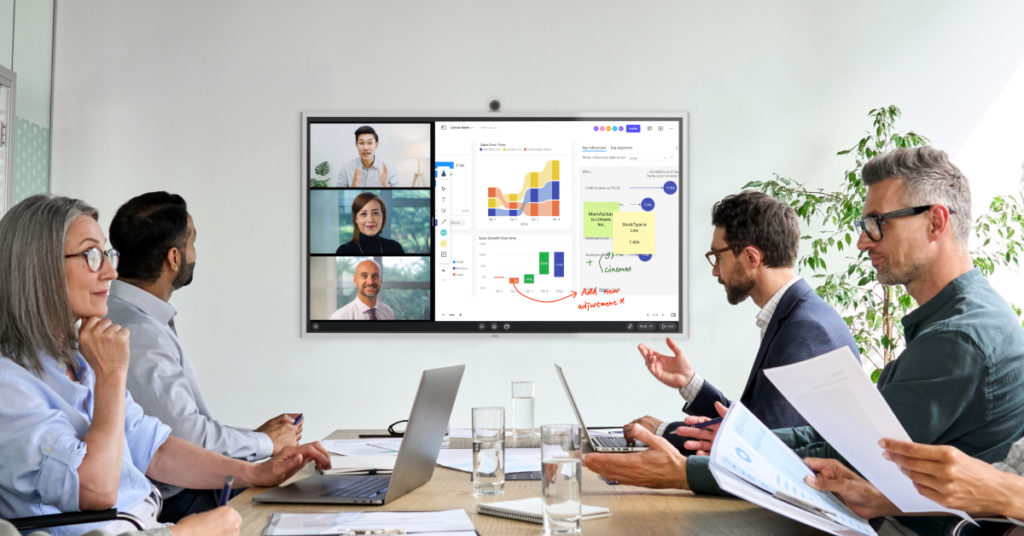
Hybrid work has moved beyond "video calls from the kitchen table" into intentional, tech-enabled collaboration. A 2025 Archie review of hybrid work stats notes that 66% of employers report increased productivity, 65% see improved wellbeing, and 56% say team communication has improved under hybrid models. When teams align their in-office days around workshops, planning, and relationship-building — and use tools like interactive whiteboards to keep remote collaborators live in the room — innovation doesn’t slow down; it becomes more intentional. Pairing visual collaboration tools with an AI meeting device like Vibe Bot ensures that what gets decided in those sessions is captured automatically, so the momentum of in-person collaboration doesn’t evaporate in the handoff to follow-up.
The Technology That Makes These Benefits Real
The 15 benefits above don’t materialize automatically — they depend on whether your team’s tools close the gap between in-room and remote participation, and whether meeting decisions actually survive the handoff to follow-up work. Two tools address these gaps directly.
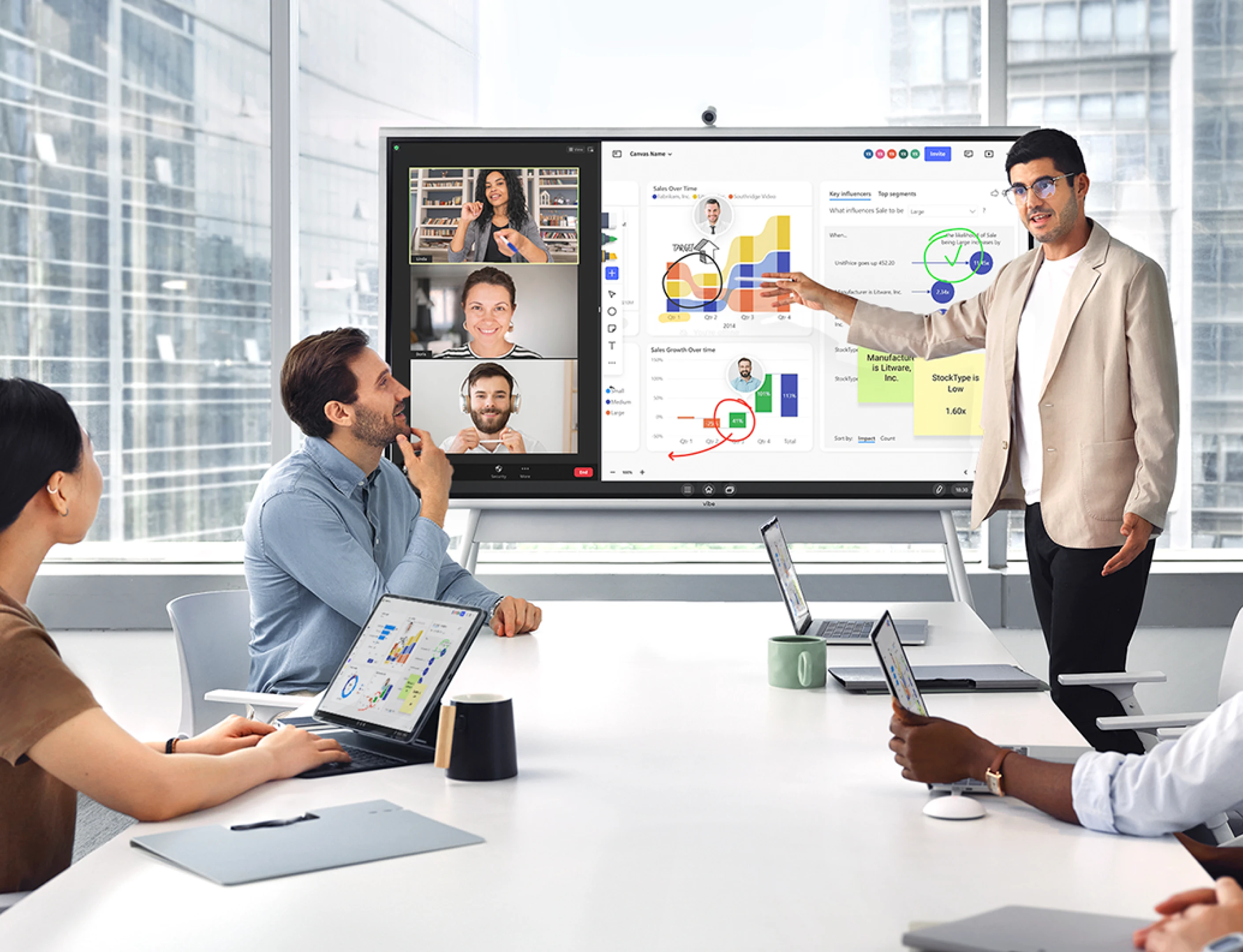
For collaboration equity (Benefits #1, #10, #15): The most common failure point in hybrid meetings is content that only in-room participants can see and edit. The Vibe Board S1 gives every participant — in-room and remote — a shared interactive canvas they can edit simultaneously, integrated with the video conferencing platform already running in the room. Brainstorms, strategy sessions, and workshops stay inclusive rather than defaulting to whoever’s physically at the whiteboard. Everything is saved to the cloud instantly, accessible after the session to anyone who attended or missed it.
For meeting capture (Benefits #1, #8, #12): Productivity gains and reduced burnout from hybrid work erode fast when every meeting still requires someone to take manual notes, draft a summary, and follow up on action items. Vibe Bot is a standalone AI conference room device that handles this automatically — 4K 360° video, beamforming audio, and on-device AI that produces a transcript, summary, and action items the moment the call ends, with no laptop required to start the session. The per-meeting administrative burden that compounds across hybrid teams disappears.
Together, these tools address the two most common reasons hybrid work underperforms its potential: remote participants who can’t contribute equally to in-room collaboration, and decisions that don’t carry forward from meeting to execution.
Explore Vibe’s workspace solutions or request a demo to see how both work in a room like yours.
FAQs
What are the 5 C’s of collaboration?
The 5 C’s of collaboration are commonly defined as communication, coordination, connection, creativity, and culture in modern hybrid-work guidance. Some frameworks swap in related terms like commitment or clarity, but the core idea is enabling aligned, connected, and creative teamwork.
What are the disadvantages of hybrid work?
Disadvantages of hybrid work include coordination complexity (scheduling who is where when), participation inequality between in-room and remote people, culture dilution, and feeling less connected to the organization. It can also introduce inequities in visibility and recognition, create tech and security overhead, and increase stress if expectations and norms are unclear.
Is hybrid work better than remote work?
Hybrid work is often better than fully remote for teams that rely heavily on synchronous collaboration, in-person workshops, and building culture through face-to-face interaction. Fully remote can be better when maximizing geographic talent reach, cost savings, and individual autonomy are higher priorities, so "better" depends on your goals and team structure.
What are the main benefits of hybrid work?
The main benefits of hybrid work include measurably higher productivity (73% of hybrid workers report being more productive, with an average boost of 19%, per the 2025 Cisco Global Hybrid Work Study), stronger employee retention (average improvement of 34%), reduced real estate costs (10–50% savings when office space is right-sized to actual utilization), and better employee wellbeing and work-life balance. Hybrid models also expand the talent pool — 87% of job seekers now prefer roles with hybrid or remote options — and reduce burnout rates compared to fully in-office arrangements (8% vs. 20%). The benefits are most pronounced when hybrid is designed intentionally around role type and work mode, rather than applied as a blanket policy.
What are the pros and cons of a hybrid work model?
Pros: Flexible schedules improve productivity and work-life balance; lower commuting burden reduces burnout; companies can right-size office footprints for significant real estate savings; hybrid arrangements attract and retain top talent; wellbeing scores and job satisfaction trend upward.
Cons: Coordination complexity increases when teams are split across locations; remote participants risk being disadvantaged in hybrid meetings if technology and norms aren’t deliberately designed for equity; culture and informal mentoring are harder to sustain without face time; visibility and promotion equity can suffer if managers default to in-person bias; security and IT overhead increases with distributed access. The downsides are manageable with clear policies, structured anchor days, and meeting technology that gives remote participants equal presence — but they don’t disappear on their own.
What are the benefits of hybrid work for employers?
For employers, hybrid work delivers on four dimensions: cost — real estate footprints can be reduced 10–50% by right-sizing to actual attendance patterns (CBRE, 2026); talent — hybrid-friendly job postings attract up to 2x more applicants, and 69% of employers report improved retention after introducing hybrid options (Cisco, 2025); performance — controlled studies show no meaningful difference in performance ratings or promotion rates between hybrid and fully in-office employees when expectations are outcomes-based (Stanford/Trip.com, Nature 2024); and diversity — 54% of employers report improved diversity and inclusion outcomes under hybrid models. The employer-side gains are most durable when hybrid policies are paired with equitable meeting technology and clear norms, so flexible work doesn’t quietly disadvantage the employees who use it most.