
The Four Actions Framework is one of the most practical tools to come out of Blue Ocean Strategy—and one of the most misunderstood. Teams often treat it as a brainstorming exercise when it’s actually a structured decision model for redesigning value. This guide explains exactly what the framework is, how each of the four ERRC actions works, and how to apply it with real examples and a ready-to-use template.
What Is the Four Actions Framework?
The Four Actions Framework is a strategic tool developed by professors W. Chan Kim and Renée Mauborgne at INSEAD Business School as part of their Blue Ocean Strategy methodology. It helps organizations break out of competitive markets by systematically reconstructing value—deciding which features to eliminate, reduce, raise, or create across a product or service.
The framework is built on a core premise: most industries compete on the same dimensions of value, which drives up costs without creating meaningful differentiation. By challenging which of those dimensions actually matter to buyers, organizations can simultaneously cut costs and increase value—opening up new market space with little or no direct competition.
The framework is often abbreviated as ERRC, representing its four actions: Eliminate, Reduce, Raise, Create.
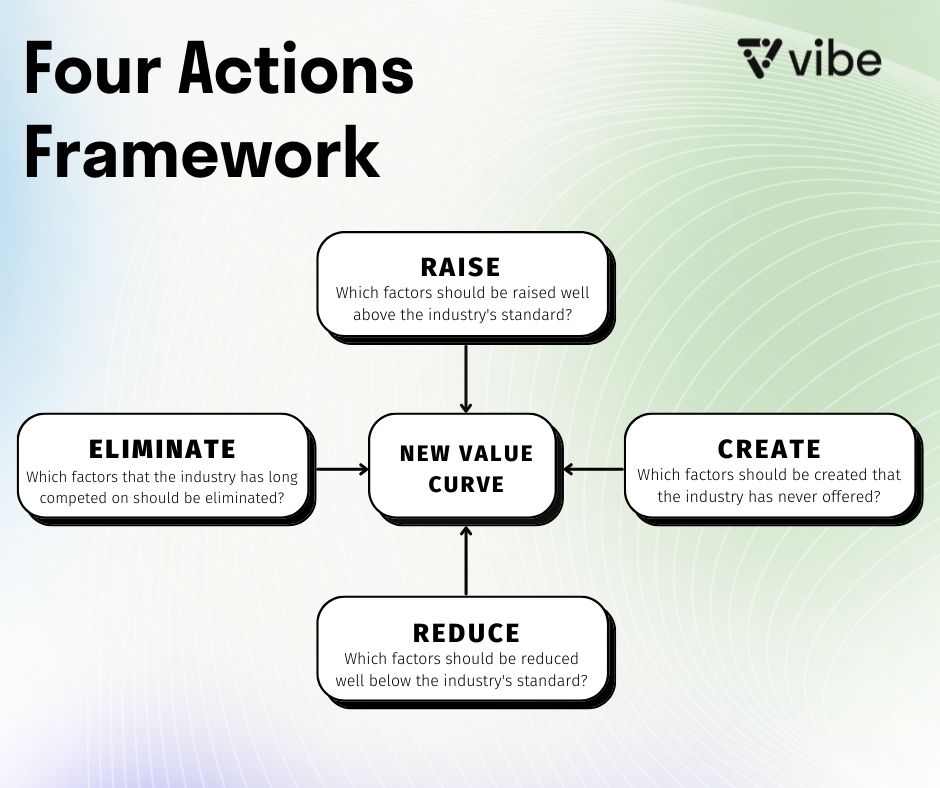 ERRC four-quadrant model
The ERRC Model: The Four Actions Explained
Each action prompts a specific question about the factors your industry competes on. Working through all four forces trade-off thinking—rather than defaulting to "add more features" or "cut costs."
|
Action |
The Question to Ask |
Strategic Effect |
|---|---|---|
|
Eliminate |
Which factors the industry takes for granted should be removed entirely? |
Cuts costs; removes features buyers no longer value |
|
Reduce |
Which factors should be brought well below the industry standard? |
Trims over-engineered elements that inflate price without adding value |
|
Raise |
Which factors should be brought well above the industry standard? |
Addresses unmet needs buyers have been tolerating |
|
Create |
Which factors should be introduced that the industry has never offered? |
Generates new demand; creates reasons to switch |
The power of the framework lies in using all four simultaneously. Eliminating and reducing free up resources; raising and creating redirect those resources toward genuinely differentiated value.
Eliminate
This quadrant focuses on factors the industry has long competed on but that buyers no longer find meaningful—or never did. Eliminating them reduces cost and operational complexity without sacrificing customer value.
The key question: Which features demand significant investment but produce little or no buyer value in return?
Common candidates for elimination include legacy features maintained for historical reasons, complex documentation that confuses rather than informs, and premium add-ons that the mainstream buyer never uses.
Reduce
Not every industry convention needs to be fully removed—some still have value, just not at the level the industry currently provides them. Reducing means dialing these factors down to a level that adequately serves buyers without over-investing in them.
The key question: Which factors are we over-delivering on relative to what buyers actually need?
Reducing frees up margin that can be redirected to the Create and Raise quadrants where genuine differentiation is possible.
Raise
Raising targets factors that buyers have consistently complained about or worked around—industry pain points that competitors have accepted as inevitable rather than solved.
The key question: Where are buyers being underserved, and what would it take to meet their real expectations?
This is where organizations typically find the most immediate satisfaction signal from customers, because they’re finally addressing frustrations that have been normalized.
Create
The Create quadrant is the most open-ended and often the most valuable. It asks teams to identify value that the industry has never offered—factors that would generate entirely new demand rather than redistribute existing buyers.
The key question: What would attract buyers who currently avoid this product category entirely?
This often requires looking outside the immediate industry at adjacent categories, non-customers, or emerging behaviors.
Four Actions Framework Examples
Example 1: Yellow Tail Wine (The Classic Case)
The most cited Four Actions Framework example is Casella Wines’ Yellow Tail brand, which became the fastest-growing wine import in U.S. history within three years of launch. The wine industry was competing on the same dimensions—prestigious vineyard heritage, complex flavor profiles, aged varieties, and intimidating labeling.
Casella’s ERRC analysis looked like this:
|
Eliminate |
Reduce |
Raise |
Create |
|---|---|---|---|
|
Oenological terminology |
Price (vs. premium wine) |
Ease of selection |
Fun, approachable branding |
|
Aging credentials |
Wine complexity |
Retail availability |
Social drinkability |
|
Vineyard prestige |
Wine range (2 varieties only) |
Taste accessibility |
— |
By eliminating what non-wine drinkers found alienating and creating a product that appealed to beer and spirit drinkers, Yellow Tail opened a new market rather than fighting for share in an existing one.
Example 2: Budget Airlines
Low-cost carriers applied the same logic to air travel. They eliminated seat class distinctions, reduced meal service and rebooking flexibility, raised on-time departure rates and route frequency, and created ticketless booking and direct online purchasing. The result was a category of traveler who previously drove or took the bus.
Example 3: Streaming vs. Cable
Streaming services applied the framework to video entertainment: eliminating channel bundles and long-term contracts, reducing production of niche specialty content, raising content quality in flagship originals, and creating on-demand viewing with no scheduled programming. The result redefined what consumers expected from video entertainment.
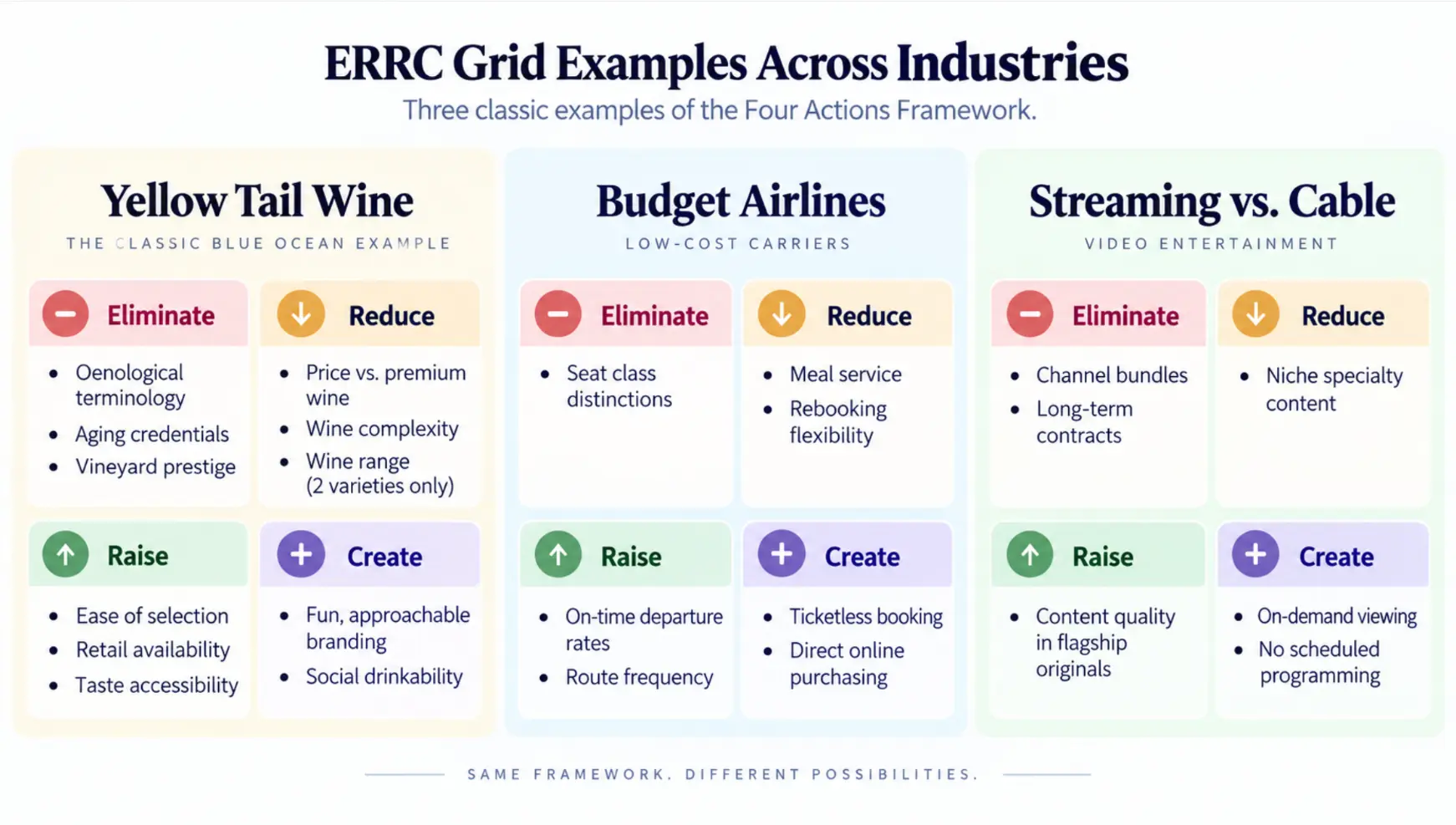 Three-column visual showing the Yellow Tail, budget airline, and streaming examples side-by-side as ERRC grids
How to Build Your Four Actions Framework
Working through the ERRC model effectively requires a structured session rather than a casual conversation. Here’s a repeatable process:
Step 1: Define the scope. Choose a specific product, service, or business unit. The framework works best when applied to something concrete rather than an entire company strategy.
Step 2: Map the current competitive factors. List every dimension your industry competes on—features, pricing structures, service models, distribution channels, marketing approaches. This becomes the input list for your ERRC analysis.
Step 3: Run through each quadrant systematically. For each factor on your list, ask the ERRC question for that quadrant. Force a decision: every factor should land somewhere, even if the answer is "keep as-is."
Step 4: Pressure-test with non-customers. The most valuable input for the Create quadrant often comes from people who don’t currently use your product. What would it take for them to switch?
Step 5: Check for internal consistency. The Eliminate and Reduce outputs should free up enough cost to fund what the Raise and Create outputs require. If they don’t, re-examine which factors are truly being cut.
Step 6: Build a Strategy Canvas. Once the ERRC analysis is complete, plot the resulting value curve against competitors on a single chart. This visualizes the degree of differentiation the new strategy creates.

Four Actions Framework Template
The ERRC model is most effective when the team can see all four quadrants simultaneously and move ideas between them. The template below can be filled in for any product or service.
Product / Service: Team / Date:
|
Eliminate |
Reduce |
|---|---|
|
What should be removed entirely? |
What should be scaled back? |
|
— |
— |
|
— |
— |
|
Raise |
Create |
|---|---|
|
What should exceed industry norms? |
What should be introduced for the first time? |
|
— |
— |
|
— |
— |
Running this exercise collaboratively—where team members can simultaneously add to each quadrant, move items, and annotate—produces better results than passing a document back and forth. Teams using a shared digital whiteboard like the Vibe Board S1 can build the ERRC grid on a shared canvas, annotate over it in real time during the session, and save the output automatically—so the analysis doesn’t get lost between the workshop and the follow-up meeting.

Conclusion
The Four Actions Framework is most valuable when it forces explicit decisions rather than open-ended ideation. The discipline of assigning every competitive factor to a quadrant—and checking that the cost savings from Eliminate and Reduce fund what Raise and Create require—is what separates it from a standard brainstorm.
The most effective way to run the analysis is collaboratively, where everyone can see the same grid and move ideas in real time. Whether you’re using the template above or a shared digital canvas, the goal is the same: walk out of the session with specific decisions, not just observations.

Frequently Asked Questions
What is the Four Actions Framework in Blue Ocean Strategy?
The Four Actions Framework is one of the core analytical tools in the Blue Ocean Strategy methodology, developed by Kim and Mauborgne at INSEAD. It structures the process of reconstructing buyer value by asking four questions: what to eliminate, reduce, raise, and create relative to current industry standards. The goal is to identify a combination of changes that simultaneously lowers costs and increases value—creating an uncontested market space rather than competing for share in an existing one.
What does ERRC stand for in the Four Actions Framework?
ERRC stands for Eliminate, Reduce, Raise, Create—the four categories of action the framework uses to reconstruct value. Each letter represents a different type of strategic decision: Eliminate removes factors the industry competes on but buyers no longer value; Reduce scales back over-engineered elements; Raise addresses unmet buyer needs; and Create introduces value factors the industry has never offered. Teams often use an ERRC grid (a 2×2 matrix) to organize their analysis visually.
How is the Four Actions Framework different from a SWOT analysis?
A SWOT analysis evaluates internal strengths and weaknesses against external opportunities and threats—it describes the current state. The Four Actions Framework is a prescriptive tool: it generates specific decisions about what to change. The two are complementary. SWOT can help identify where a product is vulnerable; the Four Actions Framework then provides a structure for deciding what to do about it.
What are some good Four Actions Framework examples?
The most cited example is Casella Wines’ Yellow Tail brand, which redesigned the wine market by eliminating complex terminology and vineyard prestige, reducing variety and price, and creating approachable branding and taste for casual drinkers. Other widely studied examples include budget airlines (which eliminated seat classes and meals while creating ticketless booking), and streaming services (which eliminated broadcast schedules and channel bundles while creating on-demand personalized viewing).
How do I run a Four Actions Framework workshop?
Start by listing every factor your industry competes on, then assign each factor to one of the four ERRC quadrants. Work through Eliminate and Reduce first to identify where resources can be freed up, then move to Raise and Create to determine where that freed capacity should be redirected. The session works best with cross-functional input—product, marketing, and customer-facing teams each bring different perspectives on what buyers actually value. Plan for at least 90 minutes and capture the output in a shared format the team can refine afterward.
Can the Four Actions Framework be used for internal processes, not just products?
Yes. While most examples involve product or service redesign, the ERRC model applies equally well to internal operations, business models, and go-to-market strategies. The same questions—what to eliminate, reduce, raise, or create—help teams identify where operational investment isn’t producing proportional value, and where redirecting effort could create meaningful improvement. Startups often use it for go-to-market strategy; larger organizations apply it to service delivery models and internal tooling.