
Remote and hybrid work didn’t end the need for human connection — it just moved it online permanently. According to Gallup’s State of the Global Workplace report, 25% of fully remote employees feel lonely on a given day, compared to 16% of on-site workers. And a June 2026 study in Science tracking 588,322 Americans found that remote work has quadrupled since the pandemic — along with a measurable rise in time spent without any human contact.
Knowing how to socialize online isn’t a pandemic coping strategy anymore. It’s a genuine life skill — one that determines whether remote work feels freeing or isolating. Whether you’re catching up with friends across time zones, building community around a shared hobby, or keeping work relationships warm from home, these seven approaches make online socializing feel less like a workaround and more like the real thing.
 A woman drinks coffee and video chats with a friend while socializing online.
1. Make Multiplayer Gaming a Regular Social Ritual
Online gaming is one of the most underrated ways to stay connected. Unlike a scheduled call where conversation has to carry everything, games give you something to do together — and a shared goal, a running joke, or a close loss becomes the basis for a real friendship.
You don’t need to be a hardcore gamer. Casual co-op games like Stardew Valley, social deduction games like Among Us, or word games like Codenames online work just as well for people who play once a week as for daily players. The key is consistency: a standing Friday game session is more connective than an occasional group chat.
If your friend group is spread across devices and platforms, check which games offer cross-platform play — most newer titles do.
2. Host a Virtual Watch Party
Streaming platforms have made it easy to watch the same content simultaneously from different locations. Services like Amazon Prime Watch Party, Teleparty (which supports Netflix, Disney+, Hulu, and HBO), and Apple SharePlay let you sync video playback so everyone’s pausing, rewinding, and reacting at the same moment.
What makes this work socially is the shared experience rather than the content itself. Keep a voice or video call open alongside the stream, and the commentary becomes the event. Pick something with a natural talking pace — a documentary, a competition show, or a movie with a slow second act — and the conversation fills itself in.
3. Use Video Calls for Parallel Work Sessions ("Body Doubling")
One of the things remote workers miss most about office life isn’t the meetings — it’s the low-level ambient presence of other people working nearby. Behavioral researchers call the practice of working alongside someone else "body doubling," and it reliably improves focus and reduces the sensation of isolation.
The setup is simple: schedule a two- to three-hour video call with a friend, colleague, or even an online community where everyone works on their own tasks in silence (or near-silence), checks in briefly at the start and end, and stays on camera. You’re not collaborating on the work — you’re just present together while doing it.
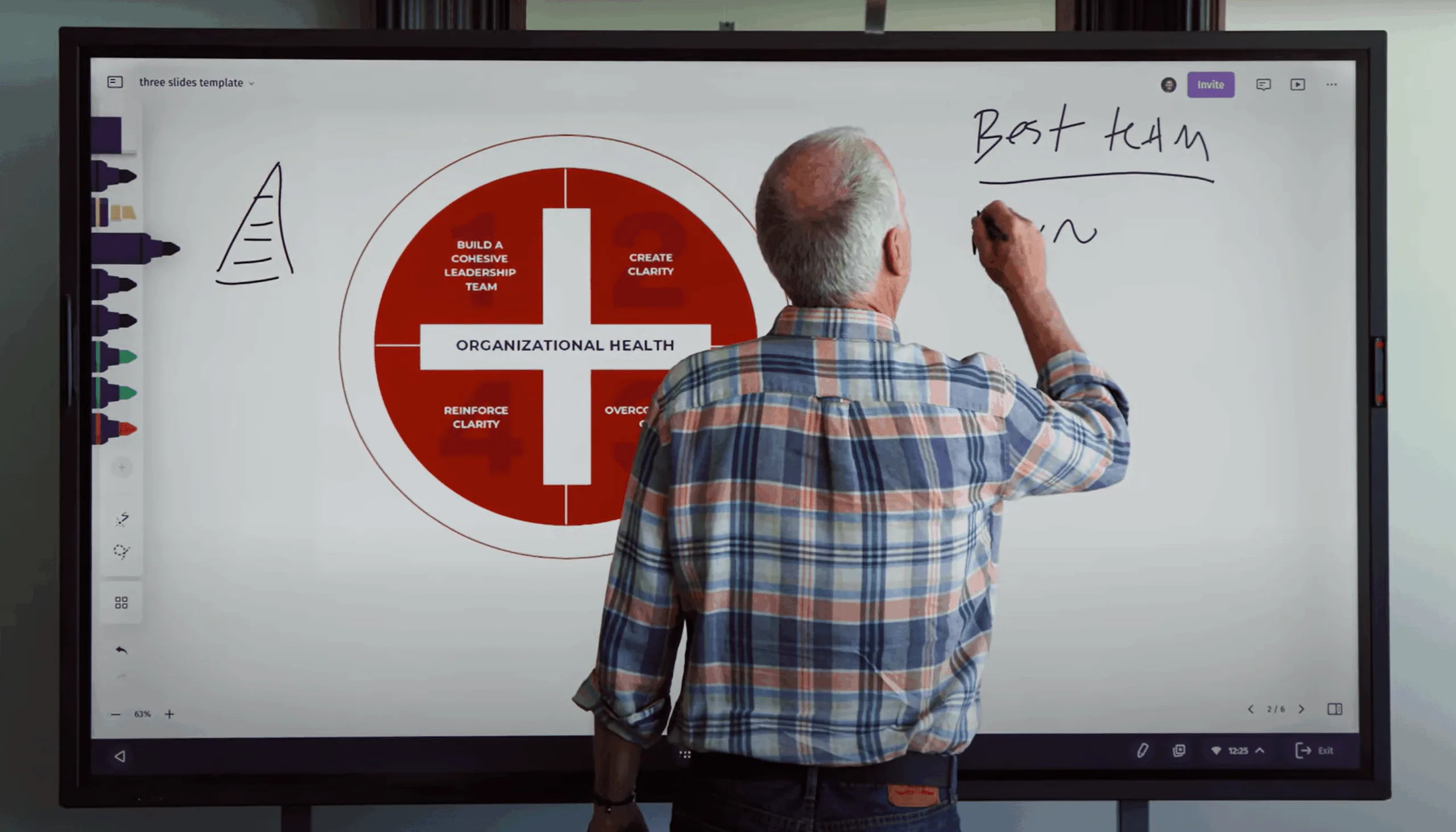
For teams that want to take this further, a shared digital canvas can make the parallel work visible and interactive. Vibe Board S1 supports screen sharing and co-annotation across remote participants, so a body-doubling session can shift naturally into a whiteboard brainstorm when the moment calls for it.
 Hybrid meetings on Vibe Board
4. Join a Virtual Book Club or Interest Community
Shared interests create the most durable online friendships because the relationship doesn’t depend on scheduling a call to catch up — the community pulls people back naturally. A book club, a crafting group, a language exchange, or a subreddit with a regular weekly thread all create recurring contact without the social pressure of a one-on-one call.
If you can’t find a community that fits, starting one is easier than it sounds. A Discord server, a Slack workspace, or even a group text can support a small book club. Assign someone to choose the next title, set a two-week reading window, and meet over video for an hour. It scales from two people to twenty without much extra infrastructure.
Platforms like Goodreads Groups already have thousands of active book clubs across every genre — a useful starting point if you’re looking for an existing community rather than building from scratch.
5. Replace the Occasional Text with a Phone Call
This sounds counterintuitive in an era of voice notes and video calls, but an old-fashioned phone call is one of the most efficient ways to deepen a friendship online. Research from the University of Texas at Austin found that people consistently underestimate how much they’ll enjoy reconnecting with someone by phone — and how much the other person will appreciate it.
The advantage of audio-only is that it’s lower stakes than video. You don’t need to be camera-ready. You can call during a walk, while cooking, or sitting on the back porch. The informality often leads to longer, more meandering conversations — the kind that actually build closeness rather than checking a box.
If video call fatigue is a factor (and for many remote workers, it is), audio-first can feel like a relief for both parties.
6. Try Online Dating or Interest-Based Social Apps
Meeting new people online has matured well beyond the early-internet awkwardness. Dating apps are the obvious entry point if you’re single, but the more interesting growth has been in apps designed specifically for friendship and shared-interest connection.
Apps like Bumble BFF are designed for platonic friendship matching. Meetup connects people around specific activities — hiking, coding, language learning, board games — in both in-person and virtual formats. For niche interests, Discord has become the de facto home for tight-knit online communities around almost anything.
The principle here is the same as offline socializing: showing up consistently in the same place around shared interests is what converts an acquaintance into a friend. One conversation rarely does it. Regular presence in the same community does.
7. Collaborate on a Creative Project
Joint creative work — a podcast, a shared blog, a songwriting project, a co-written story — gives an online friendship a shape and a purpose. It creates natural check-ins ("did you finish your section?"), moments of genuine contribution, and something to show for the relationship.
Even an informal creative pairing works. Two people who both sketch can share weekly drawings. Two people who both write can swap chapters or first drafts. The creative output matters less than the structure it provides: a reason to show up and keep communicating.
For teams and colleagues, collaborative tools make this more fluid. An interactive digital canvas lets distributed collaborators sketch, annotate, and build on each other’s ideas in real time without the friction of emailing files back and forth.
Start Building Your Online Social Life
Socializing online doesn’t require special tools or a major time investment. It requires a little intentionality: a standing game night, a book club that actually meets, a phone call instead of a text. The medium adapts to wherever you are — what stays constant is the need for regular, genuine contact with people you care about.
For teams that collaborate remotely, the same principles apply: shared tools that make presence visible and interaction easy are the infrastructure for a connected team. Explore the Vibe blog for more on remote collaboration, digital tools, and building a working environment that keeps people connected.
Frequently Asked Questions
How do you socialize online effectively?
The most effective online socializing is built on consistency and shared activity rather than one-off calls. Regular touchpoints — a weekly game session, a monthly book club, a recurring watch party — create the repeated contact that turns acquaintances into friends. Having something to do together (a game, a show, a creative project) takes pressure off conversation and makes the interaction feel natural.
What are the best apps for socializing online?
It depends on what you’re looking for. For existing friends: Discord, FaceTime, and Zoom work well for voice and video. For watch parties: Teleparty (Netflix, Disney+, HBO) and Amazon Watch Party. For meeting new people: Bumble BFF for friendship matching, Meetup for interest-based groups, and Discord servers for niche communities. For co-gaming: Steam, Xbox Game Pass, and Nintendo Switch Online all support multiplayer across many games.
How do remote workers stay socially connected?
Remote workers who stay socially connected tend to combine two strategies: maintaining existing relationships through regular scheduled contact (calls, game nights, virtual coffee chats), and building new connections through interest-based communities outside of work. Research from Gallup’s 2025 State of the Global Workplace report found that 25% of fully remote workers feel lonely on any given day — making proactive social habits more important for remote workers than for on-site employees.
Is online socializing as meaningful as in-person socializing?
For maintaining close relationships, online socializing is highly effective — especially when it involves shared activity, regular cadence, and video or voice contact. Research consistently shows that it’s the quality and frequency of interaction that drives closeness, not the medium. For meeting entirely new people, in-person settings still have an advantage, but interest-based online communities can produce genuine, lasting friendships when participants show up consistently over time.
What is "body doubling" and does it work for remote workers?
Body doubling is the practice of working in the presence of another person — not collaborating, just being present in the same space while each person works independently. For remote workers, this typically means a video call where both parties work on separate tasks, checking in briefly at the start and end. Research in behavioral science supports its effectiveness for focus and reducing isolation; many remote workers report that a standing weekly body-doubling session is one of their most valuable social habits.
How can I make friends online as an adult?
Making friends online as an adult follows the same rules as offline: repeated contact around shared interests over time. The most reliable method is finding a community built around something you already care about — a game, a genre of books, a skill you’re learning, a creative hobby — and showing up consistently. Interest-based platforms like Discord, Meetup, and Goodreads Groups lower the barrier to entry significantly by giving you an immediate shared context for conversation.