
Yes, you can record telephone calls on an iPhone. But whether doing so is legal depends on where you are, where the person you’re calling is, and whether you’ve told them the call is being recorded.
That distinction matters. In some US states, recording without notifying the other party is a misdemeanor. In others, it can rise to a felony. Getting it wrong doesn’t just create legal exposure—it can also make the recording itself inadmissible as evidence, which defeats the entire purpose.
This article focuses on the legal side: what US federal law says, which states impose stricter standards, how iPhone’s native recording feature handles compliance by design, and what the rules look like internationally. If you’re looking for a step-by-step walkthrough of every recording method available on iPhone in 2026, see our complete guide to recording phone calls on iPhone.
The Short Answer
Recording a phone call on iPhone is legal in the United States if at least one party to the conversation consents—and that party can be you. This is the federal baseline under the Electronic Communications Privacy Act (ECPA).
The complication: approximately a dozen US states require every party on the call to be informed and consent before recording begins. If you’re in California calling someone in Florida, both states’ rules come into play—and the stricter standard wins.
Apple’s built-in iOS call recording feature was designed with this in mind. Every time you start a recording, an automated voice announces to all parties: "This call will be recorded." That announcement cannot be disabled. It’s not a bug or an inconvenience—it’s the mechanism that keeps iOS recording legally defensible across every US jurisdiction.
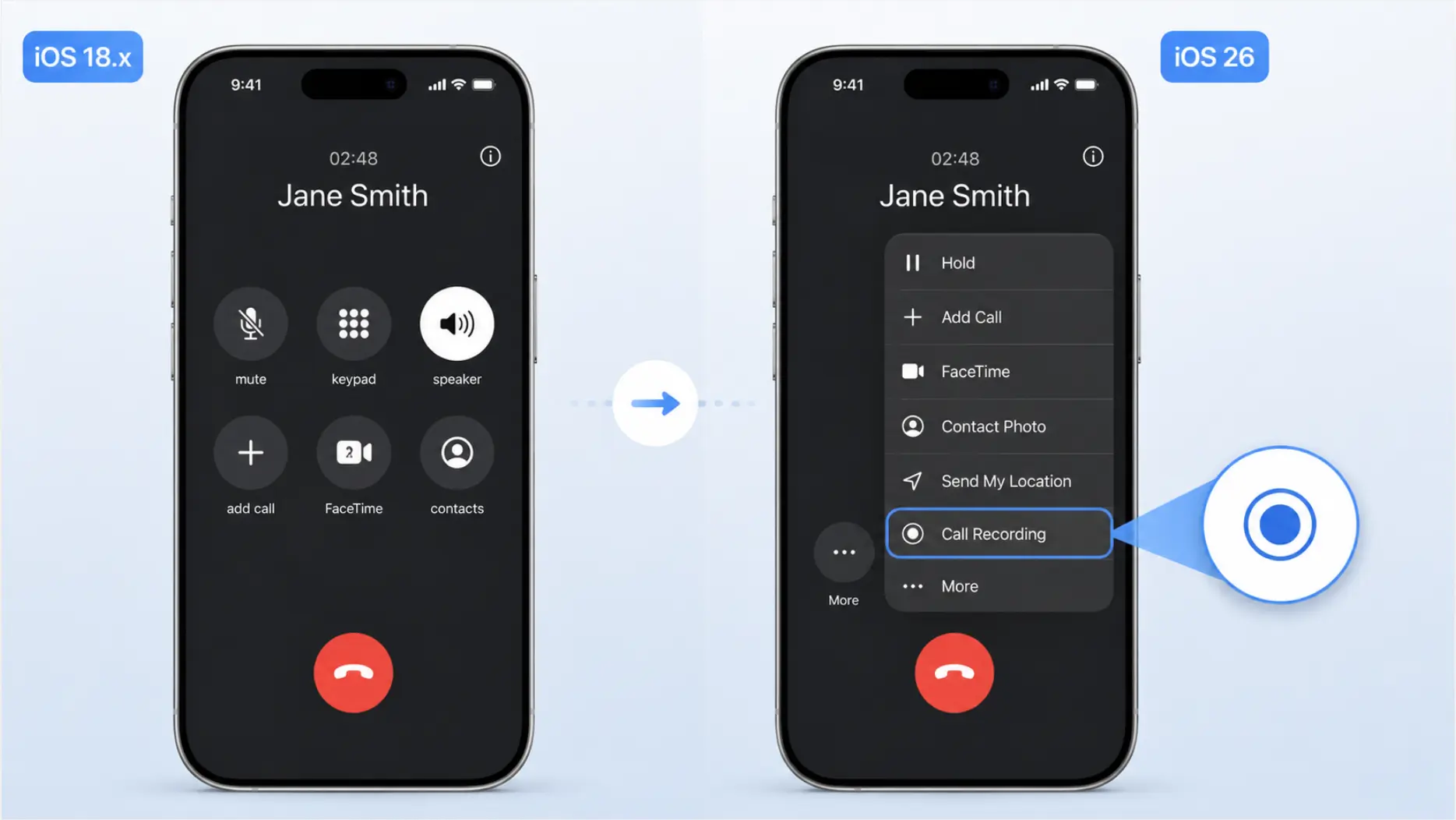 How to record phone calls on iPhone of different iOS versions
US Federal Law: The ECPA Baseline
The foundation of US call recording law is the Electronic Communications Privacy Act (ECPA), specifically the Wiretap Act (18 U.S.C. § 2511). Under ECPA, intercepting a phone call without the consent of at least one party is a federal crime. Since you are a participant in the call, your own decision to record it satisfies the one-party consent requirement.
What ECPA does not do is permit you to record calls you’re not participating in. Recording a call between two other people—without being part of the conversation—remains illegal under federal law regardless of which state you’re in.
States cannot pass laws that are more permissive than ECPA. They can, however, make recording laws stricter—and a significant number have done exactly that.
One-Party vs. All-Party Consent States
The US is divided into two categories. Understanding which one applies to your situation is the most important compliance step before you record any call.
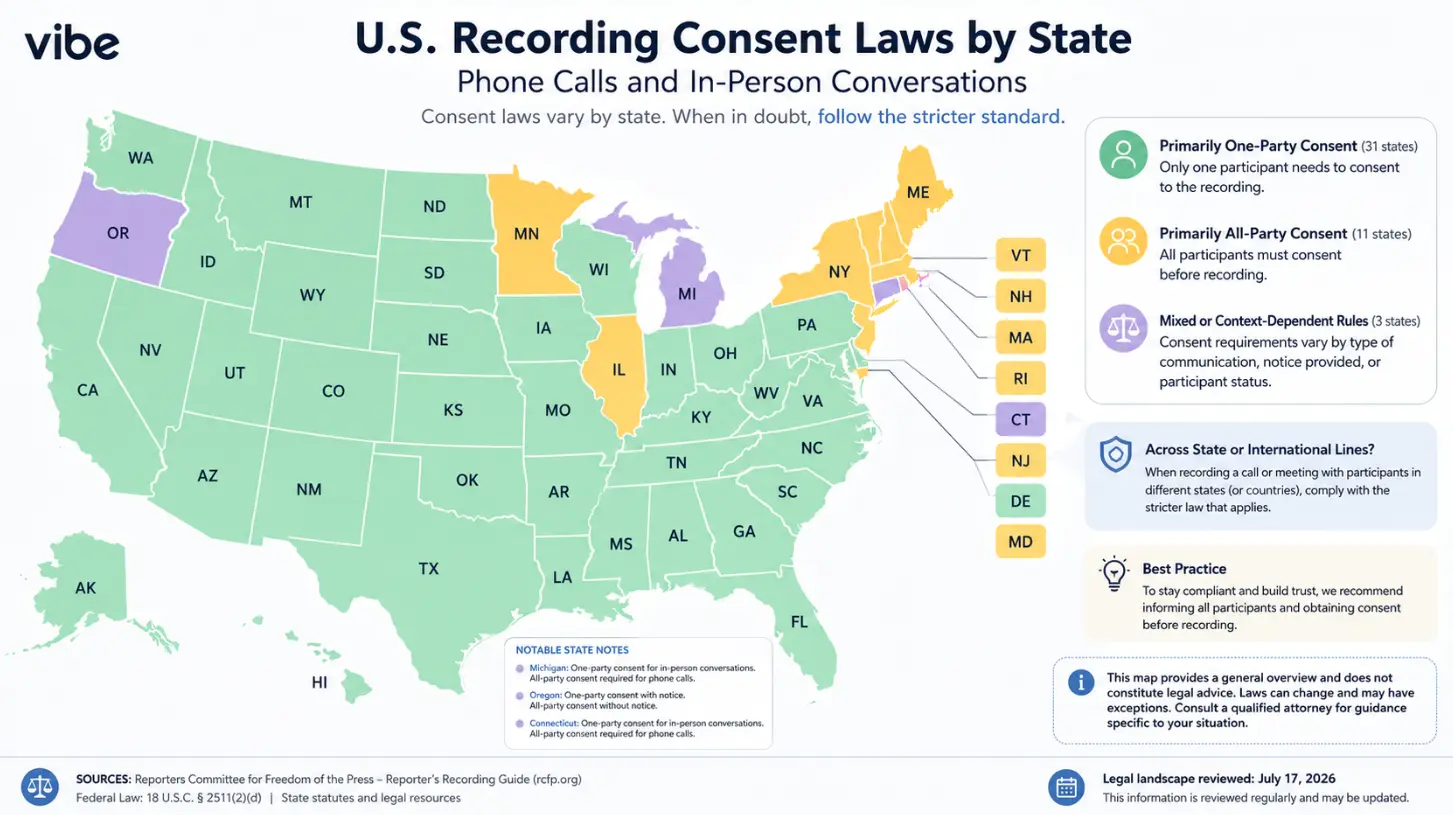 U.S. recording consent laws by state
One-Party Consent States (38 States + DC)
In these jurisdictions, only one participant in the conversation needs to consent to the recording. Since you are a participant, your own knowledge that you’re recording is sufficient. You are not legally required to notify the other party.
One-party consent states include: Alabama, Alaska, Arizona, Arkansas, Colorado, DC, Georgia, Idaho, Indiana, Iowa, Kansas, Kentucky, Louisiana, Maine, Minnesota, Mississippi, Missouri, Nebraska, New Jersey, New Mexico, New York, North Carolina, North Dakota, Ohio, Oklahoma, Rhode Island, South Carolina, South Dakota, Tennessee, Texas, Utah, Virginia, West Virginia, Wisconsin, and Wyoming, among others.
Important caveat: Even in one-party consent states, announcing the recording is considered best practice—particularly for business calls. It builds trust, reduces disputes, and protects you if the call crosses into an all-party state.
All-Party Consent States (12 States)
These states require every person on the call to be informed that recording is taking place before it begins. Consent is typically satisfied by an audible announcement at the start of the call; staying on the line after hearing the announcement is generally treated as implied consent.
As of 2026, the all-party consent states are:
|
State |
Key Notes |
|---|---|
|
California |
Strictest enforcement. Violation is a misdemeanor under Penal Code § 632. Civil penalties up to $5,000 per violation. |
|
Connecticut |
All-party consent required for phone calls. |
|
Delaware |
All-party consent required. |
|
Florida |
Felony exposure for intentional violations. |
|
Illinois |
All-party; significant for Chicago-based business calls. |
|
Maryland |
All-party consent required. |
|
Massachusetts |
One of the strictest in practice; criminal charges are possible. |
|
Montana |
All-party consent required. |
|
Nevada |
All-party consent required. |
|
New Hampshire |
All-party consent required. |
|
Pennsylvania |
All-party consent required. |
|
Washington |
All-party consent required. |
Michigan occupies a gray zone due to conflicting court interpretations. The conservative and recommended approach is to treat it as an all-party state until the law is clarified.
For a full breakdown of every state’s statute, citation, and penalty structure, see our complete US call recording consent laws guide.
The Interstate Call Problem
This is where most recording compliance mistakes happen.
When a phone call crosses state lines, the stricter state’s law applies. If you’re in Texas (one-party) calling a customer in California (all-party), California’s all-party requirement governs the recording. You must announce the recording before it begins.
The same logic applies in reverse: a caller in Florida (all-party) reaching you in New York (one-party) means Florida’s stricter standard controls.
For businesses that make or receive calls across multiple states, the safest operational policy is to treat every call as if it originates in an all-party consent state. This means a standard announcement at the start of every recorded call—regardless of where either party is located.
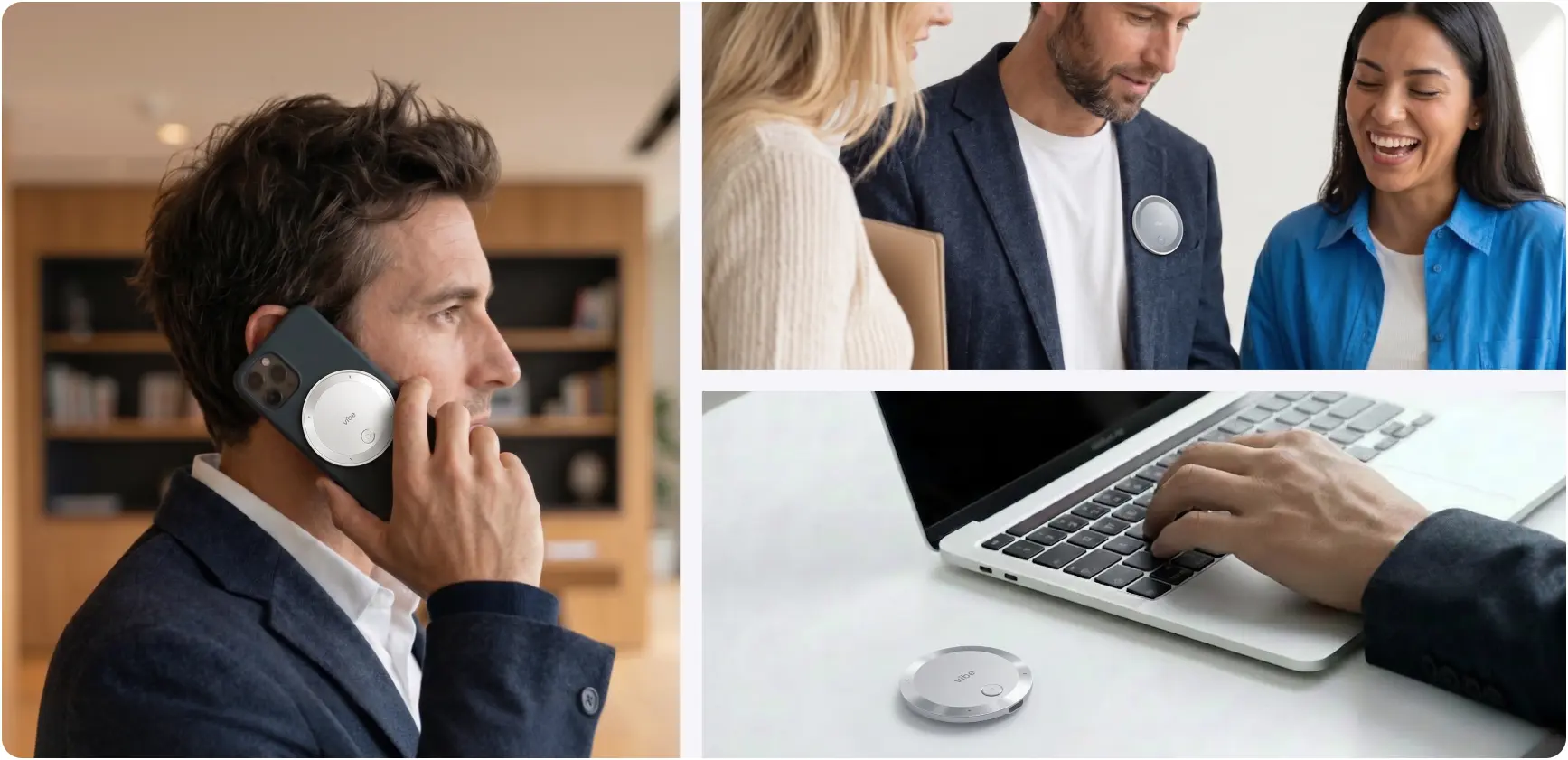 Vibe Dot used for phone call recording legally
Universal script that covers every US jurisdiction:
"Just a heads up—I’m going to record this call for my notes. Is that okay with you?"
One sentence. Verbal confirmation from the other party. Fully compliant in all 50 states.
How iPhone’s Built-In Recording Handles Compliance
Apple introduced native call recording with iOS 18.1 in October 2024. The design reflects a deliberate compliance choice: every time a recording starts, an automated announcement plays to all parties. It cannot be muted, skipped, or disabled.
This is not a limitation—it’s the feature. The mandatory announcement is what makes iOS call recording legally defensible in all-party consent states without requiring the user to remember to say anything. The system handles it automatically.
What this means in practice:
-
You cannot silently record a call using iOS native recording.
-
The other party always knows the call is being recorded.
-
This satisfies all-party consent requirements in every US state where Apple’s native recording is available.
iOS 26 moved the recording button from the top-left of the call screen to inside the More menu, but the announcement requirement remains unchanged.
Availability note: Apple’s native call recording is only available in regions where its mandatory dual-announcement system complies with local law. As of mid-2026, it is available in the US, Canada, UK, and Australia—but not in the EU or a number of other countries due to stricter local privacy regulations.
For the full how-to walkthrough—including third-party apps, Google Voice, and hardware recorders for unsupported regions—see our complete iPhone call recording guide.
International Rules: A Quick Reference
If you’re recording calls with parties outside the US, the legal framework shifts significantly.
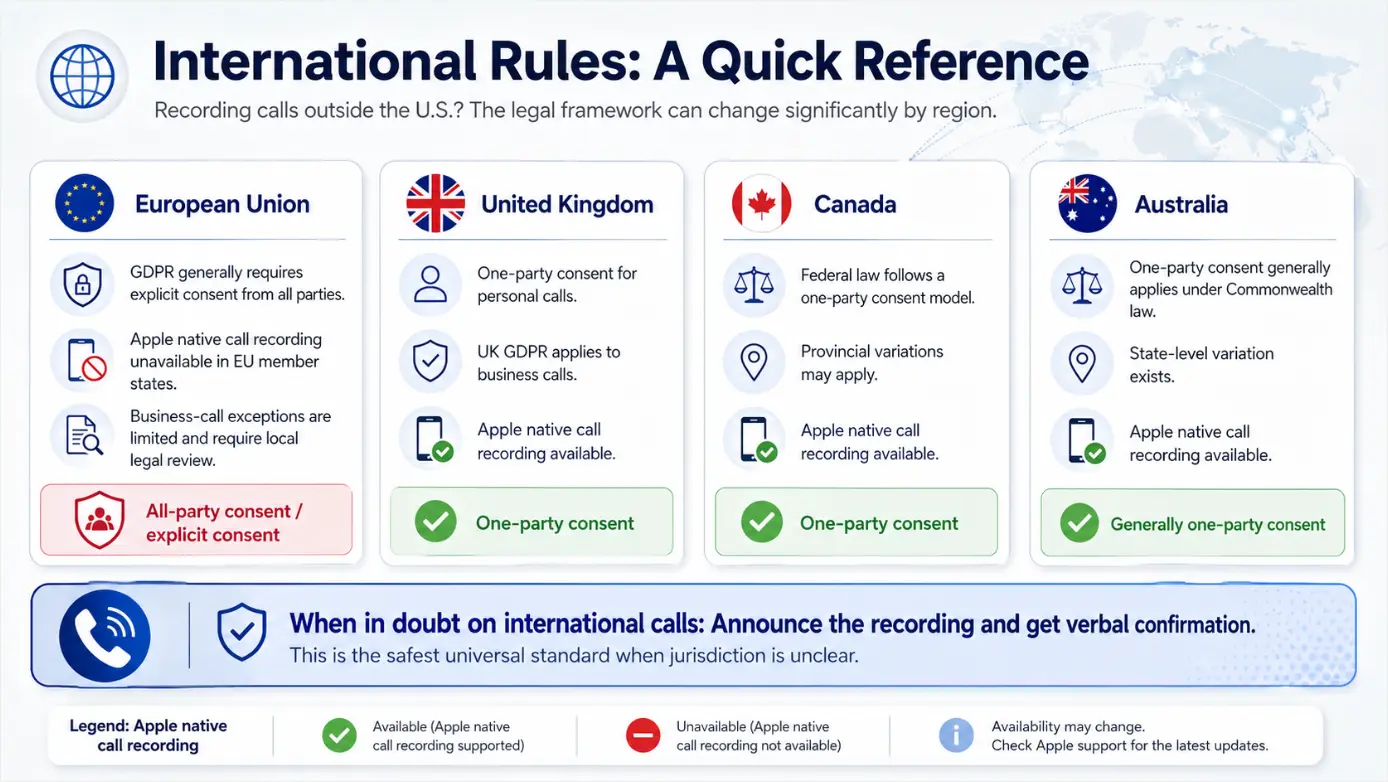 International rules on call recording
European Union: GDPR generally requires explicit consent from all parties before a personal phone call can be recorded. Apple’s native recording is unavailable in all EU member states for this reason. Business calls have limited exceptions depending on purpose and data handling, but these are narrow and require local legal review.
United Kingdom: One-party consent applies for personal calls. UK GDPR applies to business calls. Apple’s native recording is available in the UK.
Canada: Federal law (PIPEDA) follows a one-party consent model, though provincial variations exist. Apple’s native recording is available in Canada.
Australia: One-party consent generally applies under Commonwealth law, with state-level variation. Apple’s native recording is available in Australia.
When in doubt on international calls: Announce the recording and get verbal confirmation. This is the universally accepted standard regardless of local law, and it eliminates ambiguity on calls where jurisdiction is unclear.
Best Practices for Staying Compliant
Regardless of which state you’re in or which recording method you use, these practices protect you in every situation:
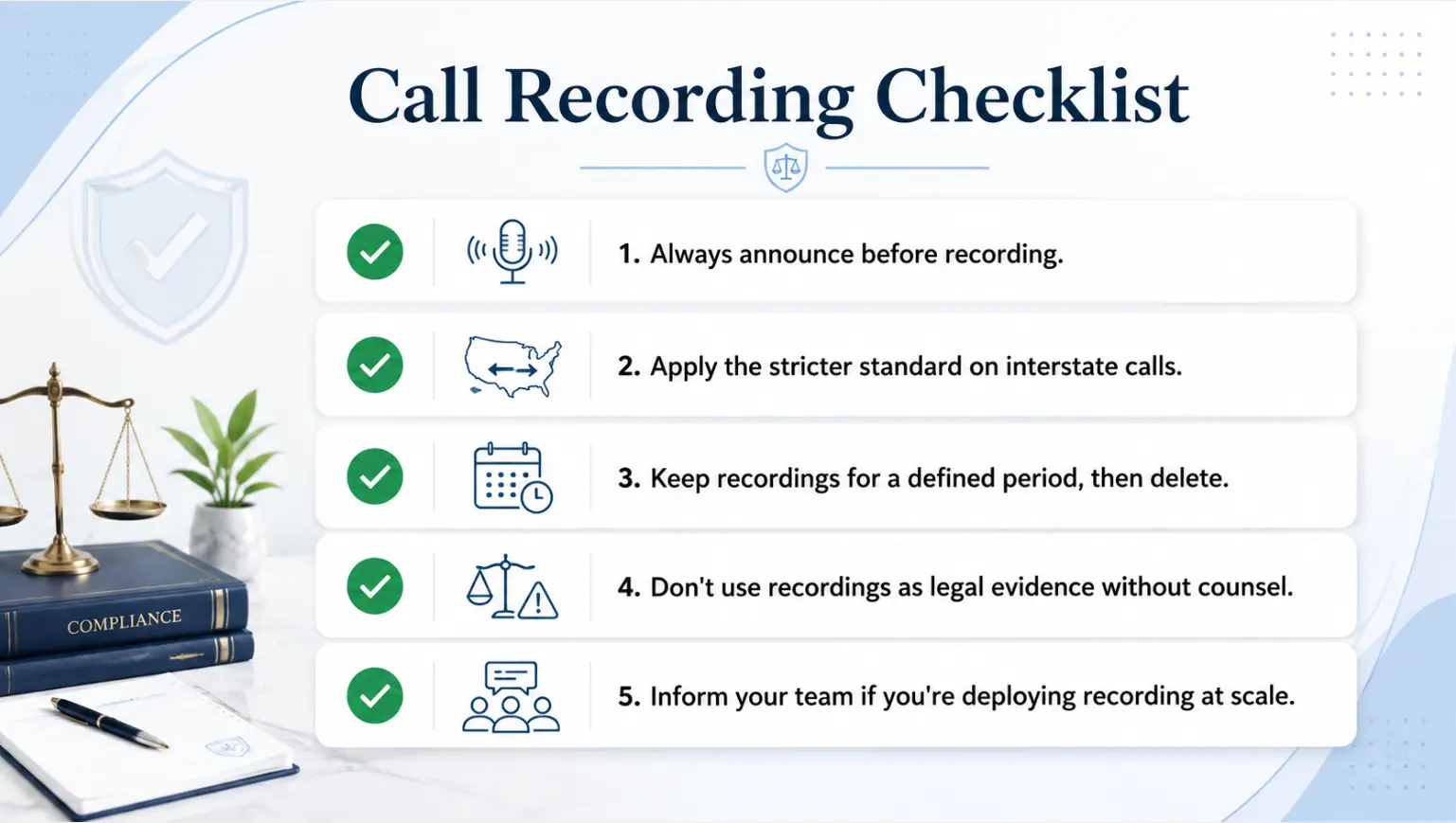 Call recording checklist
1. Always announce before recording. Even in one-party states, a brief "I’m recording this call" takes three seconds and eliminates any legal gray area. iOS does this automatically; with third-party apps or hardware recorders, it’s your responsibility.
2. Apply the stricter standard on interstate calls. When you don’t know where the other party is located—common in sales, customer service, or media contexts—default to all-party consent practices.
3. Keep recordings for a defined period, then delete. Storing recordings indefinitely increases exposure under state privacy laws and, for business contexts, HIPAA and CCPA. Establish a retention policy.
4. Don’t use recordings as legal evidence without counsel. A recording is only admissible if it was obtained lawfully in the relevant jurisdiction. Consult an attorney before relying on any recording in a legal proceeding.
5. Inform your team if you’re deploying recording at scale. For businesses using call recording across a sales or support team, a written policy covering which calls are recorded, how recordings are stored, and who has access is both a compliance safeguard and an employee protection.
The Bottom Line
Recording phone calls on iPhone is straightforward from a technical standpoint. The legal side requires more care—but it’s not complicated once you understand the two-tier framework: federal one-party baseline, with about a dozen states requiring all-party consent.
The safest habit, regardless of where you are: announce the recording at the start of every call. Apple’s iOS native recording does this automatically. If you’re using another method, a single sentence covers you in every jurisdiction.
For a full breakdown of every state’s specific statute and penalty structure, see our complete US call recording laws guide. For a step-by-step walkthrough of every recording method available on iPhone in 2026—including iOS 26, third-party apps, and AI wearables—see our complete iPhone call recording guide.
FAQs
Is it illegal to record a phone call without telling the other person?
It depends on your state. In one-party consent states, recording without notifying the other party is legal as long as you’re a participant in the call. In all-party consent states—including California, Florida, Illinois, and Washington—failing to notify the other party before recording is a violation of state law, with penalties ranging from civil fines to criminal charges.
Does iPhone’s recording feature automatically make me compliant?
In supported regions, yes—because the system plays an automated announcement to all parties. That announcement satisfies the notification requirement for all-party consent states. If you’re using a third-party app or hardware recorder that does not play an automatic announcement, compliance is your responsibility.
What happens if I record a call illegally?
Beyond potential criminal and civil liability, recordings made in violation of consent laws are typically inadmissible as evidence. In California, each illegal recording can result in a civil penalty of up to $5,000. In Florida, intentional violations can be charged as a felony.
Can I record calls for business purposes without notifying customers?
Only in one-party consent states, and only if the call stays within that state’s jurisdiction. Most businesses—particularly those operating across multiple states—use an automated disclosure ("this call may be recorded for quality assurance") at the start of every call, which satisfies all-party consent requirements through implied consent.
Does recording affect call quality on iPhone?
iOS native recording processes audio on-device and does not measurably impact call quality. Third-party apps that use a three-way call workaround can occasionally affect audio clarity depending on signal strength.
This article is for informational purposes only and does not constitute legal advice. Call recording laws change and vary by jurisdiction. Consult a licensed attorney before making recording decisions with significant legal implications.