
Picture this scenario: a consultant steps out of a client meeting, pulls a small device from her lapel, and taps a button. Within minutes, the conversation she just captured appears as searchable text with speaker labels and a summary of action items. This is how modern listening devices work: capturing spoken audio and converting it into information professionals can actually use.
Listening devices now span five distinct categories, each with different capabilities, form factors, and ideal use cases. Understanding these categories, the legal framework around recording, and how AI has changed what these devices can do is essential for anyone whose work depends on accurate conversation capture.
- Listening devices span five categories: traditional recorders, wearable AI recorders, desk recorders, room conferencing devices, and software-only tools
- 11 US states require all-party consent for recording; federal law requires only one-party consent
- AI recorders add transcription, speaker identification, summaries, and action items — traditional recorders only store audio
- Regulated industries (healthcare, legal, government, education) need HIPAA, NDAA, or FERPA compliance — most consumer devices do not qualify
- Choosing the right device type depends on where the conversation happens, compliance requirements, and whether the output is individual or team-shared
What Is a Listening Device?
A listening device is any hardware or software tool that captures, records, and processes spoken audio for later retrieval, transcription, or analysis. The category extends far beyond surveillance equipment. It includes consumer electronics, wearable AI tools, professional recording hardware, and cloud-based meeting software.
The global AI speech-to-text tool market reached $3.87 billion in 2026 and is projected to expand to $16.42 billion by 2035 at a 17.41% compound annual growth rate, according to Precedence Research. This growth signals how rapidly audio capture has moved from simple recording to intelligent processing.
The term "listening device" encompasses everything from a basic handheld voice recorder to a multi-microphone conference room system that identifies speakers and generates meeting summaries. The common thread is capturing spoken language. However, the capabilities layered on top of that capture vary dramatically by device type.
The Five Types of Listening Devices
Listening devices split into five distinct categories, each with a different form factor, optimal context, and capability ceiling. Picking the wrong category for a given context is the most common and most costly mistake buyers make.
|
Type |
Form Factor |
AI Features |
Best For |
Compliance Ready |
|---|---|---|---|---|
|
Traditional Voice Recorder |
Handheld, pocket-sized |
None, audio storage only |
Lectures, dictation, interviews |
Generally no |
|
Wearable AI Recorder |
Clips to clothing or phone case |
Transcription, summaries, speaker ID |
Off-calendar meetings, field work |
Some models (HIPAA, SOC 2) |
|
Desk Recorder |
Fixed position on desk or table |
Call recording, transcription |
Phone calls, small meetings |
Some models |
|
Room Conferencing Device |
Multi-mic array, room-mounted |
Speaker diarization, room-wide capture |
Hybrid meetings, conference rooms |
Yes (enterprise models) |
|
Software-Only Tool |
Virtual bot, no hardware |
Transcription, limited summaries |
Virtual calls only |
Varies by vendor |
Each type serves a different primary context. For example, a wearable AI recorder travels with the user and captures conversations outside the conference room, coffee shops, client sites, hospital rounds. In contrast, a room conferencing device stays fixed in a meeting space and captures everyone in the room equally. Software-only tools join virtual calls and video conferencing sessions but cannot capture in-person conversations.
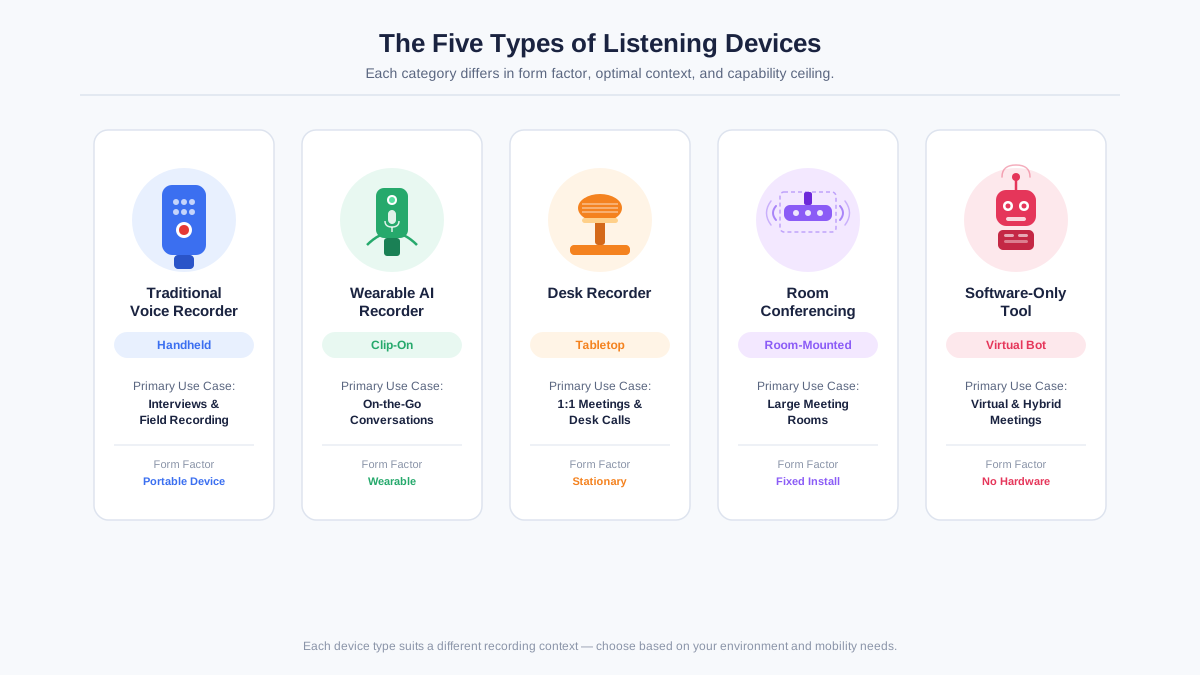 Comparison diagram showing five types of listening devices with form factors and use cases
The digital voice recorder market alone reached $2.4 billion in 2025 and is projected to grow at 11.5% annually through 2035, according to Future Market Insights. But traditional recorders represent only one category. The broader listening device category includes AI-powered tools that process audio in real time.
Traditional voice recorders store audio files. AI listening devices transform those files into structured data, transcripts, speaker labels, summaries, and action items. The difference is not incremental. It is categorical.
Common Use Cases for Listening Devices
The dominant professional use cases for listening devices include hybrid meeting capture, healthcare documentation, legal proceedings, sales coaching, and field work. Each use case has different accuracy, portability, and compliance requirements that map to different device types.
Healthcare workers spend considerable time on documentation. The American Medical Association analyzed Electronic Health Record (EHR) use across more than 200,000 physicians and found that physicians spend an average of 5.8 hours in the EHR for every eight hours of scheduled patient time, according to a review published by clinical documentation researchers. That ratio leaves limited time for direct patient care.
Peer-reviewed evidence documents the impact. A 2025 qualitative study published in JAMA Network Open (Shah et al.) found physicians report that ambient AI scribes reduce after-hours documentation and improve patient engagement during visits. A 2026 study of 1,800 clinicians across five academic medical centers found AI ambient scribes saved 16 minutes of documentation time per eight-hour patient care shift, according to STAT News.
This is not incidental paperwork. It is time clinicians could spend with patients.
The burnout connection is direct. In 2024, 43.2% of physicians reported experiencing burnout symptoms, with documentation burden cited as a leading cause, according to the American Medical Association and athenahealth Physician Sentiment Survey. AI-powered listening devices designed for clinical contexts can help reduce this burden by capturing patient encounters and generating draft notes.
Legal professionals face different pressures. Remote depositions have become standard practice: 44% of legal professionals expect their use to increase in 2026, up from 34% in 2024, according to a US Legal Support 2026 Litigation Trends Survey. Remote proceedings require reliable audio capture, clear transcription, and chain-of-custody documentation.
Knowledge workers across industries spend substantial time in meetings. The Microsoft Work Trend Index found that knowledge workers averaged 15 to 17 hours per week in meetings in 2025. Capturing those meetings accurately means the difference between acting on commitments and losing them.
Sales teams use listening devices for coaching and compliance. Recording sales calls lets managers review specific conversations, identify coaching opportunities, and surface patterns across hundreds of calls that are invisible when relying on rep notes alone. For client-facing teams specifically, recorded conversations pair with client communication tools to create a complete follow-up workflow. In regulated financial services, call recording is often a compliance mandate rather than an option, and recorded conversations may need to be stored for defined periods under FINRA and SEC rules.
Field workers, consultants, site inspectors, and field service technicians operate outside traditional office environments. A wearable AI recorder that clips to clothing and captures conversations hands-free serves contexts where holding a phone or sitting at a desk is impractical.
Is It Legal to Use a Listening Device?
Recording laws vary by jurisdiction and catch many professionals off guard. Under US federal law (18 U.S.C. § 2511), recording a conversation requires only one-party consent, meaning the person doing the recording may consent for themselves. But 11 states require all-party consent, meaning every participant must be informed and agree to the recording.
The 11 all-party consent states are California, Delaware, Florida, Illinois, Maryland, Massachusetts, Montana, Nevada, New Hampshire, Pennsylvania, and Washington. The Reporters Committee for Freedom of the Press Recording Guide provides state-by-state guidance on applicable laws. Recording in those states without informing all participants is a criminal offense.
|
State |
Consent Requirement |
|---|---|
|
California |
All-party |
|
Delaware |
All-party |
|
Florida |
All-party |
|
Illinois |
All-party |
|
Maryland |
All-party |
|
Massachusetts |
All-party |
|
Montana |
All-party |
|
Nevada |
All-party |
|
New Hampshire |
All-party |
|
Pennsylvania |
All-party |
|
Washington |
All-party |
The European Union adds another layer. Under GDPR, recording conversations requires explicit consent, and the recorded data is subject to data protection requirements including the right to erasure. Organizations operating across borders must navigate multiple legal frameworks simultaneously.
Additionally, workplace policies often impose requirements beyond minimum legal standards. Many employers require employees to notify counterparties before recording, even in one-party consent states. Internal policies may also govern where recordings can be stored, how long they can be retained, and who can access them.
The baseline best practice for professional recording is straightforward: notify participants, obtain consent where required, and maintain clear documentation of permission. This protects both the recorder and the organization.
Listening Devices in Regulated Industries
Regulated industries face requirements beyond basic consent that eliminate most consumer-grade devices from consideration. Specifically, healthcare, legal, government, and education teams need devices with HIPAA, NDAA, FERPA, or SOC 2 coverage. Most consumer devices do not have it.
Healthcare data carries particular risk. The average US healthcare data breach cost $7.42 million in 2025, the highest of any sector for the 14th consecutive year, according to IBM’s Cost of a Data Breach Report. For healthcare teams deploying listening devices, HIPAA compliance and a signed Business Associate Agreement are not optional features. They are baseline requirements.
Ransomware compounds the threat. Healthcare organizations reported 770 HIPAA breaches in 2025, the highest annual total on record, with ransomware now driving 48% of all confirmed breaches, according to the Total Assure Healthcare Cybersecurity Report 2026. Audio recordings of patient encounters are protected health information. Storing them on non-compliant devices or platforms creates vulnerability.
For US government procurement, the National Defense Authorization Act (NDAA) restricts certain telecommunications and video surveillance equipment. Federal agencies and contractors must verify that listening devices do not contain components from prohibited manufacturers. Most consumer devices lack this certification.
Education institutions face FERPA requirements for student records. A listening device used in a classroom or counseling session may capture FERPA-protected information. Device selection must therefore account for these restrictions.
SOC 2 certification indicates that a vendor’s security controls have been audited against trust service criteria. For enterprise buyers in any industry, SOC 2 provides third-party validation of data handling practices. However, consumer-grade listening devices rarely carry this certification.
The compliance filtering process is simple: identify the applicable regulatory framework, verify that a device and its cloud platform meet those requirements, and confirm that signed agreements (such as HIPAA Business Associate Agreements) are available. If any element is missing, the device is unsuitable for regulated use.
The AI Upgrade: From Recording to Intelligence
AI listening devices are categorically different from traditional recorders. Specifically, transcription, speaker identification, structured summaries, action items, and persistent team memory are capabilities that traditional voice recorders never had. Together, these features change what "listening device" means for professional work.
The key capability shift is from audio storage to structured data. A traditional recorder captures a waveform file. An AI listening device, meanwhile, captures a meeting transcript, identifies who said what, extracts commitments and deadlines, and surfaces that information when it becomes relevant.
Accuracy varies by context. A 2025 systematic review published in BMC Medical Informatics and Decision Making found AI speech recognition word error rates ranging from 8.7% in controlled single-speaker dictation to above 50% in conversational multi-speaker settings. Wearable AI recorders operate in the harder half of that range. Microphone array quality is the strongest hardware predictor of real-world accuracy.
The gap between 8.7% and 50%+ word error rates represents the difference between a transcript that is usable and one that requires extensive manual correction. Hardware quality matters more than AI model marketing claims.
The efficiency gains are measurable. A 2025 working paper examining Generative AI’s impact on task turnaround found reductions of 80% to 90% in completion time for AI-assisted work broadly; teams deploying AI listening devices for meeting documentation report similar gains in downstream note-processing time.
Speaker diarization, the ability to attribute statements to individual speakers, is particularly valuable in meetings. Knowing that "someone said we need to follow up by Friday" is less useful than knowing "the project manager said the team needs to follow up by Friday." AI listening devices with multi-microphone arrays and speaker identification create this separation.
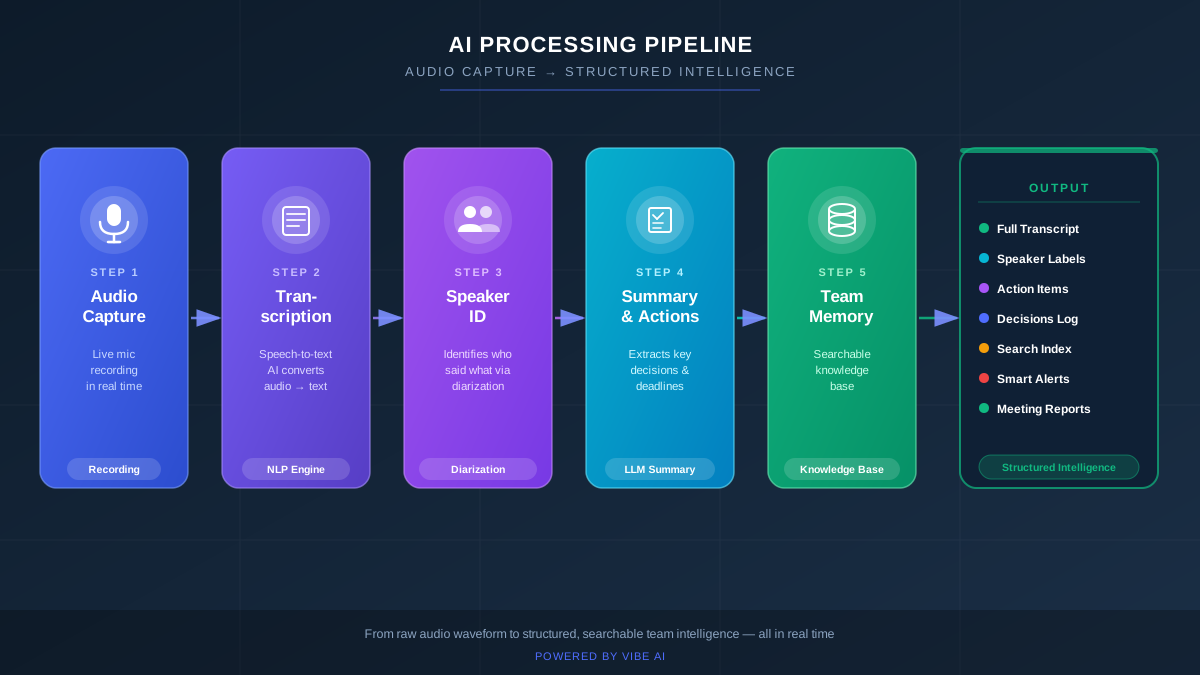 Diagram showing AI processing pipeline: audio capture, transcription, speaker identification, summarization, and team memory
Summarization adds another layer. Professionals who attend 15 to 17 hours of meetings weekly cannot re-watch every recording. AI-generated summaries surface key decisions and action items without requiring full playback. For a broader look at how AI tools handle meeting capture and workflow automation, see the comparison of AI productivity tools for hybrid teams.
The final shift is from session-level capture to persistent team memory. Most AI recorders transcribe a meeting and deliver a summary. However, some systems feed that information into a searchable knowledge base where past conversations become reference material for future work.
Listening Devices for Professional Teams
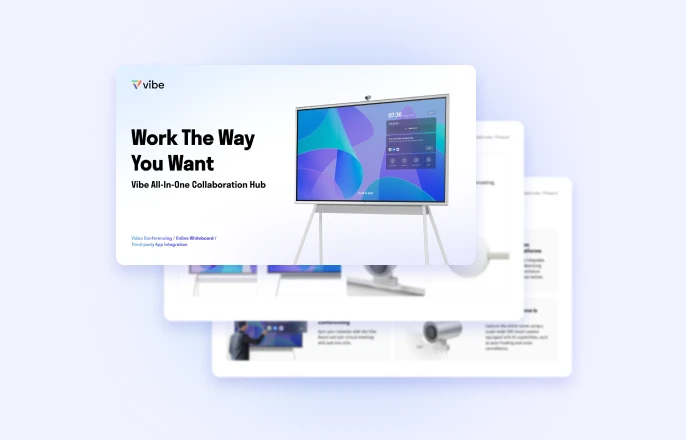
Vibe Dot and Vibe Bot address the two contexts where AI recording adds the most value: off-calendar conversations and hybrid conference rooms. The difference between a device that records and a device that builds team intelligence is what happens after the recording ends.
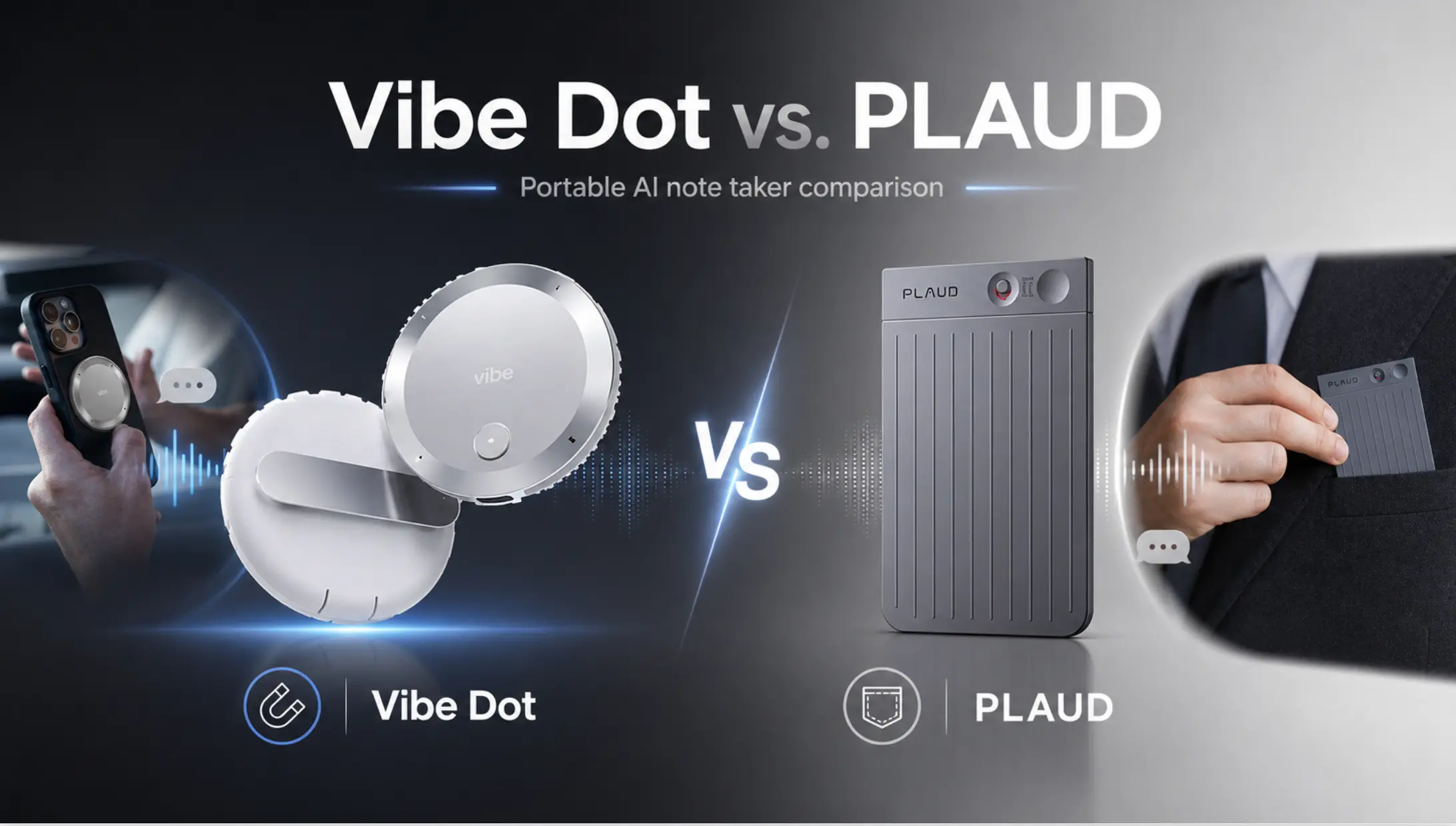
Vibe Dot is a wearable AI recorder priced at $199. It clips to clothing or a phone case and captures conversations with a five-microphone array designed for noise rejection in real-world environments.
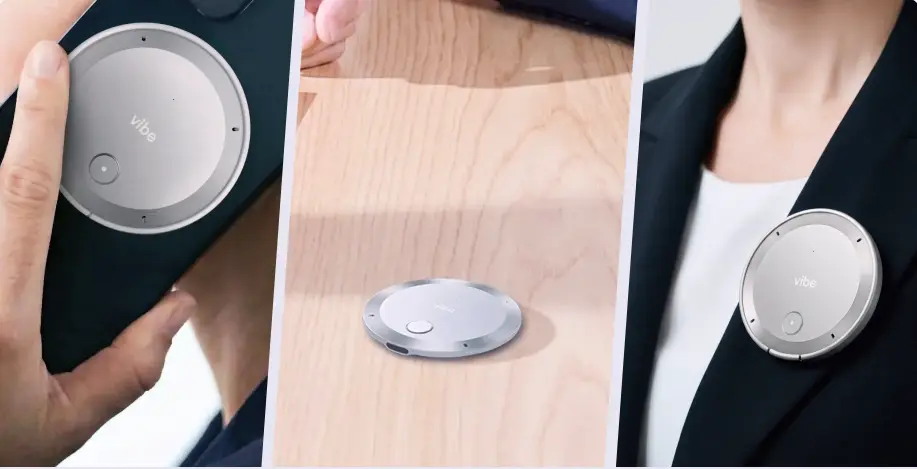 Vibe Dot wearable AI recorder device shown clipped to professional attire
Battery life exceeds 30 hours, supporting multi-day travel without recharging. The device holds SOC 2, HIPAA, NDAA, and FERPA certifications, making it suitable for regulated industries. Recordings feed into Vibe AI for transcription, summarization, and persistent storage.
Vibe Bot is a room conferencing device designed for hybrid meetings. A multi-directional microphone array captures all participants in a physical room, including those positioned away from a central meeting table.
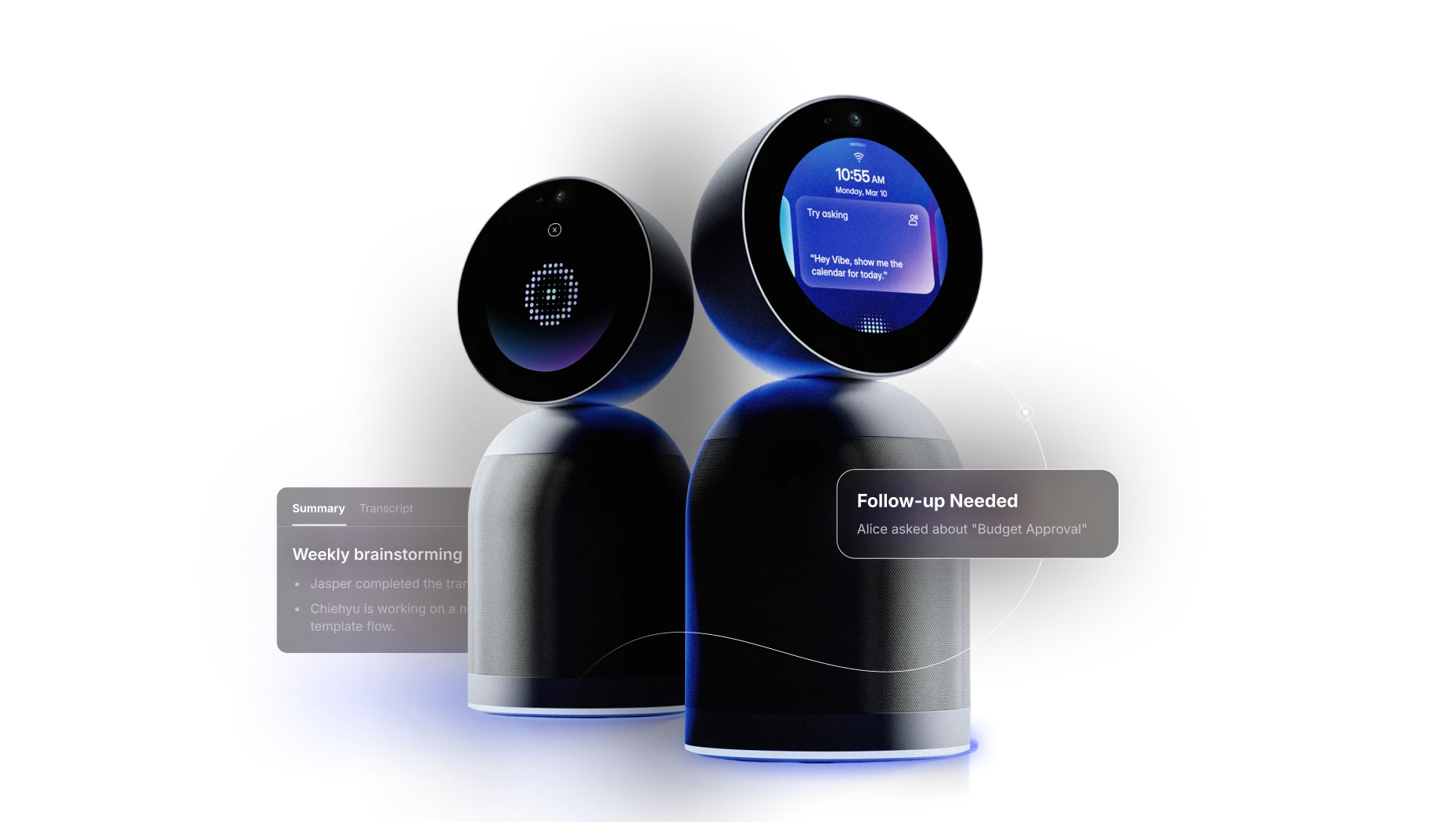
Speaker diarization identifies who said what, enabling accurate attribution in meeting summaries. Like Vibe Dot, Vibe Bot feeds into Vibe AI for team-wide access.
The context split is deliberate. In 2025, 52% of remote-capable US employees work hybrid schedules, according to Gallup.
Hybrid work creates two distinct capture problems: capturing the room and capturing remote participants. Conference room devices such as Vibe Bot address the first. Software integrations address the second. Neither alone is sufficient.
The productivity impact is measurable. According to the 2025 Microsoft Work Trend Index, based on data from 31,000 workers across 31 countries, 20% of employees now save at least one hour per day using AI tools, time that previously went to manual note-taking, follow-up drafting, and information retrieval.
That time comes from eliminating manual note-taking, reducing time spent reviewing recordings, and surfacing action items automatically.
For more on wearable AI recorders and how they compare, see the guide to best wearable AI recorders. For devices that travel with you, Vibe Dot offers a wearable form factor with professional-grade compliance coverage.
How to Choose a Listening Device
The right listening device depends on four variables: where the conversation happens, whether the context is regulated, whether the output is individual or team-shared, and whether offline recording is required.
|
Use Case |
Recommended Device Type |
Key Considerations |
|---|---|---|
|
Mobile professional, varied locations |
Wearable AI recorder |
Battery life, offline capability, form factor |
|
Hybrid meeting rooms |
Room conferencing device |
Mic array quality, room coverage, speaker diarization |
|
Virtual calls only |
Software-only tool |
Platform integration, accuracy, export options |
|
Healthcare clinical settings |
Compliant wearable or desk recorder |
HIPAA, BAA availability, EHR integration |
|
Legal depositions |
Desk recorder or room device |
Chain of custody, transcription accuracy |
|
Field inspections |
Wearable AI recorder |
Ruggedness, hands-free operation |
|
Regulated enterprise |
Any compliant device |
SOC 2, NDAA, vendor security review |
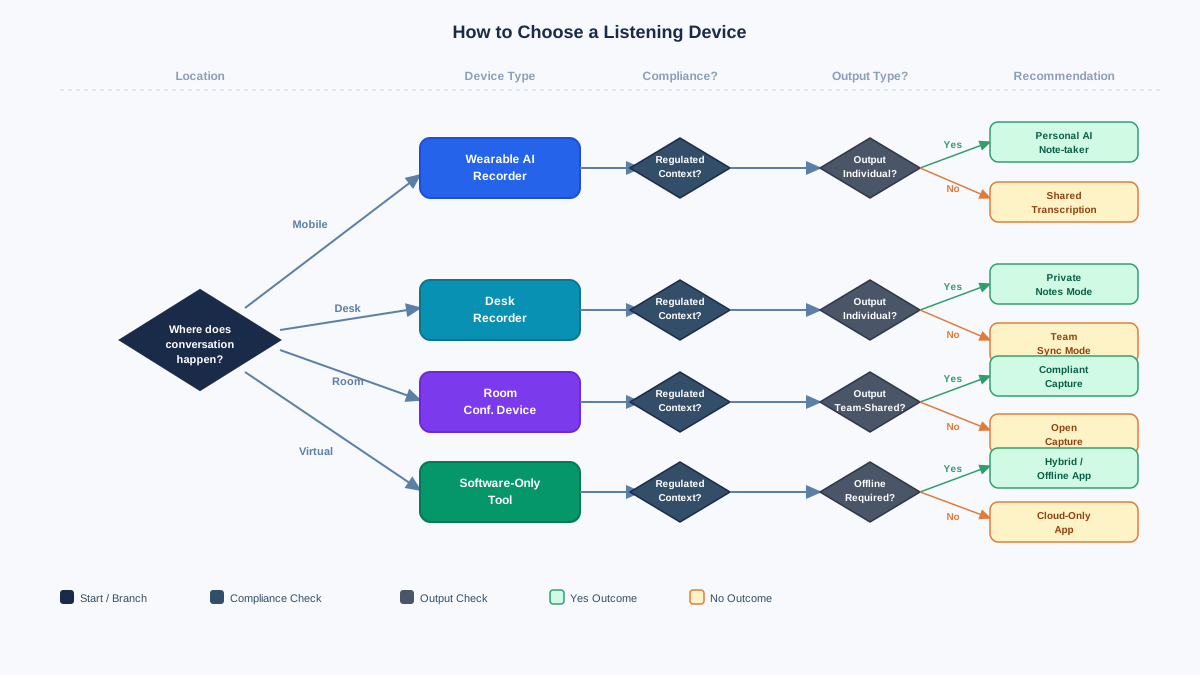 Decision flowchart for choosing the right listening device based on context and requirements
Mobile workers, consultants, sales professionals, field technicians, need devices that travel. A wearable AI recorder clips to clothing and captures conversations without disrupting workflow. Furthermore, offline recording capability matters when cellular or WiFi coverage is spotty.
Fixed-location workers have different needs. A desk recorder captures phone calls and office conversations. A room conferencing device captures multi-person meetings. The choice depends on the number of participants and the room configuration.
Regulated environments require compliance screening. Before evaluating features, confirm that a device and its associated cloud platform meet applicable requirements. If compliance is uncertain, the device is not suitable for use.
Team sharing changes the architecture. Individual professionals can use devices with personal cloud accounts. Teams need systems that feed into shared knowledge bases where meeting content becomes searchable across the organization.
The decision framework is straightforward, simply in 4 steps:
-
Map the conversation context, mobile, desk, room, or virtual.
-
Apply compliance filters.
-
Determine whether output is for individual use or team sharing.
-
Evaluate offline requirements.
Following this sequence eliminates most buying mistakes.
Final Thoughts
Listening devices have moved beyond simple audio capture. The five device categories, traditional recorders, wearable AI recorders, desk recorders, room conferencing devices, and software-only tools, each serve distinct contexts.
The legal framework requires attention to state-specific consent laws, particularly in the 11 all-party consent states. Regulated industries need devices with compliance certifications that consumer equipment lacks.
AI has transformed what listening devices do, turning recorded audio into searchable, structured information. For professionals whose work depends on accurate conversation capture, understanding these categories, requirements, and capabilities is the foundation for making the right choice.
FAQs
What are listening devices used for?
Listening devices are used in professional, healthcare, legal, and field work contexts to capture spoken conversations for transcription, documentation, and later reference. The most common applications are meeting capture, clinical note-taking, sales call recording, legal proceedings, and field observation documentation.
How accurate is AI transcription?
Accuracy varies significantly by recording environment. Controlled single-speaker settings produce low word error rates, while multi-speaker conversational settings produce much higher ones. The quality of the microphone array is the strongest hardware-side predictor of real-world accuracy. Devices with more microphones and noise-rejection design outperform those without in real meeting conditions.
Is it legal to record meetings at work?
In most of the United States, recording a conversation requires only the consent of one participant. However, 11 states require all-party consent, meaning every person in the conversation must be informed and agree. These states include California, Florida, and Illinois. Workplace policies may add further requirements beyond the legal minimum.
Can listening devices be used in healthcare?
Yes, with the right compliance posture. Listening devices used in clinical settings must meet HIPAA requirements, and the device vendor must be willing to sign a Business Associate Agreement. Most consumer-grade AI recorders do not qualify. Devices with SOC 2 and HIPAA certifications are suitable; those without are not.
What is the difference between a voice recorder and an AI listening device?
A traditional voice recorder captures and stores an audio file. An AI listening device processes that audio in real time or after recording, producing a written transcript, identifying who spoke, generating a structured summary, and surfacing action items. The output is structured data rather than a stored sound file.
Do I need consent to record a phone call?
Federal law generally requires only one-party consent for phone call recording, but 11 states impose all-party consent requirements. If any participant in the call is located in one of those states, all parties must be informed and agree before recording begins. Verify the applicable law in your jurisdiction and your employer’s internal policy before recording.
How much time can AI meeting notes save?
Time savings depend on meeting volume and prior note-taking practices. Professionals who attend many meetings and previously spent time writing up notes manually report the largest gains. The savings come primarily from eliminating post-meeting transcription and summarization work, and from being able to search recordings rather than relying on memory.