
AI assistants are entering a new phase.
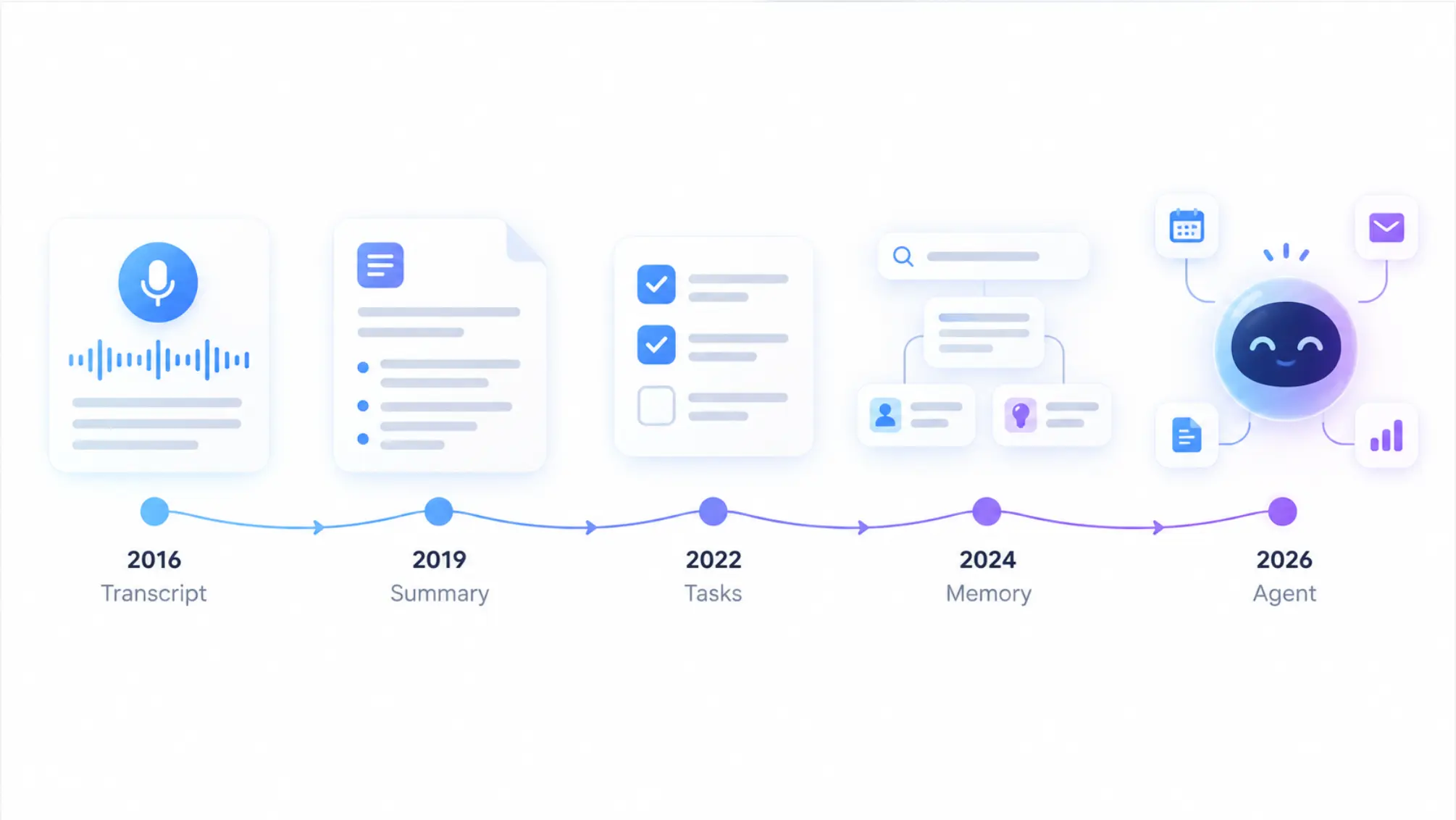
For years, the typical interaction was simple: open an app, type a question, and get an answer. Today, AI is increasingly capable of remembering context, anticipating needs, and taking action across the tools people use.
Anthropic’s launch of Claude Duet on October 21, 2026, is a clear example of this shift. It’s a proactive AI agent that can identify what needs attention, work across connected apps, and complete tasks on your behalf.
But AI assistance doesn’t have to begin inside an app.
Vibe Dot, a wearable AI assistant device, takes a different approach. It’s designed to understand conversations as they happen, connect information across meetings, and help turn real-world context into useful outcomes.
Both point toward a more agentic future. The difference lies in where they begin, how they understand your work, and how they help move it forward.
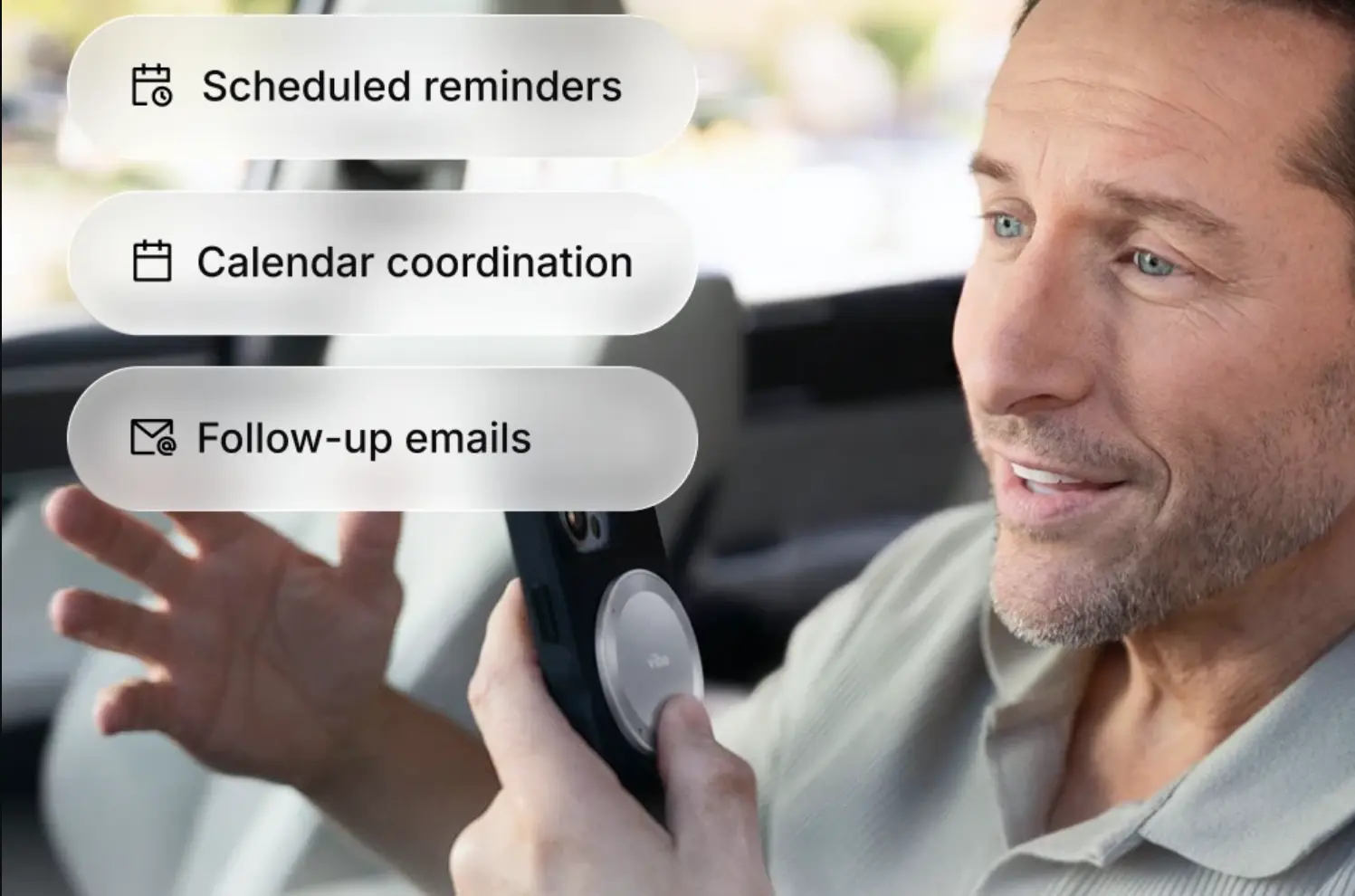 Man speaking to Vibe Dot AI assistant on his phone in a car, handling reminders, calendar coordination, and follow-up emails
What Is Claude Duet?
Claude Duet is a proactive AI agent developed by Anthropic. Rather than waiting for users to initiate every interaction, Duet is designed to recognize what needs attention and take on work across connected applications.
It extends the Claude experience with a more autonomous workflow.
According to Anthropic, Claude Duet can:
-
Anticipate what matters: Review information from your inbox and calendar, prepare morning briefings, and surface items that need your attention.
-
Execute multi-step tasks: Create documents, spreadsheets, dashboards, and other deliverables.
-
Work across applications: Use connected tools, plugins, and its cloud computer to carry out tasks.
-
Maintain context: Build on existing Claude memory, skills, and connected applications.
-
Work asynchronously: Continue completing assigned tasks while you’re away, asking for approval before sensitive actions.
You can communicate with Duet through text or voice messages, making it feel more like delegating work to an assistant than prompting a chatbot.
Claude Duet is currently available through a research-preview waitlist for eligible US Claude Pro and Max subscribers. Its capabilities and availability may evolve as the preview develops.
The idea behind Duet is straightforward: AI shouldn’t just help you think about work. It should help you get work done.
 Claude Duet
What Is Vibe Dot?
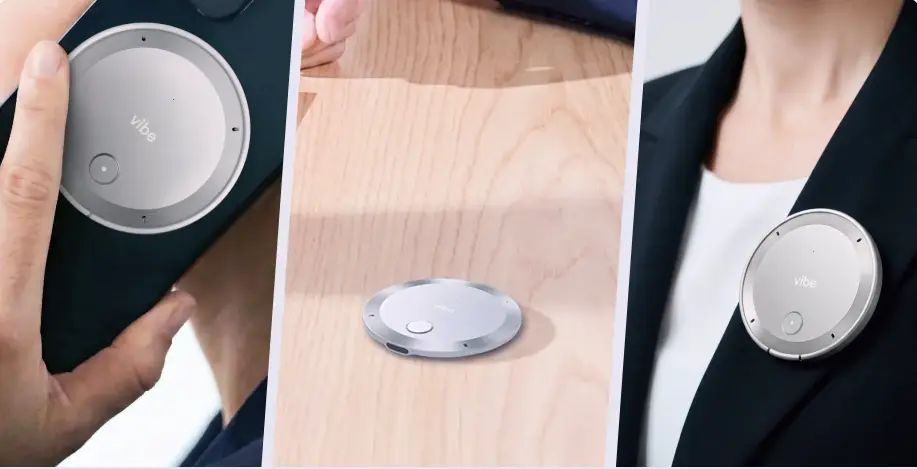
Vibe Dot is a wearable AI assistant device that brings AI assistance into everyday conversations and activities beyond the screen.
It combines dedicated hardware with Vibe AI, turning spoken interactions into organized, searchable context that can support follow-ups and future work.
Vibe Dot is built around four connected capabilities:
1. Capture: Understand Work as It Happens
Important conversations don’t always happen inside scheduled video calls.
They happen during customer meetings, site visits, brainstorming sessions, and spontaneous discussions throughout the day.
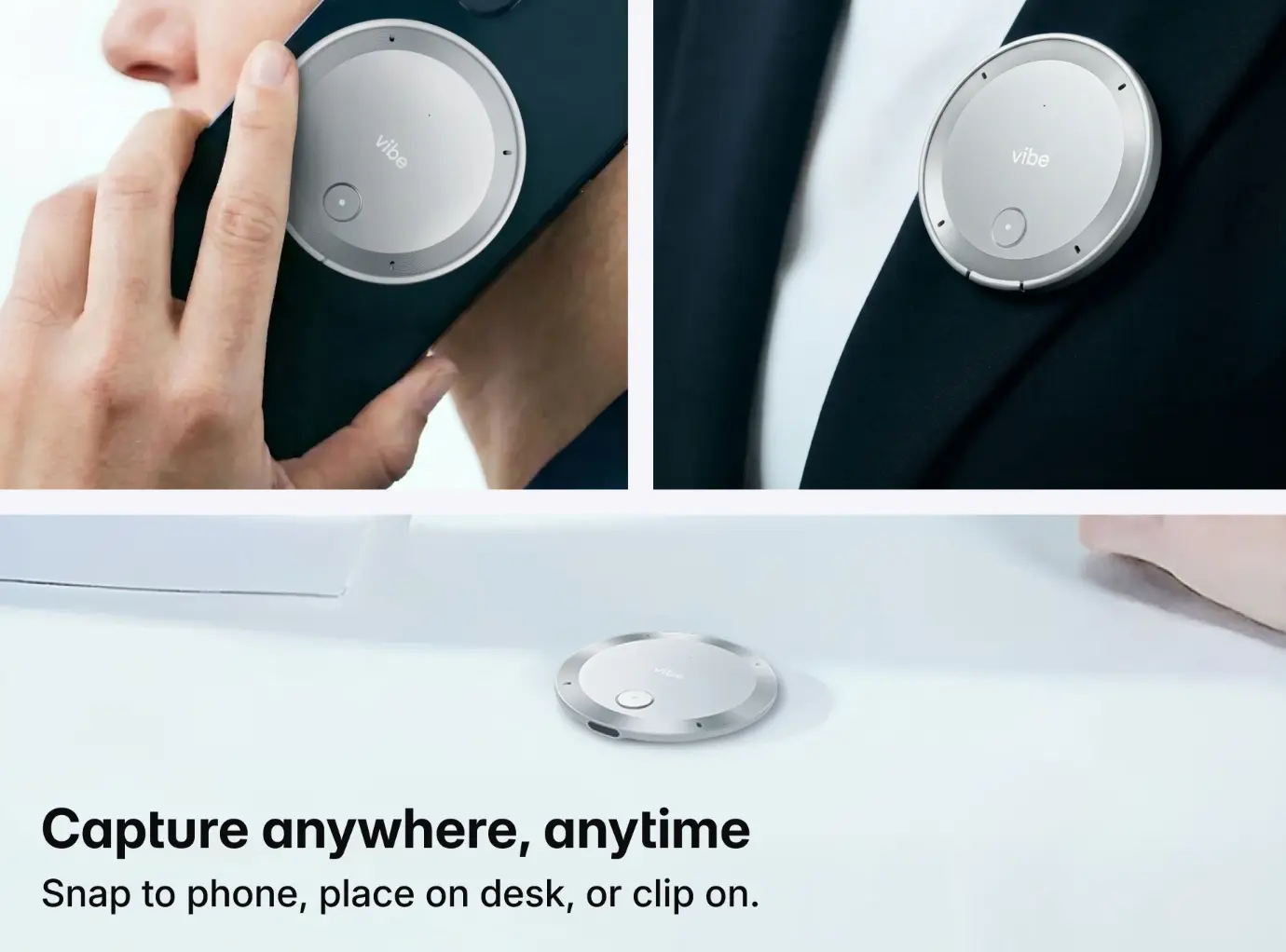
Vibe Dot provides several ways to preserve these moments:
-
Double-tap to start and stop recording a conversation.
-
Press and hold to save a thought, reminder, or personal memo.
-
Enable Auto Capture to begin recording based on voice recognition or scheduled time windows.
Auto Capture is currently in beta.
Because Vibe Dot is compact and wearable, it can move with the user rather than requiring every interaction to begin on a laptop or phone.
2. Understand: Turn Conversations Into Structured Information
Vibe AI processes recorded conversations into useful information, including:
-
Transcripts with speaker labels
-
AI-generated summaries
-
Key decisions and discussion points
-
Action items and next steps
The goal isn’t simply to preserve everything that was said.
It’s to identify the information that matters for what happens afterward.
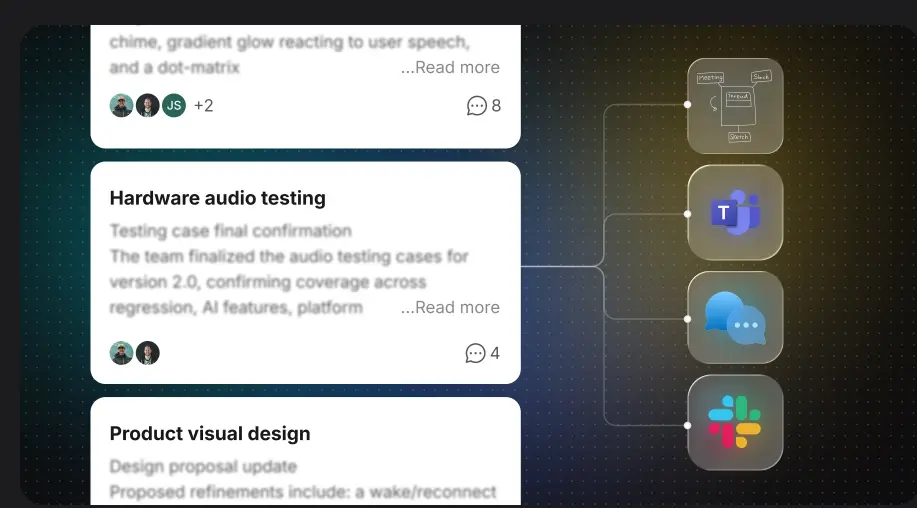 Vibe Dot meeting summaries syncing to Microsoft Teams and Slack
3. Remember: Build Context Across Conversations
Individual meetings rarely tell the whole story.
A decision made today may depend on a conversation from last week. A customer may change their requirements over several discussions. An unresolved issue may come up repeatedly before someone acts on it.
Vibe AI’s cross-conversation memory is designed to connect that history.
Users can ask questions about previous discussions, retrieve relevant decisions, and understand how information has evolved over time.
For example:
"What changed about the project timeline since our last meeting?"
Or:
"What concerns has this client raised over the past month?"
Available retrieval history depends on the Vibe AI plan.
This moves the experience beyond standalone meeting summaries toward a connected memory of work.
4. Act: Move From Decisions to Outcomes
Vibe Dot’s direction goes beyond collecting and organizing information.
Its agentic capabilities are designed to turn relevant context into actions, such as drafting follow-up emails, organizing next steps, preparing plans, and working with connected business applications.
Imagine finishing a project review and asking your assistant to prepare the follow-up based on what was discussed, what was previously agreed, and which tasks remain open.
That’s the experience Vibe Dot is building toward.
Direct voice-command execution and several cross-application Agentic Actions are currently marked as coming soon. Today’s available capabilities include conversation processing, connected memory, and action-item extraction.
Claude Duet vs. Vibe Dot: Key Differences
Both products reflect the shift toward AI that understands context and helps users accomplish tasks.
But they begin from different environments.
|
Capability |
Claude Duet |
Vibe Dot |
|---|---|---|
|
Product approach |
Proactive AI agent |
Wearable AI assistant device |
|
Primary environment |
Connected digital workspace |
Real-world conversations and connected digital workflows |
|
Interaction |
Text and voice messages |
Physical device controls, conversation recording, and Vibe AI |
|
Context |
Claude memory, connected apps, and conversation history |
Recorded conversations, cross-meeting memory, and connected information |
|
Proactive capabilities |
Briefings, task identification, autonomous work |
Auto Capture in beta; expanded agentic workflows in development |
|
Agentic actions |
Multi-step execution across apps |
Action-item extraction today; expanded cross-app execution coming soon |
|
Hardware |
Runs on supported phones and computers |
Dedicated wearable recording device |
|
Primary advantage |
Working across existing digital systems |
Connecting real-world conversations with persistent AI context |
These are differences in product emphasis, not absolute technical boundaries.
Claude can process information supplied through its supported interfaces and integrations. Vibe AI can connect with external AI tools through MCP.
The more meaningful question is how each approach fits into a person’s daily work.
Two Starting Points: Digital Work and Real-World Work
Claude Duet: Starting With Your Digital Workspace
Much of modern work already lives in digital systems.
Emails document commitments. Calendars define schedules. Project management tools track responsibilities. Documents contain decisions, plans, and research.
Claude Duet is designed to operate across these sources.
For example, a business owner might ask Duet to identify unpaid invoices, prepare follow-up messages, and organize the next steps for approval.
A manager might use it to review upcoming commitments, produce a project brief, or build a dashboard.
Its advantage comes from using available digital context to identify and complete work.
Vibe Dot: Starting With the Conversations Behind the Work
But not every important decision begins in a digital system.
A consultant might learn that a client’s priorities have changed during an onsite meeting.
A sales professional might receive verbal feedback that never appears in an email.
A project manager might uncover a new dependency during a site walkthrough.
These conversations influence decisions, but their details can be lost or fragmented if they aren’t documented.
Vibe Dot is designed to make those moments part of a more connected information history.
The wearable device helps record the interaction. Vibe AI processes the conversation, links it with related information, and makes that context retrievable later.
Its evolving agentic capabilities aim to help users act on that information, too.
The distinction isn’t simply digital versus physical. It’s about where useful context enters the AI workflow.
Memory: The Foundation of More Useful AI Assistance
 Vibe AI connecting video meeting participants
One of the most important developments in AI assistants is the shift from isolated interactions toward persistent context.
Without memory, an assistant may need the same background information every time.
With memory, it can build on previous interactions.
Both Claude Duet and Vibe Dot recognize this, but their memory experiences emphasize different sources of information.
Claude Duet: Memory Across AI Interactions and Connected Apps
Claude Duet builds on the existing Claude experience, including memory, skills, and connected applications.
That gives it continuity across interactions and access to relevant information from the tools a user authorizes.
For people whose work primarily happens through connected digital applications, this can help reduce repeated explanations and manual coordination.
Vibe Dot: Memory Across Real-World Conversations
Vibe Dot emphasizes connected conversation history.
Instead of treating each meeting as a separate document, Vibe AI links related discussions so users can revisit decisions, open questions, and changes over time.
Consider a consultant working with the same client for several months.
During the first meeting, the client outlines a project goal. Two weeks later, they revise the timeline. Another conversation introduces a budget constraint.
A transcript can describe each meeting.
Connected memory offers a different benefit: the ability to retrieve relevant information across those interactions.
For example:
"How has the client’s project scope changed since our first discussion?"
This is especially useful when work develops through multiple conversations rather than one formal document.
The future of AI memory isn’t just remembering more information. It’s retrieving the right context when it matters.
Agentic AI: From Understanding to Taking Action
Memory is valuable, but it becomes even more powerful when it helps drive what happens next.
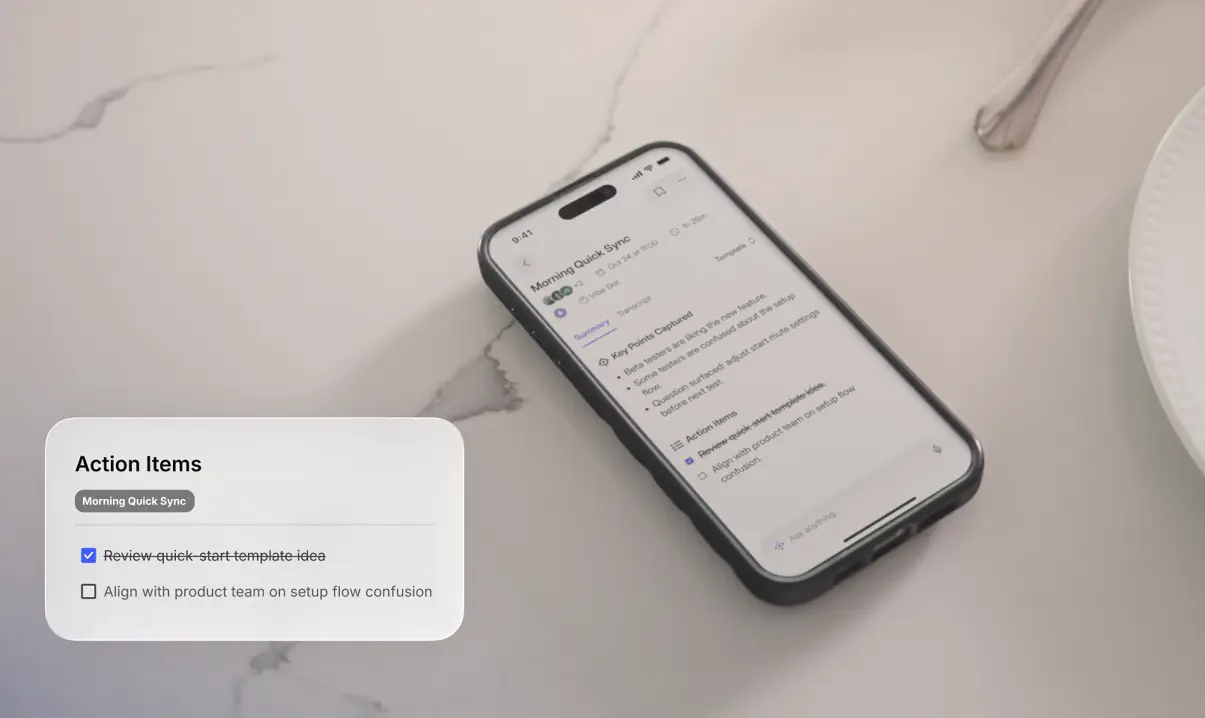 Vibe Dot app showing AI meeting summary and action items
That’s where agentic AI enters the picture.
An agentic assistant doesn’t simply summarize information or answer a question. It can interpret goals, identify steps, and perform actions through available tools, often with human oversight.
Claude Duet already emphasizes this form of execution.
It can prepare deliverables, carry out multi-step workflows, and request approval before sensitive operations.
Vibe Dot approaches agentic assistance through a different starting point: the conversations that generate tasks and commitments.
Consider a customer meeting.
During the discussion, the customer requests a revised proposal, asks for a product demonstration, and raises a question about implementation.
Vibe Dot can help preserve the discussion and organize its decisions and action items.
Its planned agentic workflows aim to take the next step: using that conversation context to prepare follow-ups and coordinate actions in connected applications.
The difference is not that one product understands tasks while the other only understands speech.
Both are moving toward a world where AI connects understanding with execution.
Claude Duet emphasizes autonomous execution across the digital workspace today. Vibe Dot is developing an agentic experience grounded in the conversations that happen throughout real-world work.
The extent of current execution capabilities differs, and users should evaluate what is available today rather than assuming planned integrations are already generally accessible.
Three Scenarios That Show the Difference
Scenario 1: A Consultant Managing Client Relationships
A consultant spends the morning preparing a presentation, then meets a client in person.
Before the meeting, an AI agent like Claude Duet could help review existing materials and prepare a briefing using available digital information.
During the meeting, however, the client introduces new priorities and changes their expectations.
A wearable assistant like Vibe Dot can help document that discussion and make its context searchable afterward.
With appropriate integration, the resulting information can inform future AI-assisted work.
The two approaches address different parts of the same professional workflow.
 Vibe Dot recorder clipped to a blazer during a conversation
Scenario 2: A Project Manager Moving Between Meetings and the Field
A project manager coordinates work across documents, schedules, and project management tools.
Digital assistants can help organize those records and prepare project updates.
But fieldwork introduces a different kind of information.
A contractor raises a scheduling concern during a walkthrough. A team member identifies an unexpected issue. A decision is made on the spot.
Vibe Dot can help turn those discussions into transcripts, summaries, and action items that are easier to reference later.
As expanded agentic integrations become available, this kind of context could support more direct project follow-through.
The opportunity is to connect what happens in the field with the systems used to manage the project.
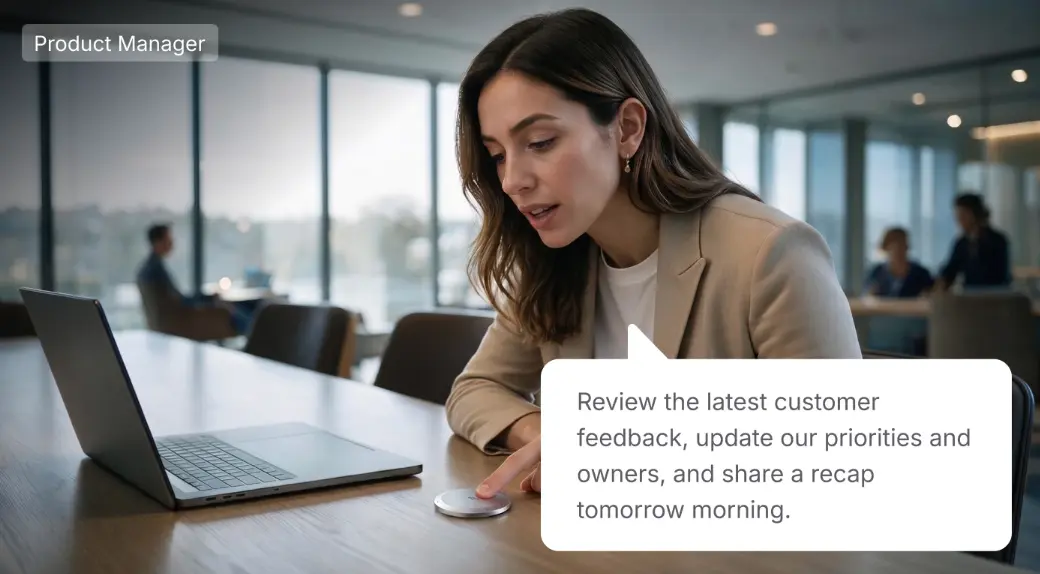 Product Manager using Vibe Dot to review customer feedback
Scenario 3: A Business Leader Navigating a Busy Day
A business leader’s day may include scheduled meetings, quick conversations, voice messages, emails, and spontaneous decisions.
An agent like Claude Duet can help manage digital priorities, generate deliverables, and surface items requiring attention.
Vibe Dot can help preserve relevant spoken discussions and connect them across the day.
Instead of relying on scattered handwritten notes or memory alone, the leader can return to previous conversations and ask what was decided.
The value of an AI assistant increasingly depends on how well it supports the full flow of work—not just individual tasks.
Can Claude Duet and Vibe Dot Work Together?
Potentially, yes.
The two approaches are not mutually exclusive.
Vibe AI supports the Model Context Protocol (MCP), an open standard that helps compatible AI applications access external information and tools.
Through supported MCP connections, relevant Vibe AI data—such as meeting transcripts, summaries, decisions, and action items—can become accessible to compatible AI clients.
This creates a potential workflow:
Real-world conversation → Vibe AI memory → Connected AI assistant → Next action
For instance, a professional could use Vibe Dot to document a customer discussion, then make the relevant information available to a compatible AI assistant to help prepare a follow-up.
However, Claude Duet is a separate research-preview product. Compatibility between Vibe AI’s MCP connection and Duet’s specific connector environment has not been established here and should not be assumed.
The broader opportunity is still significant.
As AI agents become more capable, making accurate, relevant context accessible to them becomes increasingly important.
Which AI Assistant Approach Is Right for You?
The better choice depends on where your work happens and what you expect an AI assistant to do.
Claude Duet may be a better fit if:
-
Most of your work happens across connected digital applications.
-
You want an agent to proactively identify priorities.
-
You regularly delegate multi-step digital tasks.
-
You need help preparing documents, reports, dashboards, or administrative work.
Vibe Dot may be a better fit if:
-
Important parts of your work happen during in-person conversations.
-
You want a wearable device that can move with you throughout the day.
-
You need searchable memory across meetings and discussions.
-
You want to preserve decisions and action items from real-world interactions.
-
You’re interested in an AI assistant experience that is expanding from conversation intelligence into connected actions.
The products also have different availability and purchase models.
Claude Duet is currently a research preview included for eligible Claude Pro and Max users through a US waitlist.
Vibe Dot is available as dedicated hardware, currently listed from $199, with Starter, Pro, and Max Vibe AI plan options. Advanced retrieval and connected actions vary by plan, and some features are still rolling out.
Neither approach eliminates the need for appropriate recording consent, careful data handling, or human review of AI-generated work.
The Future of AI Assistance Goes Beyond the Screen
Claude Duet and Vibe Dot represent two approaches to the same broader transition.
AI assistants are becoming more context-aware, more proactive, and more capable of helping people move from information to outcomes.
Claude Duet shows what’s possible when an AI agent operates across the digital tools people already use.
Vibe Dot explores what happens when AI assistance begins closer to real-world conversations, where decisions are made, ideas emerge, and commitments take shape.
One approach starts with digital work. The other brings more of everyday work into the AI experience.
Neither suggests that AI assistance must remain confined to a chat window.
The most useful AI assistants will be those that can understand the right context, preserve continuity, and help people take meaningful next steps—wherever their work happens.
Because getting work done starts with understanding what matters.
Frequently Asked Questions
Is Claude Duet an AI agent?
Yes. Claude Duet is a proactive AI agent developed by Anthropic. It is designed to identify priorities, work across connected applications, complete tasks, and request approval when necessary.
Is Vibe Dot just an AI voice recorder?
No. Recording is one of its inputs, but Vibe Dot is positioned as an AI assistant device. Along with conversation recording, it offers AI-generated summaries, action-item extraction, connected memory, and contextual question answering. Expanded voice-driven agentic actions are also part of its developing capabilities.
What is the main difference between Claude Duet and Vibe Dot?
Claude Duet primarily focuses on proactive task execution across digital applications. Vibe Dot focuses on bringing real-world conversations into a connected AI experience, using dedicated wearable hardware, persistent conversation memory, and an evolving agentic workflow.
Does Vibe Dot have agentic AI capabilities?
Vibe Dot combines conversation understanding, cross-conversation memory, and action-item extraction with an agentic product direction. Its expanded capabilities for direct voice commands and cross-application execution are marked as coming soon, with some integrations rolling out progressively.
Can Vibe Dot work with Claude?
Vibe AI supports MCP connections with compatible AI tools, including supported Claude workflows. This allows relevant meeting context to be made available through authorized integrations. Specific compatibility with Claude Duet’s research-preview environment requires separate verification.
Does Claude Duet have memory?
Yes. Claude Duet builds on Claude’s memory, skills, and connected application context. Its memory experience emphasizes continuity across Claude interactions and supported digital tools.
Can a wearable AI assistant replace a software AI agent?
Not necessarily. Wearable assistants and software AI agents can overlap in memory, reasoning, and task execution, but their interaction models differ. A wearable assistant offers a dedicated entry point for real-world activity, while a software agent can operate directly within connected digital applications.