
You need to capture meetings without losing a word — but Vibe Dot and Fireflies.ai solve that problem in fundamentally different ways. One is a wearable AI recorder that goes wherever you go; the other is a software bot that joins your calendar invites. The right choice depends on where your most important conversations actually happen.
This comparison breaks down how Vibe Dot and Fireflies.ai differ across recording coverage, AI capabilities, privacy, compliance, and pricing — so you can pick the tool that fits your real workday, not just your Zoom schedule.
What Each Tool Is Built to Do
Before comparing features, it helps to understand the core design philosophy behind each product.
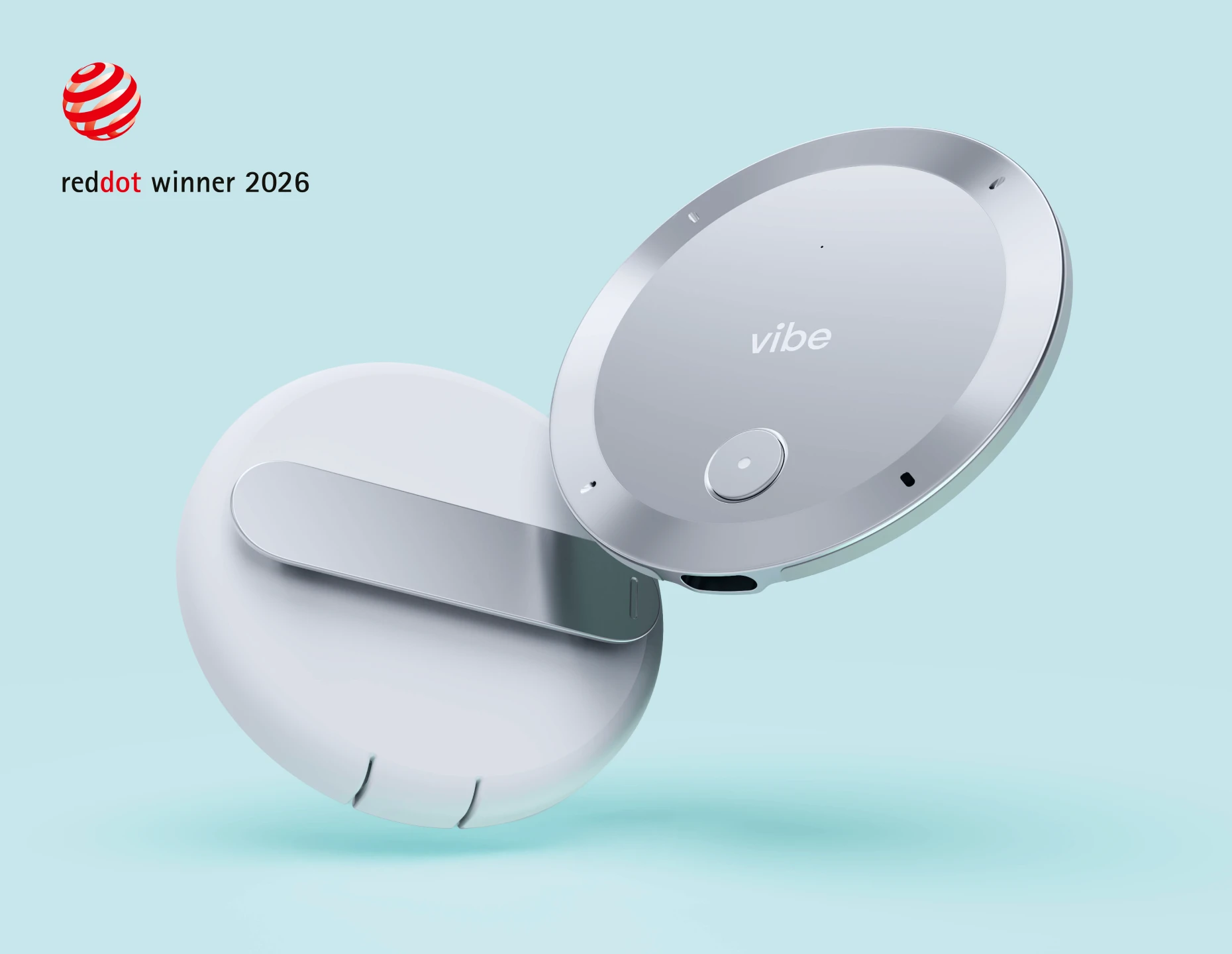
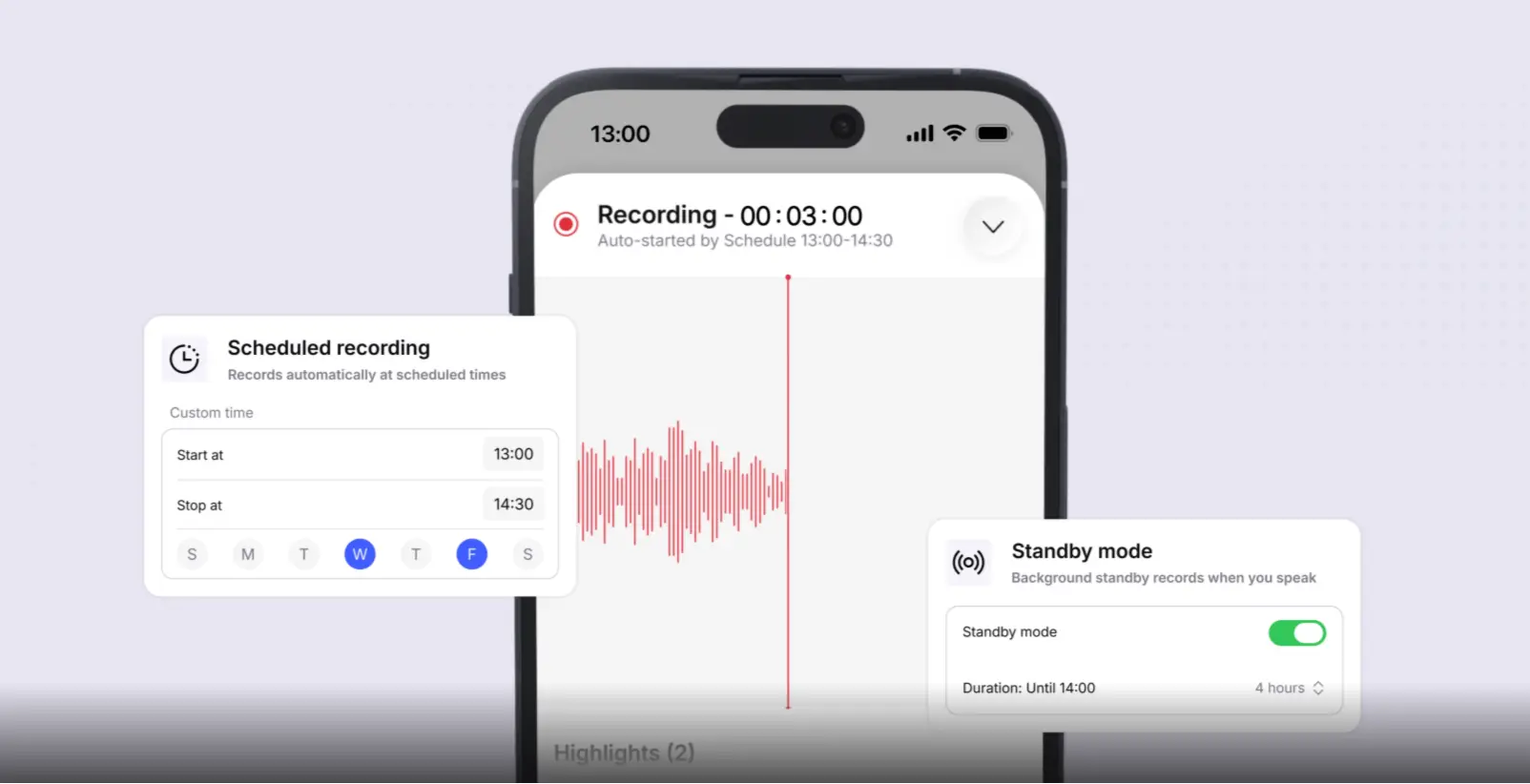
Vibe Dot is a wearable AI recording device — a physical piece of hardware you clip on or carry. It captures audio from any environment: in-person meetings, phone calls, video conferences, field visits, or casual hallway conversations. That audio flows into Vibe AI, a cross-session memory platform that connects insights across every meeting you’ve ever captured — not just the last one.
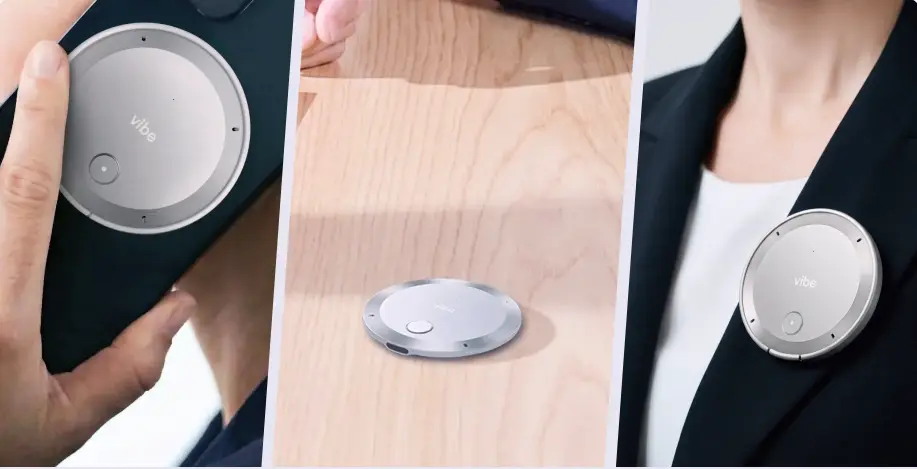 Recommended: Vibe Dot portable AI meeting recorder shown held in hand, placed on a desk, and clipped to a lapel for flexible recording use
Fireflies.ai is a cloud-based AI notetaker. It sends a bot ("Fred") into your scheduled online meetings to record and transcribe in real time, then generates summaries, action items, and searchable archives. It integrates deeply with CRMs like Salesforce and HubSpot, making it popular with sales and RevOps teams.
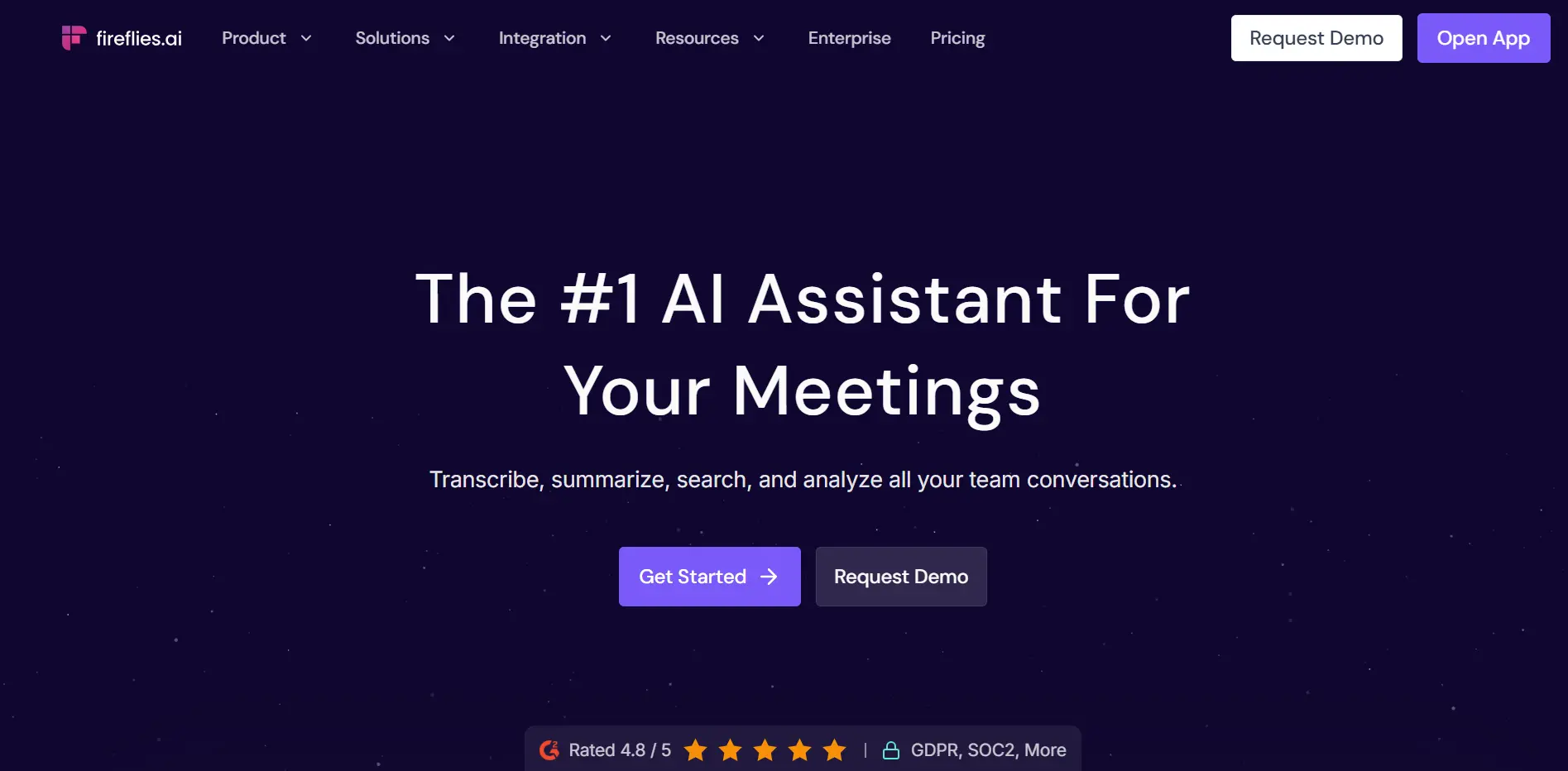 Screenshot of Fireflies AI's homepage
The fundamental difference: Fireflies lives inside your calendar. Vibe Dot lives in the real world.
At a Glance: Feature Comparison
|
Feature |
Vibe Dot |
Fireflies.ai |
|---|---|---|
|
Recording type |
Wearable hardware device |
Software bot (cloud-based) |
|
In-person meetings |
✅ Native support |
⚠️ Upload audio manually |
|
Video calls (Zoom, Meet, Teams) |
✅ Supported |
✅ Native bot integration |
|
Phone calls |
✅ Supported |
⚠️ Desktop app capture only |
|
Offline recording |
✅ Yes |
❌ No — requires internet |
|
Cross-session AI memory |
✅ Memory Graph (Vibe AI) |
❌ Per-meeting archive only |
|
FERPA certified |
✅ Yes |
⚠️ Enterprise plan only |
|
NDAA compliant |
✅ Yes |
❌ Not listed |
|
Visible bot in meeting |
❌ No bot |
⚠️ Bot joins call visibly |
|
Pricing model |
Hardware + platform subscription |
Per-seat SaaS ($10–$39/user/mo) |
|
AI credits cap |
No credit system |
Yes — AI features are credit-gated |
Recording Coverage: Where Fireflies Stops and Vibe Dot Keeps Going
This is the most consequential difference between the two tools.
Fireflies.ai is purpose-built for scheduled virtual meetings. The structural limitation is the same one that pushes people off most meeting-bot software: Fireflies.ai only works inside a scheduled online meeting. A phone call, a client visit, or a hallway conversation falls outside what it can capture, and the only workaround is manually recording audio and uploading it later — which defeats the point of having an automated tool.
Fireflies does offer a desktop app that can capture system audio without a bot for some scenarios, but recording without a Fireflies.ai Notetaker (bot) does not save audio or video files — Fireflies captures system audio and generates a transcript and summary once the meeting ends.
Vibe Dot is designed for the opposite reality. Whether you’re in a client office, on a job site, at a conference, or on a phone call, Vibe Dot records. The device captures audio locally first, then syncs to Vibe AI — so connectivity gaps don’t mean lost conversations.
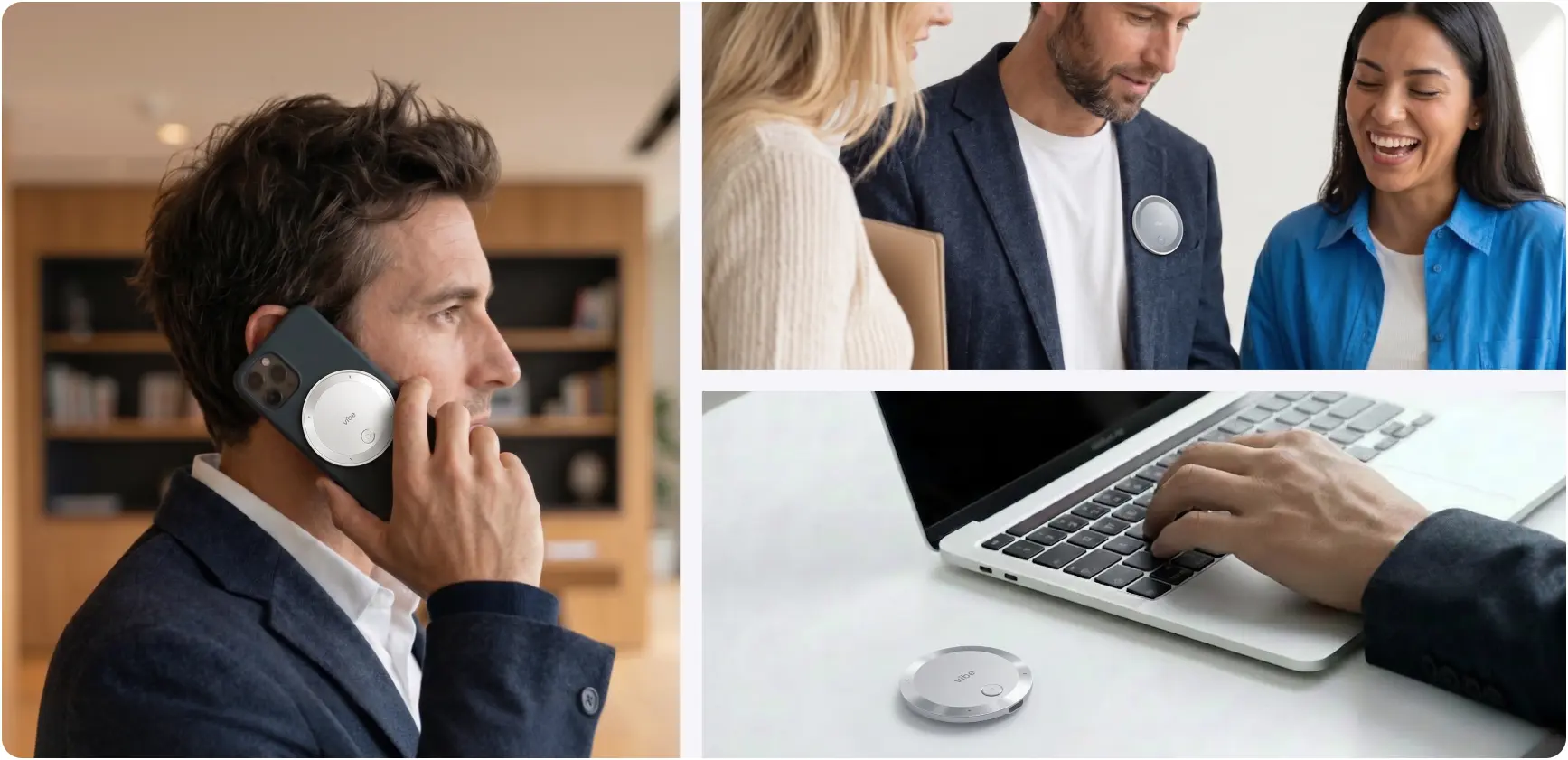
For professionals whose most important conversations happen outside of Zoom — sales reps visiting clients, healthcare practitioners in patient consultations, field teams on job sites, educators in classrooms — Fireflies has a structural gap that no software update can fix.
AI Capabilities: Per-Meeting Notes vs. Cross-Session Memory
Fireflies.ai does meeting notes well. After each call, it produces a transcript, auto-generated summary, action items, and a searchable archive. Its AskFred feature lets you query past meeting content. For teams who need a reliable post-meeting paper trail — especially sales teams logging calls to Salesforce — it delivers.
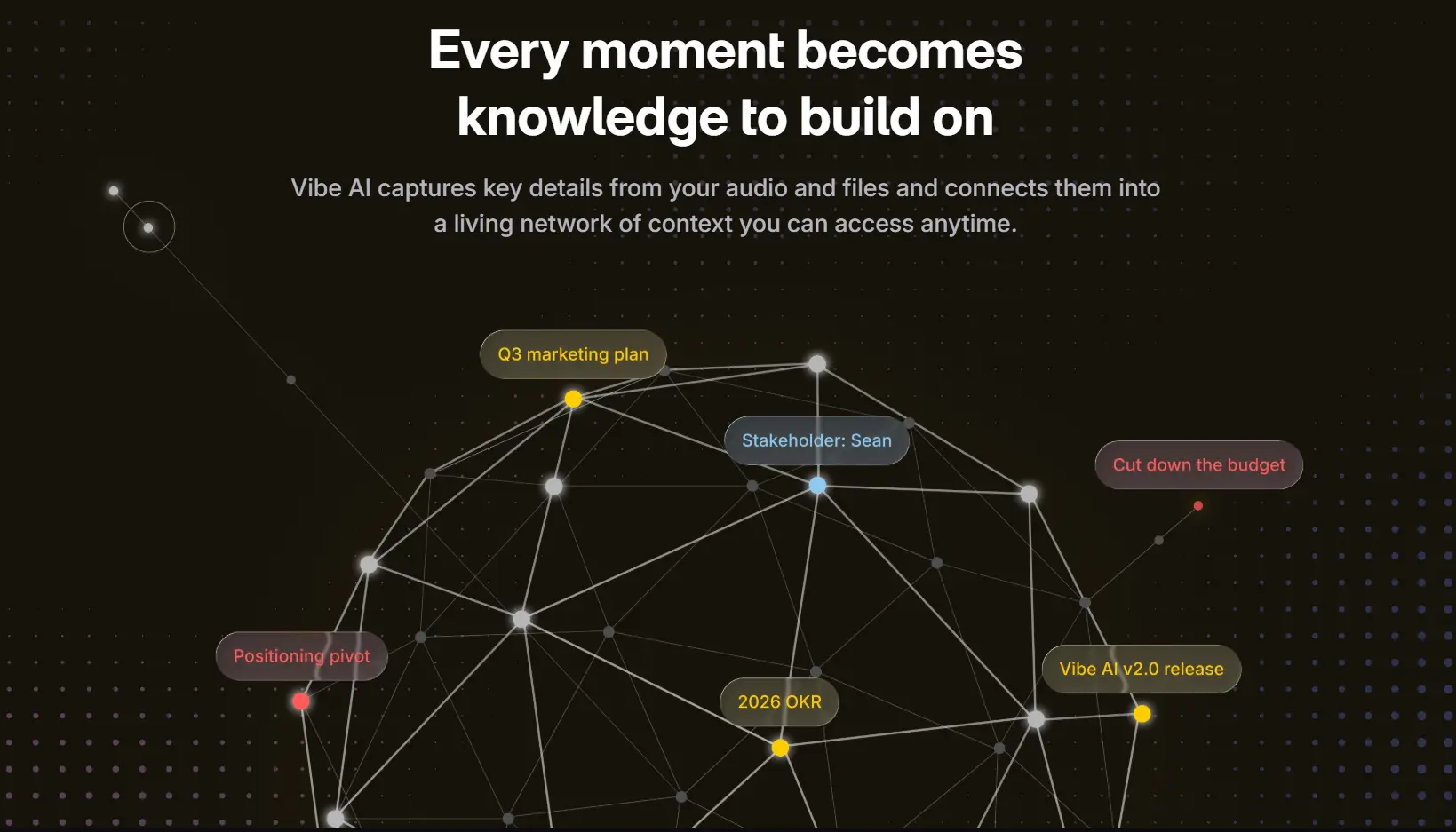
The limitation is depth. Fireflies does allow cross-meeting search — its AskFred feature lets you query across your entire transcript archive. But search and memory are different things. Searching for a keyword finds the meeting where it was mentioned. Memory understands that the pricing discussion in week two was a response to the concern raised in week one, and that the decision in week four superseded both. Fireflies gives you a searchable archive; it doesn’t build a connected model of how your work is evolving.
Vibe Dot connects to Vibe AI’s Memory Graph, which works differently. Rather than archiving meetings as isolated records, Memory Graph surfaces patterns across sessions — tracking how a project evolved, how a client’s priorities shifted, or what was promised three calls ago. It’s the difference between a filing cabinet and a thinking partner.
This distinction matters most for:
-
Sales professionals managing long deal cycles across many touchpoints
-
Consultants tracking client relationships over months
-
Executives who need context continuity across dozens of weekly conversations
-
Researchers building knowledge across interviews and field notes
Privacy, Compliance, and the Visible Bot Problem
The bot transparency issue
Every Fireflies.ai recording via the standard workflow involves a bot — "Fred" — joining your meeting as a visible participant. For external client calls, sensitive negotiations, or executive conversations, this creates friction. Some participants object; others may not consent.
Vibe Dot has no bot. Recording is hardware-based, and the consent model is straightforward: you control the device, and you’re responsible for notifying participants — the same as any physical recorder.
Compliance certifications
This is where the products diverge significantly for regulated industries.
Vibe Dot carries FERPA and NDAA certifications out of the box — making it a fit for K-12 education, higher education, and government-adjacent use cases where these certifications are a procurement requirement.
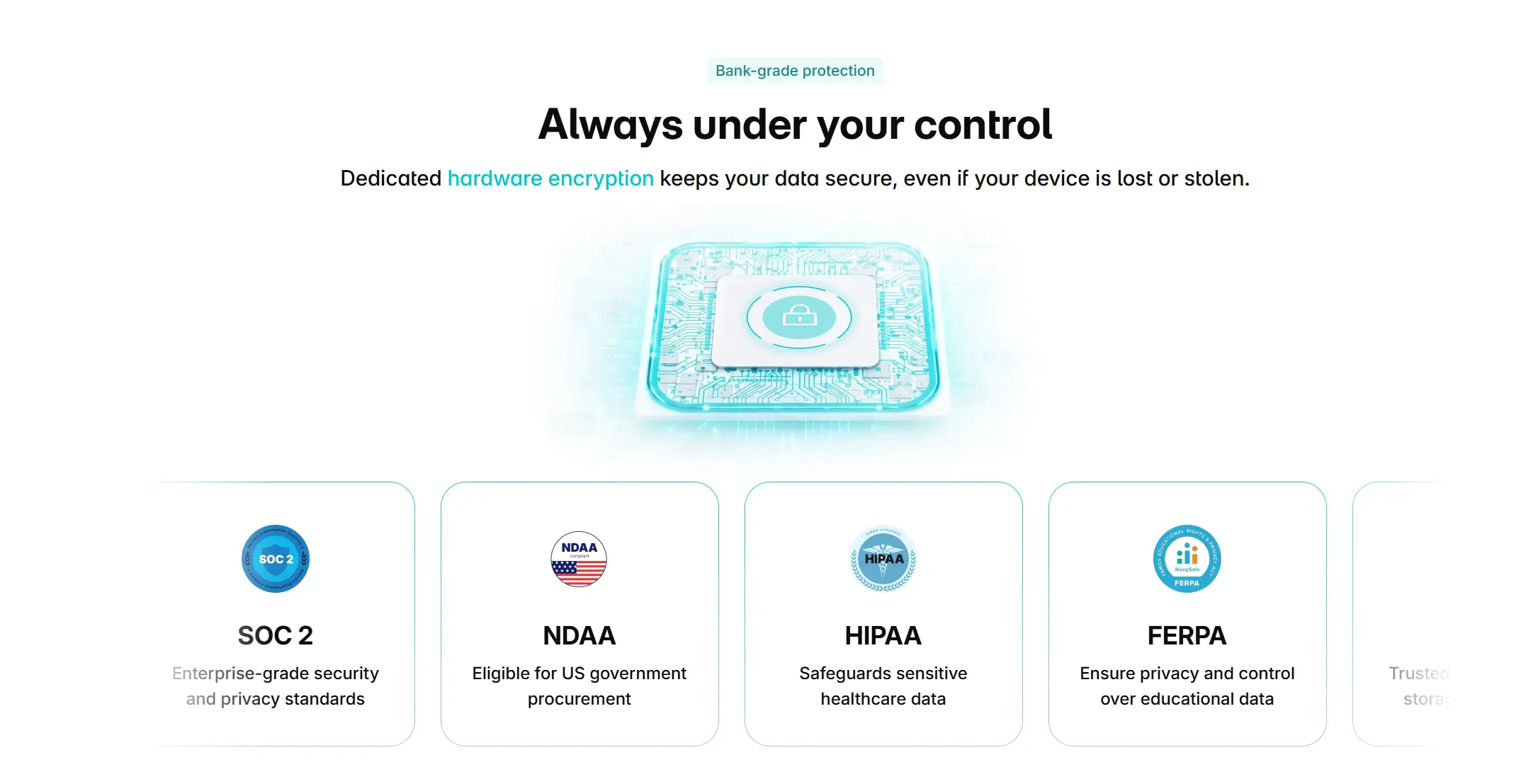 Vibe Dot security certifications including SOC 2, NDAA, HIPAA, and FERPA with hardware encryption chip graphic for bank-grade data protection
Fireflies.ai offers FERPA compliance, but FERPA compliance is available only on Enterprise plans. That means schools and districts on lower-tier plans don’t have it. Fireflies lists FERPA compliance as support for safeguarding student education records, with a signed DSA and Private Storage available for data locality — but both are Enterprise-only.
NDAA compliance (relevant for federal procurement and organizations with government contracts) is not listed on Fireflies.ai’s security page.
Cloud processing and data residency
Fireflies’ AI runs on their servers, not on your device. There’s no offline mode, no local processing option, and no way to transcribe without internet. All audio goes to Fireflies’ cloud infrastructure.
For organizations with strict data residency requirements or concerns about audio data leaving their environment, this is a meaningful constraint. Vibe Dot records locally first, giving users more control over when and how data is transmitted.
Pricing: Sticker Price vs. Real Cost
Fireflies.ai pricing
Fireflies.ai pricing in 2026 starts at $0 (Free), $10/user/month (Pro, billed annually), $19/user/month (Business, billed annually), and $39/user/month (Enterprise, billed annually).
The entry price looks competitive, but the AI credit model adds complexity. Fireflies’ most useful AI features — AskFred, advanced summaries, action-item extraction, and highlights — run on a monthly credit allowance (20 on Pro, 30 on Business, 50 on Enterprise). Hit the cap and those features pause until the next month or you buy more at roughly $0.10 each. Heavy users report paying $15–50/month above the sticker price in overages, so a "$10/seat" plan isn’t always $10.
Key integrations like Salesforce, Slack, and HubSpot are only available on the Pro plan and up, and all plans are billed per seat — costs can scale quickly as your team grows, even if not everyone is a heavy user.
Vibe Dot pricing
Vibe Dot is a hardware + platform model: a $199 one-time device purchase paired with a Vibe AI subscription. Vibe AI offers three tiers — Starter (free, 300 mins AI transcription/month), Pro ($9/seat/month billed annually, 1,200 mins + 100 AI Credits/month), and Max ($29/seat/month billed annually, unlimited transcription + 400 AI Credits/month). This structure suits individuals and teams who want a predictable cost without per-seat scaling surprises or credit systems that gate core AI features.
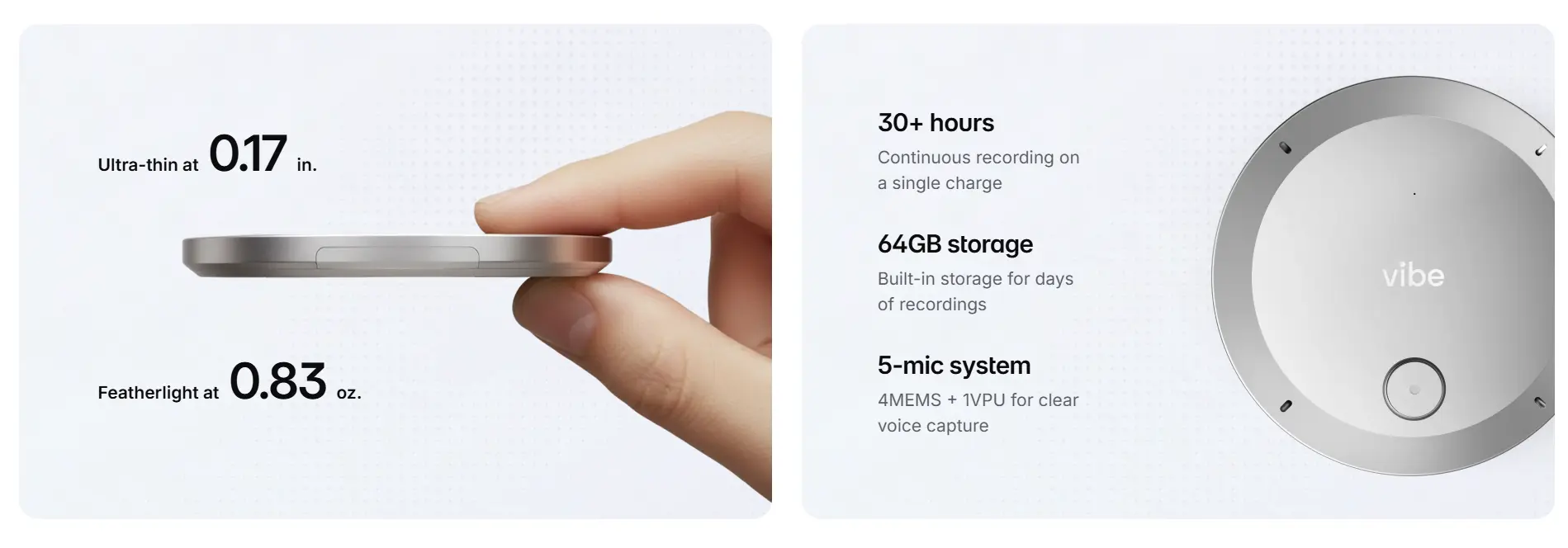 Vibe Dot specs: 0.17-inch thin, 0.83 oz, 30+ hour battery, 64GB storage, and 5-mic system for clear voice capture
Who Should Choose Which Tool
Choose Fireflies.ai if:
-
All your important meetings happen on Zoom, Teams, or Google Meet
-
You need deep, production-ready CRM integration (Salesforce, HubSpot) today — Fireflies has a mature sync; Vibe Dot’s CRM integration is on the roadmap but not yet available
-
Your team is comfortable with a visible bot in meetings
-
Budget is a primary constraint and the free tier covers your volume
-
You don’t have regulatory requirements for FERPA or NDAA
Choose Vibe Dot if:
-
Your conversations span in-person, phone, and video — not just online calls
-
You need cross-session AI memory, not just per-meeting archives
-
You operate in education or government where FERPA/NDAA certification is required
-
A visible meeting bot creates friction with clients or participants
-
You want a single device that works regardless of internet connectivity
Our Recommendation
For teams whose work happens entirely inside scheduled video calls and who need CRM-synced meeting intelligence, Fireflies.ai is a capable and well-integrated tool.
But if your conversations extend beyond the calendar — into client offices, field sites, classrooms, phone calls, or any scenario where a bot can’t follow — Vibe Dot is the more complete solution. Add the Memory Graph‘s cross-session context and FERPA/NDAA certifications, and Vibe Dot serves a broader range of professionals in a way that software-only tools structurally cannot.
The question to ask yourself: where do your most important conversations actually happen?
Frequently Asked Questions
Can Fireflies.ai record in-person meetings?
Not natively. Fireflies is designed for virtual meetings and relies on its bot or browser extension to capture calls. While users can upload pre-recorded audio files for transcription, there is no dedicated in-person recording mode.
Does Vibe Dot work with Zoom and Google Meet?
Yes. Vibe Dot captures audio from any source — including video calls played through a laptop or speakerphone — as well as in-person conversations and phone calls. It’s not limited to any platform.
Is Fireflies.ai FERPA compliant?
Fireflies offers FERPA compliance, but only on its Enterprise plan. Organizations on Free, Pro, or Business plans do not have access to the Private Storage and signed DSA required for FERPA compliance.
What is Vibe AI’s Memory Graph?
Memory Graph is Vibe AI’s cross-session memory layer. Unlike tools that store meetings as isolated records, Memory Graph builds a connected knowledge base across all your captured conversations — so you can surface context, track evolving decisions, and query your meeting history as a unified knowledge source, not a search archive.
Does Fireflies.ai work offline?
No. Fireflies requires an internet connection at all times because its transcription and AI processing happen on remote cloud servers.
How does Vibe Dot handle privacy compared to Fireflies.ai?
Vibe Dot records locally on the device before syncing, giving users control over when data leaves the device. Fireflies streams audio to its cloud infrastructure for all processing. For organizations with strict data residency requirements or sensitive audio content, Vibe Dot’s hardware-first approach offers a different privacy posture.