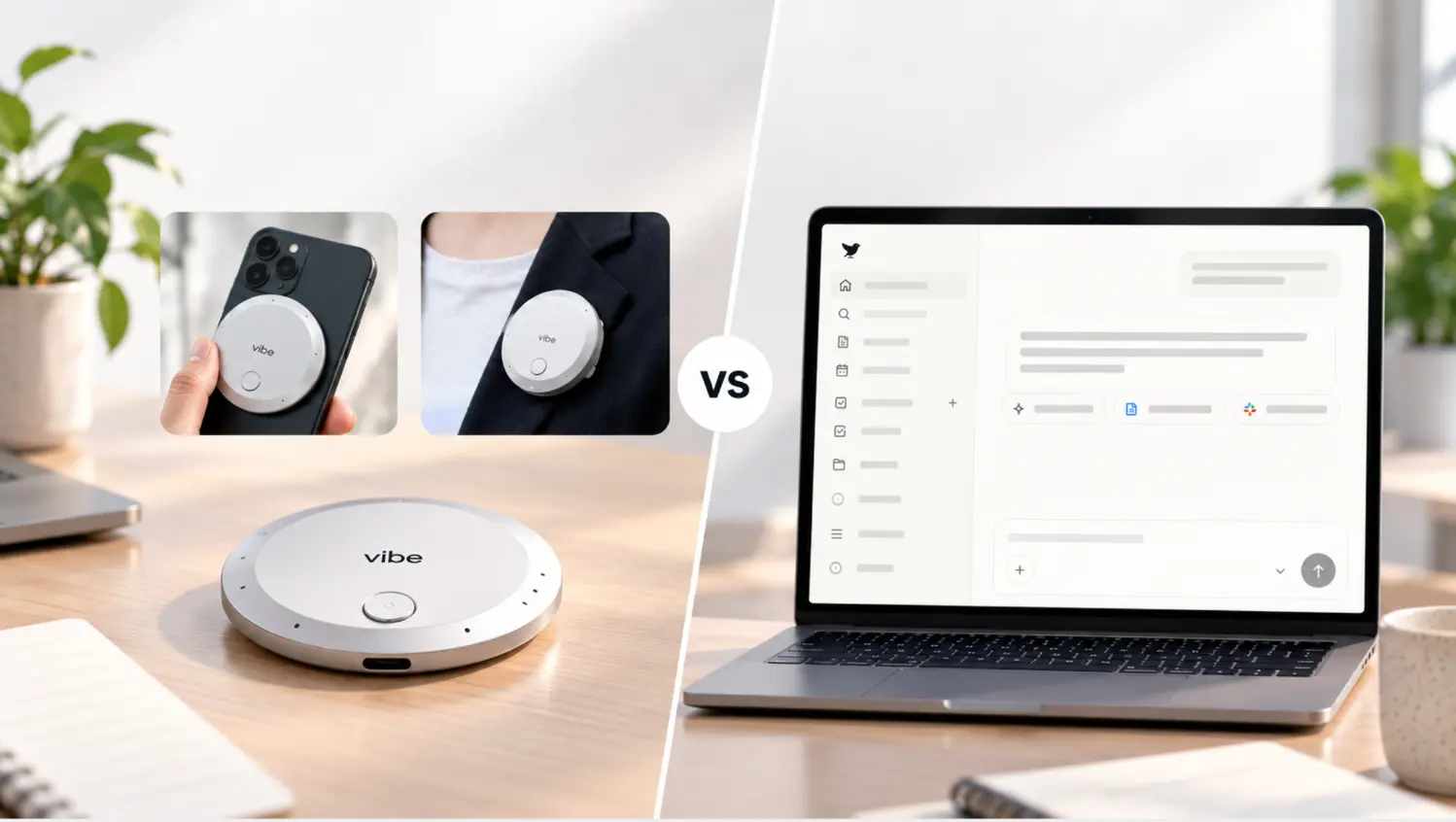

Since OpenAI introduced dots in ChatGPT on September 29, 2026, a lot of people have typed "dot AI" into a search bar and landed somewhere they didn’t expect. There are now two very different products called Dot that both promise to make your workday easier — and they’re easy to confuse.
Here’s the short version: ChatGPT Dot is an always-on software agent that does work inside your apps. Vibe Dot is a wearable device that captures the conversations your apps never see. They aren’t competitors. In fact, they solve opposite halves of the same problem.
Quick Answer: What’s the Difference?
ChatGPT Dot is an always-on AI agent inside ChatGPT. You give it a goal, connect your apps, and it keeps making progress in the background using its own cloud computer — researching, drafting, coding, and coming back to you for decisions.
Vibe Dot is a wearable AI capture device. It records conversations wherever they happen — meetings, client visits, site walks, hallway decisions — and the Vibe AI platform turns them into summaries, action items, and long-term memory you can search and ask questions about.
One acts. One listens. If your work involves both, they’re more useful together than apart.
ChatGPT Dot vs. Vibe Dot at a Glance
|
ChatGPT Dot |
Vibe Dot | |
|---|---|---|
|
What it is |
An always-on AI agent inside ChatGPT |
A wearable AI capture device + Vibe AI platform |
|
Made by |
OpenAI — the AI research lab behind ChatGPT |
Vibe — an integrated workplace solution provider built on the foundation of the Vibe Smart Whiteboard |
|
Physical form |
None — a named character or pet avatar in ChatGPT |
Clip-on device, 0.17 in thin, 0.83 oz |
|
Core job |
Execute tasks across connected apps |
Capture real-world conversations and build memory from them |
|
Where it works |
Its own cloud computer, your connected apps, optionally your computer |
Anywhere you talk — in person, in rooms, on calls, offline |
|
Where its context comes from |
ChatGPT memory and the apps you connect |
What’s actually said in your conversations |
|
Memory |
ChatGPT memory plus its own memories from connected apps |
Memory Graph: cross-session memory linking meetings, docs, and context |
|
Works offline |
No — cloud-based |
Yes — 64GB onboard storage, syncs later |
|
Availability |
ChatGPT Pro and Business Premium (eligible markets) |
Available now |
|
Price |
Included with ChatGPT Pro (from $100/month) or Business Premium |
$199 device + Vibe AI from free; Pro $9/month |
What Is ChatGPT Dot?
According to OpenAI’s help center, your dot is an always-on agent in ChatGPT that can take on ongoing responsibility and keep making progress between conversations. It’s powered by GPT-6 Astra, has its own cloud computer, and works across the apps you choose to connect.
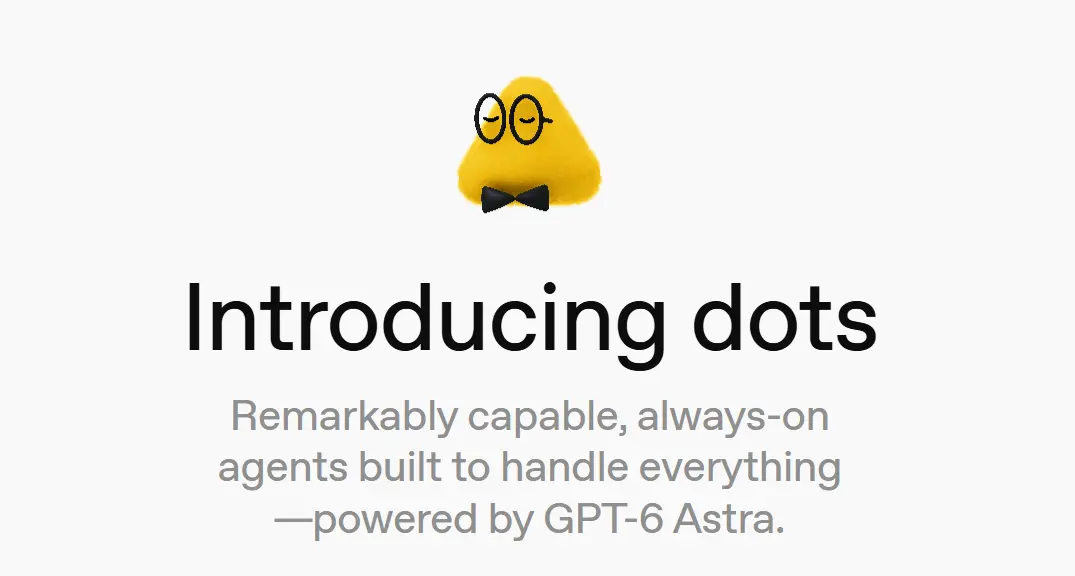 ChatGPT Dots
The idea is a shift from asking ChatGPT questions to handing it responsibilities. OpenAI’s own examples include preparing a presentation as new data comes in, turning an interview transcript into show notes and social posts, and scoping and testing a code change. You set rules for what it can do on its own, and it asks you for decisions that need your judgment.
A few practical details matter:
-
It isn’t a physical product. During setup, you choose a character or a pet for your dot — the "dot" is an avatar inside ChatGPT, not a device.
-
Its knowledge comes from connected apps. OpenAI notes that connected apps give your dot access to information it can use, and it can review that information proactively and form memories from it.
-
Access is limited at launch. Dots are rolling out to Pro users outside the EEA, Switzerland, and the UK, and to Business Premium users across supported regions, with Enterprise, Edu, and Healthcare workspaces able to try a beta if an admin enables it. Your first dot is included in the plan, and ChatGPT Pro starts at $100/month.
What Is Vibe Dot?
Vibe Dot is a wearable AI device designed to capture the conversations where work actually gets decided. It clips onto your clothing and records with a 5-microphone array (4 air microphones plus a bone-conduction sensor), holds 64GB onboard, and runs for 30+ hours on a charge. Because it records to the device first, it keeps working with no laptop open and no internet connection, then syncs when you’re back online.
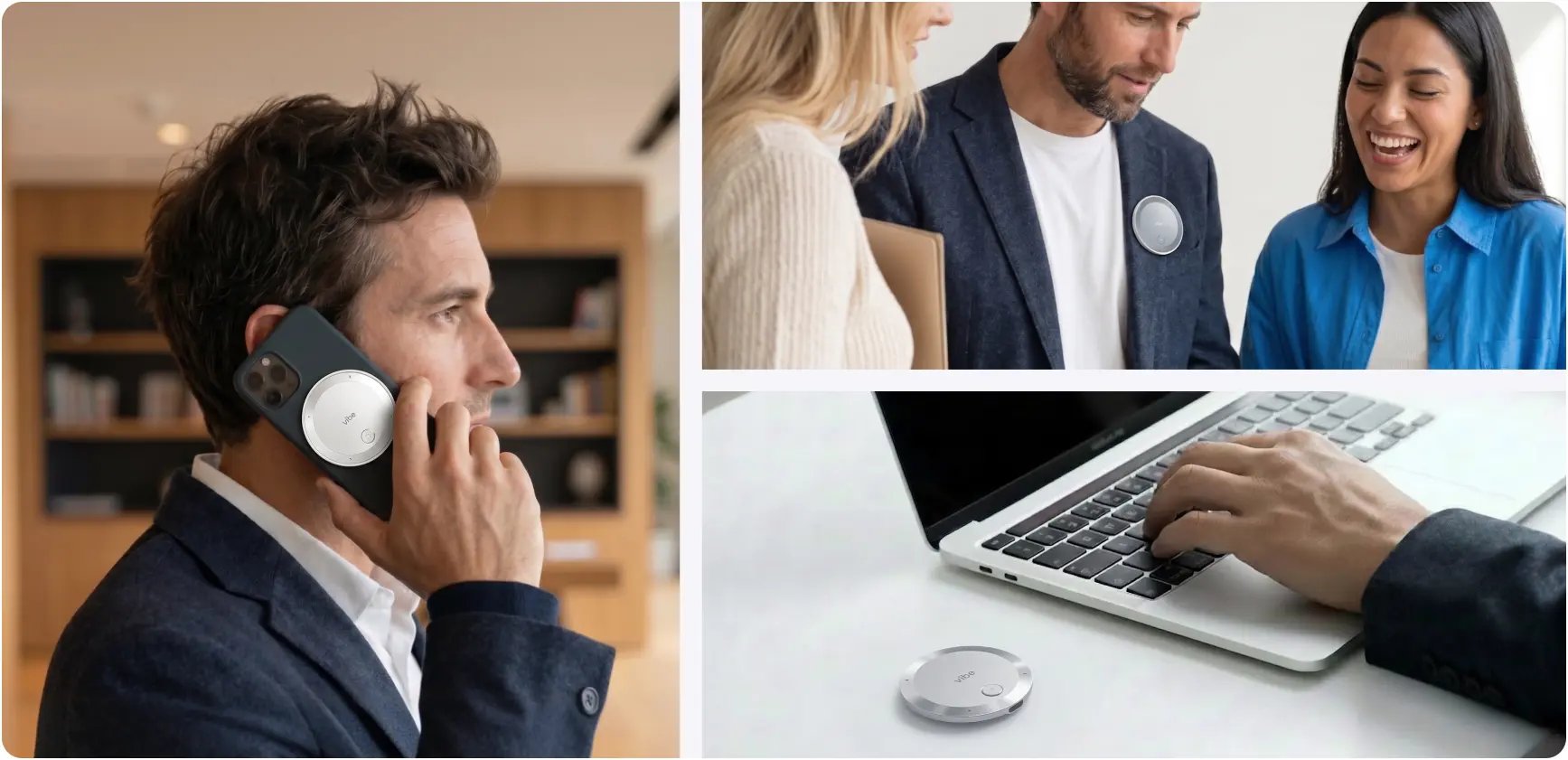 Vibe Dot
You can tap to record, or use Auto Capture (Beta) to start recording on a schedule or when it recognizes your voice. Recordings are protected by a dedicated hardware encryption chip (FIPS 140-3, Common Criteria EAL 6+), and Vibe Dot carries SOC 2, HIPAA, FERPA, and NDAA certifications.
The Vibe AI platform is where captured conversations become useful:
-
Memory Graph links your meetings, documents, and context across sessions, so the AI understands an ongoing project or client relationship — not just one meeting.
-
Ask AI answers questions across your whole meeting history, like "What did the client say about budget in our last three calls?"
-
Smart catch-up briefings get you up to speed before a follow-up.
-
Summaries and action items are generated after every conversation.
The Real Difference: One Acts on Information, One That Actually Knows Your Work
The easiest way to understand these two products is to ask where each one gets its information.
ChatGPT Dot is extraordinarily capable inside the digital world. If something lives in your email, Slack, calendar, files, or a website, your dot can find it, work with it, and act on it. But it can only work with what reaches those apps.
That’s a bigger limitation than it sounds. Microsoft’s Work Trend Index found that 57% of meetings are ad hoc calls without a calendar invite — and that doesn’t count the decisions made over coffee, at a client’s office, or on a job site. Those conversations shape the work, but none of them land in a connected app unless someone captures them.
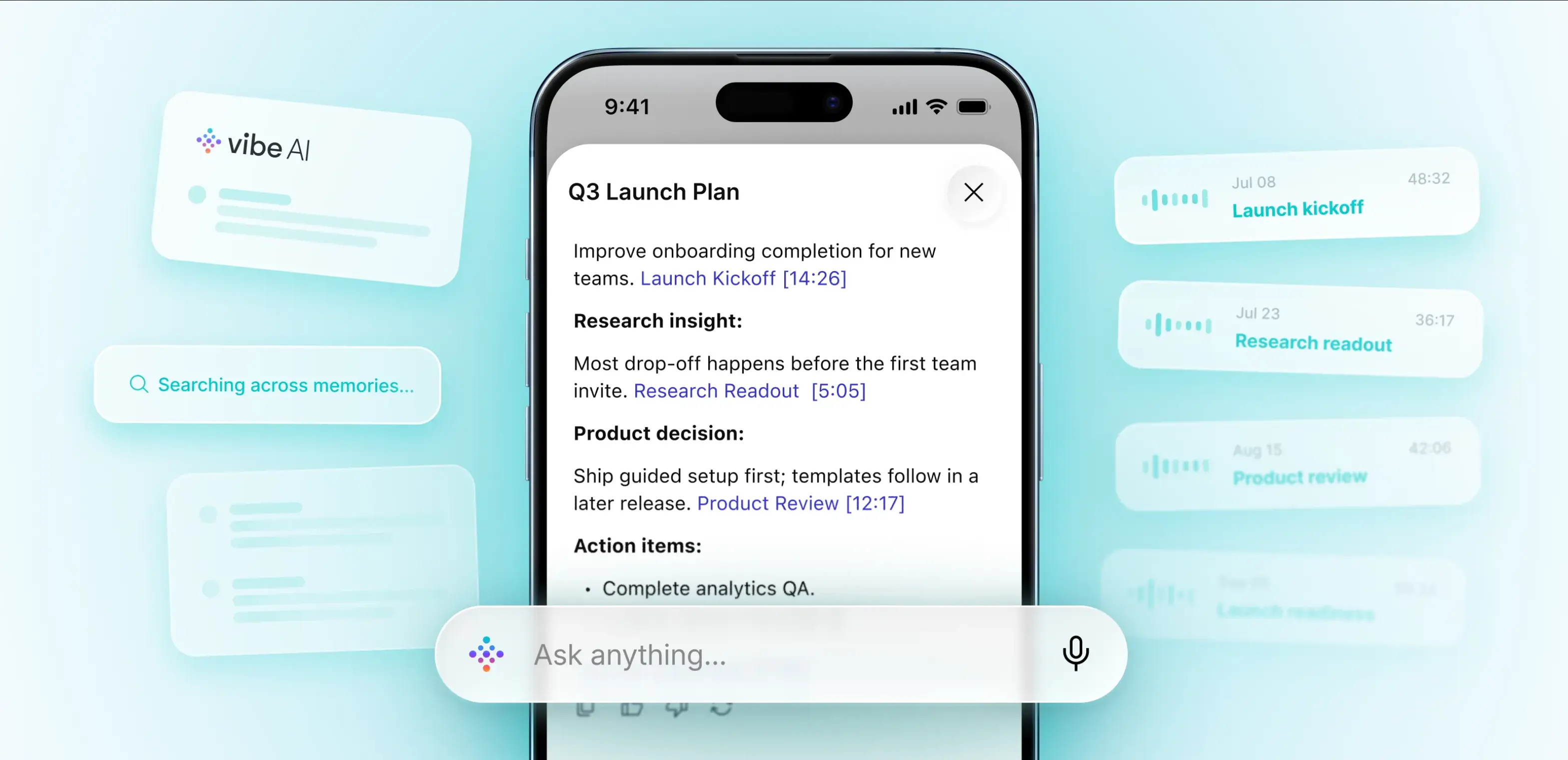
This is where most people underestimate what Vibe Dot actually does. It isn’t a recording device that produces audio files. It’s the layer that turns your real-world conversations into structured, searchable, AI-ready memory — so your entire AI stack stops depending on you to remember, summarize, and paste in the context it needs.
 Vibe AI
Every time you use ChatGPT Dot to draft a proposal, prep for a call, or scope a project, it’s working from whatever context it has access to. Vibe Dot’s Memory Graph expands that context to include what was actually said — across weeks of client calls, site visits, and team discussions — linked and queryable, not buried in a recording. The result isn’t just better transcripts. It’s an AI that genuinely knows your work.
Put simply:
-
ChatGPT Dot answers: "What should happen next, and can I do it for you?"
-
Vibe Dot answers: "What actually happened — and makes sure your AI already knows."
Why They Work Better Together
Look closely at one of OpenAI’s own example uses for a dot: turning an interview transcript into show notes and social posts. It’s a perfect agent task — but it starts with a transcript. Someone has to capture the interview first.
The same pattern shows up across real work:
-
A consultant runs a two-hour discovery workshop at a client site. Vibe Dot captures it. Afterward, an agent can draft the proposal — but only if it knows what the client actually asked for.
-
A sales lead has three in-person meetings with an account over a quarter. Vibe Dot’s Memory Graph keeps the thread of what changed. An agent preparing the renewal deck needs that history.
-
A product manager makes a scope decision in a hallway conversation. Vibe Dot records it. An agent updating the launch plan should know the scope changed.
In each case, the capture layer supplies the context and the agent layer does the follow-through.
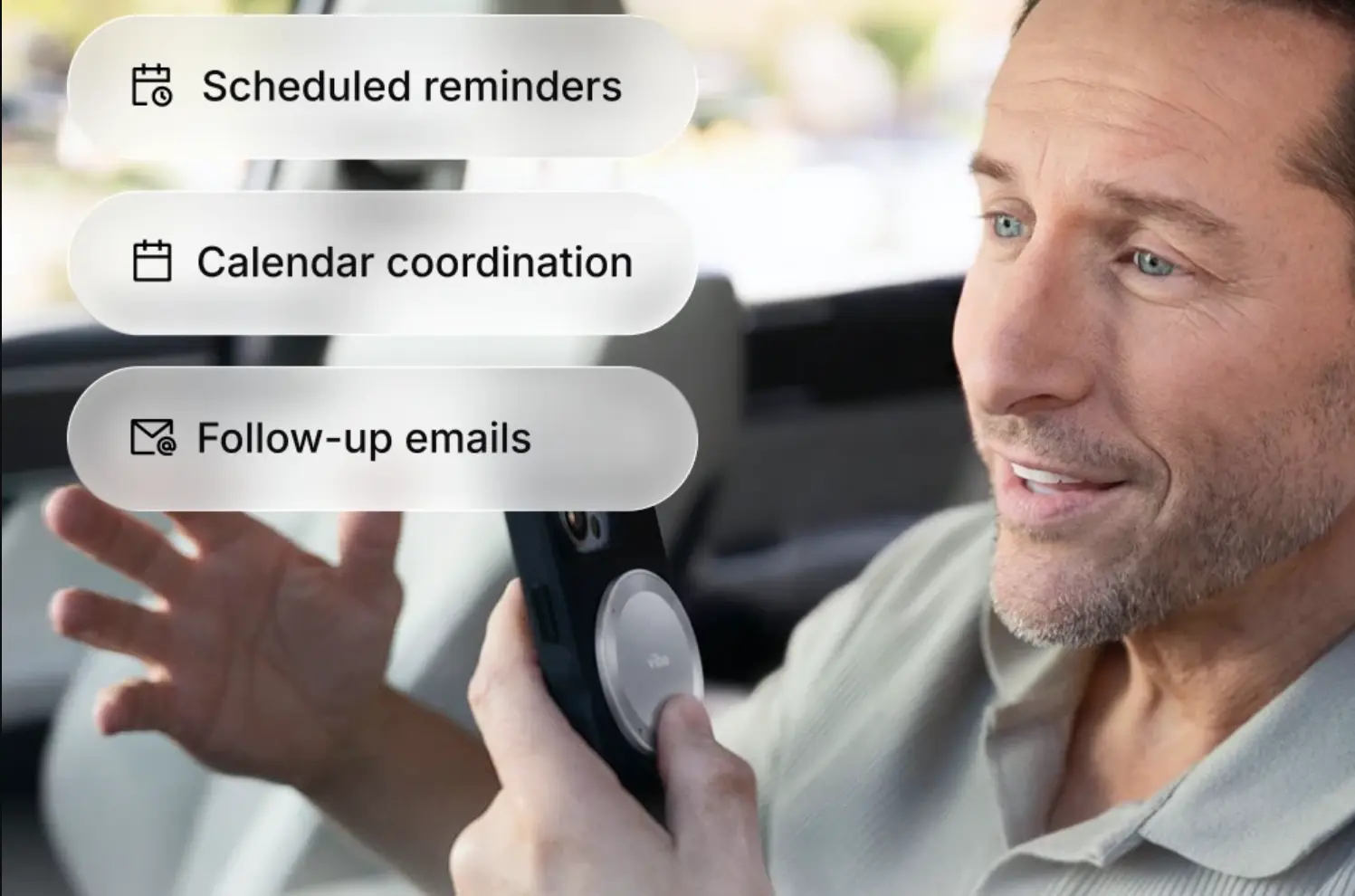
Connecting the two. Vibe AI offers an MCP connection that MCP-capable assistants, including ChatGPT, can use to look up your meetings, transcripts, and summaries on request. OpenAI notes that your dot’s Plugins screen uses shared ChatGPT settings, though available apps may differ — so if Vibe AI is available among your dot’s connected apps, your dot can pull what was actually said in your meetings instead of relying on what you remember to paste in. Either way, Vibe AI’s own Ask AI and Memory Graph give you that cross-meeting context directly.
Which Dot Do You Need?
ChatGPT Dot may be the right fit if:
-
You already pay for ChatGPT Pro or Business Premium, or are ready to
-
Most of your work lives in digital tools — email, documents, code, Slack, the web
-
You want an agent that keeps projects moving in the background and checks in for decisions
Vibe Dot is the right fit if:
-
Your important conversations happen in person, in conference rooms, or across different meeting platforms
-
You need an AI that remembers what was said across weeks or months, not just in one session
-
You work offline or in places with unreliable connectivity
-
Your organization needs hardware-level encryption and certifications like HIPAA, FERPA, or NDAA
Both, if: you want an agent to act on your work and you want it to know what actually happened in the conversations behind that work. For a broader view of how capture fits alongside general assistants, research tools, and embedded AI, see our guide to the best AI assistant tools for work.
The Bottom Line
The shared name is a coincidence, but the timing isn’t. Always-on agents like ChatGPT Dot are the newest stage in how AI fits into work — a shift we trace in the evolution of AI meeting assistants. The more capable agents become, the more their results depend on the context they’re given.
ChatGPT Dot is built to act. Vibe Dot is built to make sure the conversations that matter are never lost. If you’re choosing between them, the real question is which half of the problem you’re trying to solve — and for many professionals, the answer is both.
Frequently Asked Questions
Is Vibe Dot related to ChatGPT Dot?
No. Vibe Dot is a wearable AI capture device made by Vibe, while ChatGPT Dot is an always-on AI agent inside ChatGPT made by OpenAI. They share a name but do different jobs: Vibe Dot captures real-world conversations and builds memory from them, and ChatGPT Dot executes tasks across your connected apps. They can be used together.
Is ChatGPT Dot a physical device?
No. A ChatGPT dot is software — an AI agent inside ChatGPT with its own cloud computer. During setup you choose a character or pet avatar for it, but there’s no hardware. If you’re looking for a physical AI device that records conversations, Vibe Dot is a wearable built for that purpose.
Can ChatGPT Dot record my meetings?
ChatGPT Dot works from ChatGPT memory and the apps you connect, such as email, calendar, and Slack. It isn’t designed to sit in a room and capture an in-person conversation. To bring meeting content into your AI workflow, you need a capture tool — for example, Vibe Dot records the conversation and Vibe AI turns it into transcripts, summaries, and searchable memory.
How much does ChatGPT Dot cost compared to Vibe Dot?
Your first ChatGPT dot is included with ChatGPT Pro, which starts at $100 per month, or with Business Premium. Vibe Dot is a one-time $199 device, with Vibe AI plans starting free (300 minutes per month), Pro at $9 per month, and Max at $29 per month for unlimited transcription and memory.
Can I use Vibe Dot and ChatGPT Dot together?
Yes, they’re complementary. Vibe Dot captures what’s said in your conversations, and Vibe AI supports MCP connections with assistants including ChatGPT, letting them look up your meetings and summaries on request. Available connected apps for dots can vary by account, so check your dot’s Plugins settings. Vibe AI’s Ask AI also answers questions across your meeting history directly.
Is ChatGPT Dot available everywhere?
Not yet. At launch, dots are available to ChatGPT Pro users outside the European Economic Area, Switzerland, and the UK, and to Business Premium users in supported regions. Enterprise, Edu, and Healthcare workspaces can access a beta if an admin turns it on. Rollout is gradual, so access may take time to appear.