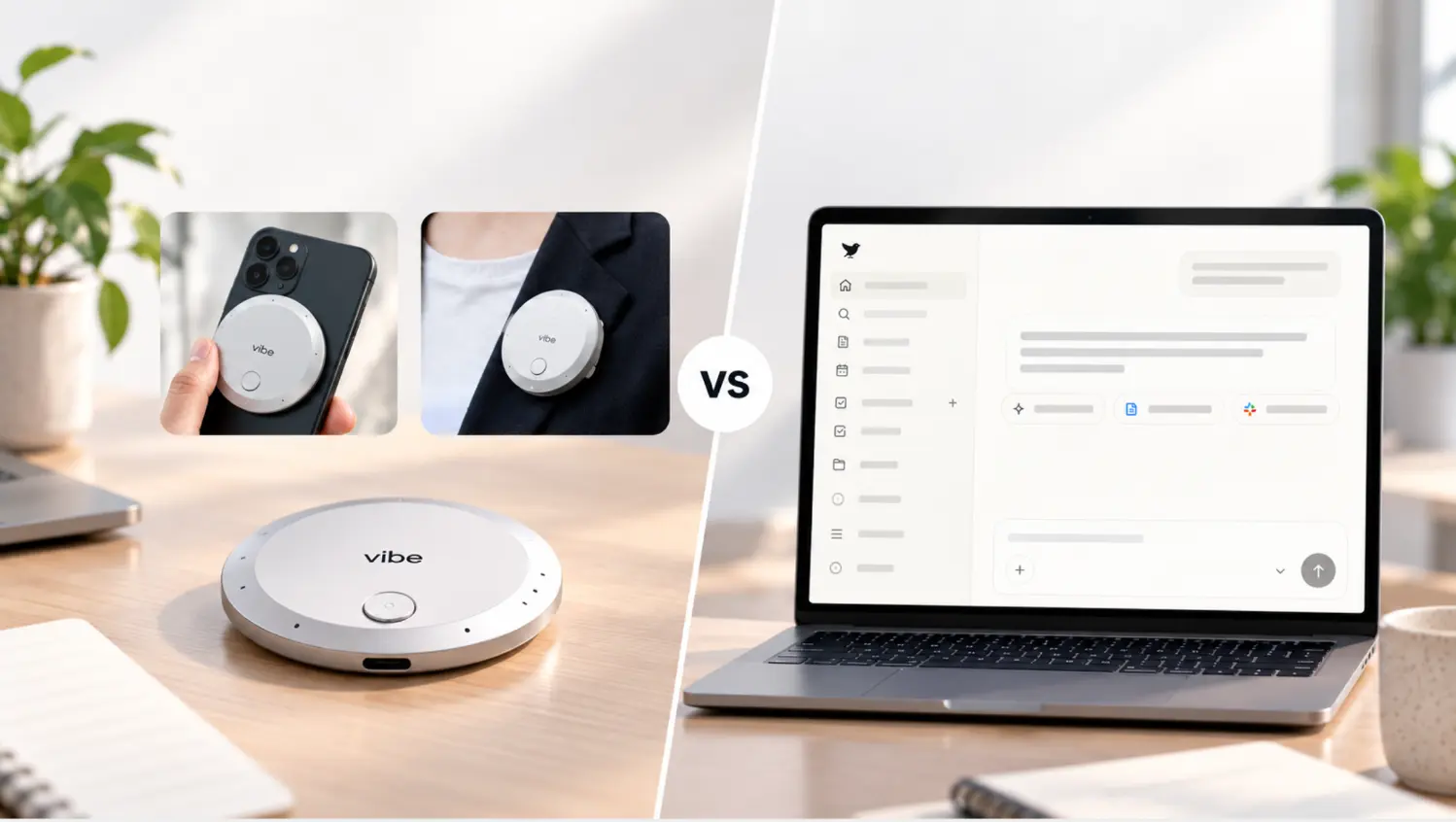

Meta closed its Connect 2026 keynote with a surprise: Muse Charm, a keychain-sized device for its Muse AI agent. If you're weighing Muse Charm vs Vibe Dot, the short answer is that they're built for different jobs. Muse Charm is a pocket companion you talk to; Vibe Dot is a wearable AI device that captures, transcribes, and remembers your real conversations, then acts on them — turning what was said into follow-ups, briefings, and next steps across the tools you already use. And you can buy it today.
We build AI hardware at Vibe, so we followed the announcement closely. Below, we compare only what Meta has confirmed publicly, flag what's still unknown, and help you decide which device matches how you actually work.
Quick Answer: Muse Charm or Vibe Dot?
-
Choose Muse Charm if you want a fun, always-available way to chat with Meta's Muse agent without pulling out your phone, and you're happy to wait until the holidays.
-
Choose Vibe Dot if you need accurate records of meetings, calls, and in-person conversations, searchable AI memory across sessions, and enterprise-grade compliance — available now.
Meta Muse Charm vs Vibe Dot at a Glance
|
Meta Muse Charm |
Vibe Dot | |
|---|---|---|
|
Primary purpose |
Talk to and interact with your Muse AI agent |
Capture, transcribe, and remember conversations |
|
Availability |
Expected December 2026 |
Available now |
|
Price |
Not yet announced |
$199 device + free Starter plan |
|
Form factor |
Keychain / pocket puck, roughly Apple Watch-sized |
0.83 oz, 0.17 in wearable |
|
Screen |
Yes — animated avatar |
No |
|
Camera |
Yes |
No |
|
Microphones |
Yes (count not announced) |
5-mic array incl. bone conduction |
|
Battery life |
Not yet announced |
30+ hours |
|
Onboard storage |
Not yet announced |
64 GB |
|
How you activate it |
Tap the fingerprint sensor |
Tap to Record or Auto Capture (Beta) |
|
Transcripts & summaries |
Not announced |
Yes, with industry templates |
|
Long-term memory |
Through the Muse agent |
Memory Graph across sessions |
|
Integrations |
Meta ecosystem |
Slack, Notion, Gmail, HubSpot and more (rolling out); MCP access for ChatGPT, Claude, Gemini, Cursor |
|
Compliance |
Not yet published |
SOC 2 Type 2, HIPAA, FERPA, NDAA, FIPS 140-3 |
Muse Charm details: Meta, Engadget, CNBC.
What Is Meta Muse Charm?
Muse Charm is Meta's first dedicated hardware for Muse, the personal AI agent the company launched earlier in September. Meta describes it as a device that connects you to your agent by voice, touch, and camera.
Mark Zuckerberg revealed it as the "one more thing" at the end of the Meta Connect keynote on September 23, 2026. Here's what's confirmed so far:
-
Size and carry: About the size of an Apple Watch, designed to hang from a keychain or slip into a pocket, with a fingerprint sensor, a small avatar screen, speakers, and microphones.
-
Interaction: Tap the fingerprint sensor in the corner and start talking; an animated, interchangeable avatar represents your Muse on screen. Reviewers have widely compared it to a Tamagotchi.
-
Core promise: Talk to your agent without unlocking a phone or opening an app. Zuckerberg called it the fastest way to reach Muse when you're not wearing Meta's glasses.
-
Status: Not in mass production. Meta has built only a handful of units and is still finalizing materials and component layout.
The momentum behind it is real: the Muse app launched September 8 and quickly passed ChatGPT as the top free iOS app.
What Is Vibe Dot?
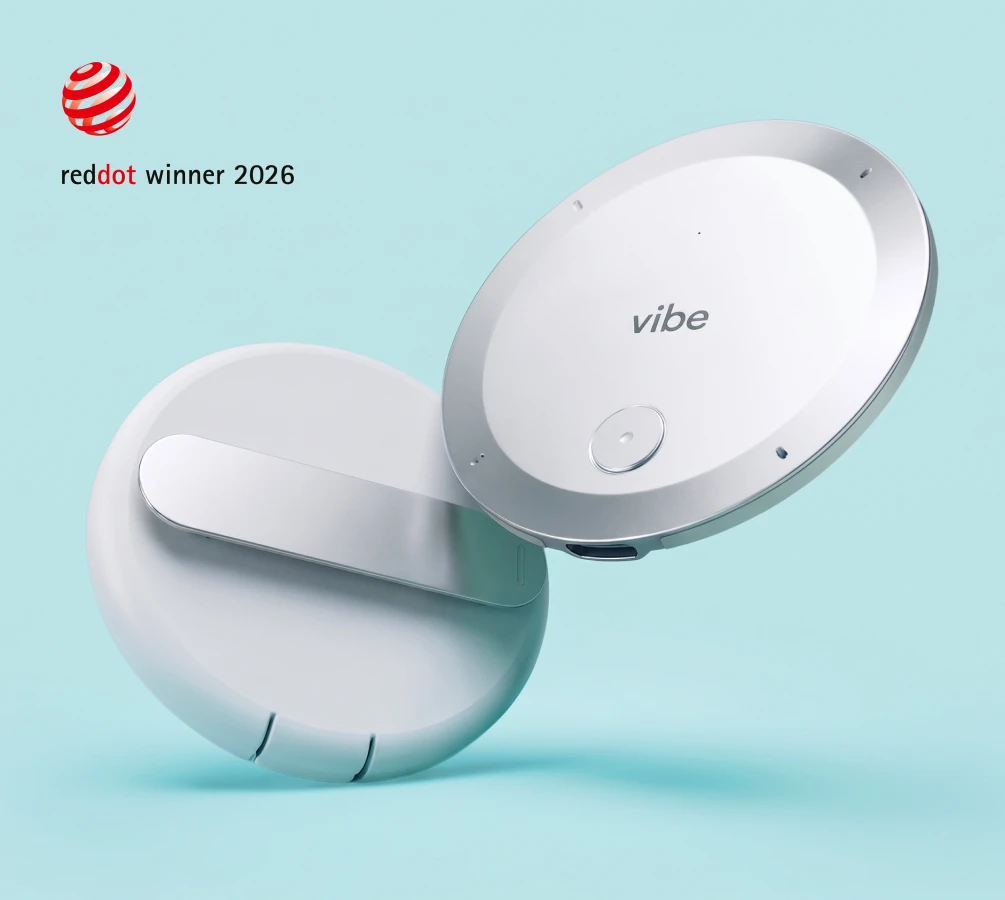
Vibe Dot is a wearable AI device. It records the conversations that matter — client meetings, sales calls, lectures, site walks, one-on-ones — and turns them into transcripts, summaries, and action items you can search and question later.
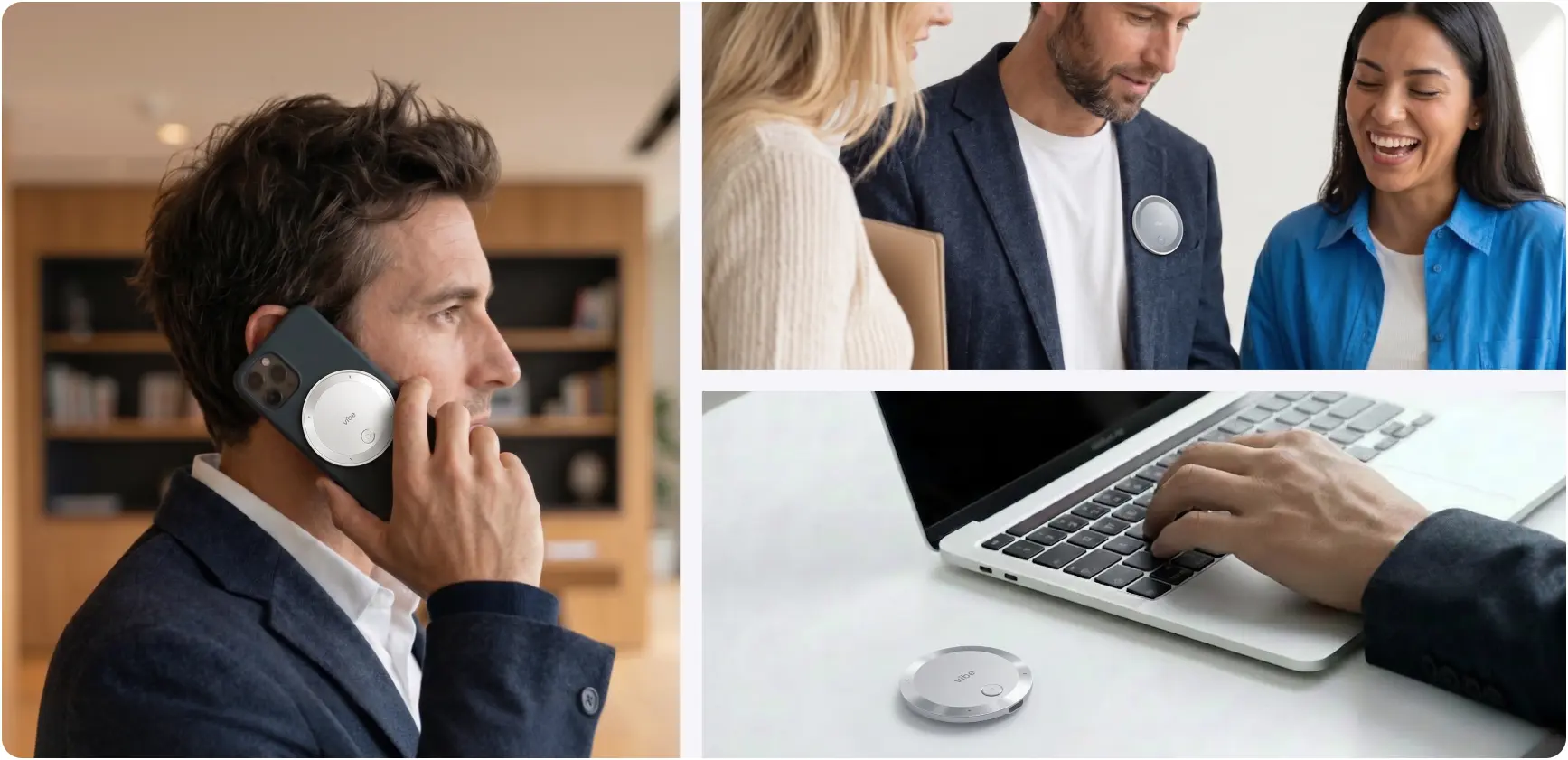 Vibe Dot used in phone calls, meetings, and at a desk
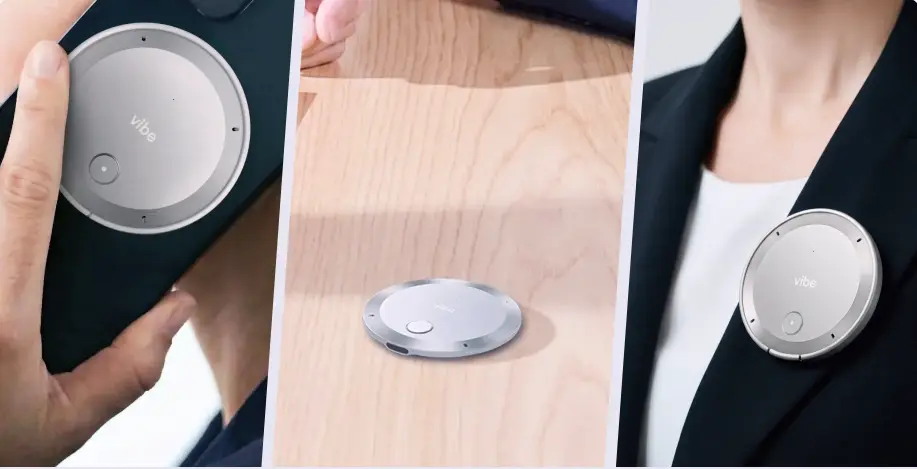
The device is deliberately minimal: 0.83 oz, 0.17 inches thin, with a 5-mic array (four air mics plus one bone-conduction mic), 64 GB of onboard storage, and 30+ hours of battery. It won the Red Dot Design Award in 2026.
What makes Vibe Dot different is the intelligence layer behind it. Every recording flows into Vibe AI, which links meetings, documents, and conversations over time, so you can ask, "What did the client say about budget in our last three calls?" and get an answer grounded in what was actually said.
Different Jobs: AI Companion vs Personal AI Work Assistant
The most useful way to compare these devices isn't spec by spec. It's by the job each one is hired to do. Muse Charm is designed as a personal companion for everyday life. Vibe Dot is designed as a personal AI work assistant, built around the full range of situations you actually work in.
Meta Muse Charm: a pocket companion for your agent
Meta Muse Charm is built around conversation with the AI. You customize your Muse — its name, avatar, even its accent and speaking pace — and the Charm gives that character a physical body you can carry and glance at. In Meta's keynote demo, Zuckerberg asked his Muse to find time on his calendar and book a session, showing the agent handling tasks on request.
That makes it a strong fit for quick questions, personal errands, and casual interaction — the moments when you'd otherwise reach for your phone.
Vibe Dot: a personal AI work assistant, designed for every part of your workday
Vibe Dot is built around the conversations your work depends on, and around what has to happen after them. Instead of waiting for you to ask, it captures the context of your workday and turns it into work that moves forward.
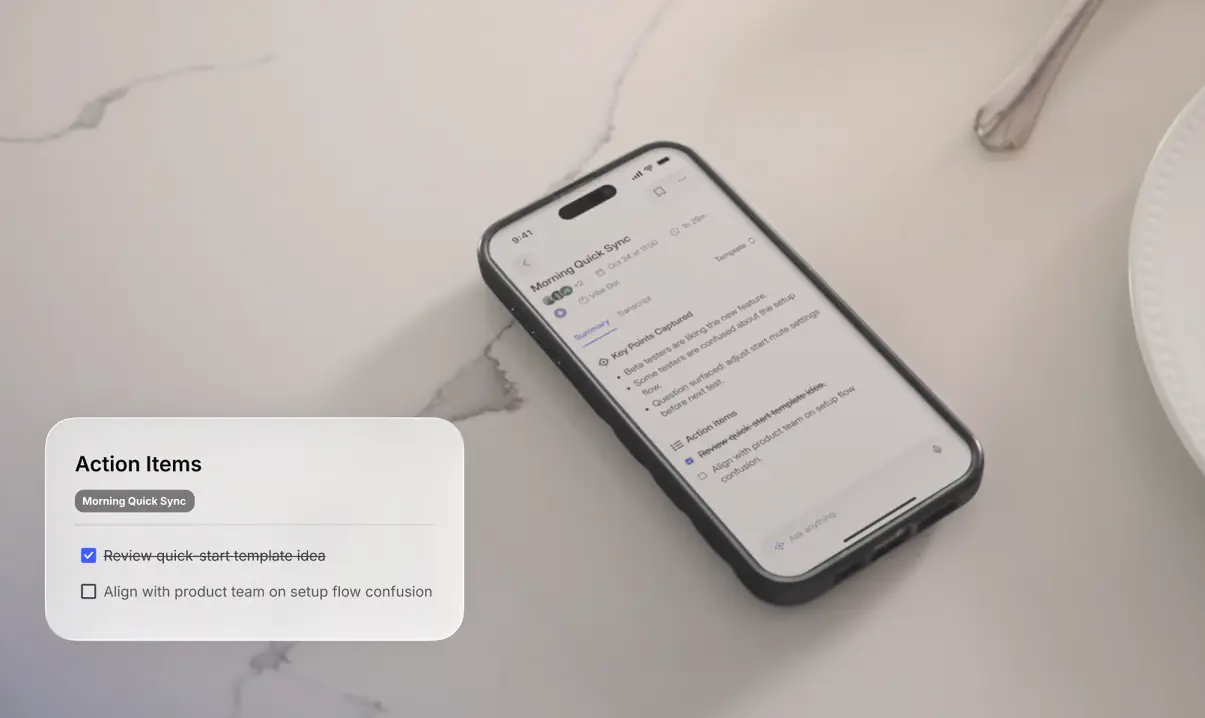 Vibe AI mobile app showing meeting summary, key points, and action items from a Morning Quick Sync recorded via Vibe Dot
Designed for every work setting, not just the conference room:
-
Meetings and calls: In the office, hybrid, or on the phone, double-tap to start with Tap to Record and mark key moments as they happen.
-
In-person and on the move: Client visits, site walks, interviews, and hallway conversations are captured by a 0.83 oz wearable with a 5-mic array and 30+ hours of battery.
-
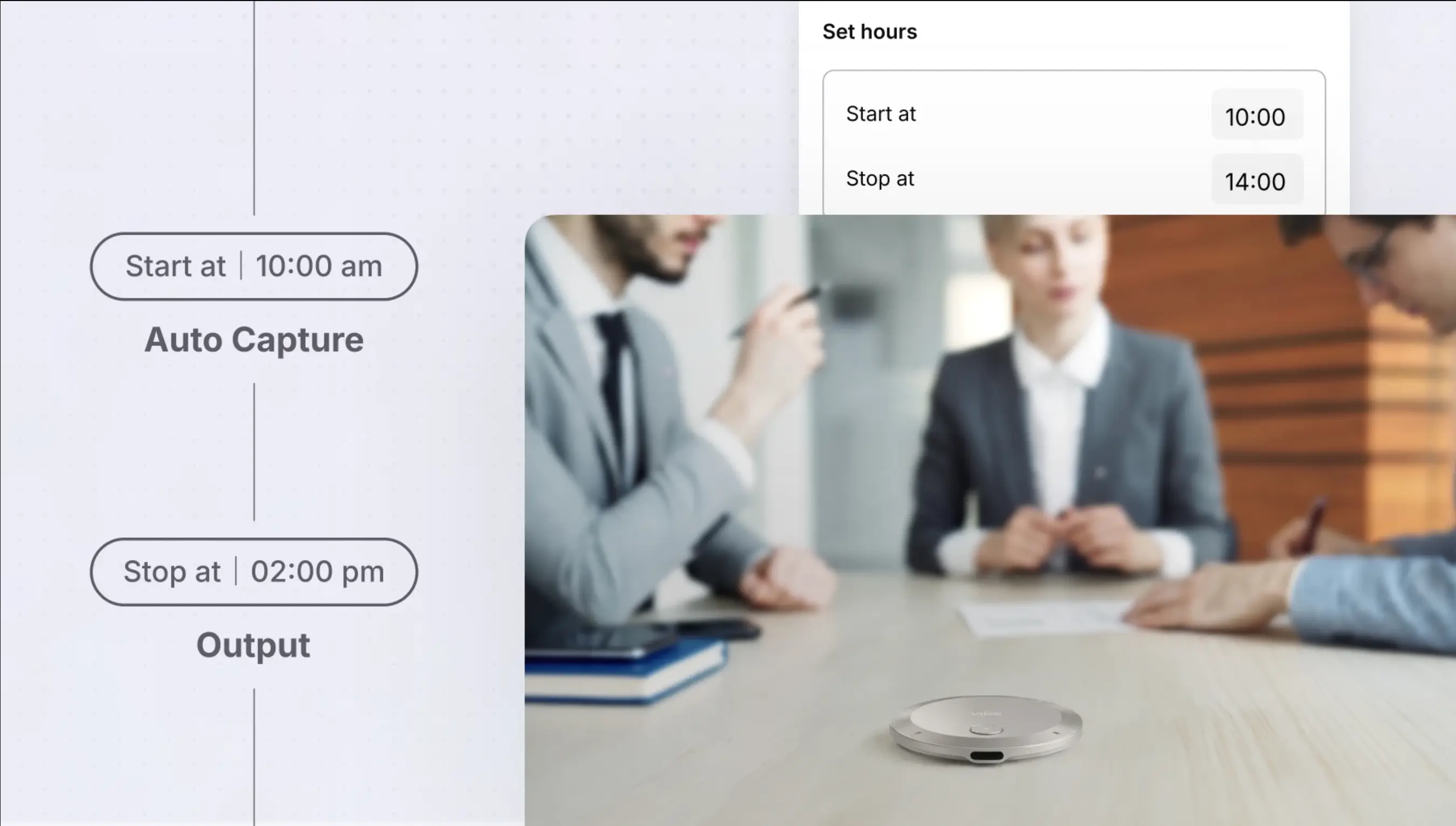
Hands-free days: Auto Capture (Beta) can start recording when it recognizes your voice, or run on a schedule you set, so nothing depends on remembering to press a button.
Built to act, not just record:
-
Memory Graph connects meetings, documents, and conversations over time, so context carries from one week to the next.
-
Ask AI searches your full meeting history. Ask "What did the client say about budget in our last three calls?" and get answers grounded in what was actually said.
-
Proactive task agent turns conversations into follow-ups and next steps, and smart catch-up briefings get you up to speed before your next meeting.
-
Workflow integrations with Slack, Notion, Gmail, Outlook, HubSpot, and more are rolling out, plus MCP access so tools like ChatGPT and Claude can pull your meeting context on request.
Built for professional standards: Vibe Dot provides real-time summaries with industry templates, plus SOC 2 Type 2, HIPAA, FERPA, and NDAA certifications for teams in regulated fields.
A concrete example: A regional sales manager runs six customer meetings in a day, most of them in person. Vibe Dot captures each one without a laptop on the table. By evening, she has summaries, action items, and follow-ups ready for every account. Before a call next month, she asks Vibe AI what that customer raised last time and gets a briefing in seconds, with no digging through notes.
Where each one falls short
To be fair to both:
-
Vibe Dot has no screen, no camera, and no avatar. It's built for work, not for chatting with an AI character. If that's what you want, it's the wrong device.
-
Muse Charm has not been announced with transcription, meeting summaries, or recording features, and Meta hasn't shared battery life, connectivity, or whether it needs a paired phone (Shane the Gamer). Those details may change before launch.
Privacy and Compliance
If you plan to use an AI device at work, data handling matters as much as features.
Vibe Dot includes a dedicated hardware encryption chip (FIPS 140-3, Common Criteria EAL 6+). Vibe AI is SOC 2 Type 2 and HIPAA attested by Prescient Assurance, and Vibe Dot also holds FERPA and NDAA certifications — important for education, healthcare, and government-adjacent teams. Customer data is not used to train AI models, and admins get granular per-thread permissions and user-controlled retention policies.
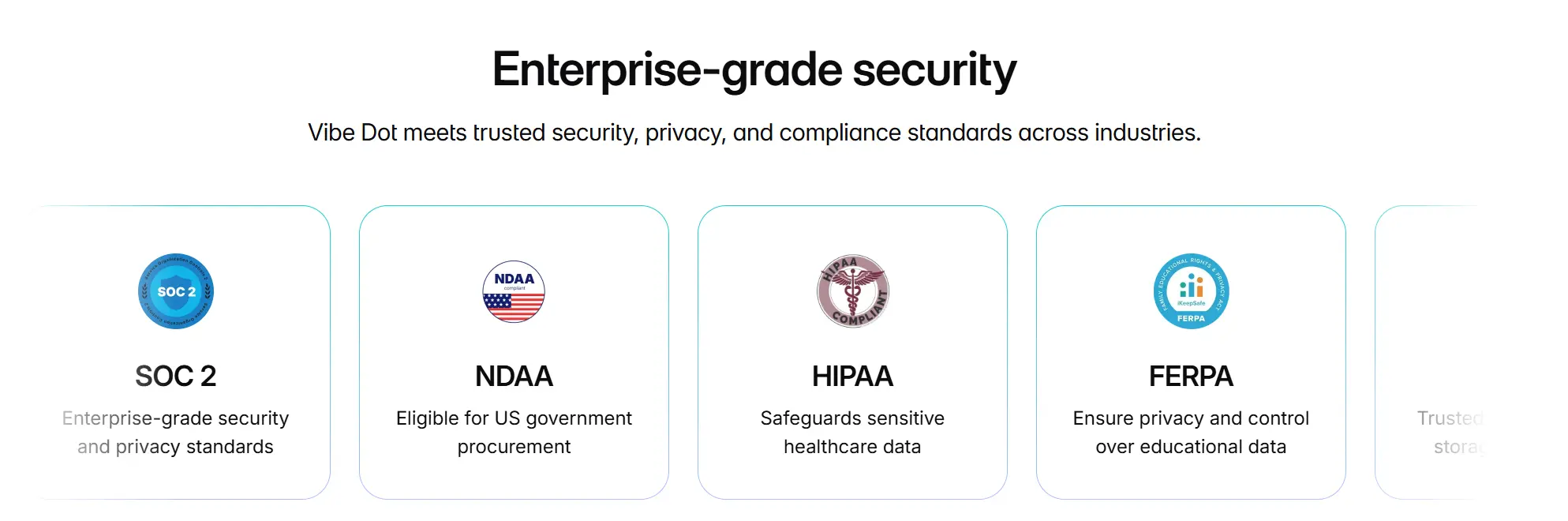 Vibe Dot's security stack — hardware encryption chip, SOC 2 Type 2, HIPAA, FERPA, NDAA badges
Muse Charm: Meta has not yet published privacy, security, or data-handling details specific to the device. The company's product page invites sign-ups for launch updates but doesn't yet list specifications. Organizations evaluating it for workplace use should review Meta's documentation once it's available.
Availability and Price
|
Muse Charm |
Vibe Dot | |
|---|---|---|
|
Ships |
Targeting December 2026 |
Available now |
|
Device price |
Not yet announced |
$199 |
|
Software plans |
Not yet announced |
Starter: free (300 min/month) · Pro: $9/month (1,200 min/month) · Max: $29/month (unlimited transcription) |
Meta says it's aiming to ship Muse Charm in time for the holidays but hasn't committed to a firm date or price.
Which Should You Choose?
Muse Charm is likely the better fit if you:
-
Already use Meta's Muse app and want faster, phone-free access to it
-
Value a playful, personalized AI character
-
Mainly need quick answers and personal task help
-
Don't mind waiting for launch details
Vibe Dot is the better fit if you:
-
Spend your day in meetings, calls, or client conversations
-
Need reliable transcripts, summaries, and action items
-
Want AI that remembers context across weeks and months of conversations
-
Work in a regulated field such as healthcare, education, legal, or government
-
Need a device now, not in December
Can you use both? Yes. They don't compete for the same moment: one is an assistant you talk to, the other captures the conversations you have with other people.
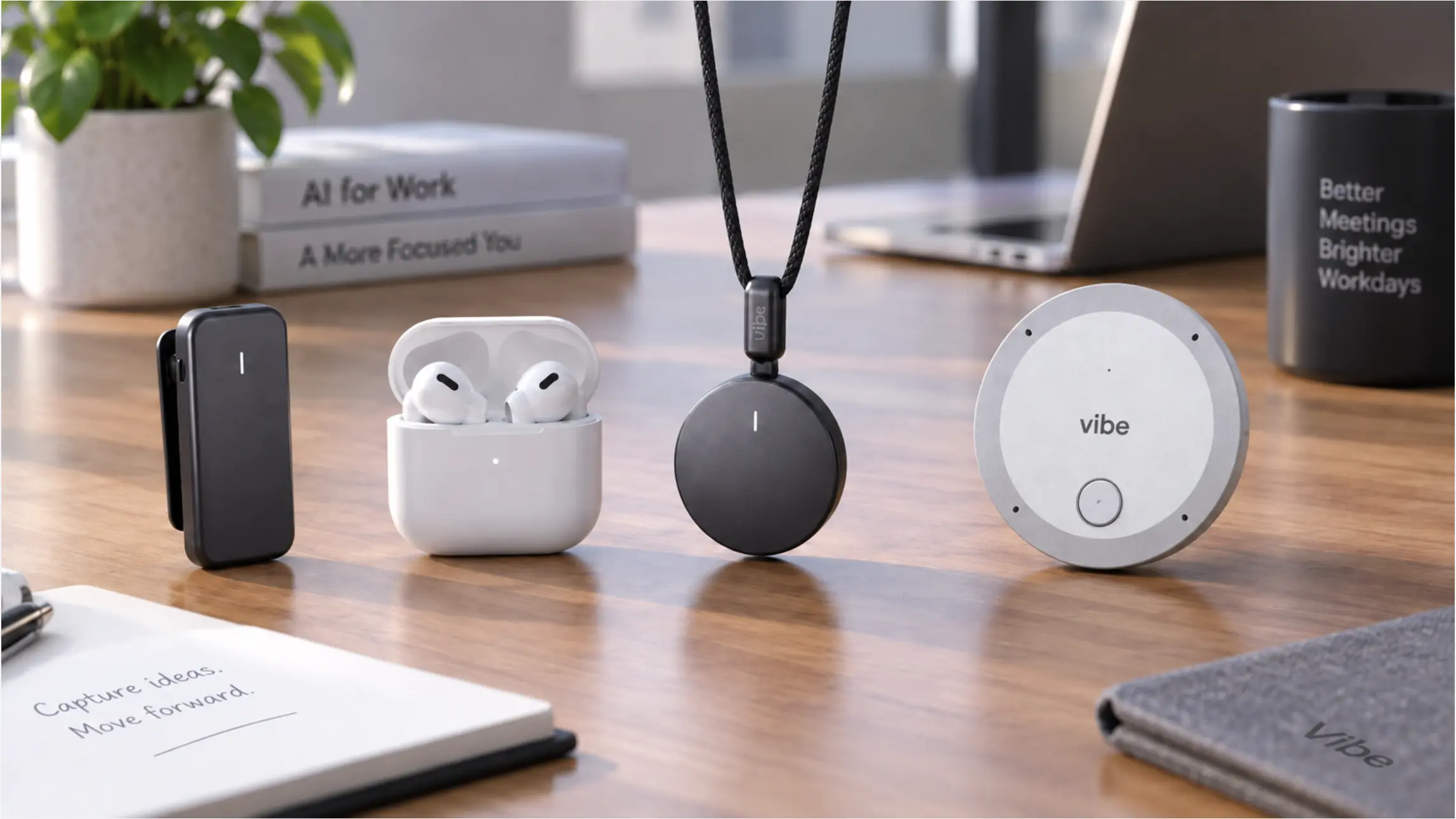
The Bottom Line
Meta Muse Charm is an intriguing new take on AI hardware: a charming, always-ready way to talk to Meta's agent, arriving this holiday season with key details still to come. Vibe Dot solves a different problem — capturing your real conversations and turning them into lasting, searchable memory — and it's ready now.
If your days are full of meetings and client conversations, you don't need to wait until December.
Frequently Asked Questions
Is Meta Muse Charm a voice recorder?
Based on what Meta has announced, no. Muse Charm is designed for talking to and interacting with your Muse AI agent, using a fingerprint sensor, speakers, microphones, a camera, and an avatar screen. Meta has not announced meeting recording, transcription, or summary features. If you need a device that records and transcribes conversations, a dedicated AI device such as Vibe Dot is built for that job.
When does Meta Muse Charm come out?
Meta says it's planning to ship Muse Charm in time for the holidays in December 2026. The device was unveiled at Meta Connect on September 23, 2026, but it isn't in mass production yet — Meta has built only a few units and is still finalizing materials and components. No firm release date has been announced, and interested buyers can sign up for updates on Meta's website.
How much does Meta Charm cost?
Meta hasn't announced a price for Muse Charm. At Meta Connect 2026, the company shared pricing for its new VR Glasses ($1,299) but not for the Charm. Pricing will likely be revealed closer to the December launch window. For comparison, Vibe Dot costs $199 and includes a free Vibe AI Starter plan with 300 transcription minutes per month.
Can Meta Muse Charm transcribe meetings?
Meta has not announced transcription or meeting-summary features for Muse Charm. Its confirmed role is giving you fast, phone-free access to your Muse agent for conversation and tasks. Vibe Dot, by contrast, transcribes meetings and in-person conversations, generates AI summaries with industry templates, and lets you ask questions across your full meeting history through Vibe AI's Memory Graph.
What's the best AI device for meeting notes right now?
For professionals who need meeting notes today, Vibe Dot is a strong choice: it's available now, weighs 0.83 oz, lasts 30+ hours, and captures audio with a 5-mic array including bone conduction. Its Memory Graph connects context across sessions, and it holds SOC 2 Type 2, HIPAA, FERPA, and NDAA certifications. Muse Charm isn't shipping until December and hasn't been announced with note-taking features.
Does Meta Muse Charm need a phone to work?
Meta hasn't said. The company hasn't detailed Muse Charm's connectivity, battery life, or whether it must pair with a smartphone. Zuckerberg emphasized that it lets you talk to Muse without unlocking your phone or opening an app, but that describes the interaction, not the technical setup. Expect clarification closer to the holiday launch.