
A senior engineer wraps up a two-week site visit and shares a critical insight: the client makes decisions in hallway conversations after formal meetings, not in the review room. Three months later, that engineer leaves. The insight lives nowhere except fragmentary recollections, and the account team walks into the next review blind.
This is the institutional memory problem. Every time someone leaves, the context they held, the why behind decisions, the shortcuts, the relationships, vanishes unless captured. Most of it was not. In 2019, Gallup estimated the cost of voluntary turnover in the U.S. at $1 trillion annually, the most recent comprehensive national estimate of its kind. The problem is not the people leaving. The problem is that what they knew never had a place to stay.
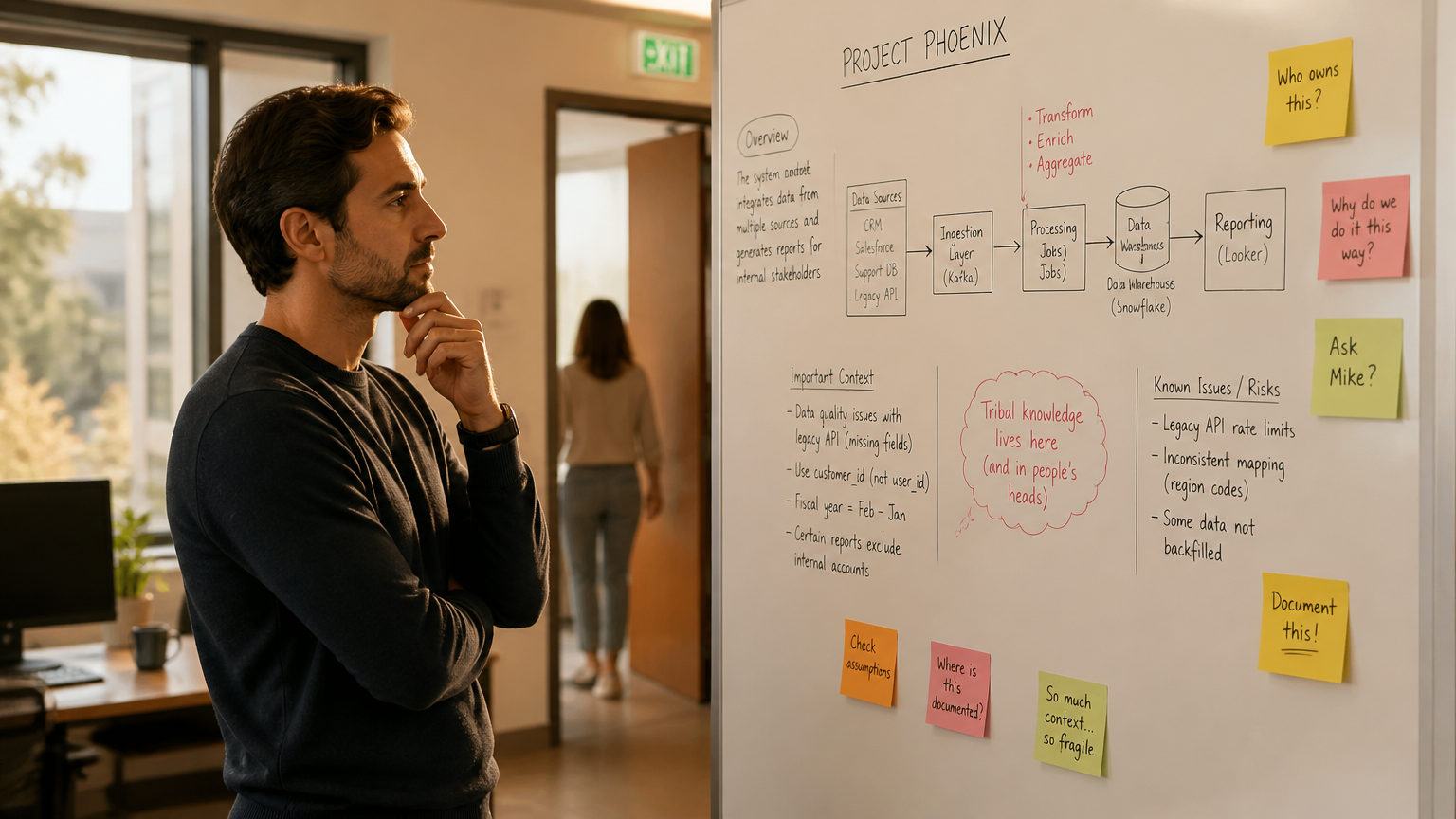 Professional in a modern office looking thoughtfully at a whiteboard covered with diagrams and sticky notes, warm natural lighting, suggesting both value and fragility of captured knowledge
What Is Institutional Memory?
Institutional memory includes three layers: explicit (documented in wikis, docs, and manuals), tacit (held in people’s heads, learned through experience), and embedded (woven into culture, habits, and workflows). The tools that most organizations use capture only the first layer.
Industry estimates widely cited in knowledge management literature, including APQC benchmarking research, suggest that 70–80% of enterprise knowledge is tacit, never written down, existing only in employees’ heads and embedded in practice. That means wikis, knowledge bases, and shared drives capture, at best, the remaining 20–30%. What actually makes work work, how to navigate internal politics, which vendor delivers on time, why a decision was made, lives in the second and third layers.
This reframes the problem. Better documentation does not solve institutional memory loss because documentation only captures explicit knowledge. What organizations lose when someone leaves is the context that documentation cannot hold, judgment calls, shortcuts, the "by the way" redirects that prevent dead ends. Capturing that requires something different.
What Institutional Memory Loss Actually Costs
The financial impact of institutional memory loss shows up in three places: the cost of turnover, the cost of searching for information that should already exist, and the cost of onboarding replacements who take months to reach productivity.
The cost of turnover is substantial. The cost of replacing an individual employee can range from one-half to two times their annual salary, according to Gallup. Replacing a knowledge worker costs 50–200% of their annual salary, according to the Society for Human Resource Management (SHRM) and Gallup research.
Knowledge workers spend roughly 20% of their workweek, nearly one full day, searching for information they should already have access to, according to McKinsey Global Institute research on the social economy. New hires in knowledge-intensive roles take 8–12 months to reach full productivity, per SHRM research, largely because they are reconstructing what their predecessors already knew. Building an effective onboarding process shortens that window, but only when the predecessor’s knowledge was captured in the first place.
In a 50-person team, that 20% search overhead translates to roughly 400 hours of lost productivity per week (50 people × 40-hour week × 20% = 400 hours), the equivalent of 10 full-time employees doing nothing but looking for information.
Where Team Knowledge Actually Leaks: Four Capture Gaps
Institutional memory does not disappear all at once. It leaks through four consistent gaps: off-calendar conversations, meeting rooms, visual collaboration, and the retrieval layer.
The Ebbinghaus Forgetting Curve shows that people forget roughly half of new information within the first hour, 70% within 24 hours, and 90% within a week, per Ebbinghaus’s original memory research. Applied to meeting content, most of what was discussed on Monday is gone by Friday, unless captured in real time.
The four-gap framework gives organizations language to diagnose where their memory leaks. A company with meticulous meeting notes but no capture of hallway conversations has a gap-one problem. A company with recordings scattered across email, chat, and cloud drives has a gap-four problem. Most organizations have all four.
Gap 1: The Conversation That Never Made the Calendar
The most consequential knowledge often surfaces in moments no calendar invite captures: the hallway check-in after a meeting, the client site visit where someone mentions what the purchasing committee cares about, the side conversation that changes how a feature gets built.
Estimates suggest roughly 90% of what an organization knows exists only in people’s heads, a figure traced to Davenport & Prusak’s foundational KM work Working Knowledge (Harvard Business School Press, 1998) and since widely validated in enterprise knowledge research.
Consider a common pattern: In one product team’s post-mortem, the engineers spent two days reconstructing the rationale for a three-year-old architecture decision. The original reasoning existed only in the head of an engineer who had left eight months earlier, and no one had asked.
The gap is not that organizations fail to document on purpose. The gap is that the knowledge worth documenting surfaces in moments designed to be informal, and asking people to take notes after an unscheduled conversation expects them to remember what they said. Wearable AI recorders are the hardware class built for this gap, they capture speech in context without requiring a deliberate documentation step.
Vibe Dot is the capture device for these moments. It clips to a lapel, snaps to a phone, or sits in a pocket, 0.83 ounces and designed to disappear into the day. Three recording modes let users match the mode to the moment: a quick press-and-hold for spontaneous memos (Spark), a double-tap for conversations worth capturing in full (Tap to record), or a pre-scheduled standby mode for recurring contexts (Auto). With 64GB of storage and 30-plus hours of battery life, it captures across a full workday without becoming a task. Every capture is automatically transcribed, summarized, and tagged with action items, then fed into Vibe AI’s memory threads so the insight that surfaced in a hallway on Tuesday is still retrievable in a meeting on Friday.
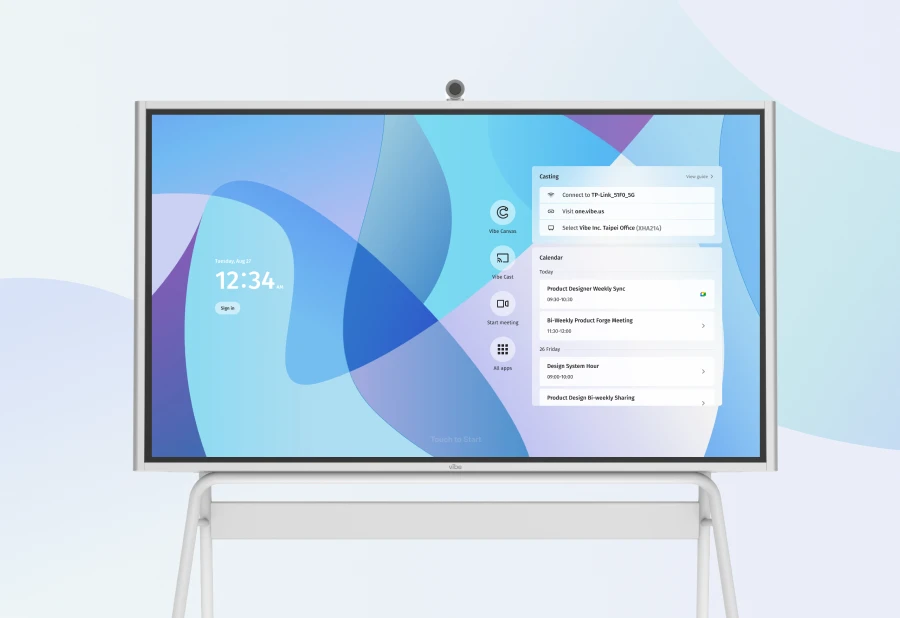
Gap 2: The Meeting Room That Doesn’t Remember
Employees spend an average of 11.8 hours per week in meetings, per Fellow’s 2025 Meeting Benchmark Report, yet only 37% end with a documented decision, according to Flowtrace data. Participants forget the bulk of what was discussed within days, and action items fall through the cracks unless someone manually writes them down. AI meeting assistants address the capture side of this gap, but most stop at the meeting room.
The meeting-room gap has two parts: capture (recording what happened) and distribution (making it accessible). A meeting that produces a decision no one can find is a meeting that did not happen.
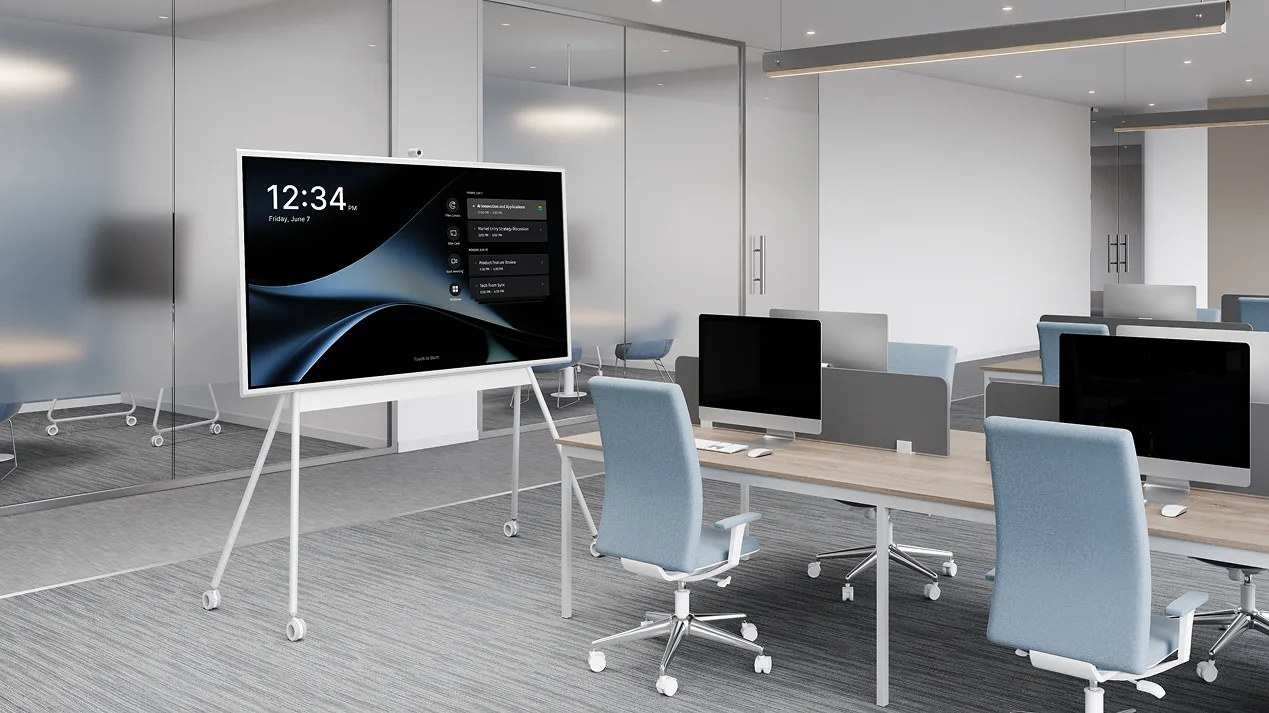
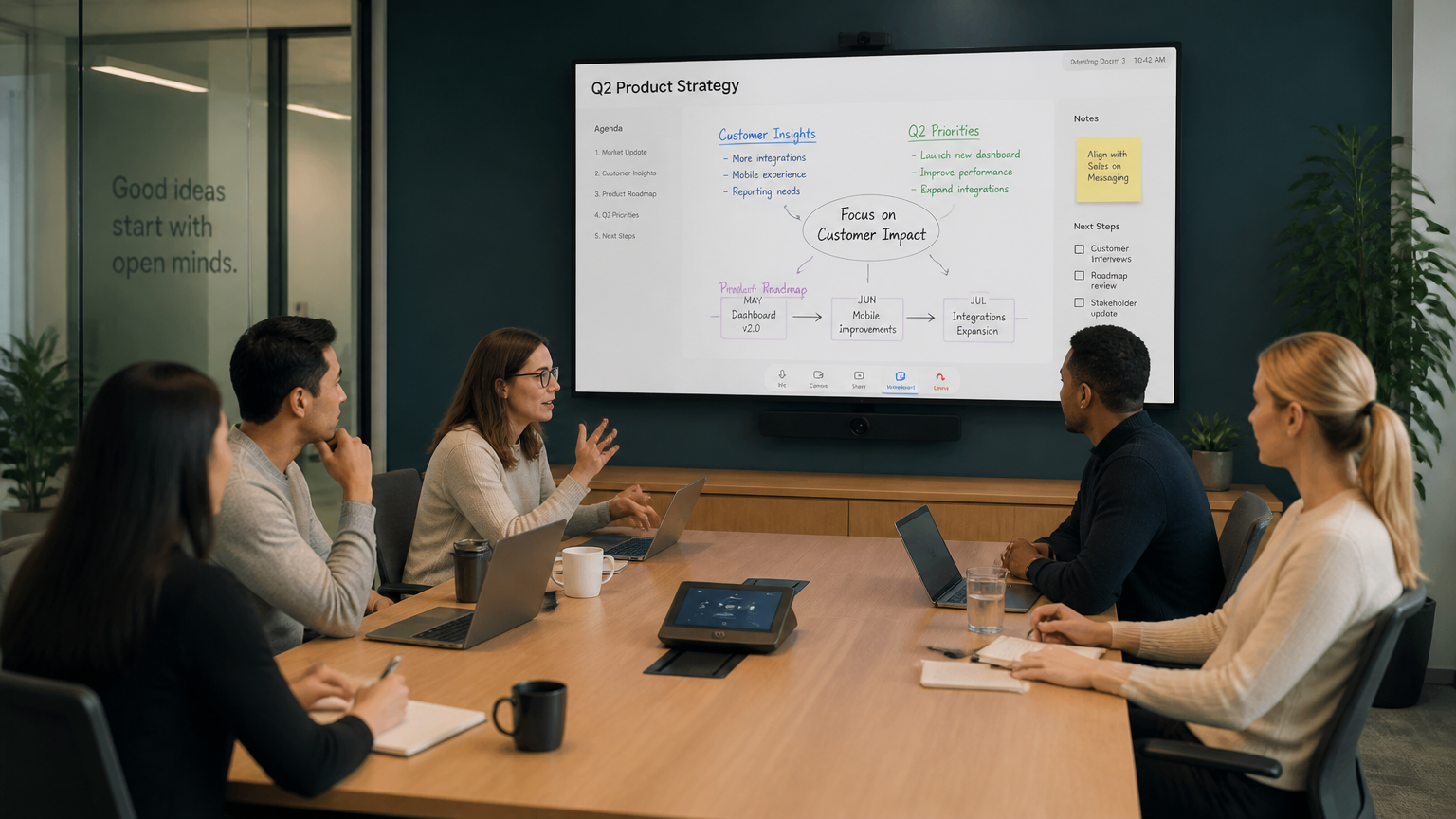 Modern meeting room with Vibe Board smart whiteboard on the wall, team members seated around conference table, professional environment
Vibe Bot is a portable 4K conferencing device for meeting-room capture. Running VibeOS, it offers AI auto-framing, AI tracking, and AI audio for Microsoft Teams Rooms, Zoom Rooms, and Google Meet. The device pairs 4K video with speaker detection and automatic transcription, creating a record of what was said without requiring a designated note-taker.
Vibe Board S1 and S1 Pro, 55″ and 75″ interactive smart whiteboards, serve as both the visual collaboration surface and the capture device. With 4K touch displays, infinite canvas whiteboarding, and cloud-saved sessions, the Board captures the meeting plus the visual context, the diagrams, annotations, and sketches that text summaries miss. Board sessions are automatically saved to the cloud, so the sketch from Monday’s session is still there on Friday when someone needs to reference it.
Together, Vibe Bot and Vibe Board create a room-level system that captures what happened, what was decided, and what was drawn, not because someone remembered to document it, but because the room itself remembers.
Gap 3: The Whiteboard That Gets Erased
Strategic decisions made on a whiteboard, the cluster diagram, the product roadmap sketch, the post-mortem cause map, carry context that a text summary cannot reproduce. The spatial relationship between items matters. The annotations and arrows matter. The topology of the thinking matters.
Most whiteboards get erased. A photo helps, but photos lose context. A typed summary helps less. Visual collaboration that vanishes at the end of a session is a structural gap in institutional memory.
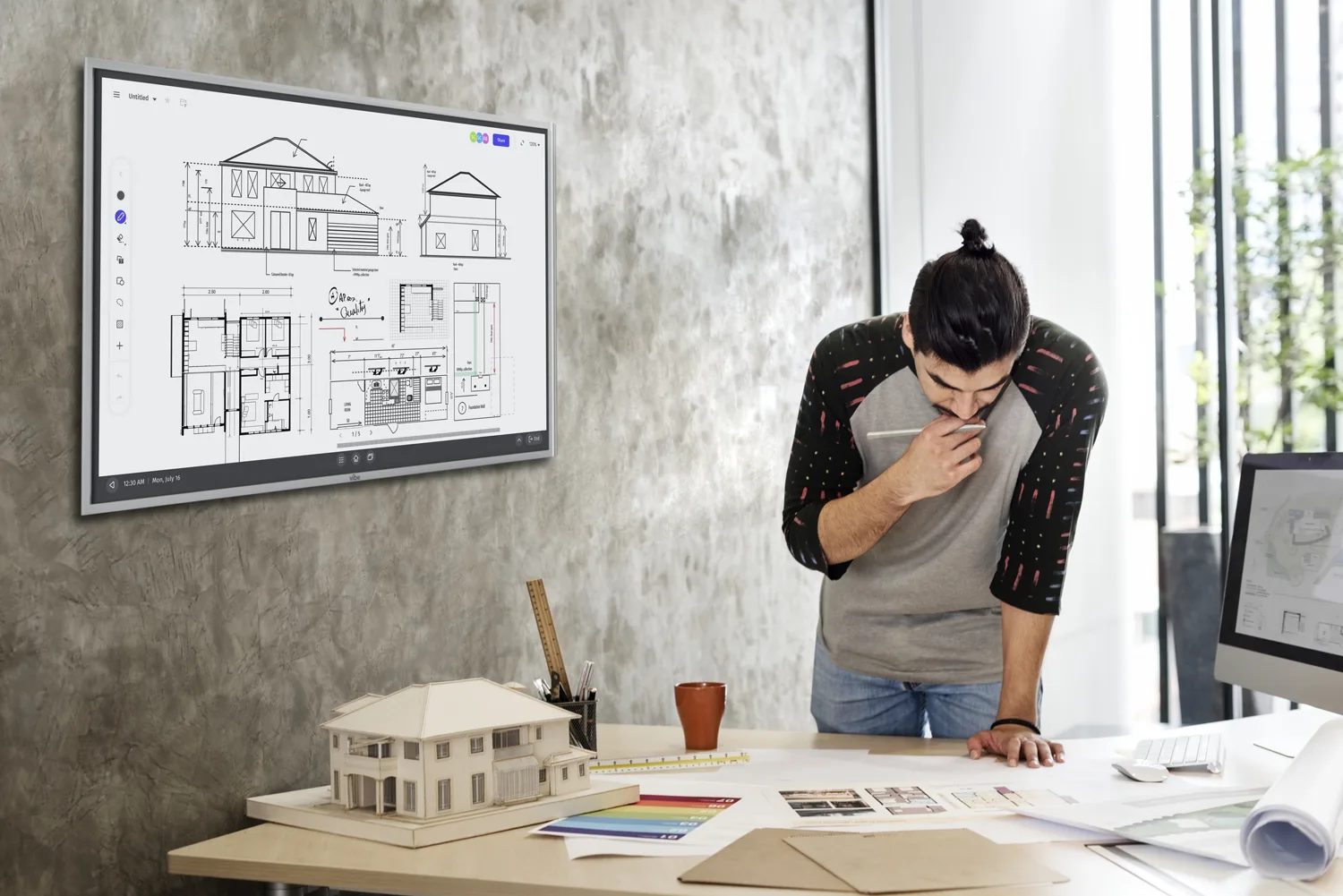
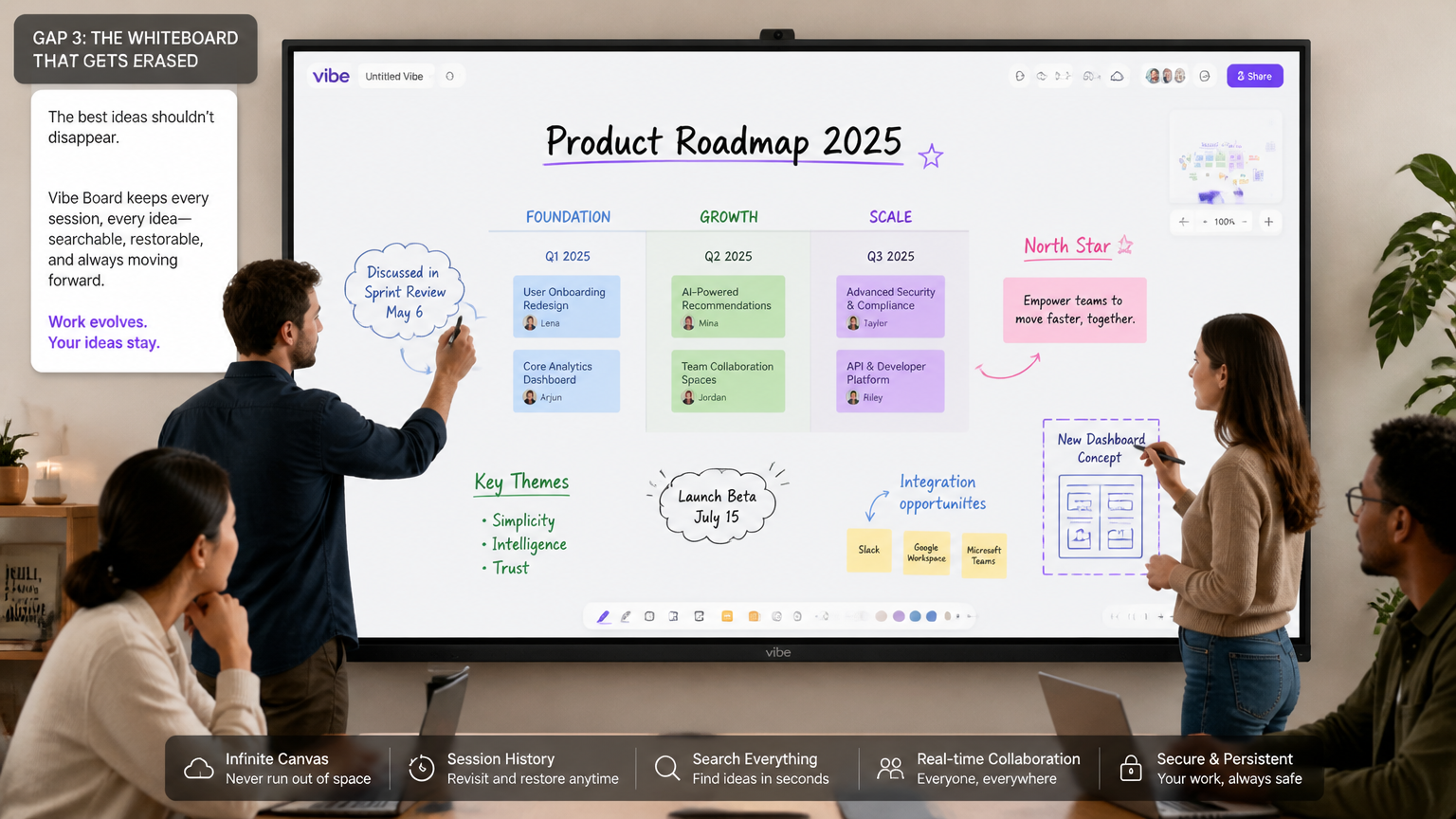 Vibe Board 75-inch smart whiteboard with annotated product roadmap and cluster diagram, infinite canvas visible, collaborative session in progress
Vibe Board S1 and S1 Pro address this gap directly. The 55″ and 75″ 4K touch displays run VibeOS with infinite-canvas whiteboarding and automatic cloud-save, the session ends, but the board does not. The S1 runs an 8-core ARM processor on Wi-Fi 6; the S1 Pro adds an Intel Core i7, Wi-Fi 6E, and faster touch response for intensive annotation work. Both support the Vibe Smart Camera and Vibe Tap for wireless screencasting.
The Board’s contribution to institutional memory is the visual layer. When a team maps a decision tree, sketches an architecture, or annotates a customer journey, that visual persists. The next person who needs to understand how a decision was reached sees not just the outcome but the thinking that produced it.
Mark Smith, CEO of the Leadership Resource Institute in Washington, D.C., described the pattern directly: "What the Vibe Board allows me to do is compile, in a single place, the documentation of a project." Running workshops for executive teams across the U.S., Smith found that the asynchronous persistence mattered as much as the session itself, teams could return to reorganize and annotate the board between sessions, and the shared canvas meant the work was always where everyone expected it to be. That continuity is the institutional memory function: the board becomes the record, not the person.
Gap 4: Captured but Siloed, The Retrieval Problem
Capturing knowledge at each gap is necessary but not sufficient. If captures live in separate tools, recordings one place, meeting summaries another, whiteboard sessions a third, they cannot compound into institutional memory.
According to Microsoft’s Work Trend Index, knowledge workers spend 57% of their time communicating in meetings, email, and chat, scattering vital information across disconnected channels. A decision documented in a CRM note does not help the engineer searching Slack. A whiteboard sketch saved to a cloud drive does not help the account manager preparing for a client call. The problem is not capture. The problem is that captures are scattered.
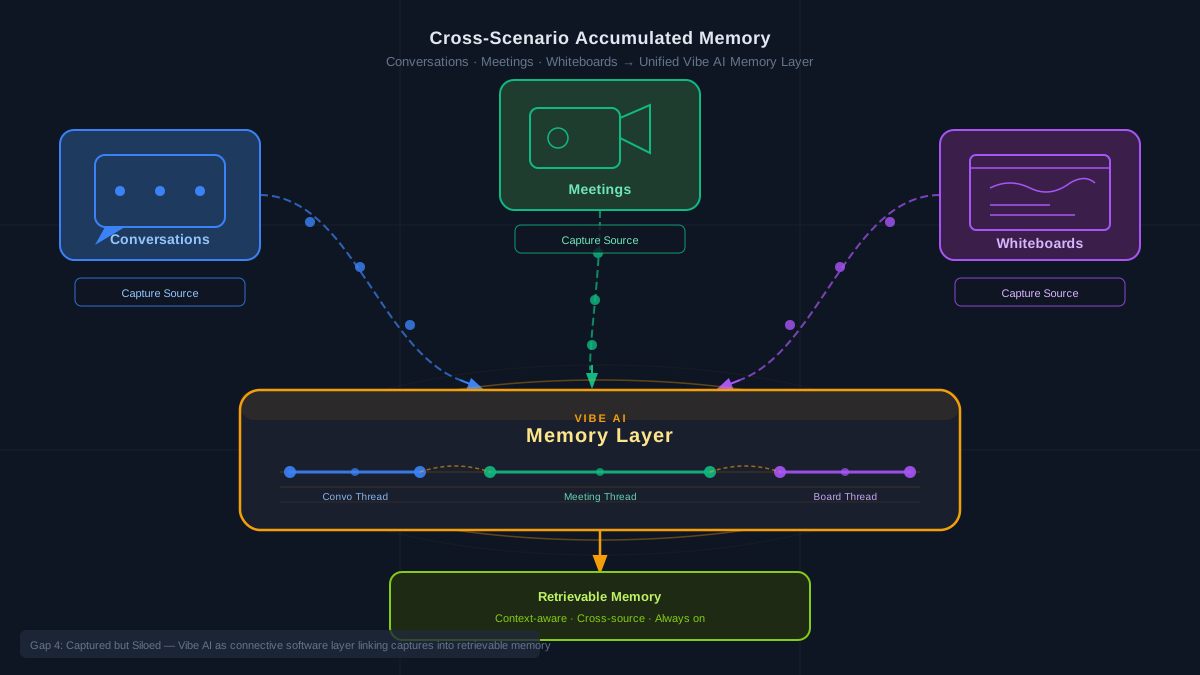 Vibe AI interface showing connected memory threads from conversations and meetings; whiteboard session integration coming soon
Vibe AI is the software layer that connects captures into retrievable memory. The subscription service ingests conversations (from Vibe Dot) and meeting summaries (from Vibe Bot), then links them into continuous memory threads, trails of related context that surface when someone asks. Whiteboard session integration is on the roadmap.
Vibe AI’s "Ask AI" feature enables cross-session question-answering: ask "What did we decide about the pricing model in Q2?" and retrieve not just a meeting summary but the hallway memos and follow-up conversations that formed the context. Memory threads organize by topic and time, making the relationship between captures visible.
The through-line is what Vibe AI calls "cross-scenario accumulated memory." Knowledge captured in the hallway (Dot) and meeting room (Bot) only becomes organizational memory when a persistent layer connects and surfaces them. Without that connective layer, each capture is an island. With it, captured knowledge becomes organizational memory.
Pricing for Vibe AI starts at free (Starter: 300 minutes/month transcription, 7-day memory retention), moving to $9/seat/month for Pro (1,200 minutes, 12-month retention, custom templates), and $29/seat/month for Max (unlimited transcription, permanent retention, advanced features).
Knowledge Management Tools Worth Knowing
A range of existing tools address specific parts of the institutional memory problem. Each has a scope. Each has a gap.
Notion offers flexible wiki-style documentation with AI-powered Q&A on indexed content. Teams use it to structure explicit knowledge, process docs, meeting notes, project outlines. The gap: Notion captures what someone writes down, not tacit knowledge from conversations. When an engineer leaves, the account manager can find the decision log, but not the whiteboard reasoning or the client call that prompted the pivot.
Confluence (Atlassian) provides structured documentation for enterprises, integrating tightly with Jira for software teams. The gap: same as Notion, explicit knowledge only. A software team documents every sprint in Confluence, but the hallway conversation where the PM and lead architect realigned the roadmap isn’t there, it never was.
Guru focuses on verified knowledge cards for sales and support teams, surfacing context in the tools where work happens (Slack, CRM). The strength: surfacing the right card at the right moment. The gap: the reasoning behind the pricing strategy, formed in a series of off-calendar calls, never made it into a card.
Otter.ai provides real-time transcription and meeting summaries for individuals. The strength: searchable transcripts of recorded meetings. The gap: six months later, the new account manager searches Otter for context on the client’s key decision-maker, but the relevant insight came from a hallway conversation at a conference, not a meeting.
Fireflies.ai offers team meeting summaries with CRM integration, making it easier to send call notes to Salesforce and HubSpot. The strength: post-meeting workflow automation. The gap: the strategy shift decided by two executives over lunch on Tuesday doesn’t appear anywhere in the Fireflies archive.
Organizations using multiple tools face the gap-four problem: captures scattered across platforms, none connected, none compounding. Teams exploring AI collaboration tools often find these platforms improve real-time work but don’t address longer-term knowledge retrieval.
How to Assess Your Institutional Memory Health
Before choosing tools, an organization benefits from a simple self-audit: which of the four gaps causes the most friction right now?
Six self-audit questions:
-
When a team member leaves, how long does it take for someone else to answer questions they would have known? (Hours? Days? Weeks? Never?)
-
When you need to find a decision from three months ago, where do you look? How long does it take?
-
What percentage of your meetings end with documented action items that someone follows up on?
-
Where do the most important client insights surface? Hallways? Meetings? Email threads?
-
When a whiteboard sketch matters later, what happens to it? Photo? Erasure? Cloud save no one finds?
-
If you asked five team members to find a policy, would all five find it? Would they find the same version?
Reactive: Knowledge lives in people. When someone leaves, you discover what they knew by noticing what no longer works. Retrieval depends on knowing who to ask. Most organizations start here.
Documented: Explicit knowledge lives in shared systems, wikis, docs, knowledge bases. Retrieval works for documented processes, but tacit knowledge remains person-dependent. This is where most organizations stop.
Compound: Multi-layer capture feeds a shared retrieval layer. Conversations, meetings, and visuals all flow into memory that anyone can search. The organization’s collective knowledge grows in place, retrievable, connected, and immune to departure.
APQC’s Knowledge Management Maturity Model defines five levels from Initial to Optimized, where institutional memory is fully embedded in enterprise strategy. The self-audit above is not a formal assessment, but it gives organizations language to talk about where they are and what would change if memory were intentional.
In practice, the maturity gap is wider than it appears. Most organizations self-assess as "Documented" but operate as "Reactive", the knowledge base goes stale faster than it gets updated. The real gap isn’t whether a wiki exists, but whether it’s alive.
Conclusion
Institutional memory does not build itself. It compounds when organizations capture knowledge at every gap, off-calendar conversations, meeting rooms, visual collaboration, and connect those captures into a layer anyone can retrieve.
The four-gap framework gives organizations a way to diagnose where memory leaks. The self-audit pinpoints which gap costs the most. The fix requires capture devices for each moment and a connective software layer that makes captured knowledge findable.
Vibe AI starts free with the Starter plan, 300 minutes of transcription monthly, 7-day memory retention. Organizations ready to capture across all four gaps can explore Vibe AI’s pricing and features to see how meetings and off-calendar conversations flow into a single memory layer.
Work isn’t the problem. Forgetting is.
FAQs
What is institutional memory in a company?
Institutional memory is the accumulated knowledge of how an organization actually works, including documented processes (explicit), hard-won experience and judgment (tacit), and habits embedded in culture and workflow. Industry estimates widely cited in knowledge management literature suggest that 70–80% of enterprise knowledge is tacit, meaning it lives in employees’ heads and never gets written down.
How do you preserve institutional memory?
Preserving institutional memory requires capturing knowledge at the moments it surfaces: off-calendar conversations, meeting rooms, visual collaboration, and the retrieval layer. Without capture devices and a connective software layer, roughly 90% of organizational knowledge remains undocumented, per the foundational KM research of Davenport & Prusak (Working Knowledge, 1998), a benchmark that enterprise KM practitioners have consistently upheld, and leaves when people do.
What happens to institutional memory when employees leave?
When employees leave, they take their tacit knowledge with them. The cost of replacing a knowledge worker runs 50–200% of their annual salary, according to SHRM and Gallup, and new hires take 8–12 months to reach full productivity, largely because they are reconstructing what their predecessors already knew.
How can a company build institutional memory?
Building institutional memory requires capture devices for each gap (wearable recorders for off-calendar conversations, meeting-room systems, persistent whiteboards) and a software layer that connects captures into retrievable memory threads. Without the connective layer, captures scatter across tools and become unretrievable, as knowledge workers spend over half their time in communication tools, scattering context across disconnected channels.
What tools help with institutional memory management?
Tools include wikis and knowledge bases (Notion, Confluence, Guru) for explicit knowledge, meeting transcription tools (Otter.ai, Fireflies.ai) for meeting-room capture, and hardware-software systems like Vibe for cross-scenario capture. In 2025, 75% of professionals use an AI note-taker in meetings, per Fellow research, but most AI note-takers stop at the meeting room, leaving hallway conversations, whiteboard sessions, and retrieval gaps unaddressed.
How much does knowledge loss cost an organization?
The costs show up in three places. First, turnover: replacing a knowledge worker runs 50–200% of their annual salary, per Gallup. Second, search overhead: knowledge workers spend roughly 20% of their workweek searching for information they should already have access to, per McKinsey Global Institute, nearly one full day per employee per week. Third, ramp-up time: new hires take 8–12 months to reach full productivity, per SHRM research, largely because they are rebuilding context their predecessors already had.