
Plaud One was announced in late August 2026, sold out its 2,000-unit Explorer Edition almost immediately, and won’t ship until Q4 2026 — with mass retail pushed to 2027. If you came here looking for a way to buy one right now, you can’t. If you came here looking for something you can actually use today, you’re in the right place.
This guide covers the best Plaud One alternatives across two categories: AI recording earbuds that share its form factor, and wearable AI recorders that solve the same underlying problem — capturing conversations and turning them into structured, searchable knowledge — in a different shape. We’ve compared each option on what actually matters for professional use: what’s available now, what it captures, what the AI layer costs, and where each one falls short.
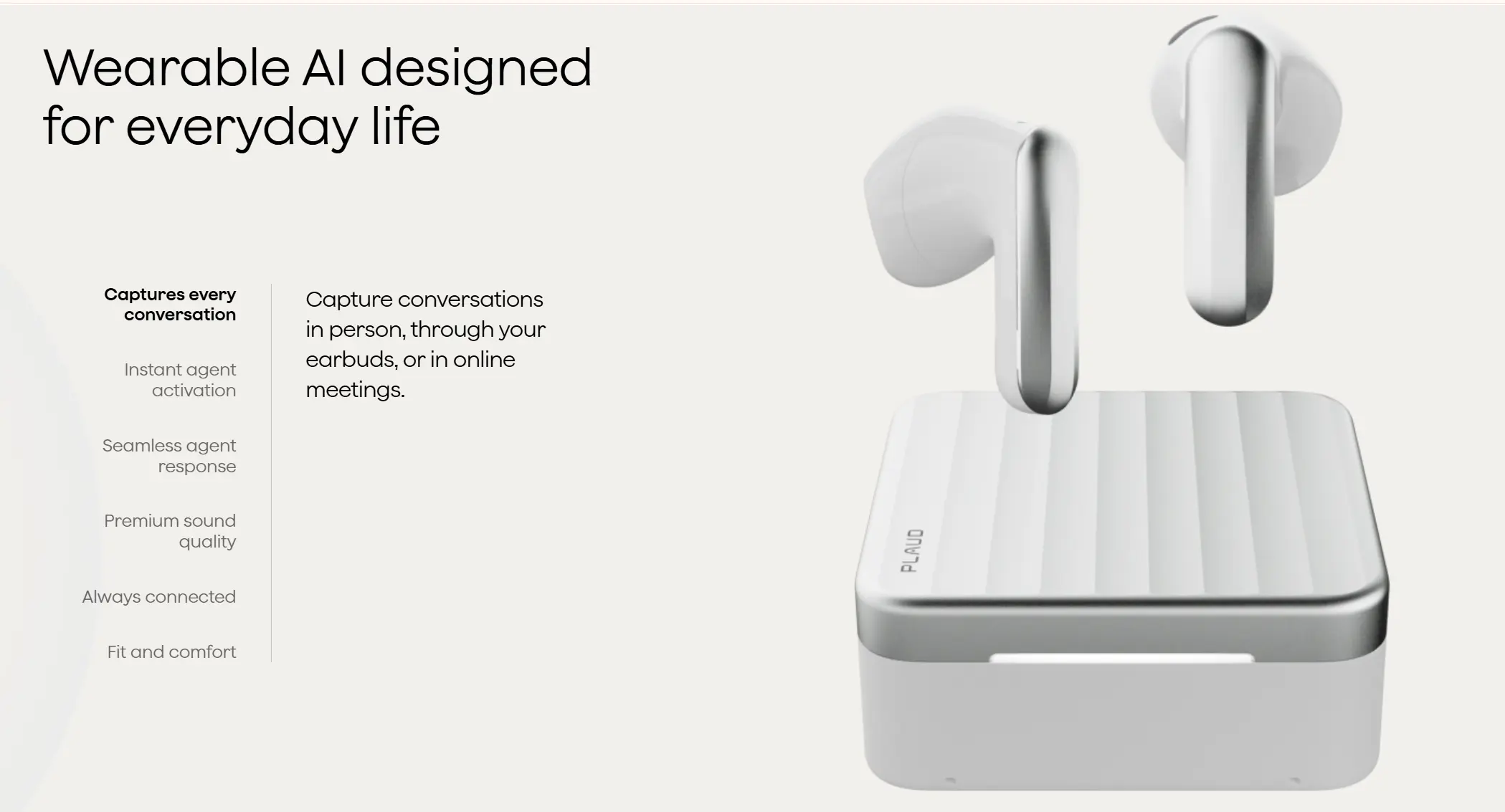 PLAUD earbuds and charging case promoted as wearable AI for capturing in-person and online conversations
Why Look for a Plaud One Alternative?
Plaud One is a genuinely interesting product. It pairs AI recording earbuds with a 4G-connected case, a Plaud Agent layer that can take actions across connected tools, and a pitch that the whole system learns from your conversations over time. The shift from "record for me" to "do it for me" is real, and it’s where the wearable AI category is heading.
The practical problems are also real:
-
It’s sold out. The 2,000-unit Explorer Edition is gone. A waitlist exists; a ship date does not.
-
The most ambitious features aren’t in the box yet. Plaud Agent, Routines, the "Hey Plaud" voice activation, and most of the agentic capabilities are labeled Plaud Intelligence beta — availability "may vary by region, device, and software version."
-
It’s only available in 8 countries. US, UK, France, Germany, Italy, Spain, Canada, Netherlands — everyone else waits for 2027 retail.
-
The free tier is thin. 300 transcription minutes per month. After $200 in included credits are spent, Pro is $99.99/year or Unlimited is $239.99/year — on top of a $249.99 device.
-
The 4G future cost is unclear. 4G is included in the Explorer Edition; Plaud says future pricing "will be shared separately," and at least one report notes a separate wireless service plan may be required.
If any of those friction points matter to your situation, here are the alternatives worth considering.
The Alternatives at a Glance
|
Device |
Form factor |
Price |
In stock? |
Free transcription |
Cross-session memory |
|---|---|---|---|---|---|
|
Vibe Dot |
Wearable clip |
$199 |
✅ Yes |
Recording + summaries free |
✅ Memory Graph |
|
viaim RecDot |
Earbuds + case |
$169.99–$199.99 |
✅ Yes |
600 min/mo |
❌ Per-session |
|
TicNote Pods |
Earbuds + case (4G) |
$199–$299 |
⚠️ Check stock |
600 min/mo |
❌ Per-session |
|
Soundcore Liberty 5 Pro Max |
Earbuds + smart case |
$229.99 |
✅ Yes |
120 min/mo (24 mo) |
❌ Per-session |
|
Fieldy 3 |
Wearable pendant/clip |
$129.99 |
✅ Yes |
150 min/mo |
❌ Per-session |
1. Vibe Dot — Best for Professionals Who Need More Than a Transcript
Price: $199 | Available: Now | Form factor: Wearable clip (attaches to lapel, collar, or phone)
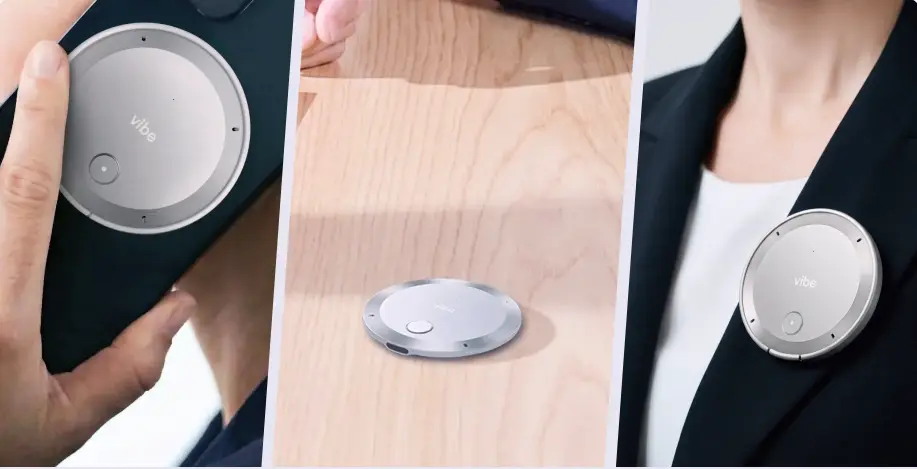 Vibe Dot AI recorder shown three ways: handheld, placed on desk, and clipped to a blazer lapel
Vibe Dot is the most direct professional alternative to Plaud One — not because it looks the same, but because it solves the same core problem more completely for most workplace scenarios.
What it captures — and how: This is where Vibe Dot’s design thinking shows. The device ships with a magnetic case, clip, and ring (for non-MagSafe phones), giving you three distinct recording modes for different situations.
Snap it to the back of your phone and it captures both sides of phone calls — the same scenario Plaud Note is known for, now with a 5-mic array including bone conduction that isolates your voice from background noise. Clip it to your lapel or collar for hands-free in-person meeting capture, covering a room from up to 30+ hours on a single charge with 64GB of local storage. Set it on the desk as a standalone recorder for interviews, brainstorms, or client visits. Every recording — regardless of mode — feeds into Vibe AI automatically.
Where it pulls ahead of Plaud One: The Memory Graph. This is the feature that separates Vibe Dot from every other device in this list. While the other alternatives below — whether earbuds or wearable pendants — summarize individual sessions in isolation, Vibe AI’s Memory Graph connects recordings to each other across days, weeks, and months. You can ask "Help me catch up on Sarah’s case" and get an answer synthesized from multiple sessions — not a link to scroll through individual files.
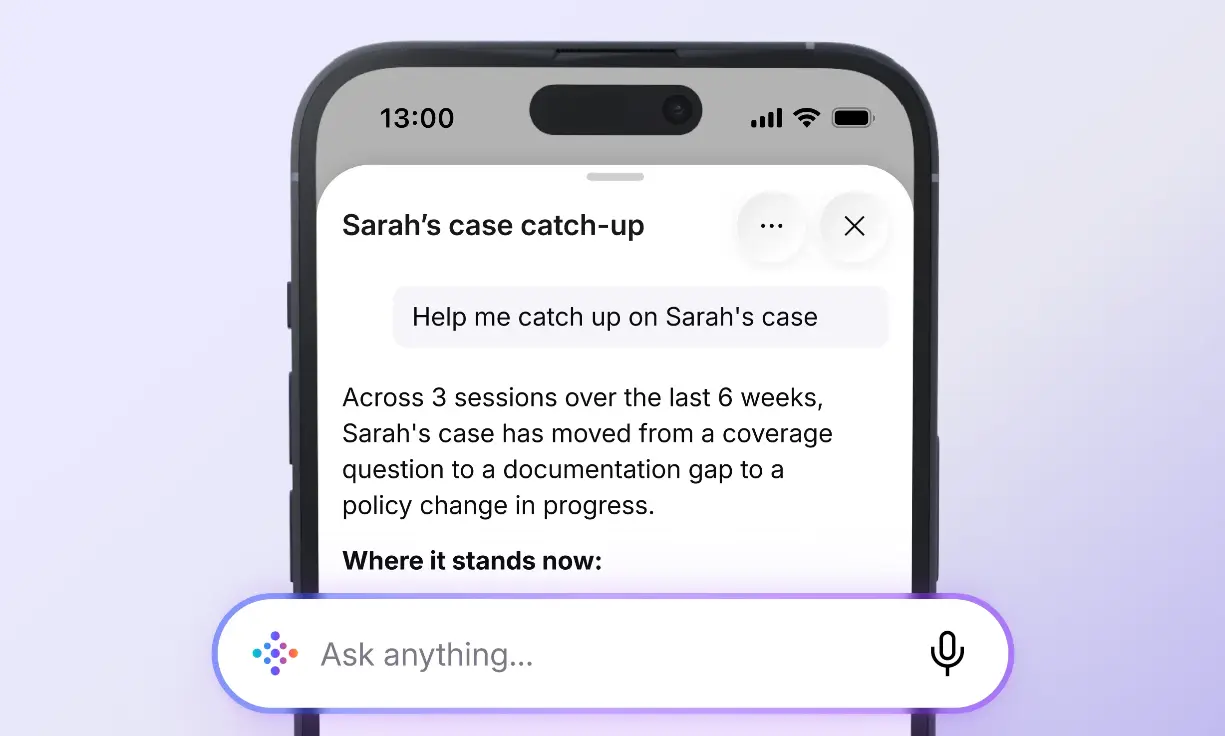 Vibe AI app answering a query about case history, summarizing progress across multiple past sessions
Plaud One promises something similar — "intelligence compounds with use" is in their marketing — but that capability is tied to Plaud Intelligence beta access and future updates. Vibe Dot’s Memory Graph is a core feature of the product today.
Compliance: SOC 2, HIPAA, FERPA, and NDAA certified. FERPA and NDAA are credentials Plaud One does not carry — relevant if you work in education, government contracting, or public-sector procurement.
Pricing: $199 (currently 20% off from $249). Core recording, transcription, and summaries are free on the Starter plan (300 min/month). Pro at $9/month ($108/year) unlocks 12 months of AI memory, cross-app retrieval, and workflow integrations. Max at $29/month adds permanent history and full agentic actions.
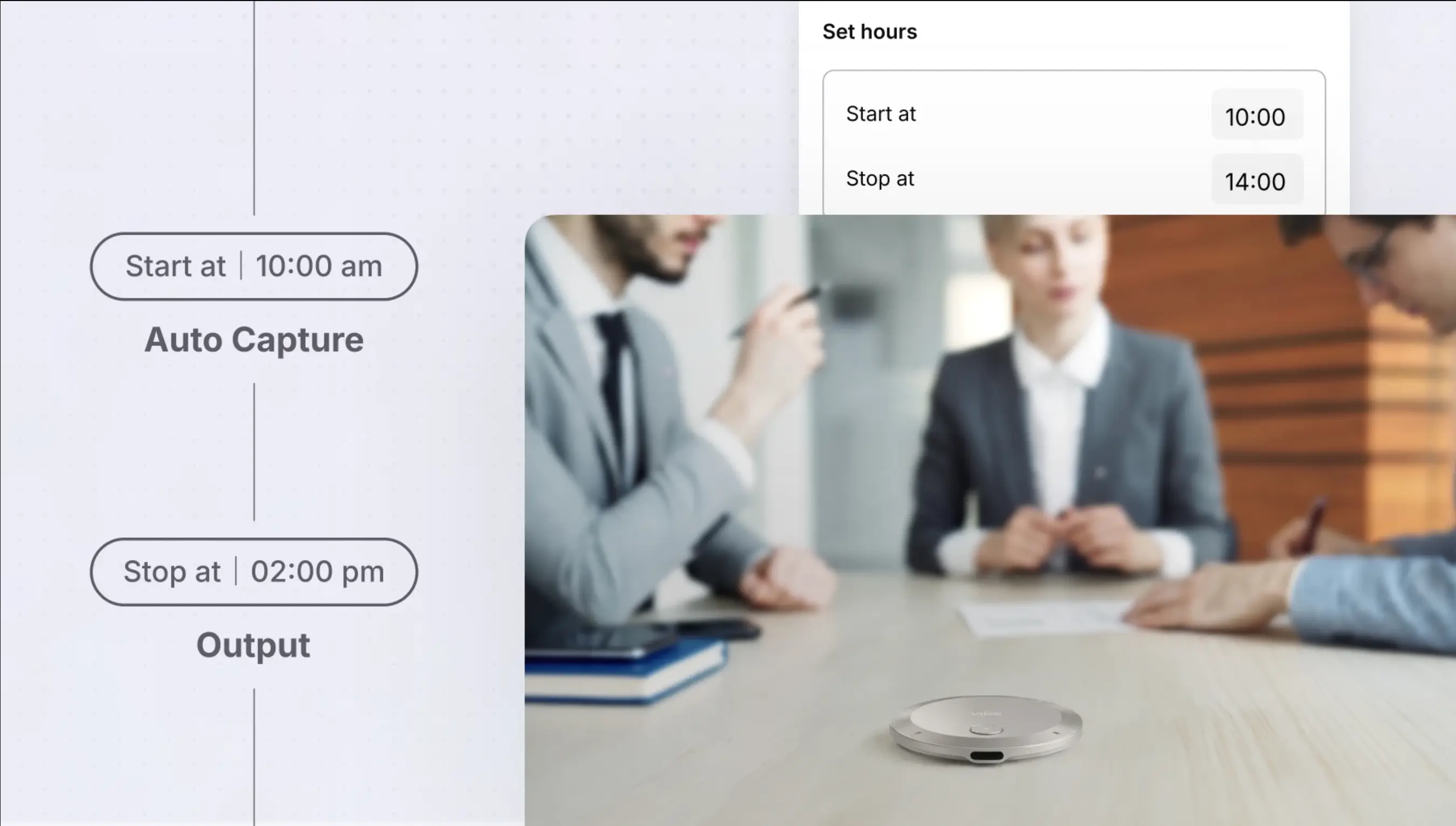
Vibe Dot isn’t earbuds, but it’s worth a look if wearable and hands-free capture is what you’re after — it clips to your lapel or phone instead of sitting in your ear. If you’d rather see the full picture, including Plaud’s own Note, Note Pro, and NotePin lineup plus software options like Granola and Otter, our complete Plaud alternatives guide covers all seven side by side.
2. viaim RecDot — Best AI Earbuds Available Now
Price: $169.99–$199.99 | Available: Now | Form factor: In-ear earbuds + recording case
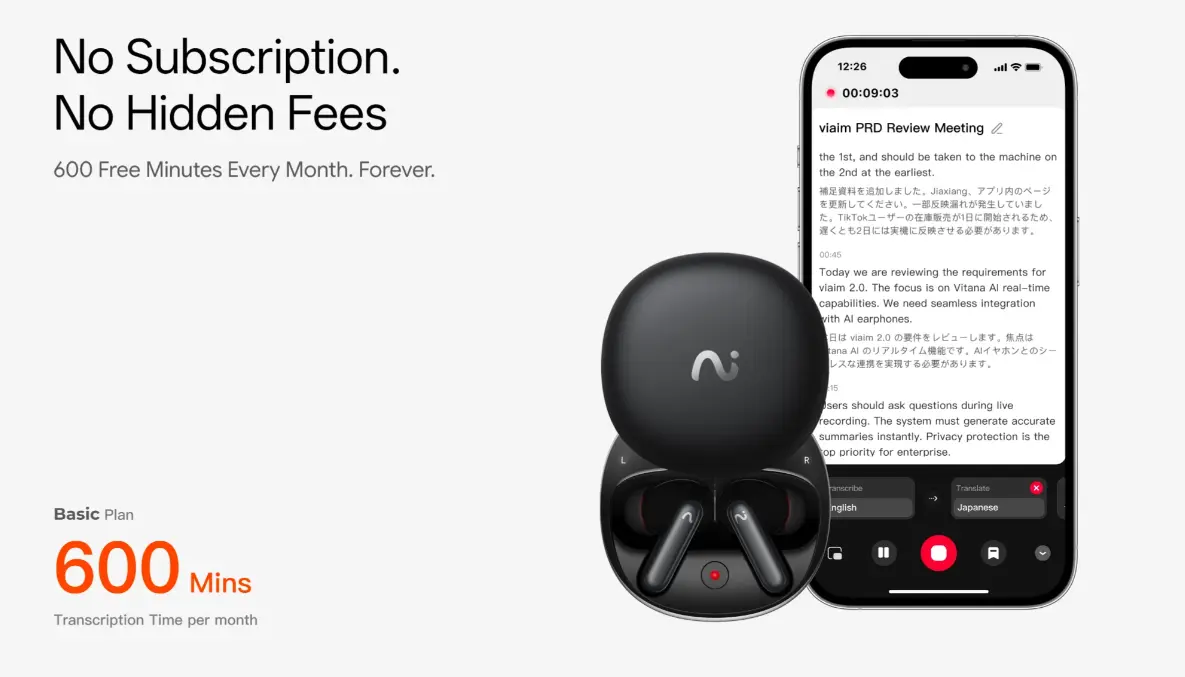 viaim RecDot
viaim is one of the few companies that shipped AI recording earbuds before Plaud One announced its launch. The RecDot is in-stock, has been in the market long enough to have user reviews, and covers the same dual-capture concept: the earbuds record calls and online meetings directly (both incoming and outgoing audio), while the case records in-person conversations from the room around you.
What it captures: In-person via the case (Plaud One claims 16.4 ft range; viaim doesn’t publish a specific range), phone calls and online meetings through the earbuds. The AI layer handles transcription and summaries through the viaim app — accessible on mobile and the web.
Free tier: 600 minutes of transcription per month — double Plaud One’s 300 minutes and significantly more than the Soundcore options. You don’t need a subscription to get started in any meaningful way.
Where it falls short vs. Plaud One: No 4G eSIM — the case needs a phone or Wi-Fi to upload. No published agentic capabilities (create tasks, draft emails, act in connected tools). No cross-session memory; each recording is its own document. If the Plaud Agent concept is what attracted you to Plaud One, viaim delivers notes and summaries but not autonomous action.
Where it wins: It’s here. It works. It has user reviews. The battery story is also strong — viaim’s OpenNote open-ear variant reaches 53 hours combined; the RecDot hits 36 hours. viaim also publishes 600 free minutes per month with no time limit on the free tier — a notably more generous baseline than most competitors.
3. TicNote Pods — Closest Hardware Match to Plaud One
Price: $199 (Kickstarter early-bird) → $299 MSRP | Available: Shipping from March 2026 | Form factor: Earbuds + 4G case
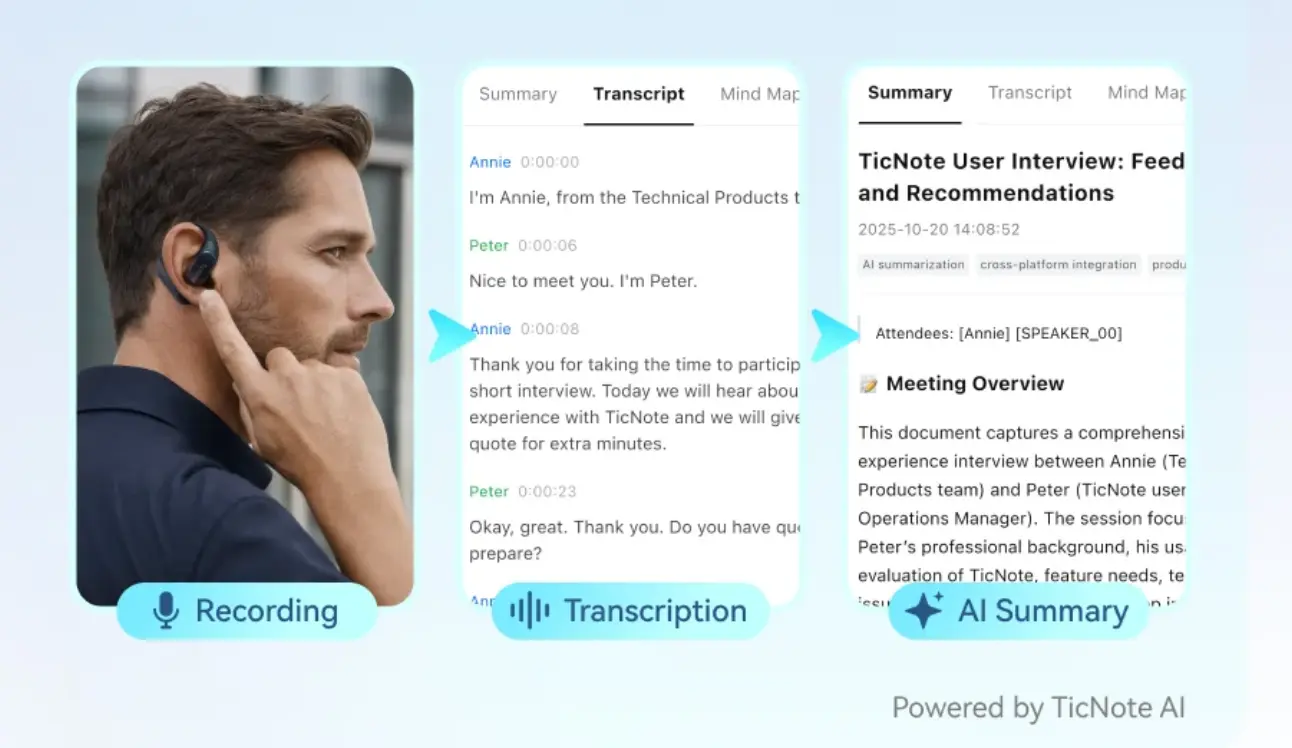 TicNote Pods
TicNote Pods from Mobvoi are the device most architecturally similar to Plaud One: both are 4G earbuds with a case that records in-person conversations independently, and both process audio without needing a nearby phone. Where Plaud One is sold out and shipping in Q4, TicNote Pods launched in March 2026 via Kickstarter (510 backers, $534,000 raised) and are shipping now.
What it captures: Earbuds capture both sides of phone calls and online meetings; the case captures in-person conversations from 5–10 meters with AI noise filtering. Shadow AI 2.0 handles transcription, summaries, and — uniquely for earbuds — generates slide decks, landing pages, and PRDs directly from recorded conversations.
Free tier: 600 minutes per month, with Pro at $119/year (2,100 min/mo) and Business at $299/year (6,600 min/mo) — more granular tiers than Plaud’s two-plan structure.
4G positioning: TicNote launched before Plaud One and makes a similar 4G-first pitch — "transcripts ready in ~3 minutes even in offline meeting rooms." One meaningful hardware note: TicNote says the 4G lives in the earbuds themselves, not only the case — though in practice the case handles the cloud sync in most scenarios.
Where it falls short: No cross-session memory — Shadow AI is session-scoped. No published compliance certifications (HIPAA, SOC 2, FERPA). The Kickstarter retail path means buyer protection and warranty terms are less clear than established retail channels. Stock availability varies; check the TicNote site directly.
Bottom line: If you want a Plaud One-style 4G + earbuds + AI architecture that you can actually buy today, TicNote Pods is the closest match in the market.
4. Soundcore Liberty 5 Pro Max — Best for Earbuds-First Users
Price: $229.99 | Available: Now | Form factor: In-ear ANC earbuds + AMOLED smart case
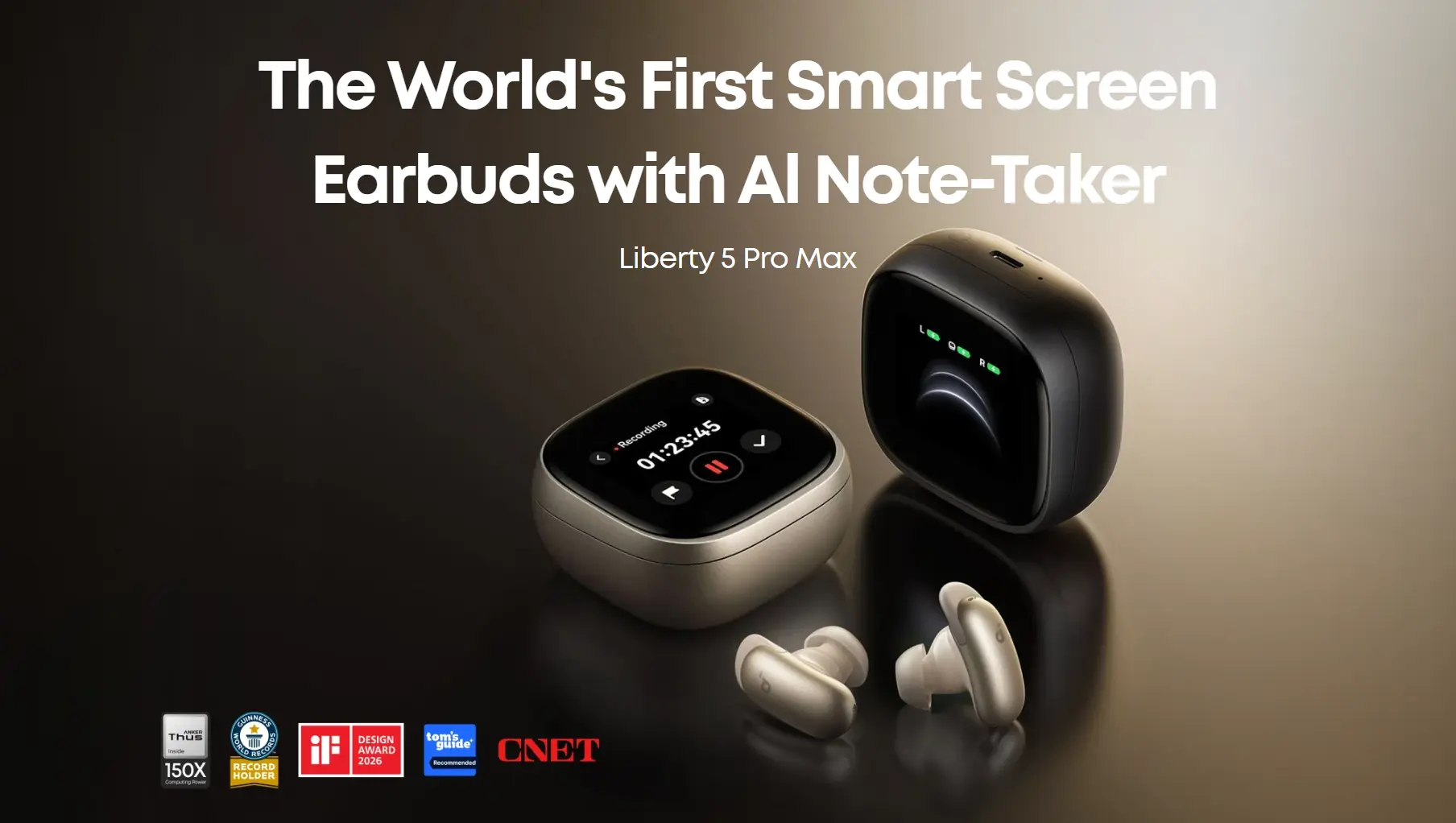 Soundcore Liberty 5 Pro Max
The Soundcore Liberty 5 Pro Max is a different animal from the others on this list: it leads with being premium earbuds first, and adds AI recording as a case-level feature. The 1.78-inch AMOLED touchscreen on the case is the hook — you can trigger recording, mark highlights, and review AI summaries without pulling out your phone.
What it captures: In-person, in-room audio only — the case records from its built-in microphone. It does not capture audio from online meetings, video calls, or phone calls. That’s a significant limitation vs. Plaud One, which captures online meetings and calls through the earbud VPU microphones.
Compliance: ISO 27001/27701, SOC 2 Type 1, HIPAA, EN 18031, NIST IR 8425. Enterprise-grade for in-person recording scenarios.
Free tier: 120 minutes per month for 24 months — the thinnest free tier in this comparison. Pro is $99.99/year (1,200 min/mo), Unlimited is $239.99/year.
Where it wins: Audio quality. The Liberty 5 Pro earbuds carry a Guinness World Records certification for the highest objective speech quality score (G-MOS) in TWS earbuds. If call quality is the primary driver — not AI features — these are the best earbuds on this list by a meaningful margin.
Where it falls short: Call/online meeting capture is absent. No cross-session AI memory. The subscription model is among the most aggressive here: 120 free minutes is barely one meeting per week, and the free tier expires entirely after 24 months. If AI recording is the main reason you’re buying, the cost math adds up faster than it looks.
5. Fieldy 3 — Best Budget Wearable AI Recorder
Price: $129.99 | Available: Now | Form factor: Wearable pendant or clip (15g)
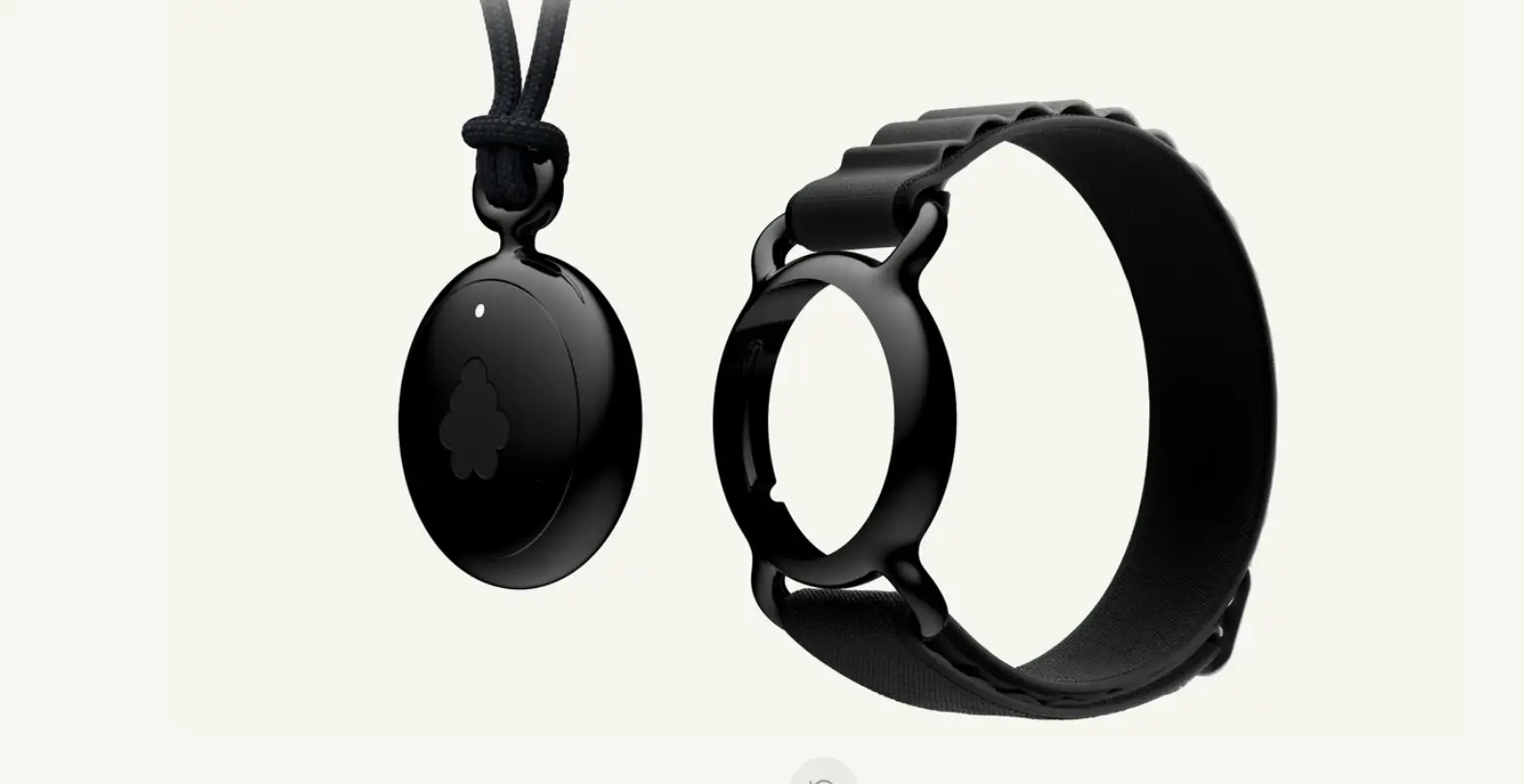 Fieldy 3
Fieldy 3, launched in July 2026 by Field Labs Inc., is the lightest and most affordable dedicated wearable AI recorder in this comparison. At 15 grams worn as a pendant or wrist clip, it’s closer to jewelry than tech gadget — which matters in environments where pulling out a phone recorder or wearing obvious earbuds would be awkward.
What it captures: In-person conversations via a high-performance MEMS microphone with background-noise filtering. Sessions up to 3 hours per recording; the device runs up to 7 days between charges. A companion desktop app (macOS and Windows) extends coverage to online meetings — a meaningful addition that the Soundcore Liberty 5 Pro Max case-only approach lacks for virtual calls.
What makes it different from Vibe Dot: Fieldy 3 is passive-first — it listens continuously once a session starts, with a visible privacy indicator light. The pitch is ambient capture with minimal friction. Vibe Dot’s five-microphone array with bone conduction gives it an edge in audio fidelity for multi-speaker rooms, and the Memory Graph connects sessions over time. Fieldy 3 doesn’t do cross-session memory — each recording is its own document.
Compliance: HIPAA-compliant. End-to-end encrypted. No audio stored after transcription. Note: FERPA and NDAA certifications are not published.
Free tier: 150 transcription minutes per month — thin for daily professional use, but the unlimited plan is $15.99/month billed yearly, which is the lowest subscription ceiling in this comparison.
Where it falls short vs. Plaud One: No 4G. No agentic features. No cross-session memory. In-person capture only (without the desktop app). But at $129.99 with a $15.99/month unlimited option, it’s the lowest-friction entry point for anyone not ready to commit $200+ to a wearable AI device.
One caution: Some users report Bluetooth pairing reliability issues in community feedback. Fieldy requires a phone connection for AI processing — if the Bluetooth drops mid-meeting, the session may not upload cleanly.
How to Choose
You need it today, and you want cross-session AI memory → Vibe Dot The only device in this list where multiple recordings connect to each other over time. If you’re running deals, projects, or client relationships where context compounds across sessions, no earbuds alternative does this yet.
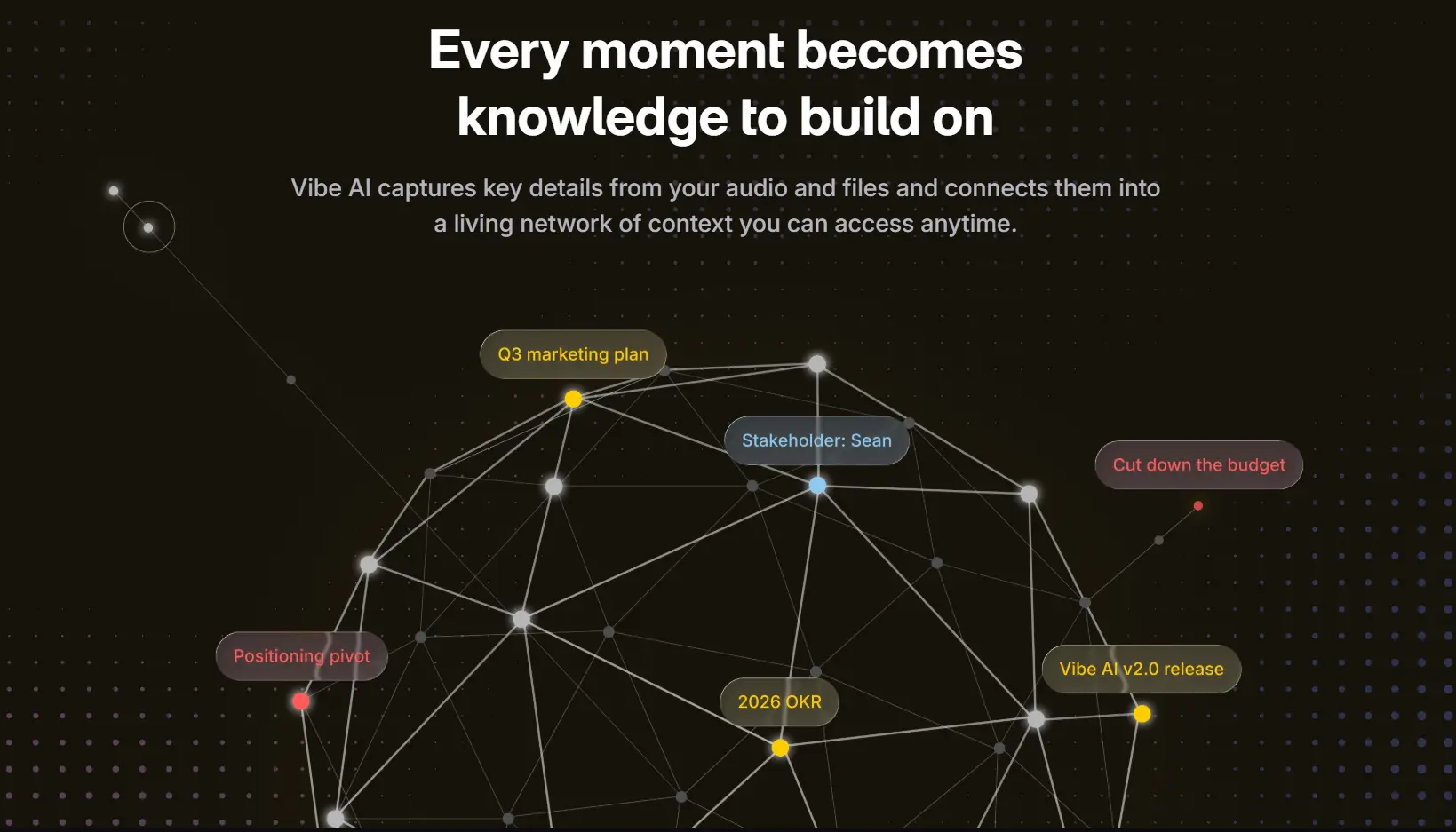 Vibe AI knowledge graph visualization connecting meeting topics, stakeholders, and decisions into one network
You want earbuds that capture both calls and in-person, and you want something available now → viaim RecDot In stock, ships to most markets, 600 free minutes monthly, and has enough reviews to know what you’re getting. Not agentic, but reliable.
You want the 4G architecture closest to Plaud One, available now → TicNote Pods The most architecturally similar product that actually ships. Check stock availability before ordering.
You already care more about audio quality than AI features, and in-person-only recording is enough → Soundcore Liberty 5 Pro Max Best earbuds on this list by objective audio metrics. But if online meetings and calls are where you spend most of your day, the in-person-only recording limitation is disqualifying.
You want a wearable AI recorder at the lowest possible price point → Fieldy 3 At $129.99 with a $15.99/month unlimited plan, Fieldy 3 is the most affordable way into the wearable AI recorder category. It’s for in-person capture primarily, works well as a pendant or clip in client-facing environments, and covers online meetings via the desktop app.
You work in education or government contracting and compliance certifications matter → Vibe Dot FERPA and NDAA certifications appear only on Vibe Dot in this comparison — neither Plaud One, TicNote, viaim, Soundcore, nor Fieldy publishes these credentials.
You want to wait for Plaud One itself → Join their waitlist If the 4G + earbuds + agent combination is specifically what you want, it’s worth waiting — just don’t expect to use it before Q4 2026, and budget for the subscription after the $200 in credits runs out.
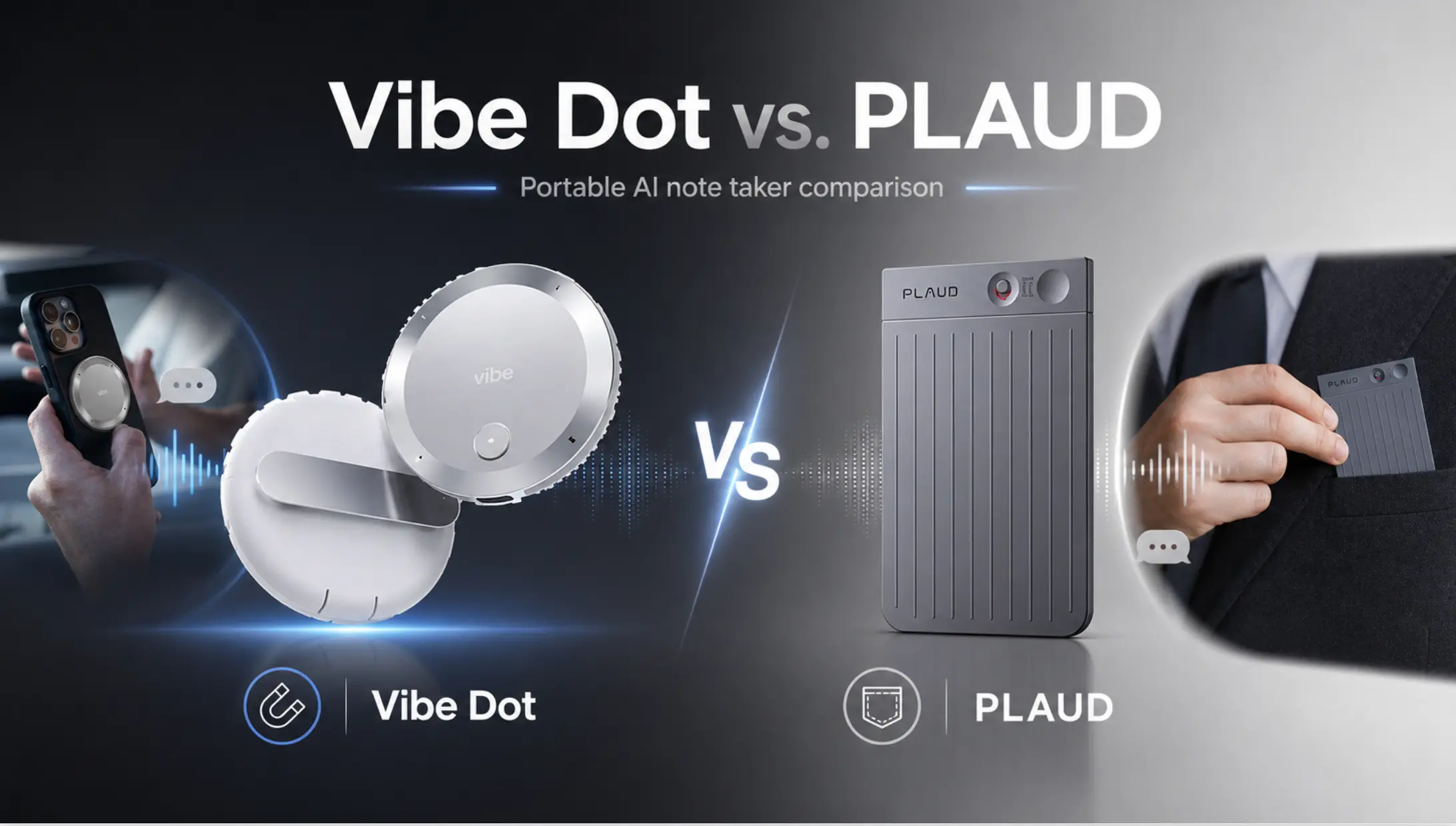
Conclusion
Plaud One represents where the wearable AI category is heading: earbuds that don’t just record, but understand intent and act across your tools. The design direction is right. The timing isn’t — at least not for anyone who needs a device before Q4 2026.
The alternatives in this guide are available now, cover the same use cases from different angles, and in some cases solve specific problems — cross-session memory, enterprise compliance, open-ear comfort — that Plaud One doesn’t address even on paper.
If you need something today, start with Vibe Dot for cross-session memory and professional compliance, or viaim RecDot for earbuds that capture both calls and in-person conversations. If 4G standalone connectivity is the specific requirement, TicNote Pods ships now. If audio quality is the priority and in-person-only capture is enough, Soundcore Liberty 5 Pro Max is the most polished earbud option. If budget is the main filter, Fieldy 3 at $129.99 is the lowest-friction entry point into wearable AI recording.
Plaud One will be worth revisiting when it ships and independent reviews arrive. Until then, you don’t have to wait.
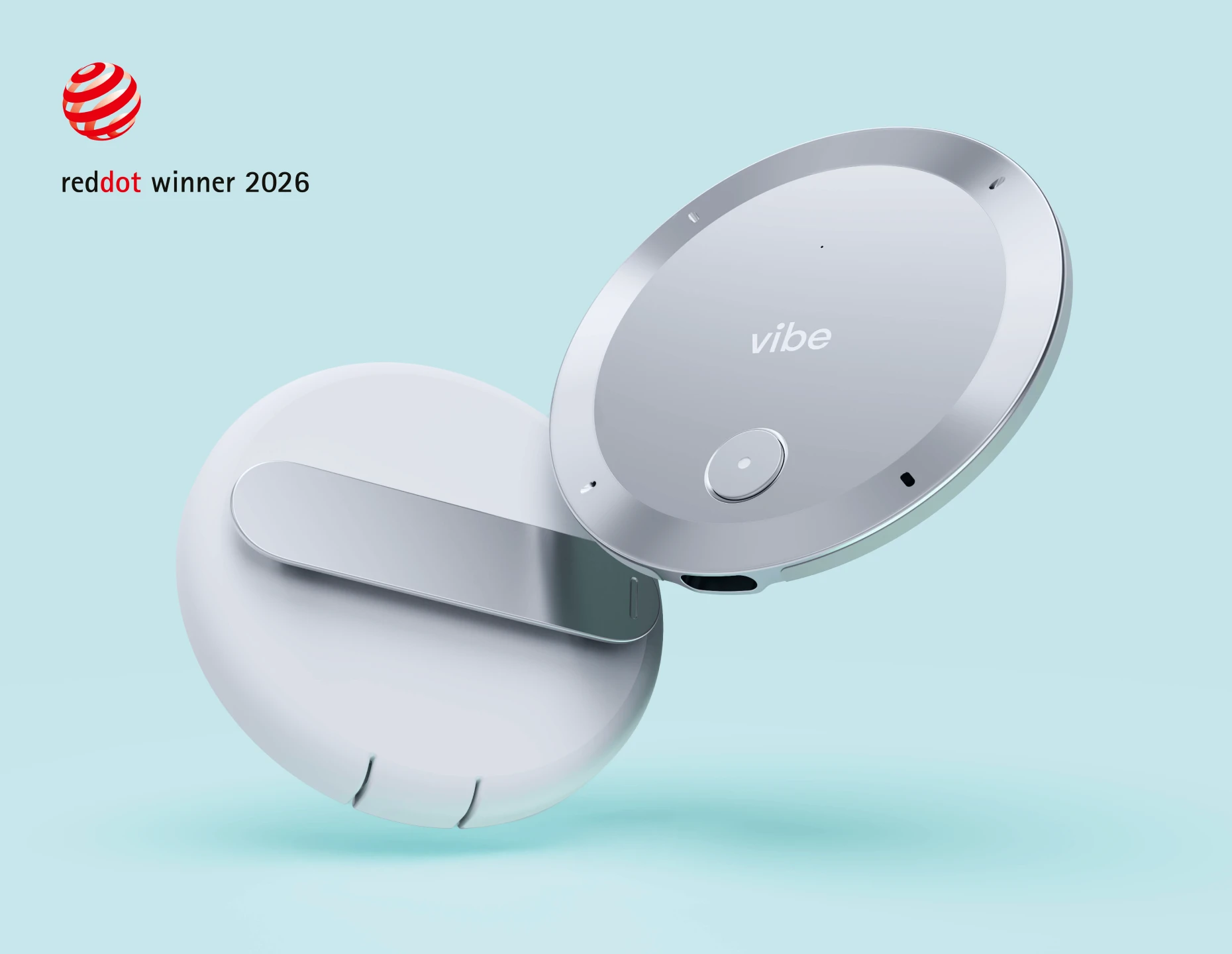
Frequently Asked Questions
What is the best Plaud One alternative available right now?
The best Plaud One alternative you can buy today depends on your primary use case. For cross-session AI memory and professional compliance (FERPA, NDAA), Vibe Dot at $199 is the strongest option. For AI recording earbuds you can order immediately, viaim RecDot at $169.99–$199.99 is the most established choice with a generous free tier of 600 transcription minutes per month.
When will Plaud One ship?
Plaud One Explorer Edition is listed as a pre-order with estimated shipping in Q4 2026, limited to 8 countries. The 2,000-unit Explorer Edition is sold out; the company is collecting waitlist signups for the next availability window. Mass retail is planned for 2027.
Do any Plaud One alternatives include 4G connectivity?
Yes. TicNote Pods include built-in 4G eSIM in both the earbuds and case, launched in March 2026, and are available for purchase now. TicNote Pods were the first 4G AI note-taking earbuds to ship commercially.
Can any of these alternatives record online meetings like Zoom or Google Meet?
viaim RecDot, TicNote Pods, and Plaud One all capture online meetings and phone calls through in-ear microphones (including incoming audio). Soundcore Liberty 5 Pro Max and Soundcore AeroClip 2 Pro record in-person audio only — they do not capture online meeting or call audio. Vibe Dot is optimized for in-person capture.
Are any of these devices HIPAA compliant?
Vibe Dot (SOC 2, HIPAA, FERPA, NDAA), Soundcore Liberty 5 Pro Max (SOC 2 Type 1, HIPAA, ISO 27001/27701), and Plaud One (SOC 2, HIPAA, GDPR, ISO 27001) all carry HIPAA certification. viaim and TicNote do not publish HIPAA compliance documentation.
What is the total cost of ownership for a Plaud One alternative over three years?
Rough three-year cost estimates (hardware + subscription, excluding 4G):
-
Vibe Dot: $199 hardware + $0 for core recording and summaries (Memory Graph Pro plan adds cost for extended retention)
-
viaim RecDot: ~$170–$200 hardware + $240/year Ultra plan if you exceed 600 min/mo = ~$890 over 3 years
-
TicNote Pods: ~$199 hardware + $119/year Pro = ~$556 over 3 years
-
Soundcore Liberty 5 Pro Max: $229.99 hardware + $99.99/year Pro (after 24 months of limited free tier) = ~$430 over 3 years, but only capturing in-person audio
-
Plaud One: $249.99 hardware + $200 credits used up + $99.99–$239.99/year + 4G plan TBD