
If you’ve been comparing AI note-taking devices, you’ve probably landed on Plaud more than once. It’s the category leader for a reason — millions of units sold, strong reviews, and a genuinely useful product. But a newer device, Vibe Dot, is built around a different bet: instead of asking you to remember to press record, it tries to remember the conversation for you.
We put the two head-to-head — specifically Vibe Dot against the Plaud Note Pro, Plaud’s current flagship — to see where each one actually wins.
The short answer
If you mostly need to press a button, record a conversation, and get a clean transcript back, Plaud is a mature, well-built tool that does exactly that. If you want a device that captures conversations you didn’t plan for, and can connect what was said this week to what was said three weeks ago, Vibe Dot is doing something Plaud isn’t built to do yet.
Same form factor, different philosophy
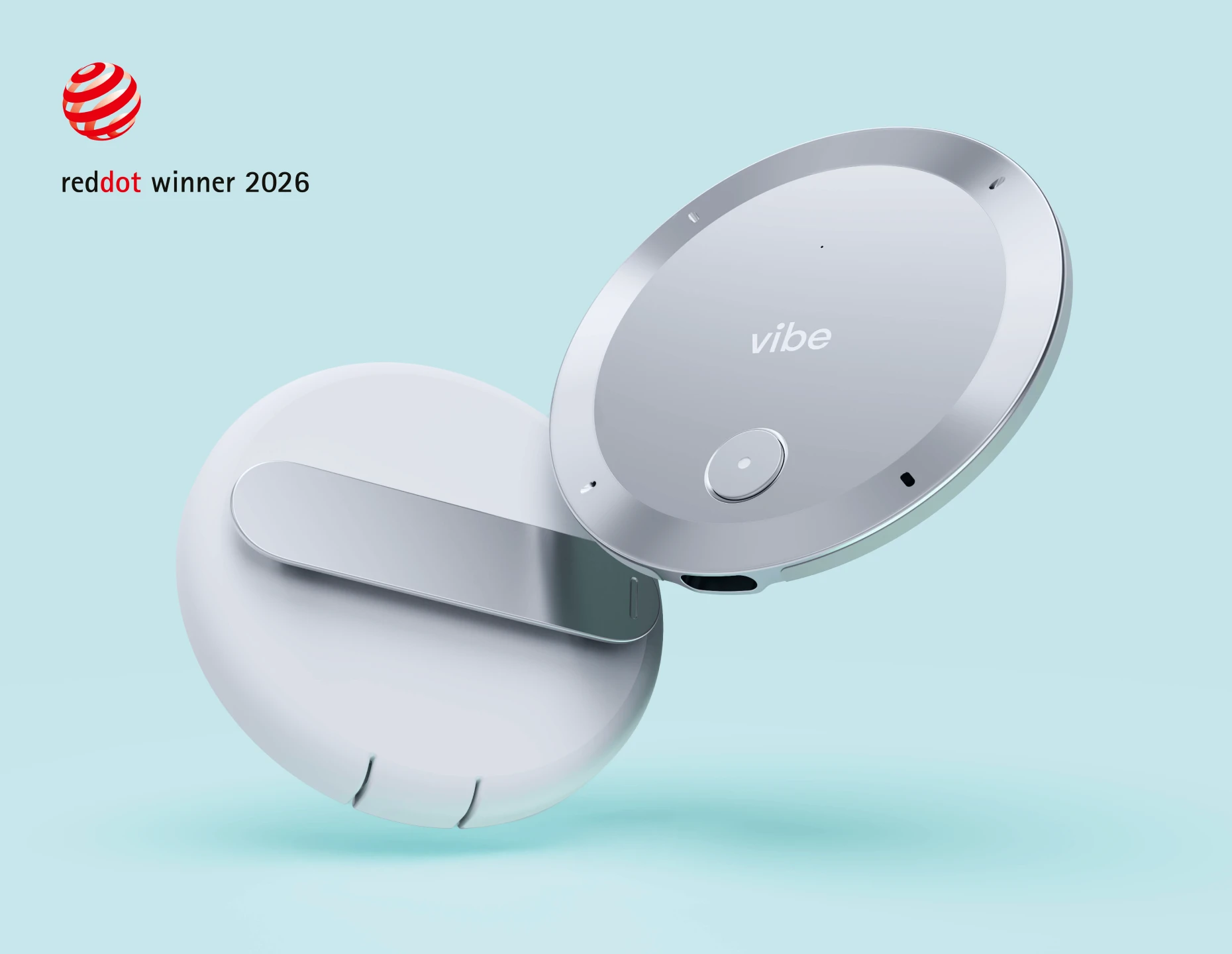
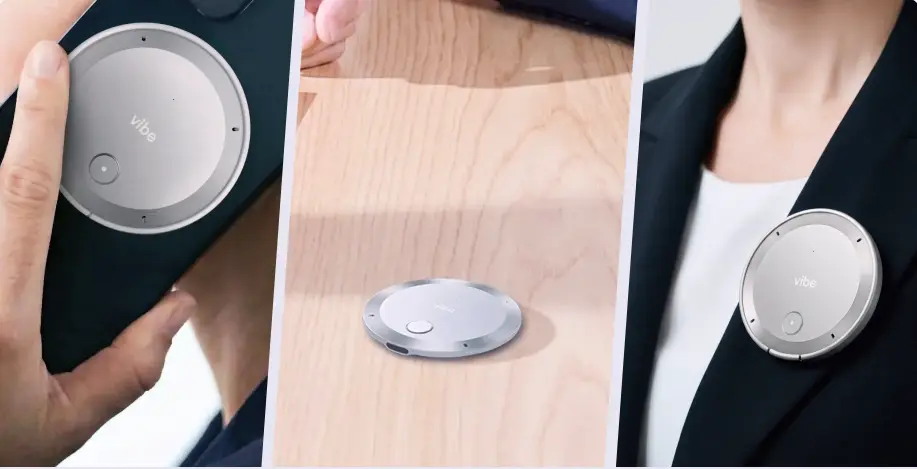
Both devices are small enough to snap onto the back of a phone, clip to a collar, or sit on a desk. That’s where the similarity ends.
Plaud is a record-on-demand device. You decide a conversation is worth capturing, you press the button, and Plaud handles the rest — transcription, summary, action items. It’s a tool that responds to your decision.
Vibe Dot adds a layer Plaud doesn’t have: it can capture conversations automatically during hours you set, without you having to reach for a button before the conversation starts. And once a conversation lands in Vibe AI, it doesn’t sit there as an isolated file — it becomes part of a running context that later conversations can draw on.
The gap between these two products isn’t really in the spec sheet. It’s in what happens before you remember to hit record, and what happens after the meeting ends.
Quick comparison
|
Feature |
Vibe Dot |
Plaud Note Pro |
|---|---|---|
|
Form factor |
Phone-mount, wearable, or desktop |
Phone-mount card (not wearable) |
|
Microphones |
4 MEMS + 1 VPU (bone conduction) |
4 MEMS + 1 VPU |
|
Pickup range |
16.4 ft (5m) |
16.4 ft (5m) |
|
Battery life |
30+ hours |
30 hrs (Enhance) / 50 hrs (Endurance) |
|
Storage |
64GB |
64GB |
|
Recording trigger |
Auto-capture (Auto/Schedule) + manual tap |
Manual button press only |
|
Cross-conversation memory |
✅ Memory Graph links related conversations automatically |
❌ Each recording stored independently |
|
Agentic task execution |
✅ Spark voice commands → MCP-connected agents (some in beta) |
⚠️ Zapier/AutoFlow only |
|
Summary templates |
Custom templates (Pro tier+) |
✅ 10,000+ templates |
|
Hardware encryption chip |
✅ TPM 2.0, FIPS 140-3 |
❌ Cloud-only processing |
|
Mobile app |
✅ |
✅ iOS & Android |
|
Device price |
$199 (early-bird, from $249) |
$189 |
|
Software, starting at |
Free tier; Pro $9/seat/mo |
Free tier; Pro ~$8.33/mo (billed annually) |
|
SOC 2 |
✅ |
✅ |
|
HIPAA |
✅ |
✅ |
|
FERPA |
✅ |
❌ |
|
NDAA-eligible |
✅ |
❌ |
|
ISO 27001 |
❌ |
✅ |
|
GDPR |
❌ |
✅ |
|
Best for |
People who want fewer things to remember and more context that sticks |
People who want a mature, affordable, press-to-record tool |
Pricing current as of July 2026. Vibe Dot reflects early-bird pricing; Plaud reflects annual billing. Both companies adjust pricing periodically — check current pages before purchasing.
Recording: automatic vs. on-demand
Plaud’s Note Pro puts an AMOLED display right on the device so you can confirm at a glance that it’s recording — but you still have to remember to press the button before the moment you want captured actually happens.
Vibe Dot adds two auto-capture modes, Auto and Schedule, that record automatically during hours you define, on top of its own manual Tap-to-record and a quick-memo mode called Spark. The idea is to solve a specific problem: the most useful detail in a conversation often comes up before anyone thought to hit record — in the hallway before the meeting, in the small talk after it ends.
Bottom line: For a meeting you planned for, both devices work fine. For the moments you didn’t plan for, Vibe Dot is doing something Plaud currently can’t.
Memory: one file at a time vs. connected context
Plaud treats every recording as its own file. Its "Ask Plaud" feature lets you query a single recording after the fact, which is genuinely useful — but it’s retrieval you have to initiate, scoped to one conversation at a time.
Vibe AI takes a different approach: every conversation gets folded into a running Memory Graph, so a decision made three weeks ago can surface automatically in this week’s summary, without you searching for it.
Bottom line: If your work involves following the same clients or projects over time, Vibe Dot’s automatic linking saves you from digging through old recordings. If most of your recordings are one-off and unrelated to each other, this difference won’t matter much to you.
AI capability and ecosystem
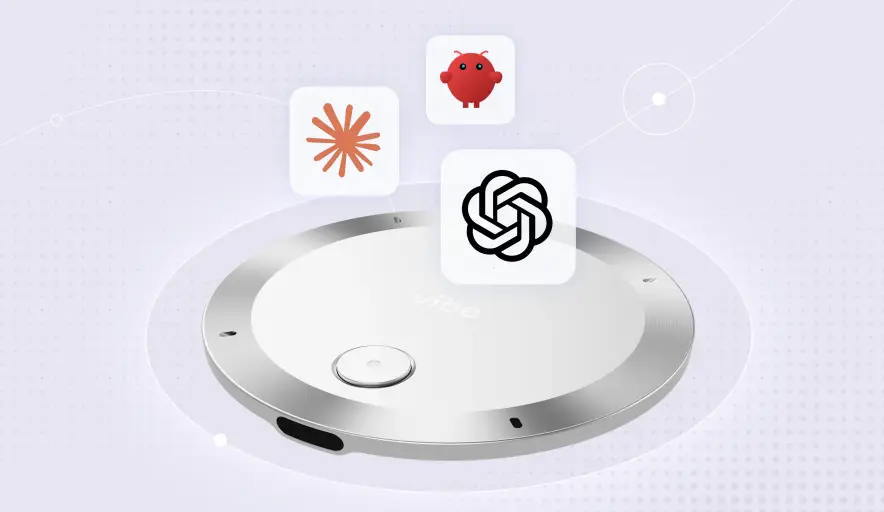
Plaud has a mature transcription layer. It supports 112 languages, speaker labels, custom vocabulary, more than 10,000 summary templates, and user-selectable AI models including GPT, Claude, and Gemini. If your main workflow is recording a conversation, generating a transcript, choosing a template, and reviewing a polished summary, Plaud is a strong and proven option.
Vibe Dot is built for a different workflow. In addition to over 100 language support, speaker labels, its AI experience focuses less on giving you thousands of templates but more on turning captured conversations into usable work output: structured notes, action items, follow-up context, and next-step prompts that help you move work forward. Spark also gives Vibe Dot a quick way to capture thoughts or trigger future workflows by voice, while planned integrations with Slack, Notion, Jira, Linear, and CRM tools are designed to bring conversation context closer to the tools where work actually happens.
Bottom line: Plaud is stronger today if you want a mature transcription-and-template system. Vibe Dot is the better fit if you want an AI recorder designed around work output, follow-up, and future workflow integration.
Security and compliance
Vibe Dot ships with a dedicated hardware encryption chip (TPM 2.0, FIPS 140-3) and carries SOC 2, HIPAA, and FERPA certifications, plus NDAA eligibility — a fit for U.S.-regulated industries like healthcare, education, and government.
Plaud is certified to ISO 27001, SOC 2, HIPAA, and GDPR, with all processing handled in the cloud rather than on a dedicated chip. GDPR certification gives it an edge for organizations with EU data-residency requirements.
Bottom line: Vibe Dot is the stronger fit for teams that prioritize hardware-level protection and U.S.-regulated workflows, including healthcare, education, and government.
What it actually costs
|
|
Free tier |
Pro tier (1 year) |
Higher tier (1 year) |
|---|---|---|---|
|
Vibe Dot |
$199 device + $0 software(300 min/mo, 7-day memory) |
$199 + $108/yr (Pro, $9/seat/mo)= $307 |
$199 + $348/yr (Max, $29/seat/mo)= $547 |
|
Plaud Note Pro |
$189 device + $0 software(300 min/mo) |
$189 + ~$100/yr (Pro, ~$8.33/mo)= $289 |
$189 + $239.99/yr (Unlimited)= $429 |
|
Year 2 onward (software only) |
$0 |
Vibe Dot: $108/yr · Plaud: ~$100/yr |
Vibe Dot: $348/yr · Plaud: $239.99/yr |
At the free and Pro tiers, the two are within about $18–$20 of each other in year one — this isn’t a story about which one is cheaper. It’s about what the extra context and automation are worth to you. The gap widens at the top tier, where Plaud’s Unlimited plan is meaningfully less expensive than Vibe AI Max; if unlimited transcription volume is your main requirement, that’s worth weighing directly.
Which one should you get?
|
If you’re… |
Go with |
|---|---|
|
Someone who just needs reliable on-demand recording |
Plaud Note Pro |
|
Someone who often catches key details before a meeting officially starts |
Vibe Dot |
|
Tracking the same clients or projects over weeks or months |
Vibe Dot |
|
Looking for a wearable pin rather than a phone-mount card |
Plaud NotePin S |
|
Part of a European organization needing GDPR/ISO 27001 |
Plaud |
|
In U.S. healthcare, education, or government |
Vibe Dot |
|
Interested in voice commands that trigger agent actions |
Vibe Dot (confirm which integrations are live) |
|
Budget-conscious and only need core transcription and summaries |
Plaud |
FAQ
The hardware specs look almost identical — so what’s the real difference?
The mic arrays, pickup range, and storage are genuinely close, since both devices are built around the same phone-mount card format. The real differences are in how recording gets triggered, whether the AI remembers across conversations, and whether there’s a dedicated hardware encryption chip on the device itself.
Can Plaud capture a full conference room?
No — Plaud is built for close-range, individual use, with best performance within a few feet of the device. For full-room coverage, a device like Vibe Bot (a separate, room-based product) is a better fit than either Vibe Dot or Plaud.
Does Vibe Dot’s auto-capture mean it’s always recording?
No. Auto-capture only runs during hours you define (Auto/Schedule modes), and you can switch back to manual Tap-to-record at any time — it isn’t blanket, all-day recording.
How do the two handle offline use?
Plaud can record offline and syncs for transcription once connected. Vibe Dot’s AI processing — transcription and summarization — requires an internet connection.
Which one should individuals vs. teams pick?
If you just need reliable, affordable, on-demand recording, Plaud Note Pro is a safe choice. If you or your team keep coming back to the same clients or projects over time, Vibe Dot’s cross-conversation memory can save real time you’d otherwise spend re-reading old notes.