
Most team check-ins follow the same pattern: a quick "any updates?" that gets filled with polished answers and polite silence. Nobody mentions what’s actually slowing things down. Nobody shares what they’re genuinely excited about. And the team walks out just as aligned — or misaligned — as before.
The Rose, Bud, Thorn exercise fixes that. It’s a structured reflection framework that gives every participant a clear, non-threatening way to share a win (Rose), a challenge (Thorn), and an opportunity they’re watching (Bud). The result is a more honest conversation in less time — whether you’re running a sprint retrospective, kicking off a classroom lesson, or checking in with a remote team.
This guide covers everything you need to run it well: what the framework means, step-by-step instructions, real examples across different contexts, a ready-to-use template, and answers to the most common questions teams ask.
What Is the Rose, Bud, Thorn Exercise?
 Rose, bud, thorn exercise — Vibe
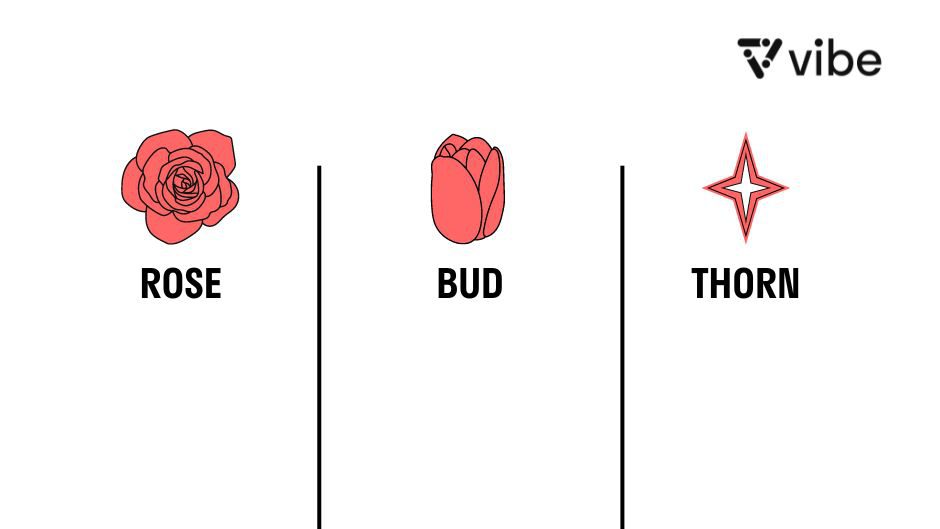
The Rose, Bud, Thorn exercise is a structured reflection tool that uses a simple botanical metaphor to organize feedback into three categories:
-
Rose — something positive, a success, or a highlight
-
Bud — something with potential, an emerging opportunity, or an idea worth developing
-
Thorn — a challenge, obstacle, or frustration
Originating from the design thinking community — most notably popularized through Stanford’s d.school — the framework has spread well beyond product design. Today it’s used in agile retrospectives, classroom discussions, therapy sessions, family dinners, onboarding programs, and leadership offsites.
What makes it work is structure without rigidity. Participants aren’t asked to "share feedback," which can feel vague or confrontational. They’re asked to fill three specific buckets, which lowers the emotional stakes and makes it easier for quieter voices to contribute.
How the Rose, Bud, Thorn Exercise Works: Step-by-Step

Running the exercise takes anywhere from 10 minutes for a quick team check-in to 45 minutes for a deeper retrospective. Here’s how to do it.
Step 1: Set the context
Decide what you’re reflecting on before the session. This could be a completed project, the past week, a specific meeting, a product prototype, or even a personal goal. Without a clear topic, responses tend to be scattered and hard to act on.
Step 2: Give participants time to think
Before opening the floor, give everyone 5–10 minutes to write down their own Rose, Bud, and Thorn independently. This prevents groupthink and ensures that the first person to speak doesn’t set the frame for everyone else.
Step 3: Share and discuss
Go around the room (or screen) and have each person share their three items. In a time-constrained setting, ask for one of each per person. In a longer session, open each category as a group — collect all Roses first, then Buds, then Thorns — which can help with thematic clustering.
Step 4: Cluster and prioritize
For team settings, group similar responses together on a whiteboard or collaborative canvas. Look for patterns: recurring Thorns often point to systemic issues; recurring Buds often surface the team’s next priority.
Step 5: Identify actions
A reflection exercise without follow-through is just venting. Close the session by agreeing on at least one concrete next step — something to protect, something to investigate, and something to address.
Rose, Bud, Thorn: What Each Element Really Means
Rose (Successes and Highlights)
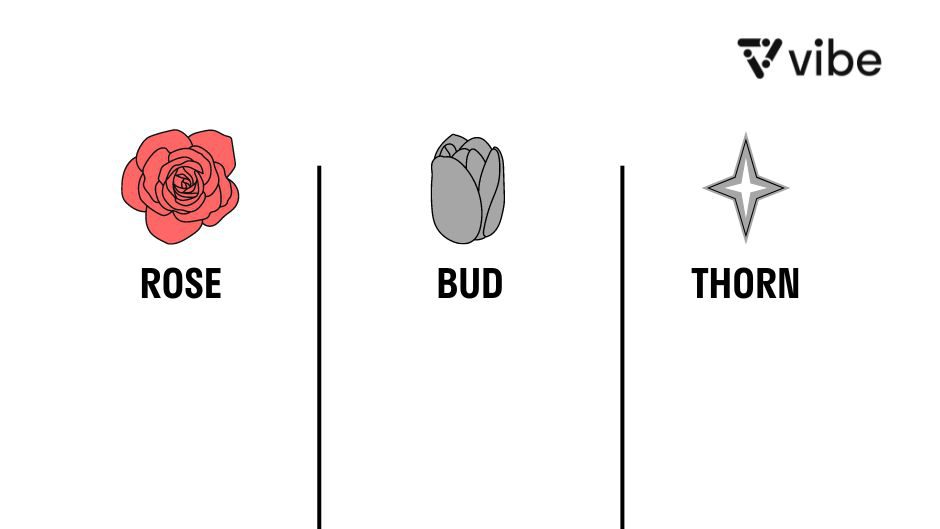
The Rose represents what went well. In a team context, this is the place to recognize behaviors and decisions that drove good outcomes — not just results, but the process behind them. The goal isn’t empty praise; it’s identifying what’s worth repeating.
 Rose represents what went well
Good Rose prompts:
-
What am I most proud of from this period?
-
What worked better than expected?
-
Which team behavior or decision made the biggest difference?
Bud (Opportunities and Potential)
The Bud is where optimism lives. It’s not what’s working yet — it’s what could work with more attention, time, or investment. Buds are often the most forward-looking and energizing part of the exercise, because they redirect attention from what went wrong toward what could go right.
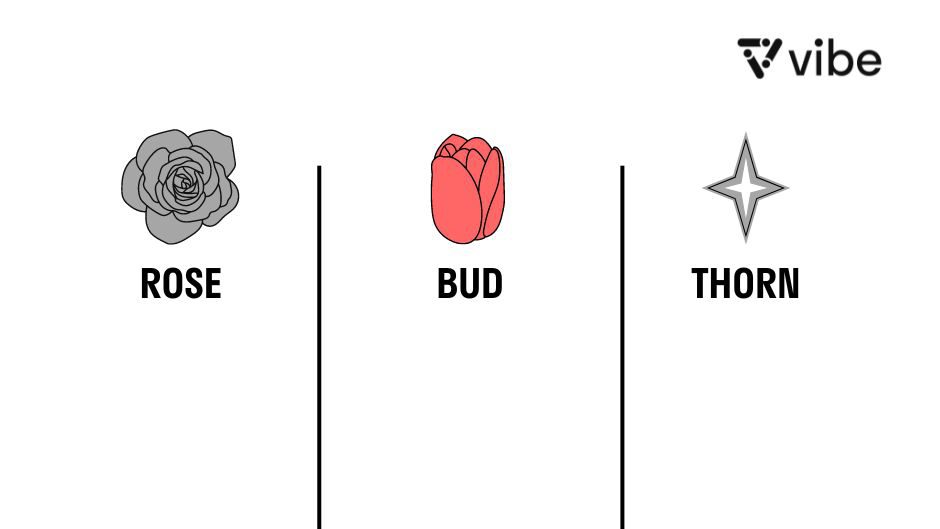 Bud is where optimism lives
Good Bud prompts:
-
What idea hasn’t been fully explored yet?
-
Where do I see untapped potential?
-
What would I try if I had more time or resources?
Thorn (Challenges and Obstacles)
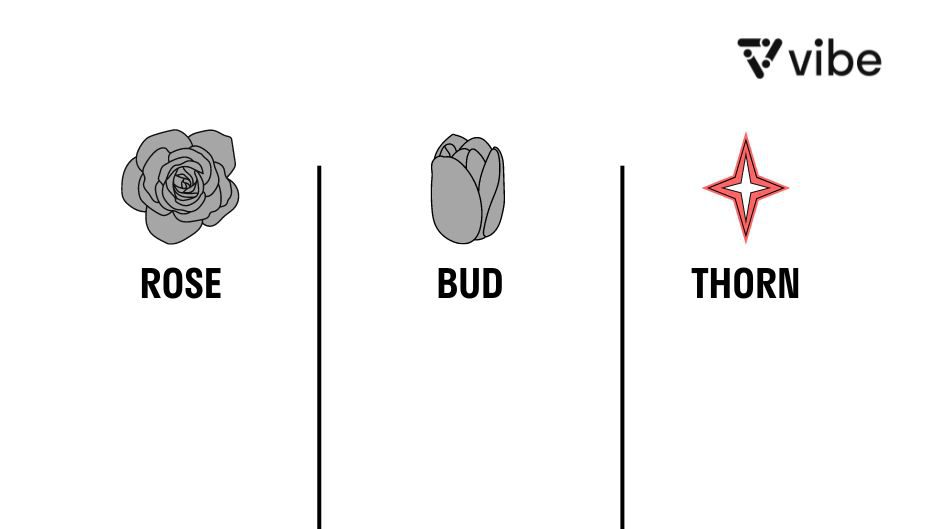 Thorn is the honest part
The Thorn is the honest part. It surfaces frustrations, bottlenecks, and failures in a way that feels safe to share — because it’s framed as part of a larger, balanced picture rather than a complaint. Teams that regularly surface Thorns tend to solve problems before they become crises.
Good Thorn prompts:
-
What slowed us down or blocked progress?
-
What created unnecessary friction or confusion?
-
What am I most worried about going forward?
Rose, Bud, Thorn Examples
The most common question teams ask is: "What does a good response actually look like?" Here are real-world examples across different settings.

Examples for a Work Team (Sprint Retrospective)
|
Example | |
|---|---|
|
Rose |
"We shipped the feature two days early because the team proactively flagged a dependency conflict in the planning session." |
|
Bud |
"Our new async standup format reduced interruptions — if we refine the prompts, it could replace half our sync meetings entirely." |
|
Thorn |
"The handoff between design and engineering is still creating rework. We need a clearer definition of ‘design-ready’ before tickets move over." |
Examples for a Classroom Setting
|
Example | |
|---|---|
|
Rose |
"The group project helped me understand the material better than studying alone — I actually remember it now." |
|
Bud |
"The guest speaker session sparked a lot of questions we didn’t have time to explore. A follow-up Q&A session would go deep." |
|
Thorn |
"The assignment instructions weren’t clear about the expected format, so I spent a lot of time on something that didn’t end up mattering." |
Examples for Personal Reflection (Daily or Weekly)
|
Example | |
|---|---|
|
Rose |
"I had a focused 90-minute block this morning with no interruptions and got more done than the rest of the day combined." |
|
Bud |
"I’ve been reading about time-blocking — I think it could help me stop context-switching so much during the workday." |
|
Thorn |
"I said yes to three things I should have declined this week and ended the week behind on my actual priorities." |
Examples for a Product Design Session
|
Example | |
|---|---|
|
Rose |
"User testing showed that the new onboarding flow cut time-to-first-action from 4 minutes to 90 seconds." |
|
Bud |
"Several users mentioned they’d love an offline mode — that’s worth adding to the roadmap." |
|
Thorn |
"The notification system is creating confusion. Users aren’t sure which alerts require action and which are just informational." |
Examples for an Icebreaker (Personal/Social Context)
For icebreakers, the scope shifts from work to life in general. Participants share a personal Rose, Bud, and Thorn — something that went well recently, something they’re looking forward to, and something they’re working through.
|
Example | |
|---|---|
|
Rose |
"I finally finished a book I’d been meaning to read for two years." |
|
Bud |
"I’m thinking about starting a morning walk routine — I’ve been wanting to build a better way to start the day." |
|
Thorn |
"I’ve been struggling to disconnect from work in the evenings, which is affecting my sleep." |
Rose, Bud, Thorn Template
You don’t need special software to run the exercise, but having a template reduces friction and helps participants structure their thinking before the discussion begins.
Simple written template (for individual use):
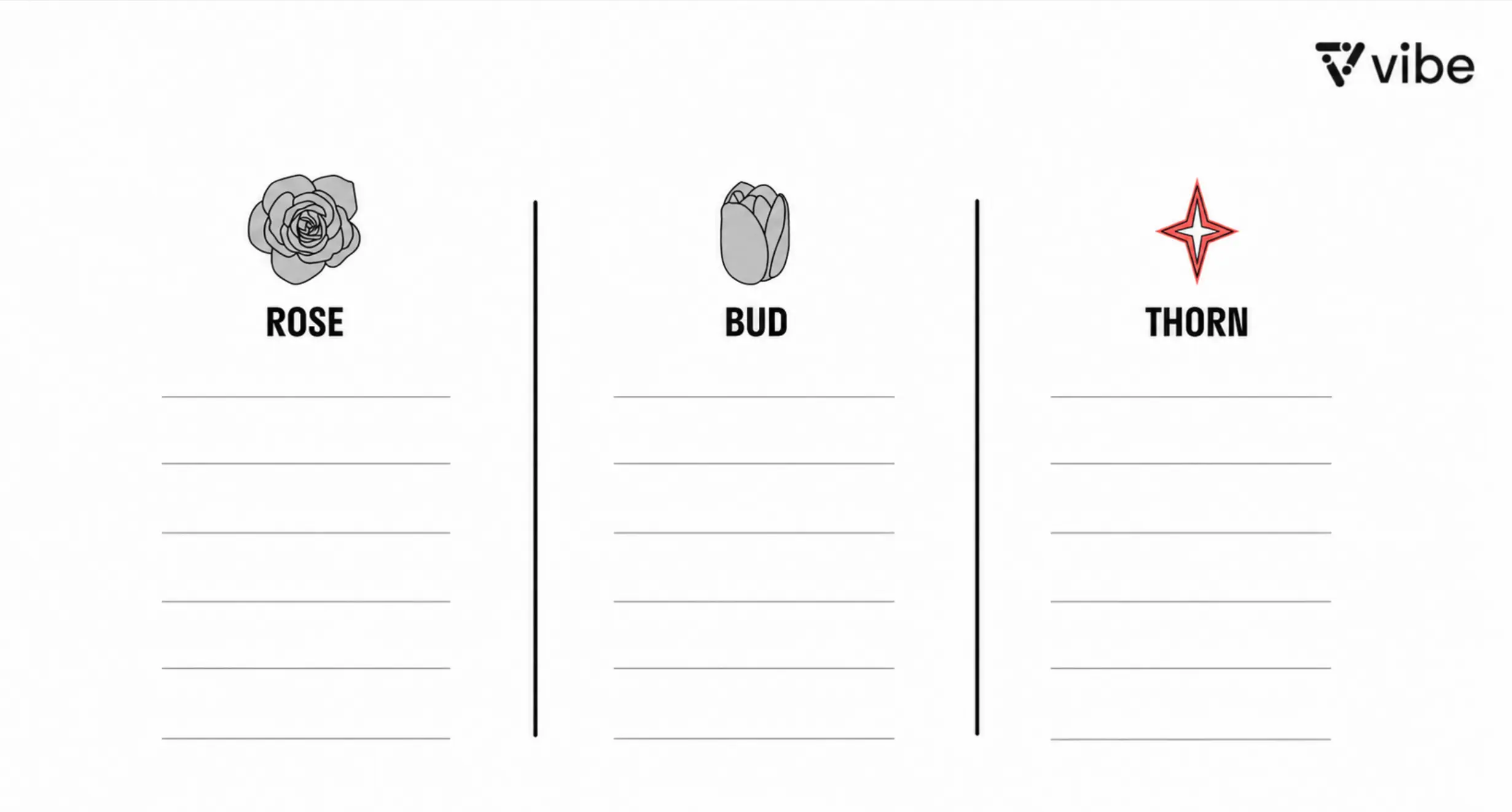 Rose, Bud, Thorn template for individuals
For team sessions on a shared whiteboard:
Create three columns labeled Rose, Bud, and Thorn. Each participant adds sticky notes (physical or digital) to the relevant column. After everyone has contributed, group similar notes together and discuss the clusters.
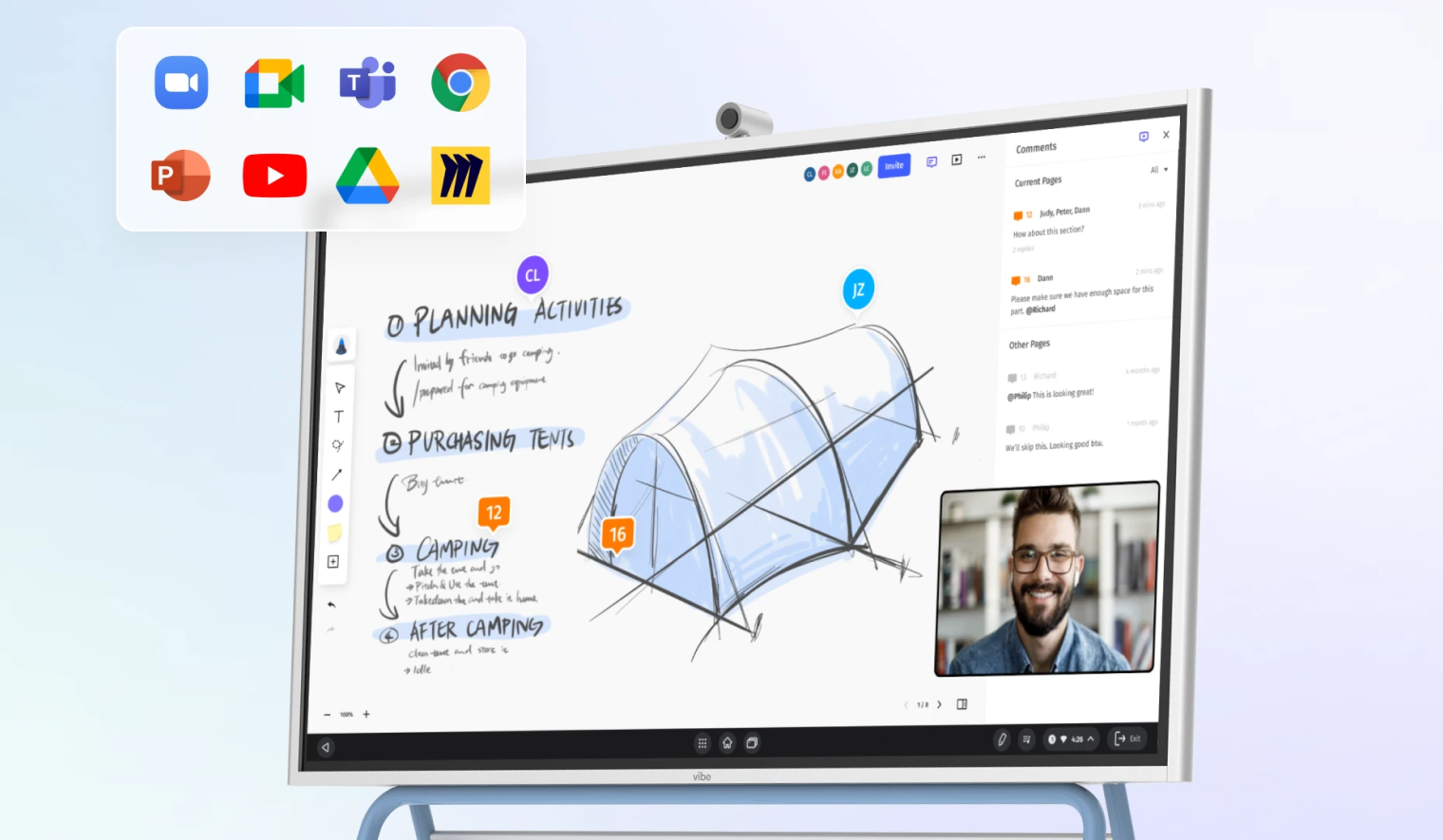
You can use Vibe’s Canvas to run this collaboratively in real-time — participants can add and rearrange sticky notes together, whether they’re in the same room or distributed across time zones. Teams using Vibe Bot in their meeting room can also capture the full discussion as it happens, with live transcription and auto-generated notes so nothing from the retrospective gets lost.
Who Uses the Rose, Bud, Thorn Exercise (and How)
The framework adapts well across contexts. Here’s how different groups commonly use it:
Agile and product teams use it as a lightweight retrospective format that covers what to sustain (Rose), what to explore next (Bud), and what to fix (Thorn) — without requiring a two-hour meeting.
Teachers and students use it to reflect on lessons, units, or group projects. It gives students a structured way to give feedback that feels constructive rather than critical, and helps teachers identify what’s landing and what isn’t.
Managers and coaches use it for 1:1 check-ins as a way to surface how someone is actually doing — not just task status updates. The Thorn prompt in particular often surfaces issues that wouldn’t come up in a standard check-in.
Design and UX teams use it during user research debrief sessions and prototype reviews. Each team member shares a Rose, Bud, and Thorn from the research session, which quickly highlights consensus and disagreement.
Facilitators and trainers use it at the end of workshops and training programs as a closing reflection that doubles as feedback for the facilitator.
Families and social groups use it as a dinner table or classroom icebreaker — especially with younger participants who find open-ended reflection prompts difficult to answer.
Benefits of the Rose, Bud, Thorn Exercise
It balances reflection. Many feedback frameworks skew toward problems or skew toward positives. Rose, Bud, Thorn requires both, which leads to more honest and more useful conversations.
It gives ceveryone a structure to contribute. Quieter team members often stay silent in open-ended discussions. The three-category format gives them a clear script for participating without having to generate their own framing.
It surfaces opportunities, not just problems. Most retrospective formats focus on what went wrong and what to fix. The Bud category shifts attention to what could go right — which is just as important for team momentum.
It’s fast to run. A basic round of Rose, Bud, Thorn with a team of five takes under 15 minutes. That makes it practical for recurring use — weekly check-ins, end-of-sprint reviews, or project closings.
It works in any medium. In-person, remote, async, written, verbal — the framework doesn’t require any particular format or tool to work.
Variations and Alternative Names
The Rose, Bud, Thorn format goes by several other names depending on context:
-
Roses, Buds, and Thorns — the plural version, often used in classroom settings
-
Rose, Thorn, Bud — same framework, different ordering (Thorn often moved to middle to end on a positive/hopeful note)
-
Glad, Sad, Mad — a simpler emotional variant for younger audiences
-
Plus, Delta — a two-category version focused on what to keep and what to change
-
4Ls (Liked, Learned, Lacked, Longed For) — a more detailed retrospective variant for teams wanting more granularity
-
Start, Stop, Continue — a common management variant focused on behaviors
For teams wanting to go deeper on the opportunity side, some facilitators add a fourth category: Seed — an early-stage idea that isn’t ready to be called a Bud yet but is worth keeping track of.
FAQ
How do you run a Rose, Bud, Thorn session?
Choose a specific topic or time period to reflect on. Give participants 5–10 minutes to write down one Rose (a success), one Bud (an opportunity), and one Thorn (a challenge) independently. Then share and discuss as a group, looking for patterns and agreeing on follow-up actions.
What is the "Bud" in Rose, Bud, Thorn?
The Bud represents potential — something that isn’t fully developed yet but shows promise. It’s the forward-looking element of the framework: not what’s working now, but what could work with more attention or investment. It’s often the most generative part of the discussion.
What is the purpose of the Rose, Thorn, Bud design thinking technique?
In design thinking, the exercise helps teams get a 360-degree view of a prototype, process, or experience. The Rose identifies what’s working and worth preserving. The Thorn uncovers friction points and pain. The Bud surfaces latent opportunities that might inform the next design iteration.
How long does the exercise take?
For a quick team check-in, 10–15 minutes. For a full sprint retrospective or project review, 30–45 minutes. For a classroom activity with discussion, allow 20–30 minutes depending on group size.
Can you use Rose, Bud, Thorn asynchronously?
Yes. Share the template in a shared document or collaboration tool before a meeting, ask participants to fill it in advance, and use the live session to discuss patterns and decide on actions rather than collecting responses in real time.
What’s the difference between Rose, Bud, Thorn and a standard retrospective?
Standard retrospectives vary widely in format. Rose, Bud, Thorn is one specific format that’s faster and more accessible than longer structured retrospectives like the 4Ls or Sailboat exercise. It works well for teams that want a consistent, lightweight reflection ritual rather than a periodic deep-dive.