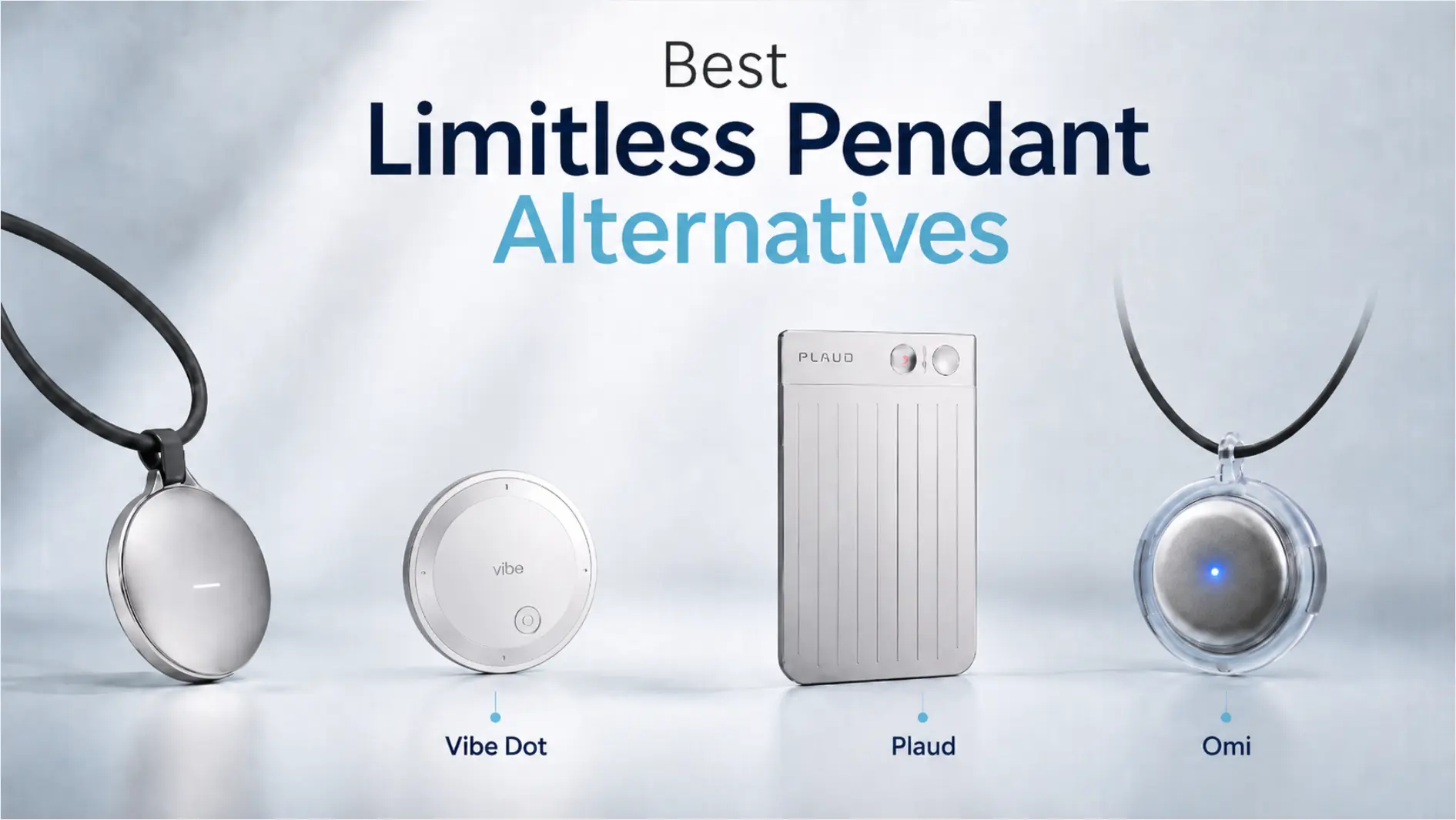

Fathom is one of the highest-rated AI meeting notetakers available — a 5.0 on G2 across nearly 7,000 reviews is almost unheard of at that scale, and its free tier is the most generous in the category. If your work life is mostly Zoom, Google Meet, and Microsoft Teams calls on a desktop, it is genuinely hard to criticize.
But "mostly video calls on a desktop" describes fewer and fewer teams. If your best client conversations happen over lunch, if your sales reps are on-site three days a week, if your critical decisions get made in the hallway before anyone opens their laptop — Fathom has a documented, structural blind spot: it is online-meeting-only, desktop-only, and has no mobile app. Those are not configuration gaps. They are product architecture decisions that draw a hard line around what Fathom can see.
Vibe Dot is a physical AI wearable designed to sit on the other side of that line. This comparison covers both tools across the dimensions that actually determine which one is right for your team.
What Each Tool Is Built to Do
Fathom: The AI Notetaker for Online Meetings
Fathom records, transcribes, and summarizes video calls on Zoom, Google Meet, and Microsoft Teams. It joins as a visible bot, keeps full audio and video recordings with playback, and generates structured AI summaries and action items within minutes of the meeting ending.
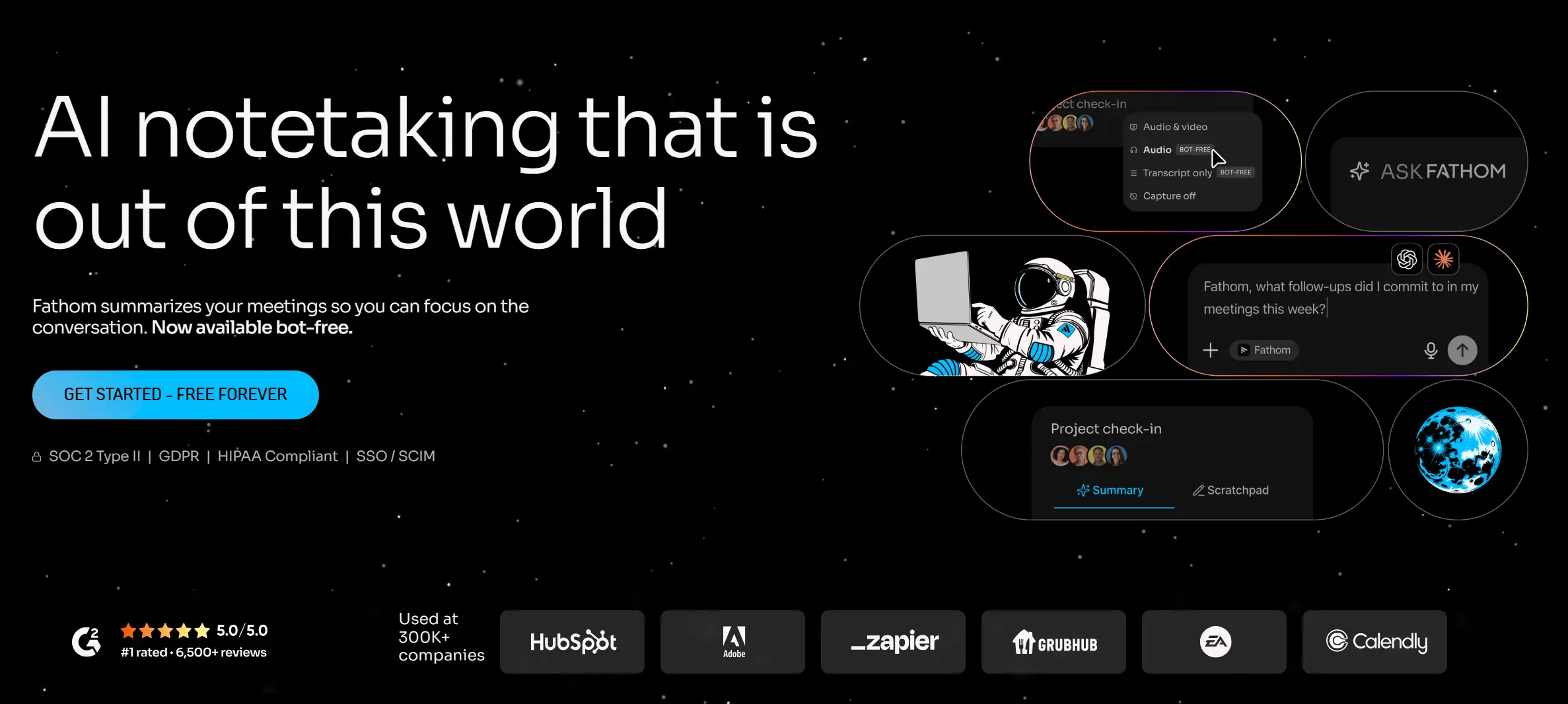
Its free tier is genuinely unlimited on the recording and transcription side — no minute caps, no storage meter, no trial countdown. The paid layer is where AI intelligence deepens: unlimited polished summaries, CRM field sync, the "Ask Fathom" cross-meeting query assistant, and at the Business tier, Deal View and AI scorecards for sales coaching.
Fathom is a PLG-first product: individuals adopt it for free, find it indispensable, and pull it into team workflows. That motion has worked — it was recognized as HubSpot's Most Used App of the Year in 2025 and has placed on G2's Best Software Awards Top 100 for 2026.
Platform: Mac, Windows (desktop only; no mobile app; iOS in development)
Meeting coverage: Zoom, Google Meet, Microsoft Teams — live online meetings only
Vibe Dot: The AI Device for Every Conversation
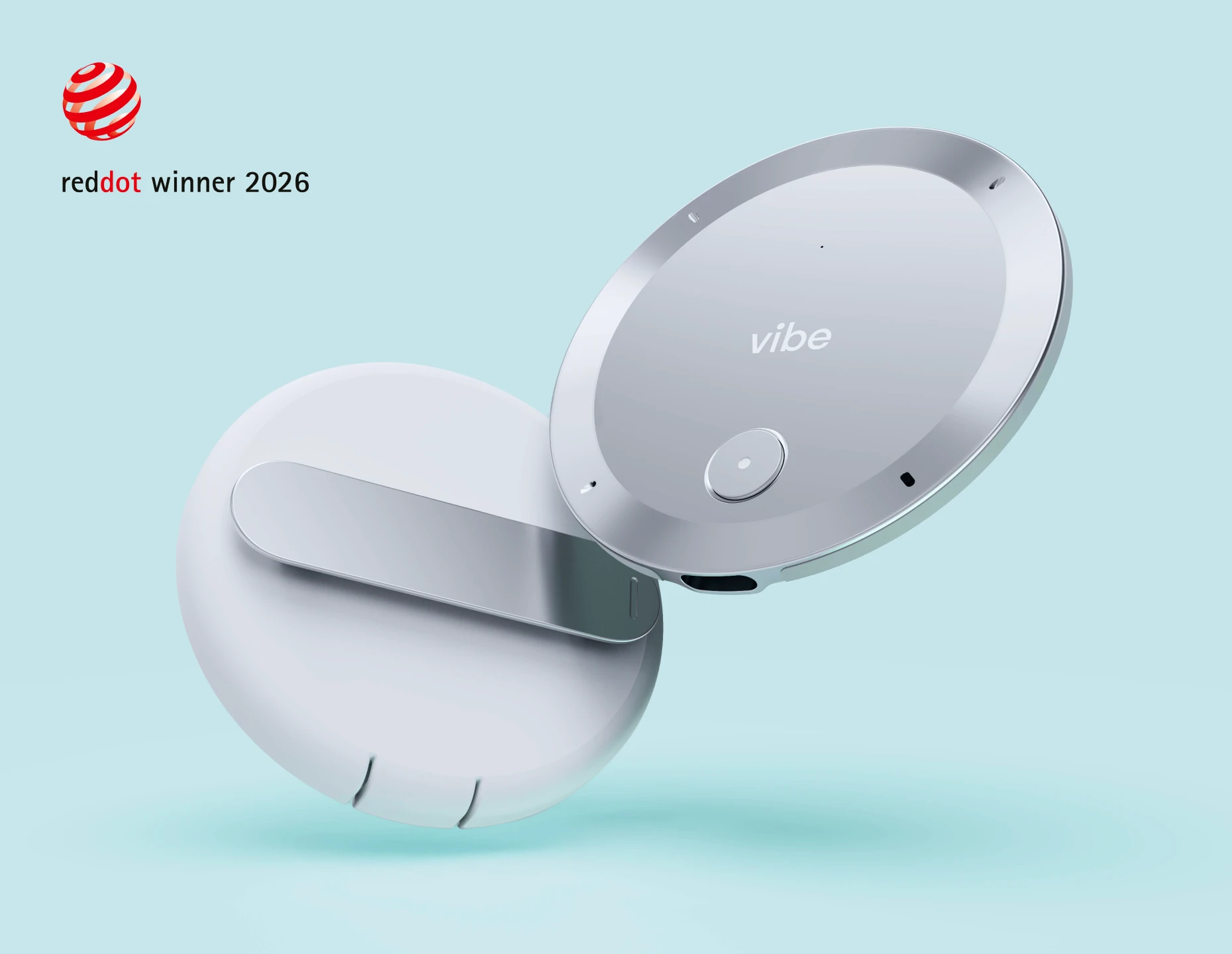
Vibe Dot is a wearable AI recording device — 0.83 oz, 0.17 inches thin, a Red Dot Design Award winner for 2026 — with a 5-microphone array (4 air mics + 1 bone-conduction) and 64GB of onboard storage. It captures, transcribes, and summarizes conversations wherever they happen: a client's office, a conference room, a job site walkthrough, a sales dinner, or a commute call — no laptop, no video conferencing app required.
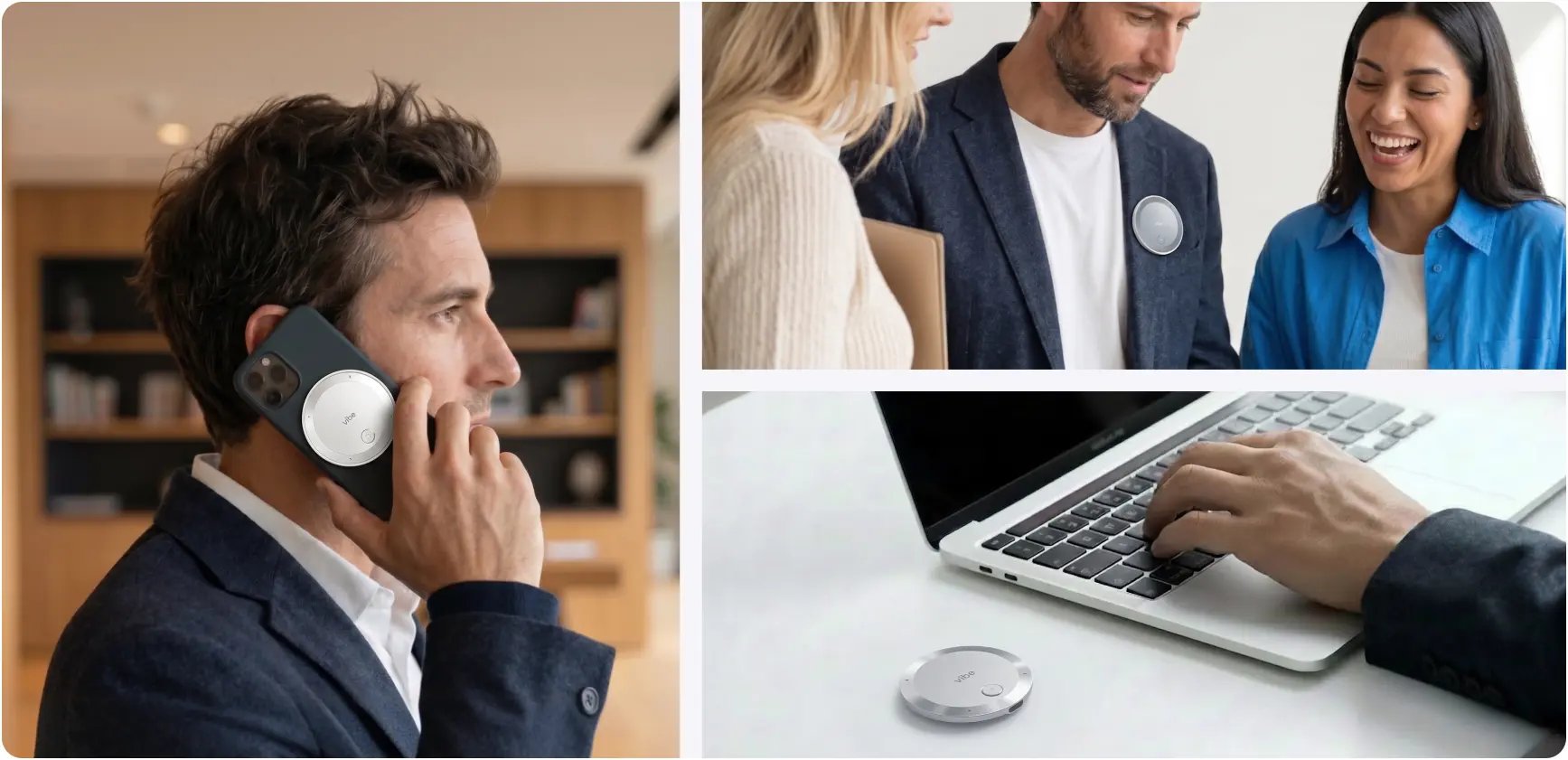
Every recording syncs to Vibe AI, which builds a persistent, cross-session Memory Graph from all your captured conversations. It links meetings, documents, and Slack threads into a unified knowledge base that accumulates over time — so the context from a client call three weeks ago is available when you open next week's follow-up. This is architecturally distinct from per-meeting summary tools, including Fathom.
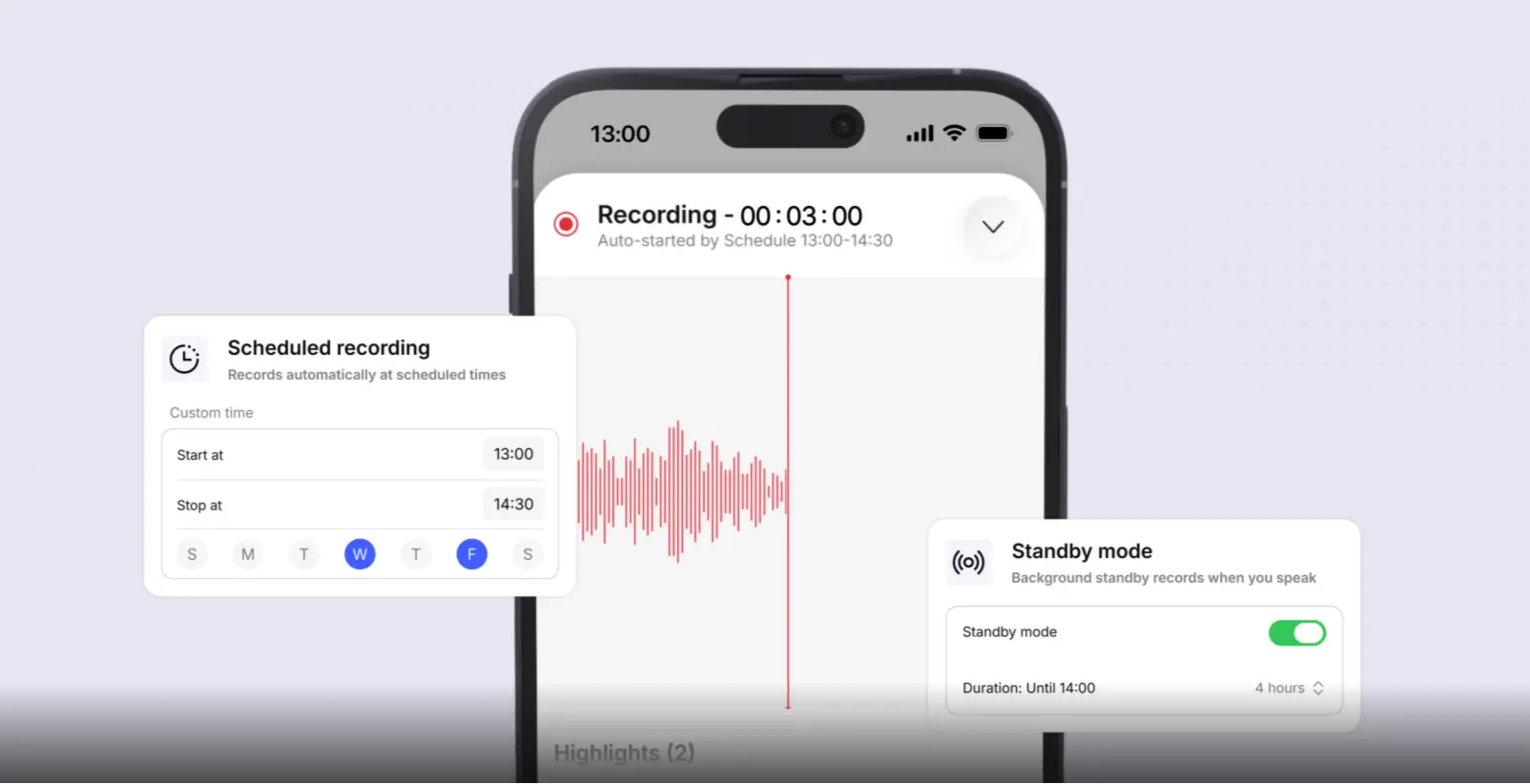
Vibe Dot supports three recording modes: Tap to Record (double-tap to start, tap to mark key moments, tap to stop), Auto Capture in Standby (voice-activated — the device recognizes your voice and starts recording automatically), and Auto Capture Scheduled (set a window; the device records the full duration). Security is handled by a dedicated hardware encryption chip certified to FIPS 140-3 and Common Criteria EAL 6+, with SOC 2 Type 2, HIPAA, FERPA, and NDAA certifications.
Platform: Physical hardware device + Vibe AI web platform (platform-agnostic)
Meeting coverage: Any spoken conversation — online or offline, in-person or remote
Head-to-Head Comparison
|
Vibe Dot |
Fathom | |
|---|---|---|
|
Form factor |
Physical wearable device |
Software app (Mac, Windows desktop) |
|
Offline / in-person meetings |
✅ Core use case |
❌ Not supported |
|
Online meeting support |
✅ Via Vibe AI integration |
✅ Core use case |
|
Mobile app |
✅ iOS + Android companion |
❌ No mobile app |
|
Audio recording + playback |
✅ Stored with hardware encryption |
✅ Full audio + video playback |
|
AI summaries |
✅ Real-time + post-meeting |
✅ Post-meeting (5/month free; unlimited on paid) |
|
Cross-session memory |
✅ Memory Graph — persistent, cross-session |
❌ Per-meeting history only |
|
CRM integration |
✅ HubSpot, Salesforce via OpenClaw |
✅ HubSpot + Salesforce (Team/Business plans) |
|
Sales coaching / Deal View |
❌ Not a current feature |
✅ Business plan only |
|
Automatic CRM field write-back |
✅ Via Vibe AI agentic workflows |
✅ Business plan |
|
Speaker identification |
✅ 5-mic array with directional tracking |
✅ Bot-based diarization (25+ languages) |
|
Language support |
✅ 90+ languages |
✅ 25+ languages |
|
Visible to meeting participants |
✅ Physical device is inherently visible |
✅ Bot joins participant list |
|
Hardware encryption |
✅ FIPS 140-3, Common Criteria EAL 6+ |
❌ Software-level only |
|
Security certifications |
✅ SOC 2, HIPAA, FERPA, NDAA |
✅ SOC 2 (in progress), GDPR, CCPA |
|
Free tier |
✅ Starter free (300 min/month, 7-day memory) |
✅ Unlimited recording + transcription; 5 AI summaries/month |
|
Paid pricing (entry) |
$199 device + Pro $9/seat/month |
Team $18/user/month (2-seat minimum) |
Where Fathom Wins
The strongest free tier in the category
Fathom's free plan records and transcribes an unlimited number of meetings with no cap of any kind on recording or storage. The paywall sits at the intelligence layer — polished AI summaries are capped at 5 per month on the free tier, with unlimited on Premium. For anyone who wants to capture and store video call recordings without spending anything, Fathom is the easiest starting point in the category.
The paid tiers add real depth at an accessible price. The Team plan at ~$18/user/month (billed monthly) unlocks team-wide search across all shared meeting recordings, shared folders, collaborative highlights, keyword alerts, and HubSpot/Salesforce CRM sync. The Business plan at ~$28/user/month adds the features that make Fathom a lightweight alternative to Gong: AI scorecards that evaluate calls against manager-defined criteria, Deal View that aggregates every Fathom call tied to a HubSpot or Salesforce deal into a single timeline with an AI-generated deal summary, and CRM field-level sync that writes structured data (pain points, next steps, stakeholder signals) back into the deal record automatically.
Purpose-built for the online sales workflow
Fathom's product roadmap is clearly oriented around the revenue team. Deal View — available at the Business tier — is genuinely useful: a manager can review the full history of a deal across every recorded call, with an AI-generated summary of the relationship, competitor mentions, pricing objections, and stakeholder sentiment, without watching a single recording. Combined with AI scorecards and keyword alerts, it gives sales managers a systematic call-review infrastructure at a price point well below Gong or Chorus.
For a team that runs its entire sales motion through Zoom and Meet, where every rep call is online and every deal is tracked in HubSpot or Salesforce, Fathom's Business plan provides a coherent end-to-end workflow that Vibe Dot does not currently replicate.
Audio and video recording with full playback
Fathom keeps both audio and video from every meeting. If a transcript is ambiguous, if someone disputes what was agreed, or if a manager wants to watch a specific rep handle an objection, the recording is there. This is a meaningful advantage over Granola (which discards audio) and a practical parity point with Vibe Dot (which retains encrypted audio).
Where Vibe Dot Wins
It captures the conversations that Fathom architecturally cannot
Fathom requires an active video call on Zoom, Meet, or Teams running on a Mac or Windows desktop. The moment a conversation moves off-screen — a client visit, an in-person board meeting, a field walkthrough, a working lunch — Fathom cannot capture it. This is a design constraint, not a configuration gap: the product has no mobile app, no offline recording mode, and no support for audio uploads from other sources.
Vibe Dot is designed specifically for this. Clip it to a lapel, double-tap to start, and it captures the conversation with the same transcription and summarization quality it brings to a recorded Zoom call. For sales teams whose deal-making conversations happen at client sites, for consultants who run in-person workshops, for executives whose most important decisions get made in the room before the slides are even opened — Vibe Dot covers the territory Fathom cannot reach.
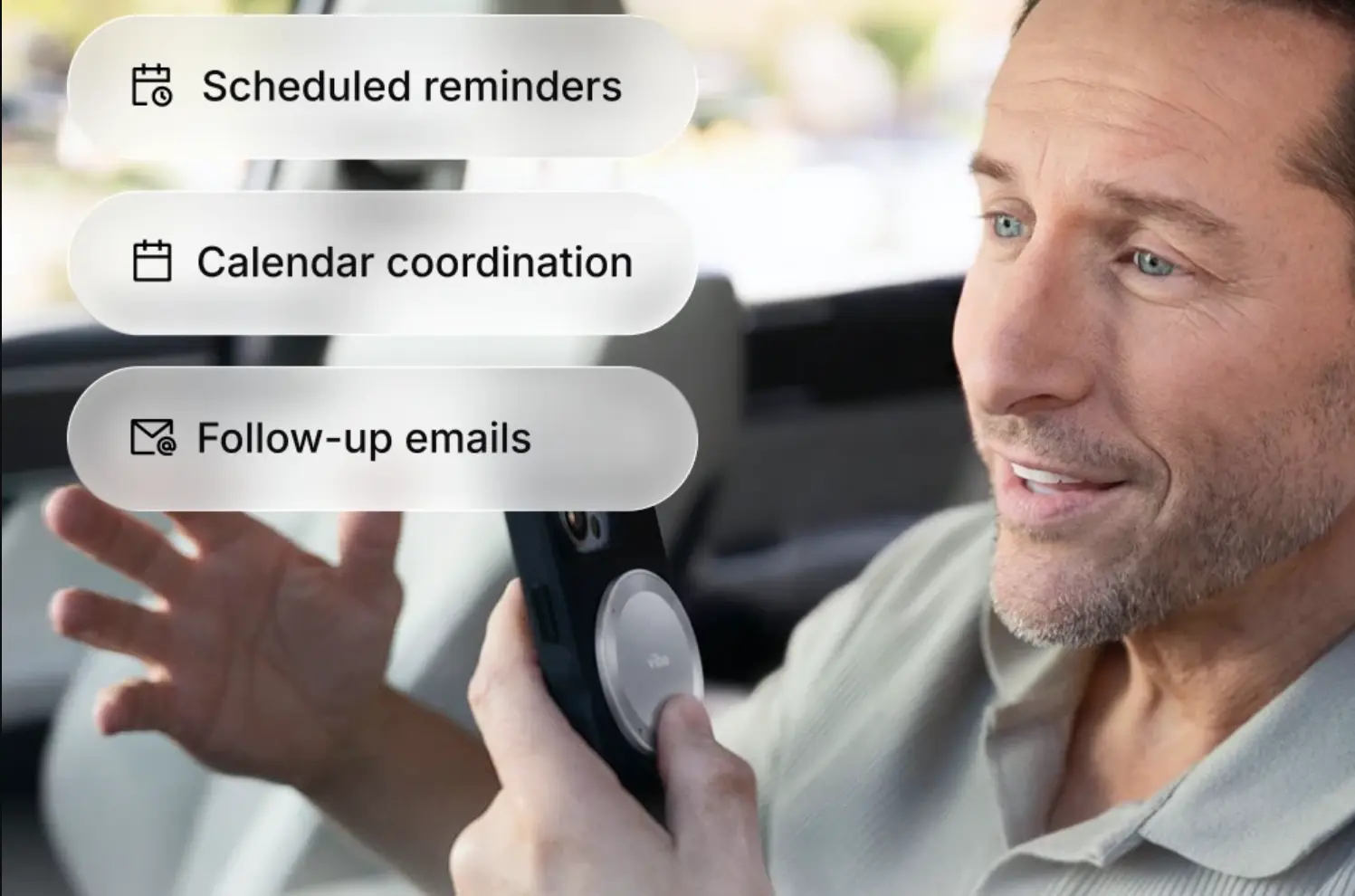
Persistent cross-session memory, not per-meeting summaries
Fathom's intelligence is meeting-scoped. Each call produces a summary, action items, and CRM notes — but there is no accumulated memory that links what a client said in March to what came up in August, or connects a theme across ten discovery calls without a manager manually reviewing each one.
Vibe AI's Memory Graph is built differently. Every captured conversation — online or offline — is processed into a persistent, cross-session knowledge base that links meetings, documents, and Slack threads over time. Ask it to surface everything a specific prospect has said about timeline concerns across the last six months and it returns cited, searchable results. For organizations that treat their meeting history as institutional knowledge rather than individual records, this architecture is meaningfully different.
Hardware-grade security where software encryption stops
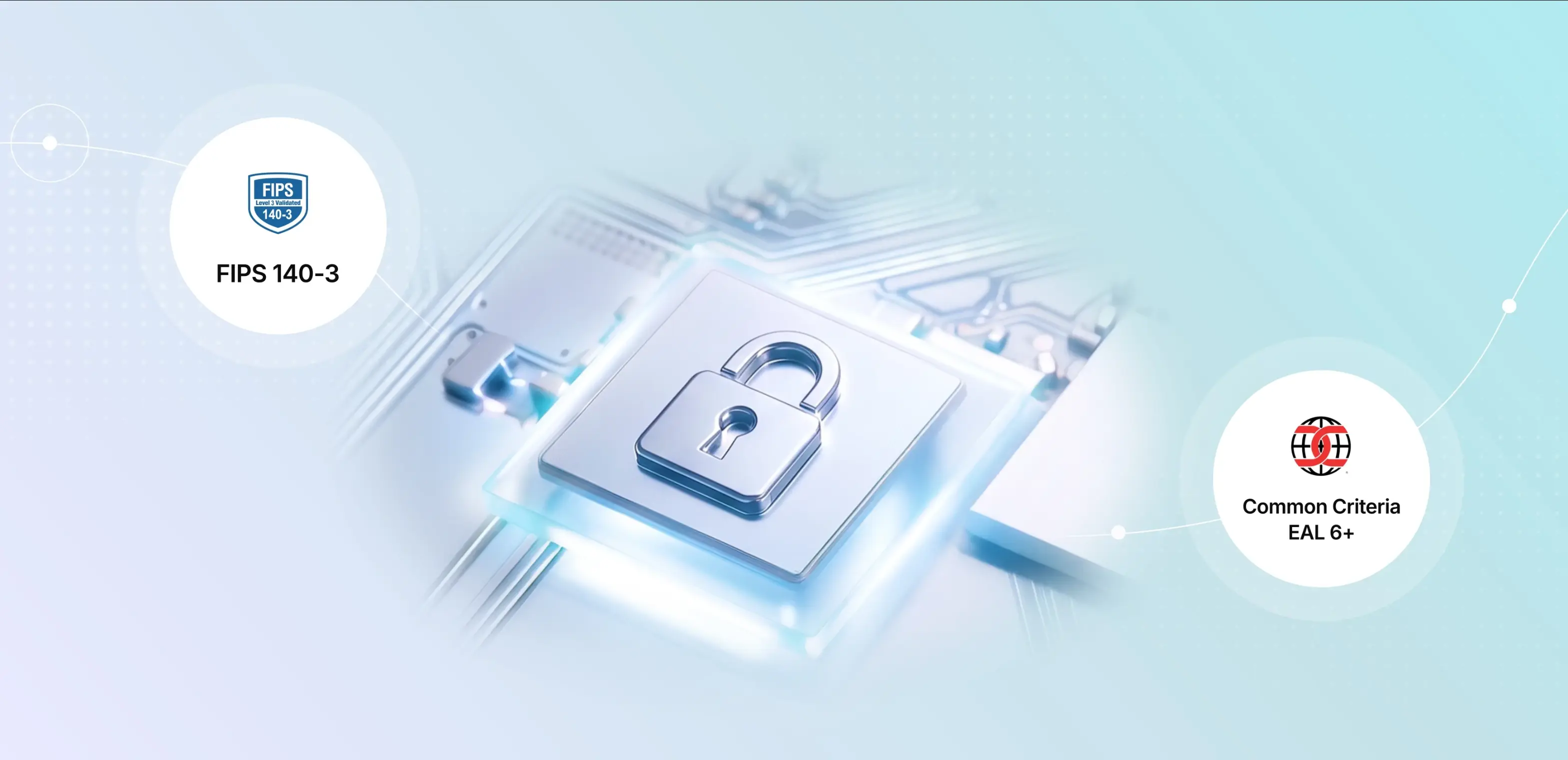
Vibe Dot carries a dedicated hardware encryption chip certified to FIPS 140-3 and Common Criteria EAL 6+. Recordings stored on the device are unreadable if the device is lost or plugged into an unauthorized computer — a protection layer that software-level encryption cannot replicate. Combined with SOC 2 Type 2, HIPAA, FERPA, and NDAA certifications, Vibe Dot is the more defensible choice for teams in regulated industries: healthcare, government-adjacent organizations, higher education, and financial services.
Fathom's security posture is appropriate for most commercial use cases — SOC 2 certification is in progress, with GDPR and CCPA compliance in place — but it does not carry HIPAA, FERPA, or NDAA, and has no hardware encryption layer.
90+ languages vs. 25+
Vibe Dot supports transcription in 90+ languages out of the box. Fathom supports 25+ languages. For global teams, multilingual sales organizations, or any team where participants regularly speak different primary languages, this is a practical difference in which meetings the tool can actually process.
Pricing Compared
Fathom pricing (as of October 2026)
|
Plan |
Monthly |
Annual/mo |
Key inclusions |
|---|---|---|---|
|
Free |
$0 |
$0 |
Unlimited recording + transcription; 5 AI summaries/month |
|
Premium |
~$20/user |
~$16/user |
Unlimited AI summaries, action items, Ask Fathom, custom templates |
|
Team |
~$18/user |
~$15/user |
All Premium + shared library, team search, CRM sync (up to 3 users/domain) |
|
Business |
~$28/user |
~$25/user |
All Team + CRM field sync, Deal View, AI scorecards (2-seat minimum) |
Vibe Dot pricing (as of October 2026)
|
Component |
Price |
|---|---|
|
Vibe Dot device |
$199 (one-time) |
|
Vibe AI Starter |
Free (300 min/month, 7-day memory retention) |
|
Vibe AI Pro |
$9/seat/month or $108/year (1,200 min/month, 12-month memory, 100 AI Credits/month) |
|
Vibe AI Max |
$29/seat/month or $348/year (unlimited transcription, unlimited memory, 400 AI Credits/month) |
For teams evaluating total cost of ownership: Fathom Business at $25/seat/month annually adds up to $300/seat/year with no hardware cost, but also no offline capture. Vibe Dot at $199 device + $108/seat/year (Pro) is $307/seat/year in year one, with full offline and online coverage. From year two onward, the per-seat cost is $108/year — significantly below Fathom Business.
Who Should Choose What
Choose Fathom if:
-
Your team's critical meetings happen exclusively on Zoom, Google Meet, or Teams
-
You want a zero-cost starting point with unlimited recording — the free tier is genuinely the best in the category
-
You run a sales team and want lightweight Gong-alternative coaching features (AI scorecards, Deal View) without enterprise pricing
-
CRM write-back automation into HubSpot or Salesforce is a core workflow requirement
-
Everyone on your team works from a Mac or Windows desktop
Choose Vibe Dot if:
-
Your team operates across both virtual and physical environments, and your best conversations don't always happen on a video call
-
You need meeting capture that follows individuals — not sessions — across in-person visits, field work, or events
-
Your organization operates in a regulated industry (healthcare, government, education) and needs HIPAA, FERPA, or NDAA certification alongside SOC 2
-
You want persistent cross-session memory that accumulates institutional knowledge over time, not per-meeting summaries
-
Language coverage beyond 25 languages matters to your team
-
The total cost of ownership over 18+ months matters — after the initial device purchase, Vibe Dot Pro costs less per seat annually than Fathom Business
For many enterprise teams, the honest answer is both: Fathom for structured online meetings, Vibe Dot for everything else, all feeding into the same Vibe AI Memory Graph.
Conclusion
Fathom and Vibe Dot are strong at different things, for different teams, in different environments.
Fathom is the best online-meeting notetaker available at its price point. Its free tier is unmatched, its sales team features are well-designed, and its CRM integrations work cleanly. For a team that runs entirely on video calls and measures success through pipeline, it is a compelling choice from the free tier to Business.
Vibe Dot answers a different question: what happens to all the conversations that never make it to a calendar invite? The client site visit, the team debrief at lunch, the in-person workshop, the hallway decision — Fathom leaves these invisible. Vibe Dot was built to capture them, connect them to everything else your team knows, and make that institutional knowledge accessible across time.
For teams that operate in both worlds, the choice is not one or the other. It is the right tool for each environment.
Frequently Asked Questions
Can Vibe Dot replace Fathom entirely for a team that only does online meetings?
For pure online meeting workflows, Fathom is the stronger dedicated tool — especially at the Business tier, where Deal View, AI scorecards, and deep CRM field sync are purpose-built for sales teams running on video calls. Vibe Dot covers online meetings via Vibe AI, but its primary design intent is physical-world capture. If your team never has an in-person conversation that matters, Fathom is the more focused choice. If in-person capture is a requirement even occasionally, Vibe Dot is the only option that handles both.
Does Fathom have a mobile app?
No — as of October 2026, Fathom runs on Mac and Windows desktops only. An iOS version has been described as in development, but there is no Android app and no timeline for release. This means Fathom cannot capture phone calls, tablet-joined meetings, or any in-person conversation. Vibe Dot has iOS and Android companion apps and captures in-person conversations natively.
How does Vibe Dot handle speaker identification compared to Fathom?
Vibe Dot uses a 5-microphone array (4 air mics + 1 bone-conduction mic) with directional audio processing to separate speakers based on position and voice profile. Fathom uses platform-based diarization through its meeting bot, which works well in clean call environments. For in-person multi-speaker meetings with ambient noise — the scenarios Fathom cannot reach at all — Vibe Dot's hardware mic array handles speaker separation more reliably than any software approach relying on a laptop microphone or Bluetooth audio.
Is Fathom or Vibe Dot better for HIPAA-regulated industries?
Vibe Dot. Fathom's current security posture (SOC 2 in progress, GDPR, CCPA) does not include HIPAA attestation. Vibe Dot carries SOC 2 Type 2, HIPAA, FERPA, NDAA, and FIPS 140-3 certifications, with hardware-level encryption on the device itself. For healthcare organizations, covered entities, or any team handling PHI in meeting content, Vibe Dot is the compliant choice.
What is Fathom Deal View and does Vibe Dot have an equivalent?
Deal View is a Fathom Business-tier feature that aggregates every Fathom-captured call linked to a specific HubSpot or Salesforce deal into a single shared workspace, with an AI-generated deal summary, a chronological interaction timeline, and Ask Fathom for deal analysis. It is a practical, affordable alternative to enterprise conversation intelligence platforms like Gong for teams with structured online sales processes. Vibe Dot does not currently have a dedicated Deal View equivalent — its strength is cross-session Memory Graph memory across all conversations, which covers a broader scope but without Fathom's deal-centric aggregation interface. Teams that rely on Fathom's Deal View for pipeline reviews should factor this in.
Can I use Vibe Dot and Fathom together?
Yes, and some enterprise teams do. Vibe Dot captures in-person and offline conversations; Vibe Bot handles conference room video meetings with AI-assisted live notes; Fathom handles individual desktop video calls. All Vibe Dot and Vibe Bot recordings feed into the same Vibe AI Memory Graph, creating a unified knowledge base. Fathom sits separately. Whether running both makes sense depends on whether the Fathom Business tier's CRM and coaching features justify the additional per-seat cost alongside Vibe AI Pro.