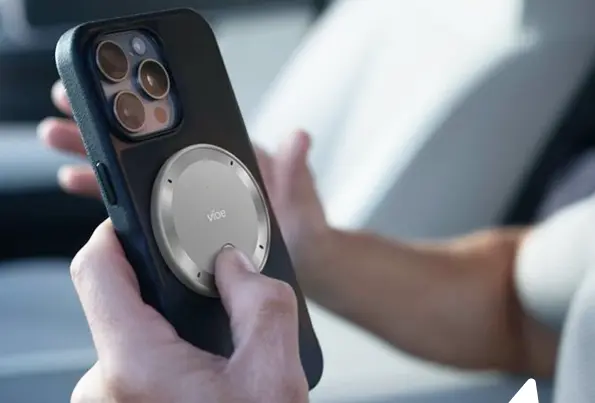

Most AI meeting tools solve for one scenario: the scheduled Zoom call. But research consistently shows that 40% of business-critical conversations never happen in a video conference — they happen in hallways, at client sites, in coffee shops, and on the factory floor. That gap is exactly where a Vibe Dot vs. Granola comparison gets interesting.
Granola is arguably the best software-based AI notepad for online meetings today. Vibe Dot is a physical AI device designed to capture every conversation — wherever it happens. They’re not quite fighting for the same user. But if you’re evaluating AI meeting tools for a team that operates across both virtual and physical spaces, understanding the difference is worth your time.
What Each Tool Actually Does
Granola: The AI Notepad for Online Meetings
Granola is a macOS, Windows, and iOS application that transcribes your computer’s system audio during video calls — without sending a visible bot into the meeting. During the call, you jot down only the things you think matter. After the call ends, Granola merges your rough notes with a full AI-processed transcript to produce polished, structured meeting notes.
Since its Series B raise of $43 million in May 2025, Granola has expanded into team collaboration with shared folders, cross-meeting AI chat with citation, and "Recipes" — reusable AI prompt workflows for post-meeting tasks like follow-up emails or pipeline updates. It works on Zoom, Google Meet, Microsoft Teams, Slack Huddles, and Webex.
Best for: Knowledge workers, VCs, and product teams who live in back-to-back video calls and want beautiful, searchable meeting notes with minimal friction.
Vibe Dot: The Physical AI Device for Every Conversation
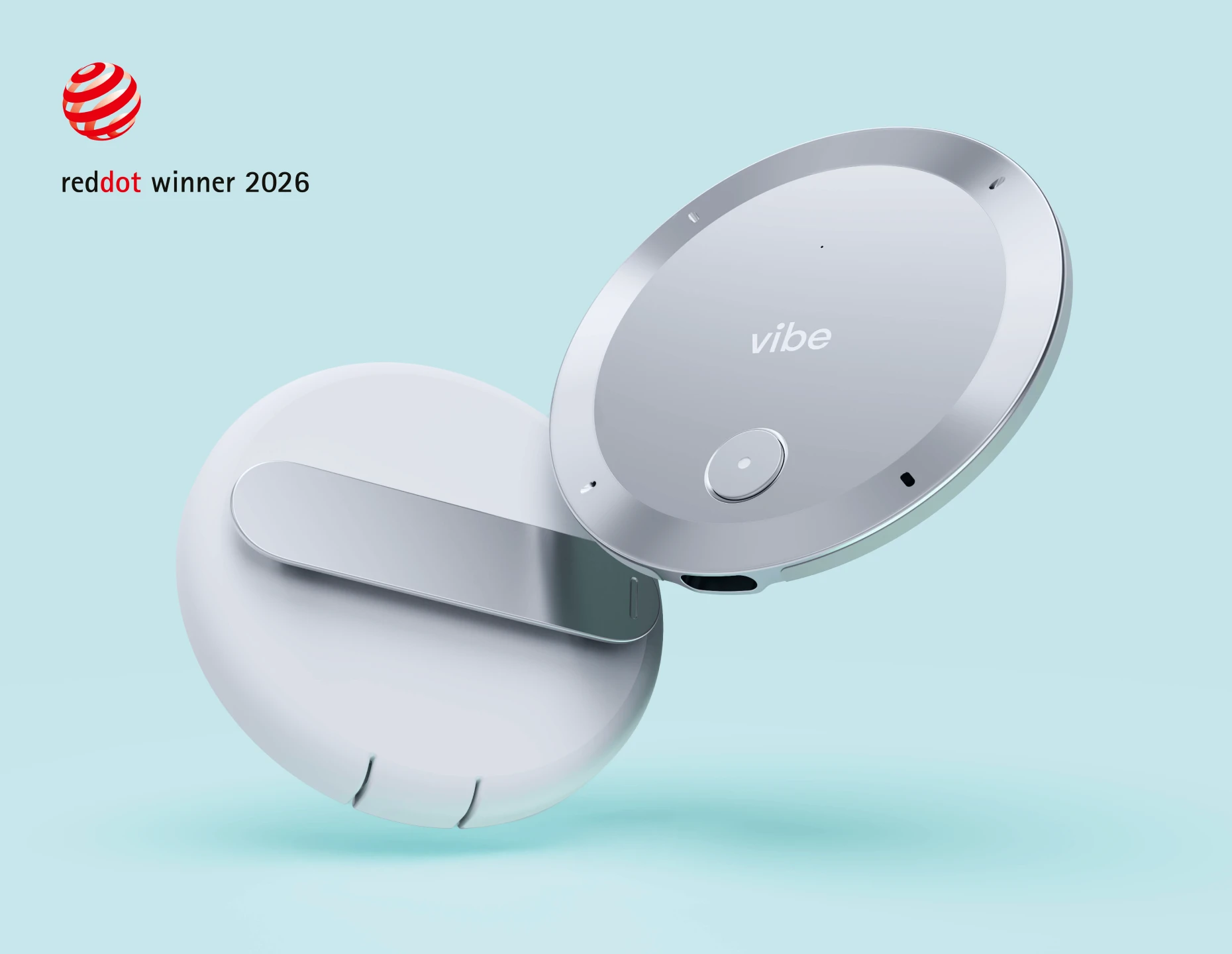
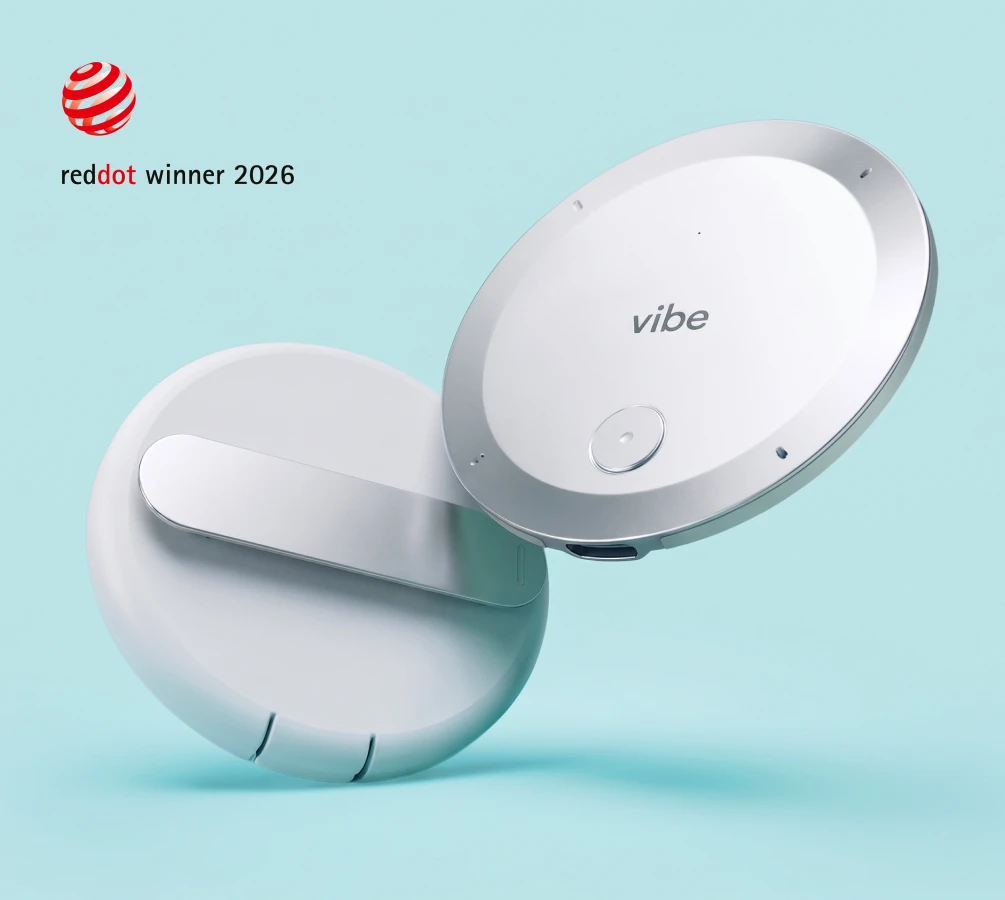
Vibe Dot is a compact wearable AI device — 0.17 inches thin, 0.83 oz — with a 5-microphone array including bone conduction. It captures, transcribes, and summarizes spoken conversations in real time, syncing everything to the Vibe AI platform as structured, searchable institutional memory.
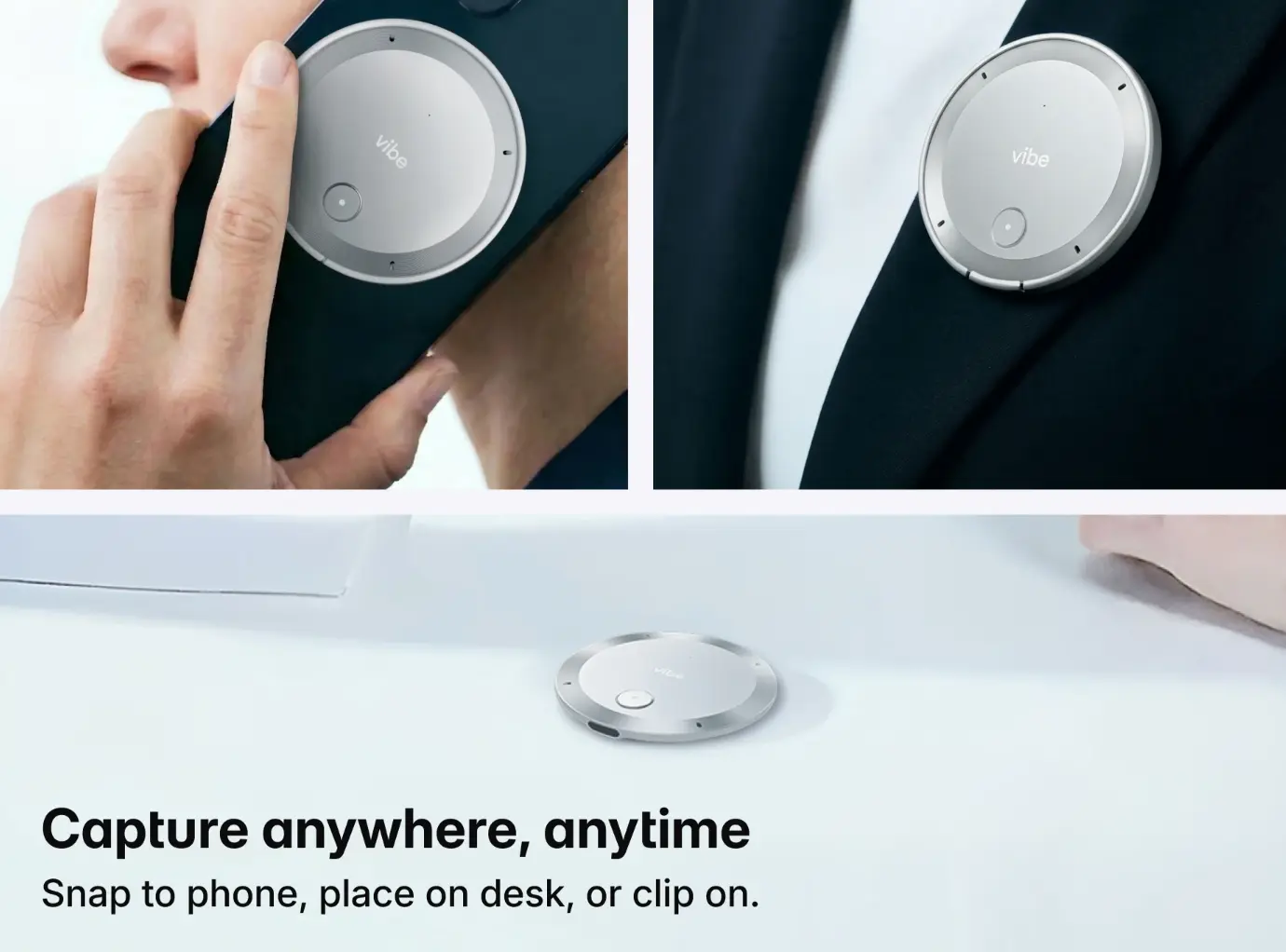
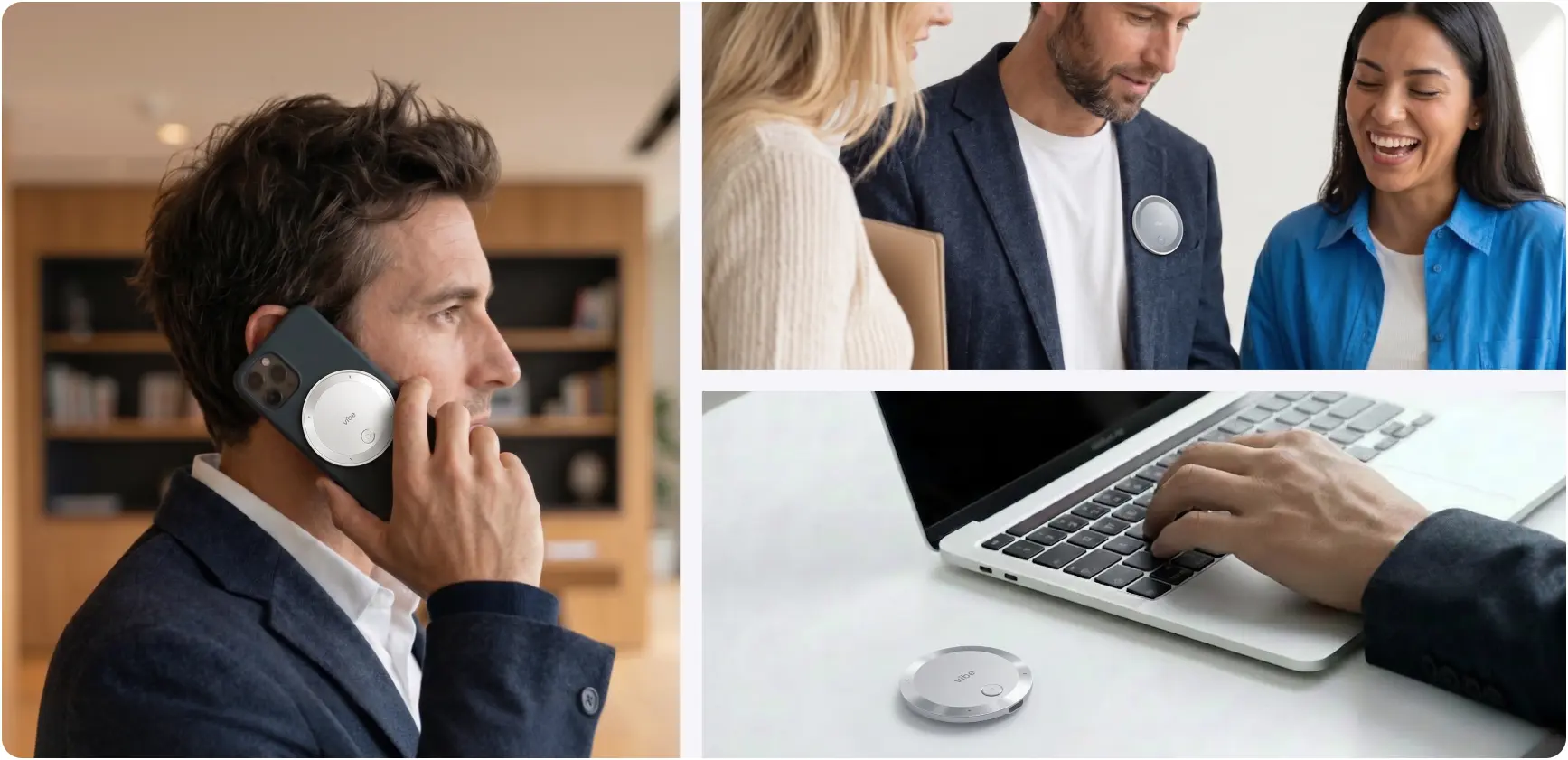 Vibe Dot in three settings: on a phone during a call, clipped to a lapel in a group meeting, and on a desk beside a laptop
Unlike software-based tools, Vibe Dot operates independently of any computer or video conferencing app. It works in person, outdoors, in conference rooms without screens, and in any language across 90+ supported. Voice commands can trigger connected AI agents — Claude for reasoning, Codex for task structuring, and Vibe’s proprietary OpenClaw agentic layer for pushing action items to Slack, Notion, Jira, HubSpot, and other tools.
Best for: Sales teams, field consultants, executives, and enterprise teams whose critical decisions happen across both online and physical environments.
Head-to-Head Comparison
|
Vibe Dot |
Granola | |
|---|---|---|
|
Form factor |
Physical wearable device |
Software app (macOS, Windows, iOS) |
|
Offline / in-person meetings |
✅ Native — core use case |
❌ Requires a computer on the call |
|
Online meeting support |
✅ Works via Vibe Bot integration |
✅ Core use case |
|
No meeting bot required |
✅ Hardware captures locally |
✅ Software captures system audio |
|
Speaker identification |
✅ 5-mic array with directional awareness |
⚠️ Requires per-platform manual setup |
|
AI memory across sessions |
✅ Persistent Memory Engine |
⚠️ Limited to meeting history within account |
|
Agentic follow-up |
✅ OpenClaw auto-pushes to Slack, Jira, CRM |
⚠️ Recipes require manual trigger |
|
Team collaboration |
✅ Shared workspace via Vibe AI |
✅ Shared folders, cross-meeting chat (Granola 2.0) |
|
Hardware encryption |
✅ Dedicated chip, data unreadable if stolen |
— (software-level only) |
|
Privacy / consent model |
✅ Visible device signals recording to room |
⚠️ Invisible to other participants — subject to active litigation |
|
Multilingual support |
✅ 90+ languages |
⚠️ English-primary; multilingual limited |
|
SOC 2 + HIPAA |
✅ Both |
✅ SOC 2 Type 2, GDPR; HIPAA for Enterprise |
|
Price |
From $199 device + free Starter plan |
Free tier + $14/user/month (Business) |
|
Platform |
Hardware + Vibe AI SaaS |
macOS, Windows, iOS (Android coming) |
Where Granola Wins
Granola earns its reputation. For someone who spends most of their day on video calls, it is the cleanest, least-friction AI notetaking experience available.
The human-AI collaboration model is genuinely thoughtful. Rather than fully automating notes (which tends to produce bloated, unfocused output), Granola asks you to jot your own rough impressions during the meeting. The AI then enriches your notes against the full transcript. The result feels more like your voice than a generic summary — and it keeps you engaged in the conversation rather than transcribing in real time.
Granola 2.0 makes it genuinely useful for teams. Shared folders, cross-meeting AI chat with inline citations, Slack integration that pushes summaries automatically, and folder templates for sales pipelines, user research, and hiring loops — Granola has moved well beyond a personal notetaking app. The Recipes feature, launched in October 2025, lets teams build and share reusable AI workflows tied to meeting content.
Free tier is genuinely usable. Unlimited meetings with AI notes, custom templates, and AI chat — all on the free plan. The Business tier at $14/seat/month is positioned at a price point that makes team-wide adoption easy.
Where Vibe Dot Wins
1. It captures the conversations that never make it to a calendar invite
Granola’s architecture has a hard constraint: it works by capturing your computer’s system audio. That means it only functions when you’re on a video call on a device running the app. The moment you step into a client’s office, a factory floor walk-through, or an impromptu hallway debrief, Granola goes dark.
Vibe CEO Charles Yang has been direct about this market gap: "We believe that still 40% of all meetings happen in the physical world where there’s no Slack and no Google Meet." Vibe Dot was built specifically for those moments. Clip it to your shirt, tap to start, and it captures in-person conversations with the same fidelity it brings to recorded calls.
For sales teams doing on-site visits, consultants running client workshops, executives with back-to-back in-person meetings, or field teams whose critical knowledge lives in verbal handoffs — Vibe Dot is the only option in this comparison that even attempts to solve the problem.
2. Physical presence is transparent; software invisibility is now a legal risk
Granola’s defining product decision — that its app captures audio without joining the meeting as a visible bot — was marketed as a feature: "Other people in the room won’t know it’s there." That same design choice became the basis for a federal class action lawsuit filed July 30, 2026 (Chamberlain v. Granola, Inc.), alleging that Granola intercepted meeting participants’ conversations without their knowledge or consent, then used that content to train its AI models by default.
The lawsuit’s core argument is that an invisible tool leaves non-users with no practical way to know they’re being recorded, opt out, or control how their words are used afterward.
Vibe Dot‘s physical form factor sidesteps this structural problem. A device sitting on a conference table is visible. The act of placing it signals to everyone in the room that capture is happening — the same social contract that exists when someone sets a phone on the table to record. This transparency matters increasingly as enterprise legal and compliance teams scrutinize AI tool procurement.
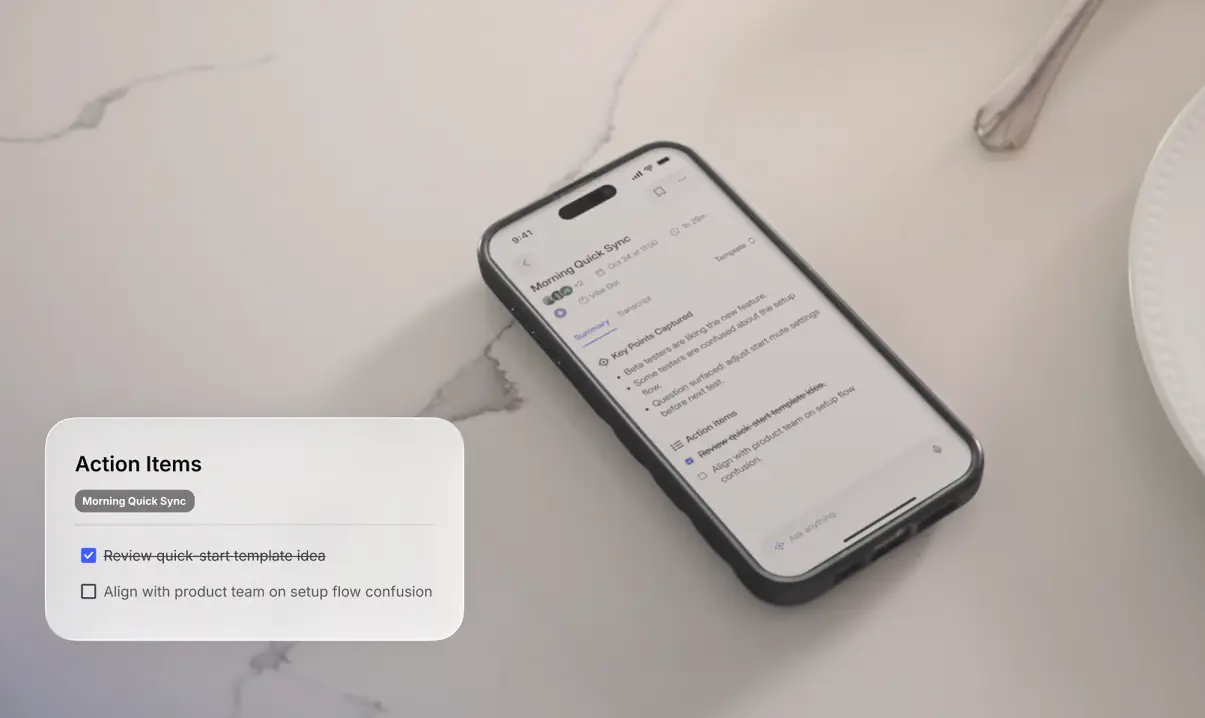 Vibe Dot mobile app showing AI meeting summary and action items checklist from a Morning Quick Sync meeting on iPhone
For organizations operating in regulated industries — financial services, healthcare, legal, government — the consent architecture of a visible, hardware-based device is meaningfully easier to defend than a software tool that operates silently in the background.
3. Continuous, cross-session memory across all conversations
Granola’s memory is bounded by the meeting history in your account — and only covers the meetings that happened while the app was running on a connected device. Each session is an island.
Vibe Dot feeds every captured conversation — online or offline — into the Vibe AI Memory Engine, which builds a persistent, searchable knowledge base that accumulates over time. Ask it what a specific client said about budget constraints three weeks ago, across three separate meetings, and it surfaces the answer with citations. That’s a fundamentally different value proposition from meeting-level summaries.
4. Agentic follow-through, not just summaries
Both tools produce summaries. Vibe Dot goes further: its OpenClaw agentic layer can automatically push action items to Slack, create tickets in Jira or Linear, update CRM records in Salesforce or HubSpot, or trigger Notion pages — triggered by voice command or automatically post-meeting. Granola’s Recipes feature offers similar automation, but requires users to manually initiate each workflow.
The distinction matters at scale. When a sales rep finishes five client calls in a day, manual workflow initiation per meeting adds real friction. Vibe Dot’s agentic layer is designed to make follow-through automatic.
Who Should Choose What
Choose Granola if:
-
Your team’s critical meetings happen primarily over video conferencing
-
You want the least-friction, most polished AI notetaking experience for online calls
-
You’re an individual power user who values the human-guided AI note enrichment model
-
Budget is a constraint and the free tier meets your volume needs
Choose Vibe Dot if:
-
Your team operates across both virtual and physical environments
-
You have field sales, on-site consulting, or in-person client relationships where critical context gets lost
-
Your organization has legal, compliance, or HR sensitivities around undisclosed recording
-
You need agentic follow-up that automatically closes the loop across your project management and CRM stack
-
You want a unified memory layer across every conversation, not just scheduled video calls
The Bigger Picture: One Tool or Two?
It’s worth noting that Granola and Vibe Dot aren’t mutually exclusive for every team. Granola excels at the structured online meeting workflow. Vibe Dot fills the physical world. Some enterprise teams will find value in running both — using Vibe Bot for conference room video meetings and Vibe Dot for everything else, with all data flowing into the same Vibe AI platform.
That said, if you’re evaluating a single tool that covers the broadest range of how your team actually works — not just the calendar invites — Vibe Dot is the more complete answer.
Conclusion
Granola is a genuinely excellent product for what it is: the best AI-powered notepad for people who live on video calls. Its human-guided enrichment model, team collaboration features, and generous free tier make it a strong choice for remote-first teams with predictable, calendar-driven meeting schedules.
Vibe Dot solves a different and arguably larger problem: the full scope of conversations where business actually gets done — including the 40% that never appear on a calendar. Its physical form factor brings transparency to recording, its hardware architecture brings enterprise-grade security, and its agentic follow-up layer closes the loop that most meeting tools leave open.
For organizations that take seriously both capturing institutional knowledge and acting on it across the full range of how their teams communicate, Vibe Dot is the more complete answer.
Frequently Asked Questions
Does Vibe Dot work with Zoom and Google Meet, or only for in-person meetings?
Vibe Dot works for both. For in-person and offline conversations, it operates entirely standalone — no laptop or app required. For online meetings, Vibe Dot integrates with the Vibe AI platform, and teams often pair it with Vibe Bot for full video conferencing coverage with AI live notes and camera framing.
Is Granola’s "no bot" approach actually better for privacy?
It depends on whose privacy you’re weighing. For the Granola user, having no bot join the meeting is less intrusive for remote participants. But for people in the same physical or virtual meeting who don’t use Granola, the software’s invisibility means they have no way to know they’re being captured — a distinction that is now the subject of a federal class action lawsuit filed in July 2026. Vibe Dot’s physical presence makes recording transparent by default.
Can Vibe Dot transcribe multiple speakers accurately?
Yes. Vibe Dot uses a 5-microphone array including bone conduction, plus directional speaker tracking. One of Granola’s documented limitations is that speaker diarization (identifying who said what) requires per-platform manual configuration and remains imprecise in noisy or multi-speaker environments. Hardware-based directional capture handles this more reliably.
What happens to my recordings if I lose the Vibe Dot device?
Vibe Dot includes a dedicated hardware encryption chip. If the device is plugged into an unauthorized computer, the stored recordings are unreadable. Your data stays encrypted at the device level, separate from cloud storage.
Does Granola work without an internet connection?
No. Granola requires an active internet connection for AI processing. Vibe Dot captures audio locally on-device, and syncs to the Vibe AI cloud when connectivity is available — making it usable in low-connectivity environments like manufacturing floors, remote client sites, or international travel.
How much does Vibe Dot cost compared to Granola?
Vibe Dot is a hardware purchase starting at $199 for the device, with a free Starter software plan (300 min/month transcription, 7-day memory). Granola’s free tier offers unlimited meetings but limited history. Granola Business is $14/user/month. Vibe AI Pro and Max plans are available for teams that need extended limits and agentic workflows — see Vibe AI pricing for current details.