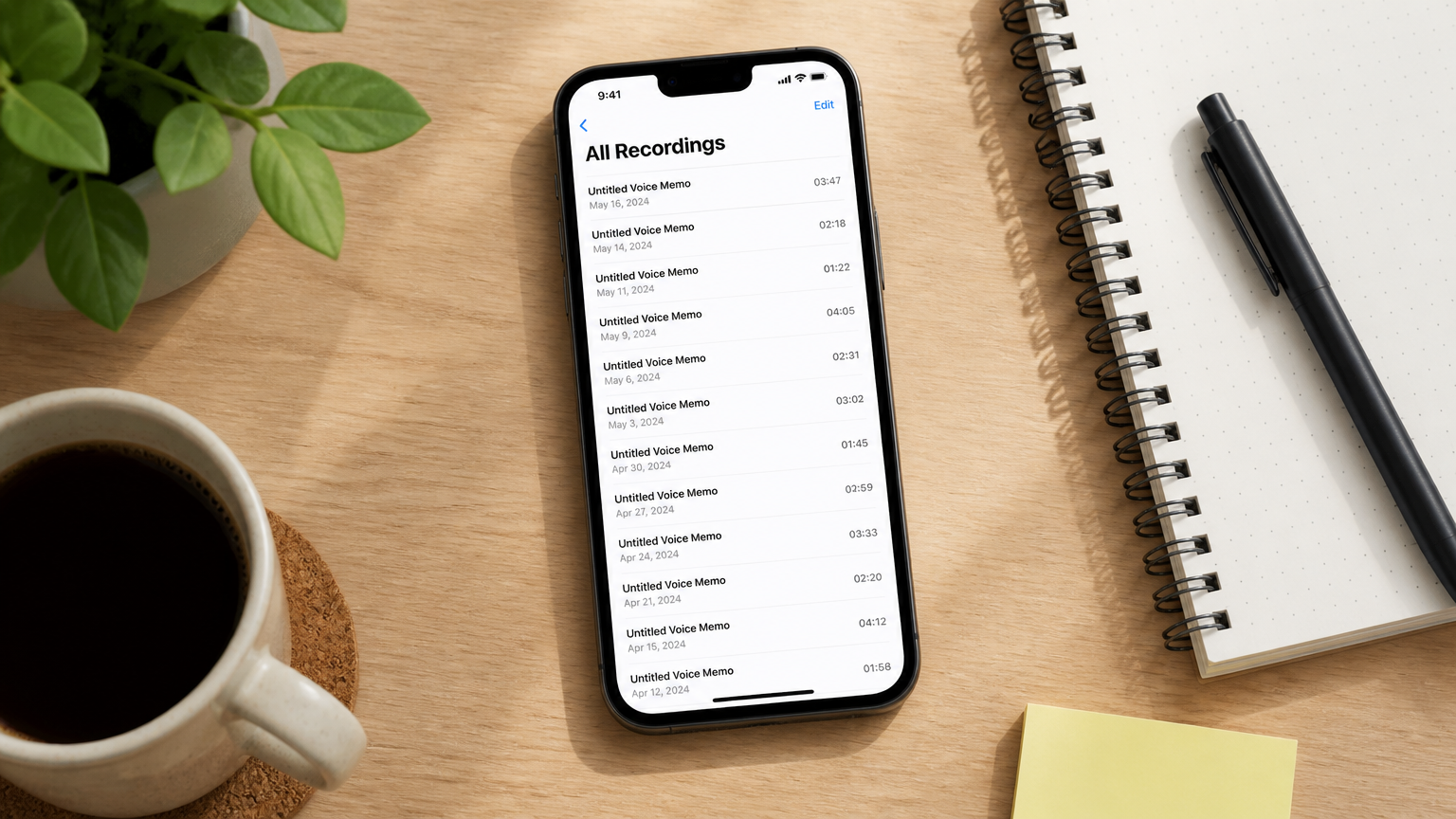

The meeting ends. A clear commitment was made — you’ll send the document by Thursday, you’ll follow up on the timeline, you’ll check on the budget number. You meant it. You knew it mattered. And then you closed the meeting window, walked to your next thing, and the commitment evaporated with the same completeness as if it had never existed.
This isn’t forgetting in the ordinary sense. You don’t think "I had a follow-up and forgot it." The follow-up simply stops existing in any functional sense the moment it leaves your field of attention. Three days later, when someone asks about the document, you don’t remember deciding not to send it — you don’t remember it at all.
This is what the ADHD community often calls "task object permanence" — the experience that tasks, like objects for an infant, stop existing when they’re no longer directly visible. It’s one of the most consequential patterns in ADHD at work, and it’s almost entirely invisible until something goes wrong.
A note before we go further: "object permanence" is a term from developmental psychology that describes how infants learn that objects continue to exist when they can’t see them. Its application to ADHD task management is informal — a metaphor that the ADHD community has found useful, not a clinical term. The underlying experience is real and well-documented; the label is borrowed, not official. For clinical information about ADHD, CHADD and your clinician are the right sources.
 A split screen, on which left shows a laptop screen with a meeting in progress; right shows the same laptop closed, with a blank desk where the commitment was
What’s actually happening
The phenomenon has a more precise description in the research literature than "object permanence," but the outcome is the same. A PLOS One study comparing adults with ADHD against matched controls on complex prospective memory tasks found large-scale impairment concentrated in task planning — constructing an elaborate intention, maintaining it across time, and executing it without an external cue — with only negligible effects on recall or execution of individual steps.
In practical terms: the intention to follow up forms in the meeting. It’s real. It has specifics attached to it. But maintaining that intention across the context switch from "meeting" to "everything else happening in my day" is exactly the kind of prospective task — the kind that requires holding an intention in working memory across time without an external trigger — where ADHD impairs most reliably.
Add to this what’s sometimes called "working memory as a whiteboard." The whiteboard holds whatever’s currently active. When the meeting closes, the whiteboard gets erased and filled with whatever comes next. The follow-up intention isn’t transferred to storage; it’s overwritten.
This is why standard advice doesn’t work. "Just write it down" fails because writing it down is itself a task that requires working memory at the moment working memory is being erased. "Keep a to-do list" fails because a to-do list you can’t see has no more presence than the intention itself. "Set a reminder" works sometimes, but requires remembering to set the reminder at exactly the moment you’re least likely to remember anything.
Why the problem is worse than it looks
The immediate cost of a missed follow-up is visible: the document doesn’t get sent, the question doesn’t get answered, someone follows up asking where things are. That’s embarrassing but recoverable.
The less visible cost is relational and reputational. A pattern of follow-ups that disappear doesn’t read as a cognitive pattern — it reads as not caring, not being reliable, not following through on commitments. In a professional context, the difference between "this person has ADHD and follow-ups disappear from working memory" and "this person said they’d do something and didn’t" is invisible to anyone who isn’t inside your head. The behavioral outcome is identical. The interpretation is often the most damaging version.
There’s also a compounding effect. Every follow-up that disappears is information that never reaches the person who needed it, a decision that gets made with incomplete data, a relationship that runs on a slightly incorrect model of what was agreed. Over months, the gap between what was actually committed to and what actually got done creates a fragmented record that nobody can reconstruct — including you.
The three places follow-ups disappear
The pattern isn’t random. There are three specific transition points where a follow-up is most likely to evaporate:
At the end of the meeting. The moment the meeting ends is the highest-risk moment. Attention transitions to "what’s next" — the next meeting, the urgent message that came in, the thing you were in the middle of before. The follow-up is real during the meeting; the transition erases it.
After a context switch. Even if you carry the follow-up past the end of the meeting, a single interruption — a message, a question from a colleague, a task that needs immediate attention — is often enough to clear it from working memory. Context switches are follow-up erasers.
When the task isn’t physically visible. A task in a to-do app that’s closed is functionally invisible. A commitment written in the chat window of a meeting platform that you’ve moved away from has the same presence as no commitment at all. "Out of sight, out of mind" is not a metaphor for ADHD — it’s a description of how working memory actually functions in this context.
Why most task management systems don’t solve this
Standard advice for follow-ups assumes that if you capture the task, you’ll remember to check where you captured it. To-do apps, note-taking systems, project management tools — they all work on the premise that the barrier is capture, and that once something is written down in a system, it’s handled.
The barrier isn’t capture. The barrier is the gap between capture and the moment the task becomes relevant again. A task sitting in Notion that you don’t open is indistinguishable from a task that was never captured. The system solves the storage problem; it doesn’t solve the surfacing problem.
What would actually solve the surfacing problem is a system that does two things standard task managers don’t:
Brings the task to you at the moment it’s relevant, rather than waiting for you to go look for it. Not a generic daily reminder ("you have 47 tasks"), but a specific surface — "you have a meeting with this person in 30 minutes and you said you’d send them the document by Thursday."
Creates the task from the source of the commitment, rather than requiring you to manually capture it. If the commitment was made verbally in a meeting, the task should be extractable from that conversation, not dependent on you remembering to enter it somewhere during the window when working memory is being overwritten.
How AI capture changes the equation
The recording doesn’t solve object permanence. It creates the conditions under which object permanence can be solved.
A verbal commitment made in a meeting and captured in a recording is different from one that lives only in working memory. It exists somewhere independent of your attention. That existence is necessary but not sufficient — a recording that sits in a folder and never gets reviewed has the same practical effect as a commitment that was never recorded.
What closes the gap is the combination of three things:
Structured action item extraction. A recording that gets automatically parsed for commitments — "you’ll send the document by Thursday" identified as a discrete action item with an owner and a deadline — turns a verbal moment into something that can be tracked, surfaced, and acted on without requiring you to re-engage with the full recording.
Proactive surfacing before it matters. An action item that appears on your task list three days after the meeting is better than nothing. An action item that surfaces in a smart catch-up brief before your next interaction with the same person is worth much more — because that’s the moment when "I said I’d send the document" has context, urgency, and the person you owe it to directly in front of you.
Cross-session memory that connects commitments to people and projects. A follow-up that’s linked to a person rather than stored as a standalone note has a natural trigger: every time that person’s name comes up, the associated commitment is connected to it. That’s fundamentally different from a to-do item that exists in isolation.
Vibe Dot is built around this architecture — Vibe AI’s proactive task agent extracts commitments from recordings and can surface them when they become relevant, and the Memory Graph links those commitments to the people and projects they’re connected to rather than storing them as isolated items. The underlying point isn’t device-specific, though: any system that does these three things — extracts, surfaces proactively, and links to context — changes the equation. Most recording tools and most task managers handle one of these; the gap is in the combination.
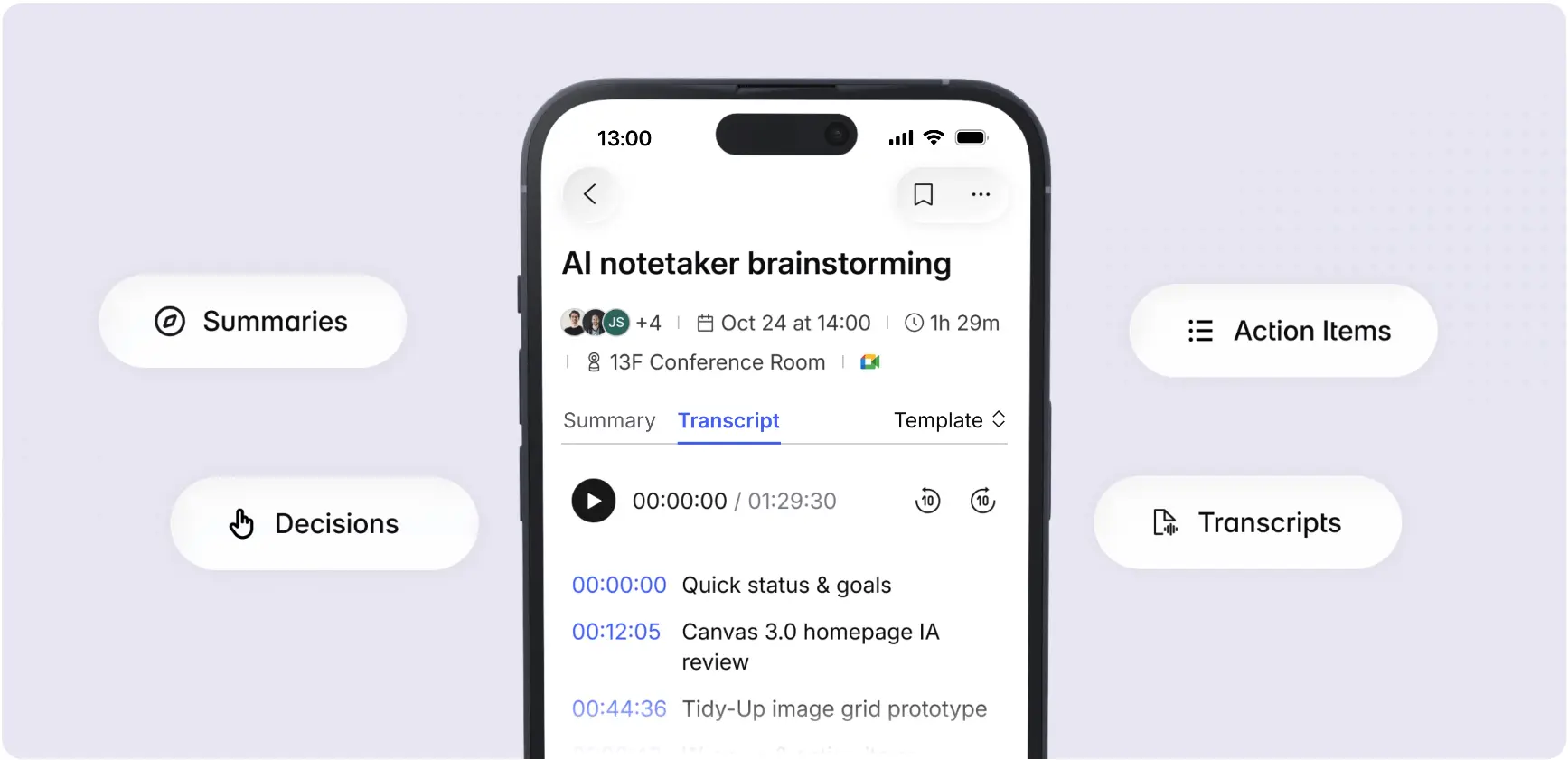 Vibe AI mobile app transcript view of an AI notetaker brainstorming meeting, with Summaries, Decisions, and Action Items
What this still doesn’t fix
Object permanence for tasks is a real pattern with real costs. A recording and task-surfacing system addresses part of it. It doesn’t address all of it.
The commitment has to be captured in the first place. A verbal follow-up in a meeting that wasn’t recorded doesn’t become an extractable action item. The capture problem precedes the object permanence problem; solving one without the other only moves the gap.
Proactive surfacing requires review. An action item that surfaces before a meeting is useful only if you read it before the meeting. A smart catch-up that arrives and goes unread has the same outcome as a task that was never created. Some baseline habit of checking — even a brief one — is still necessary.
Not every commitment is extractable. "We’ll probably talk about that next time" is a commitment in some contexts and a vague intention in others. Automated extraction works best on explicit, specific commitments; ambiguous ones still require judgment about whether they’re real.
The relational cost of past follow-ups that disappeared doesn’t reverse. A system that prevents future disappearances doesn’t retroactively repair the impression created by previous ones. That’s a separate, slower kind of work.
The short version
A follow-up that leaves your screen doesn’t get forgotten — it stops existing. That’s the experience, and the mechanism behind it (prospective memory impairment under conditions of task planning) is specific enough that "try harder" and "keep a better to-do list" don’t address it.
What does address it is changing the structure: extract commitments from their source rather than relying on manual capture, surface them at the moment they’re relevant rather than waiting for you to check a list, and link them to people and context rather than storing them as isolated items.
The tools that do this are not magic — they still require the conversation to be captured, and they still require some baseline of checking. But the gap they close is the one that causes most of the damage: the forty-eight-hour window between "I said I’d do this" and "I don’t remember saying that at all."

Frequently Asked Questions
What is ADHD task object permanence?
It’s an informal term the ADHD community uses to describe the experience of tasks disappearing from working memory when they’re no longer directly visible — similar to how infants behave before they’ve learned that objects continue to exist when hidden. It’s a metaphor, not a clinical term, but it describes a real pattern: the moment a follow-up commitment leaves the active screen or context, it often stops having any functional presence in attention, until an external cue forces it back.
Is task object permanence a recognized clinical symptom?
Not under that name. The underlying experience is related to working memory impairment and prospective memory difficulties that are well-documented in ADHD research. The term "object permanence" as applied to tasks is informal, borrowed from developmental psychology, and used in the ADHD community as a useful metaphor. For clinical information, CHADD and your clinician are the right sources.
Why doesn’t a to-do list solve this?
A to-do list solves the capture problem — the task exists somewhere. It doesn’t solve the surfacing problem — the task needs to be visible at the moment it’s relevant. A to-do app that’s closed has no more presence in your attention than a task that was never written down. The gap is between where a task is stored and when it appears in front of you without you having to remember to look for it.
How does recording a meeting help with follow-up disappearance?
It doesn’t solve the problem directly — a recording in a folder has the same visibility problem as a task in a closed app. What it enables is: structured extraction of the commitment from the recording, automated surfacing of that commitment when it becomes relevant, and linking of the commitment to the person or project it belongs to. Those three things together change the structure of the problem, from "remember to check" to "the relevant thing appears when it matters."
What’s the difference between forgetting a follow-up and ADHD task object permanence?
Standard forgetting involves an intention that was formed and then decayed from memory over time. Task object permanence describes something more immediate — the intention stops having presence the moment the context switches, not gradually over hours or days. The follow-up doesn’t feel forgotten; it feels like it was never there, because functionally it wasn’t — the context switch cleared it before it had a chance to transfer anywhere.
Do reminders work for this?
Sometimes, with caveats. A reminder works if it fires at the right moment — close enough to when the task needs to happen to be actionable, specific enough to recreate the context of what was agreed. A generic daily reminder that says "check your tasks" is rarely specific enough to surface the right thing at the right moment. A specific reminder that says "you have a meeting with X in 30 minutes and you committed to sending them the document" is closer to what actually works — which is why proactive surfacing tied to calendar context matters more than simple reminder systems.