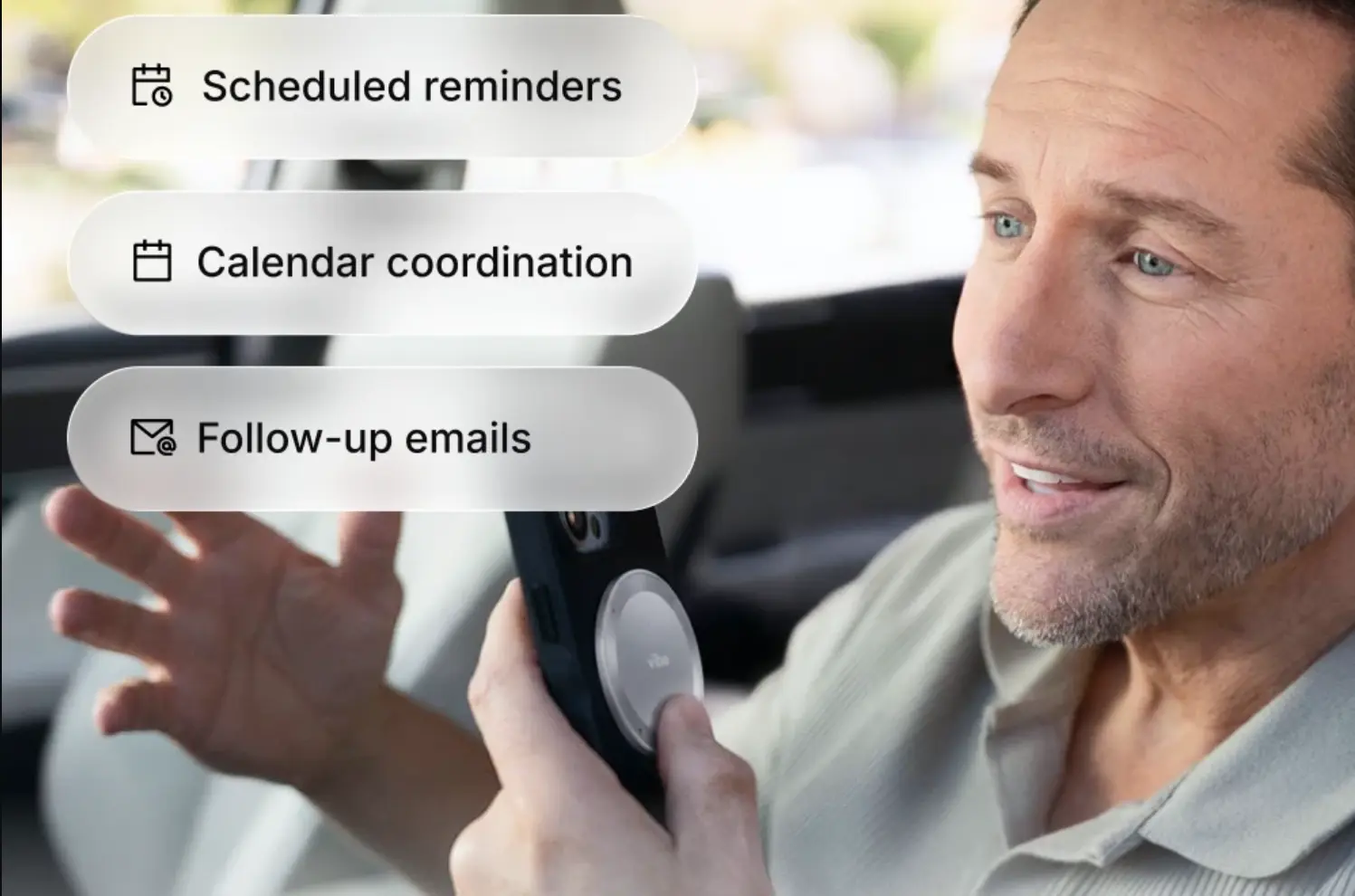

The meeting ends. You said yes to something — clearly, with full intention. Three days later, when someone follows up, you don’t know when it was due. Not because you forgot agreeing to it. Because the deadline was never real.
This is time blindness operating inside a meeting. Not the version about running late or losing track of hours. The version where "yes" feels like a complete thought, and "by when" was a detail that happened at the edge of the conversation, at the exact moment your attention was transitioning to whatever came next.
Here’s what that moment looks like in practice: the meeting is wrapping up. Action items are being summarized. Someone says "can you get that to us before the sync next week?" You nod, or say yes, or type "ok" in the chat. The meeting closes. Your next notification arrives. By the time you’re at your desk with a free moment to write things down, the deadline — "before the sync next week," which was Tuesday — has the same presence in your working memory as something you heard in a dream.
A note on the term: time blindness is widely used in the ADHD community but isn’t an official clinical diagnosis. The underlying mechanisms — difficulty perceiving time as a continuous dimension, challenges with future-time orientation — are well-documented in the research. For clinical information, CHADD and your clinician are the right sources.
 Woman in team meeting looking overwhelmed by unresolved action items, thought bubbles showing Yes, By when, calendar and clock icons
Why "just write it down" doesn’t work here
The standard advice for meeting follow-through is to write things down. It’s correct and it misses the problem.
Writing things down during a meeting requires two things to happen simultaneously: tracking what’s being said in the conversation, and filtering that stream to identify "this sentence is a deadline I need to capture." That filtering step — deciding which of many things being said is the one worth writing — is exactly the kind of attention-splitting task where ADHD impairs most reliably.
And even when the filtering works, the window for capture is approximately thirty seconds at the end of a meeting when attention is already transitioning. The yes happened during active engagement. The by when came at the close, in the gap between conversations, when the relevant information had the least possible chance of making it anywhere durable.
A PLOS One study comparing adults with ADHD against matched controls found large-scale impairment concentrated in task planning — constructing an intention with specific parameters and maintaining it across a context switch. The deadline was heard. The context switch cleared it.
A to-do app doesn’t fix this. A task you created without a deadline is a task with a missing field — it sits in your list with no temporal anchor, no urgency, no moment at which it becomes relevant. "Follow up on the vendor proposal" is not an action item. It’s a hope that happens to be in a list.
The five fields a real action item needs — and which one goes missing
A commitment from a meeting that has a real chance of happening has five pieces:
|
Field |
What it answers |
Missing how often |
|---|---|---|
|
What |
The specific deliverable |
Rarely — this usually lands |
|
Who |
The named owner (not "we") |
Sometimes |
|
By when |
A specific date or milestone |
Very often |
|
To whom |
Who receives it when done |
Usually |
|
Open question |
What’s unresolved that affects this |
Almost always |
Time blindness attacks the "by when" field specifically. It’s the field most often left implicit — "before next week’s sync," "as soon as you can," "when you get a chance" — and the field that ADHD makes hardest to convert from implicit to explicit in the moment it’s stated.
Without a by when, the other four fields don’t matter much. A deliverable with an owner and no deadline is a task that will be done whenever the urgency of other things creates a gap. Which, for most ADHD professionals, means never — or at the worst possible moment.
What actually closes the gap
The fix isn’t paying more attention during meetings. The fix is changing where the "by when" gets established — from the end of a conversation to a structured output that exists after it.
Vibe Dot records the meeting. Vibe AI processes the recording and produces a structured action item output — not a transcript to read through, but a parsed set of commitments with the five fields extracted where they were stated. "Can you get that to us before the sync next week?" becomes: What: [deliverable], Who: you, By when: [date of next Tuesday’s sync], To whom: the requestor, Open question: none flagged.
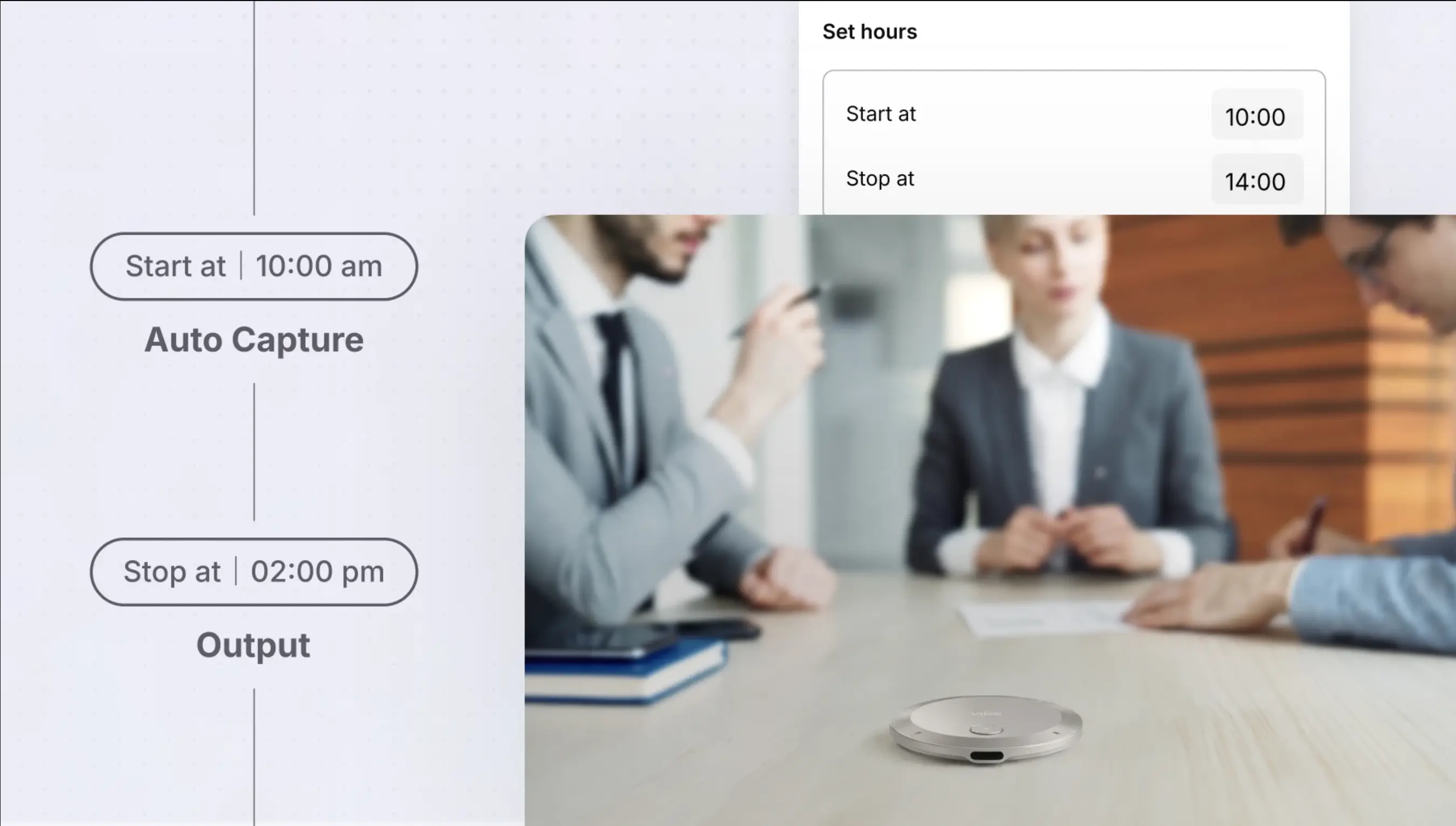 Vibe Dot on meeting room table with Auto Capture UI showing scheduled recording from 10:00 am to 2:00 pm for automatic meeting output
What was implicit in the conversation — "the sync next week" — gets resolved into an actual date. What was stated at the edge of your attention gets captured before the context switch erases it.
Smart catch-up briefings surface the commitment before it matters. Not a generic reminder that you have tasks — a specific brief before a meeting with the same person that tells you what was agreed, what was committed, and whether it happened. The urgency that time blindness delays until the deadline arrives is manufactured earlier, when you can still do something about it.
Cross-meeting Ask AI (Pro and Max plans, 1 credit per query) closes the retrieval side. "What deadlines did I commit to in meetings this week?" is a query, not a reconstruction from memory. The by when exists somewhere accessible rather than somewhere you’d have to go find.
These capabilities are built on the recording, which means the capture step — the one that competes with the end-of-meeting transition — happens automatically. You don’t have to remember to capture the deadline at the thirty-second window when it was least likely to happen.
Practical setup: Scheduled recording handles recurring meetings without you arming anything. For one-offs, Tap to Record. Standby Mode (Beta) covers the conversations that weren’t on the calendar but produced commitments anyway. For how to configure this, see the setup guide for ADHD users.
The patterns that make time blindness worse in meetings
Even with a recording system in place, a few patterns are worth knowing because they generate by-when gaps that are harder to extract:
Meetings that run over compress the action item summary. The last five minutes — when deadlines would be stated — get rushed or dropped. What was supposed to be "let’s confirm owners and dates before we close" becomes "okay we’re already over time, let’s sync offline." The by when never gets said.
Implicit deadlines don’t resolve automatically. "Before the next sync" requires knowing when the next sync is. "As soon as possible" has no date attached. Vibe AI flags these as unresolved by-when fields — which is useful, but only if you then go fill them in.
Urgency arrives too late. The ADHD relationship with future time means that "by Tuesday" has limited felt reality on Thursday. The urgency that motivates action arrives approximately when the deadline does — which is not a useful distribution. Smart catch-up briefings are designed specifically to manufacture earlier urgency, but they work better when the deadline was captured precisely in the first place.
What this still doesn’t fix
An unstated deadline can’t be extracted. If the meeting ended with "we’ll figure out the timeline later," no capture system produces a date. The by-when field stays empty because it was never filled.
Extraction surfaces candidates, not certainties. "I’ll try to look at that before Friday" may be a firm commitment or someone being polite. The structured output flags it; you still evaluate whether it was real.
Time blindness affects delivery, not just capture. Having a deadline captured accurately doesn’t change how future time is perceived. A task due Tuesday still feels less urgent on Friday than on Tuesday. Capture changes what you know; it doesn’t change when urgency arrives. Pairing accurate capture with calendar blocking, smaller intermediate steps, and deliberate review habits addresses the delivery side in ways that recording alone can’t.
The short version
Time blindness in meetings creates a specific gap: between saying yes to something and acquiring a clear sense of when it’s due. The gap forms because deadlines are often implicit rather than stated, because the moment of capture competes with the moment of transition, and because future time doesn’t generate the urgency that would motivate careful capture.
The fix isn’t trying harder to listen for deadlines. It’s changing the structure: making the "by when" explicit at the moment of commitment through real-time capture, extracting it from the recording immediately after, and surfacing it before the deadline arrives rather than when it does.
"Yes" is half of a commitment. "By when" is the half that determines whether it happens.

Frequently Asked Questions
What is time blindness in ADHD?
An informal term in the ADHD community describing difficulty perceiving time as a felt, continuous dimension — where the future feels flat rather than lived. "Next week" doesn’t generate the same felt sense of impending reality it might for someone without ADHD. It’s not a clinical diagnosis, but the underlying mechanisms are well-documented. For clinical information, CHADD and your clinician are the right sources.
Why do ADHD professionals say yes to things without knowing when they’re due?
Two things compound. Deadlines in meetings are often implicit — "before the sync" rather than a specific date — and ADHD makes it harder to convert implicit timelines into explicit ones automatically. And even when a deadline is stated, the end-of-meeting context switch is a high-risk moment for working memory: the deadline was heard, the transition cleared it before it landed anywhere.
Does recording a meeting fix time blindness?
Recording creates the conditions for fixing it. A recording that produces structured action items with extracted deadlines — rather than a transcript to read through — moves the "by when" from something you have to capture in real time to something that exists in the output. What you do with that output still matters: seeing the deadline before it arrives, acting on it while there’s still time, is the step that recording enables but doesn’t complete.
Why doesn’t a to-do list work for meeting deadlines?
A to-do list solves storage, not surfacing. A task without a deadline has no temporal anchor — no moment at which it becomes urgent or visible. It sits in the list at the same level of priority as everything else until either the deadline appears or someone follows up asking where things are. The by when is the field that turns a task into something with a natural moment of relevance.
How is this different from just forgetting the deadline?
Standard forgetting involves encoding something and then having it decay from memory. Time blindness in meetings is often about the encoding step itself — the deadline existed in the conversation but didn’t register as requiring capture, or future events were noted but didn’t generate the urgency that would motivate writing them down carefully. It’s less "I forgot the deadline" and more "the deadline didn’t feel concrete enough to write down at the moment it was stated."