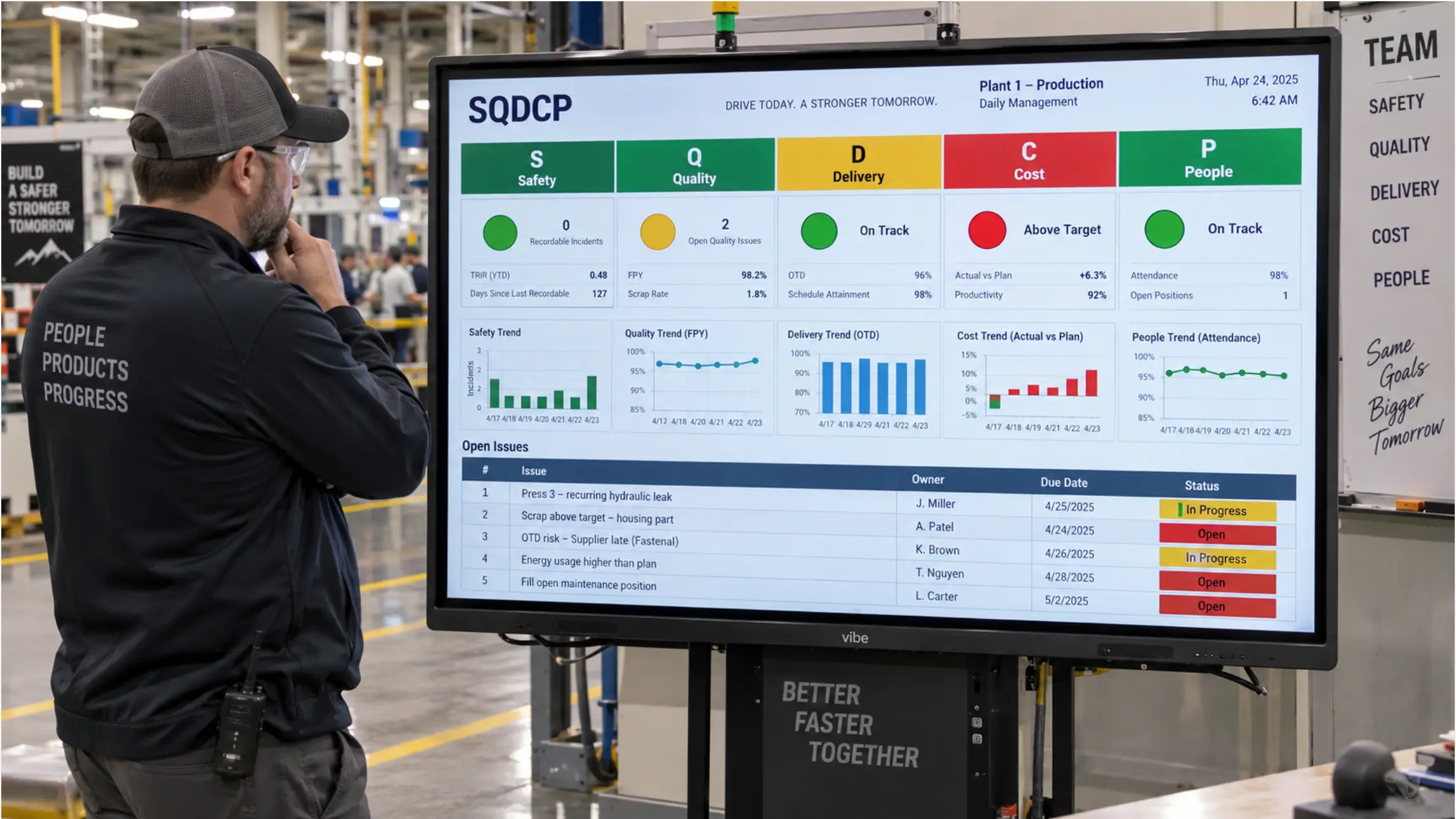

"Obeya" is a Japanese word meaning "big room." In lean manufacturing, it refers to something more specific: a dedicated space where cross-functional teams come together to make the current state of the operation visible and to make decisions about it, together, on a regular cadence.
Toyota developed the Obeya concept during the Prius program in the 1990s, when leaders realized that managing a technically complex project across departments required a place where all the critical information could be seen at once and where the right people could act on it quickly. As the Lean Enterprise Institute describes it, Obeya is a form of visual management — and when combined with a structured meeting cadence, it becomes a management system.
That distinction matters. An Obeya room is not a room with charts on the walls. It is a room with charts on the walls that a cross-functional team reviews on a regular schedule, with a clear process for identifying problems, assigning owners, and following up on actions. As IndustryWeek’s coverage of lean Obeya practice describes it, drawing on the Lean Leadership Academy: Obeyas provide dedicated space and time for coordination and problem-solving, designed to minimize organizational barriers. The room without the cadence is wall decoration. The cadence without the room is just another meeting.
This article covers what a manufacturing Obeya room needs, how to set one up using the tools most teams already have, and where the display technology fits in.
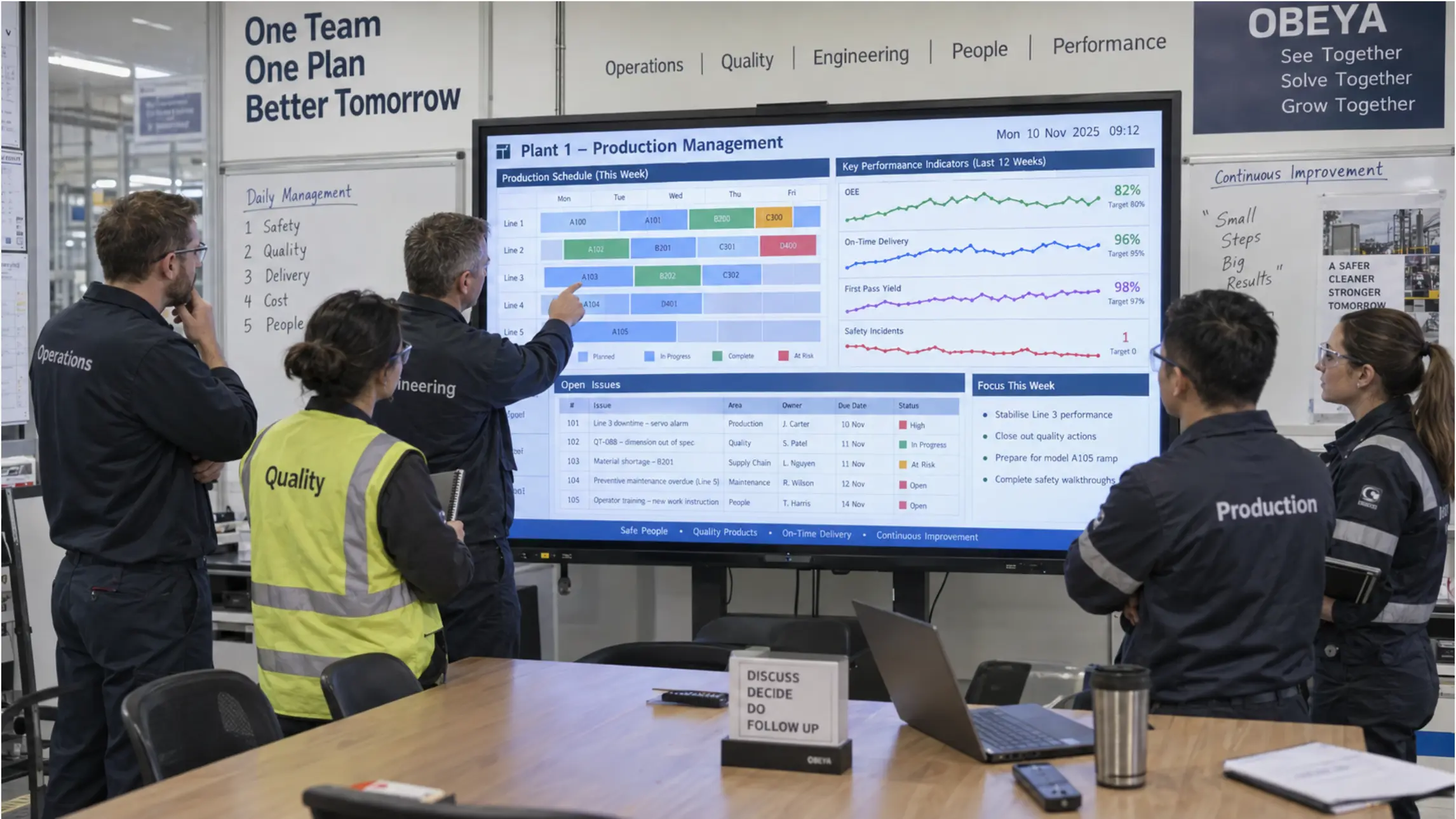 A manufacturing Obeya room with a large interactive display showing production schedules, KPI trends, and an open issues board
What an Obeya Room Is Doing
An Obeya room in a manufacturing context serves as the place where the operation’s critical information is visible to everyone who needs to act on it — not summarized in a report, not scattered across individual dashboards, but consolidated and visible at once.
What is typically on the walls (or the display) of a manufacturing Obeya:
-
Performance metrics — production output versus target, quality rates, safety status, delivery performance. The same categories an SQDCP board tracks, but at a plant or program level rather than a workstation level.
-
Project and improvement activity — active improvement projects, their status, milestones, and owners. Where are we in the kaizen? What was committed at the last review?
-
Problem-solving activity — open issues, escalated items, A3s in progress. What is being worked on and who is responsible?
-
Trend data — how performance is moving over time, not just today’s snapshot. Is quality improving or declining? Is the delivery trend moving toward or away from target?
The room is not a dashboard. The difference is the cadence: a dashboard is looked at when someone thinks to look at it. The Obeya is reviewed on a fixed schedule, by a specific group of people, with a structured conversation about what the information means and what needs to change.
The Two Things an Obeya Requires
Every guide to Obeya rooms eventually comes back to the same two requirements. Both are necessary; neither is sufficient on its own.
1. Visual management: the information, visible at once.
The information on the walls needs to be current, legible, and organized so that someone walking into the room can understand the state of the operation without being briefed. Stale charts, unreadable fonts, or disorganized layouts undermine the room’s purpose. The test is simple: can a team member who missed last week’s review walk in, look at the room, and understand where things stand?
2. A meeting cadence: the people, regularly, with a process.
The Obeya only works if the right people show up on a consistent schedule to review what is on the walls and make decisions. A weekly review where plant leadership, engineering, quality, and production planning are all in the room — looking at the same information, raising the same problems, assigning the same actions — is what makes the room a management system rather than a gallery.
One Lean practitioner’s description of this is precise: "The wall is not the point. The weekly conversation in front of the wall is." The room creates the conditions for that conversation; it does not replace the discipline of having it.
What the Physical Room Requires
Not every manufacturing facility has a dedicated room to spare for an Obeya. The physical requirements are modest: enough wall space to display the relevant information visibly, enough floor space for the team to stand or sit comfortably during the review, and proximity to the operation it is managing.
Wall space. In a traditional Obeya, charts and boards cover the walls on paper or whiteboard. A dedicated display replaces some or all of that wall space and adds the ability to show live data, switch between views, and annotate during the review.
Location. The Obeya should be close enough to the floor that it reflects the operation’s reality, not far enough removed that it becomes a reporting exercise. A room adjacent to the production area, where the team can step from the review to the floor without a significant walk, reinforces the connection between what is on the walls and what is actually happening.
Access. The room should be accessible between reviews, not locked or repurposed. Team members who want to review the current state of an improvement project, check the trend on a quality metric, or update the status of an action item should be able to do so at any time — not only during the scheduled meeting.
Setting Up the Display
A traditional Obeya uses physical walls — paper charts, printed A3s, sticky notes, whiteboard sections. This works well when the team is co-located, the information updates slowly, and someone has the time to maintain the physical displays.
Manufacturing operations that need more current data, that include remote participants, or that want to reduce the overhead of maintaining physical charts benefit from a display that connects to live data sources and can show multiple information types on a single screen. The gap between a physical visual management wall and a live digital display is most visible in the Obeya context, where the room’s value depends entirely on the information being current.
The display as a wall section. The Vibe Board S1 Pro, mounted on a wall or positioned on a rolling stand, serves the same function as a section of the Obeya wall — but shows live data rather than printed charts. Production output pulls from the ERP. Quality metrics update when the QMS refreshes. KPI trends are current rather than last week’s printout. The team walks into the review with information that reflects today, not the last time someone had time to update the charts.
Split-screen for multiple information types. During the Obeya review, the team typically needs to move between several types of information: performance metrics, project status, open issues. A display running Windows can show multiple windows simultaneously — a Power BI dashboard alongside an Excel project tracker, or an A3 document alongside the production schedule — without switching devices. For a 60-minute review that covers several topics, this reduces the transition time between sections.
Remote participant integration. For manufacturing teams where engineering or quality leadership is not always on-site, the Vibe Board S1 Pro handles the Teams or Zoom call alongside the visual content. Remote participants see the same displays the room is looking at. When the facilitator annotates a metric or updates a project status on the board, the remote participants see the change in real time. The Obeya review does not require everyone to be physically in the room to be effective — it requires everyone to be looking at the same information and having the same conversation.
The Content: What Goes in the Obeya
The specific content of an Obeya varies by organization, by the operation it manages, and by the lean maturity of the team. There is no single correct layout. What is consistent is the type of information the room needs to contain.
Performance walls. Current-state metrics for the dimensions the team is responsible for — the same categories an SQDCP board tracks, but at the level of the Obeya’s scope. A plant-level Obeya shows plant-level metrics; a program-level Obeya shows program metrics.
Improvement activity. Active improvement projects — kaizens, corrective actions, engineering changes — with their current status and expected completion. This section answers the question: what are we doing to change the trend, and where are we in doing it?
Problem-solving activity. Open A3s, escalated QRQC items, issues raised from Gemba walks that have not yet been resolved. This section answers the question: what problems are we actively working on, and who owns them?
A cadenced structure. The review follows a consistent sequence — the same sections, in the same order, every time. Consistency allows the team to build a rhythm: they know where to look for performance data, where to find project status, and where open issues are tracked. A review that follows a different structure every week requires re-orientation each time and loses the efficiency that makes the Obeya valuable.
The Facilitator: Why the Room Needs an Owner
The most common failure mode for Obeya rooms is not the display technology or the room layout. It is the absence of a consistent facilitator.
The Obeya review needs someone who owns the cadence — who ensures the meeting happens, who prepares the room before the review, who drives the conversation through the sections, and who follows up on actions between sessions. Without that person, the review drifts: the meeting gets shortened when things are busy, sections get skipped when the data is not ready, actions from the last session are not checked before the new ones are added.
The facilitator is not necessarily the most senior person in the room. In many manufacturing Obeyas, the continuous improvement manager or the operations manager facilitates. What matters is that the role is clear, the person is consistent, and the cadence is protected even when the operation is under pressure.
The display technology makes the facilitator’s job easier — live data means less pre-meeting preparation, digital annotation means actions are captured in the room rather than transcribed afterward, and remote integration means the review can happen even when some participants cannot be on-site. But the technology does not replace the facilitator. It gives them better tools.
Common Setup Mistakes
Building the room before defining the cadence. A room with charts on the walls and no scheduled review is not an Obeya. The cadence — who attends, how often, what sections are covered, how actions are tracked — should be defined before the room is set up. The room is the space for the cadence; it does not create it.
Putting too much information on the walls. An Obeya that tries to display everything relevant to the operation becomes unnavigable. The test for what belongs in the room is whether the review team will act on it in the session. Information that is reviewed but never acted upon should be removed.
Using the room only for the scheduled review. An Obeya that is used once a week for the scheduled meeting and ignored between sessions is functioning at a fraction of its potential. The room should be accessible continuously — for team members to check project status, update action items, or review the trend data outside of the scheduled meeting. A display that stays on and shows current information between reviews makes this possible without additional effort.
Letting the information go stale. A room where the charts reflect last month’s performance, the project status board has not been updated in two weeks, and the open issues list has items that were resolved months ago is not supporting the team’s decision-making. It is creating noise. Keeping the room current is the facilitator’s ongoing responsibility — not a one-time setup task.
The Room Is Not the System
An Obeya room that the team uses consistently, that shows current information, and that is run by a facilitator who protects the cadence is one of the most effective tools in lean manufacturing for closing the gap between information and action. It is also one of the most frequently misunderstood.
The room itself — the walls, the charts, the display — is not the system. The system is the regular gathering of the right people to look at the right information and make decisions together. The room creates the conditions for that to happen. When it works, problems surface earlier, decisions get made faster, and the team’s shared understanding of the operation is deeper than any report could provide.
Request a demo to see how Vibe Board supports Obeya reviews and cross-functional visual management in manufacturing, or request a quote if you are ready to deploy.
Frequently Asked Questions
How is an Obeya room different from a war room?
The terms are often used interchangeably, and the concept is similar: a dedicated space where a cross-functional team converges to manage a complex initiative. The Obeya is specifically rooted in lean manufacturing principles — visual management, PDCA, and a structured review cadence — while "war room" is a more general term that can describe any intensive coordination space. In practice, the distinction is less important than the discipline of the cadence and the quality of the visual management.
Does an Obeya have to be a dedicated room?
Not necessarily. Some organizations use a section of a larger space — a designated area of the conference room, or a corner of the production office — as their Obeya. What matters is that the space is consistently used for the Obeya review, that the visual displays remain in place between sessions, and that the team associates that physical location with the review cadence. A rolling display helps in environments where a dedicated room is not available — the board is wheeled into position for the review and stored nearby between sessions.
What is the right meeting frequency for a manufacturing Obeya?
This depends on the pace of the operation and the scope of what the Obeya manages. Daily is common for operational Obeyas focused on shift performance and immediate problem-solving. Weekly is common for improvement-focused Obeyas tracking project progress and trend data. Some organizations run both: a daily operational review at the floor level and a weekly strategic review at the plant or program level. The frequency should match the pace at which the information changes and the pace at which decisions need to be made.
How do we prevent the Obeya review from turning into a status report?
By structuring the conversation around decisions rather than updates. The facilitator’s job is to move the review past "here is what happened" to "here is what we are going to do about it." This requires that the information on the walls is current enough to serve as the basis for a decision — not a summary of what was already known. It also requires that action items are tracked with owners and due dates visible in the room, so the conversation can return to them at the next review.