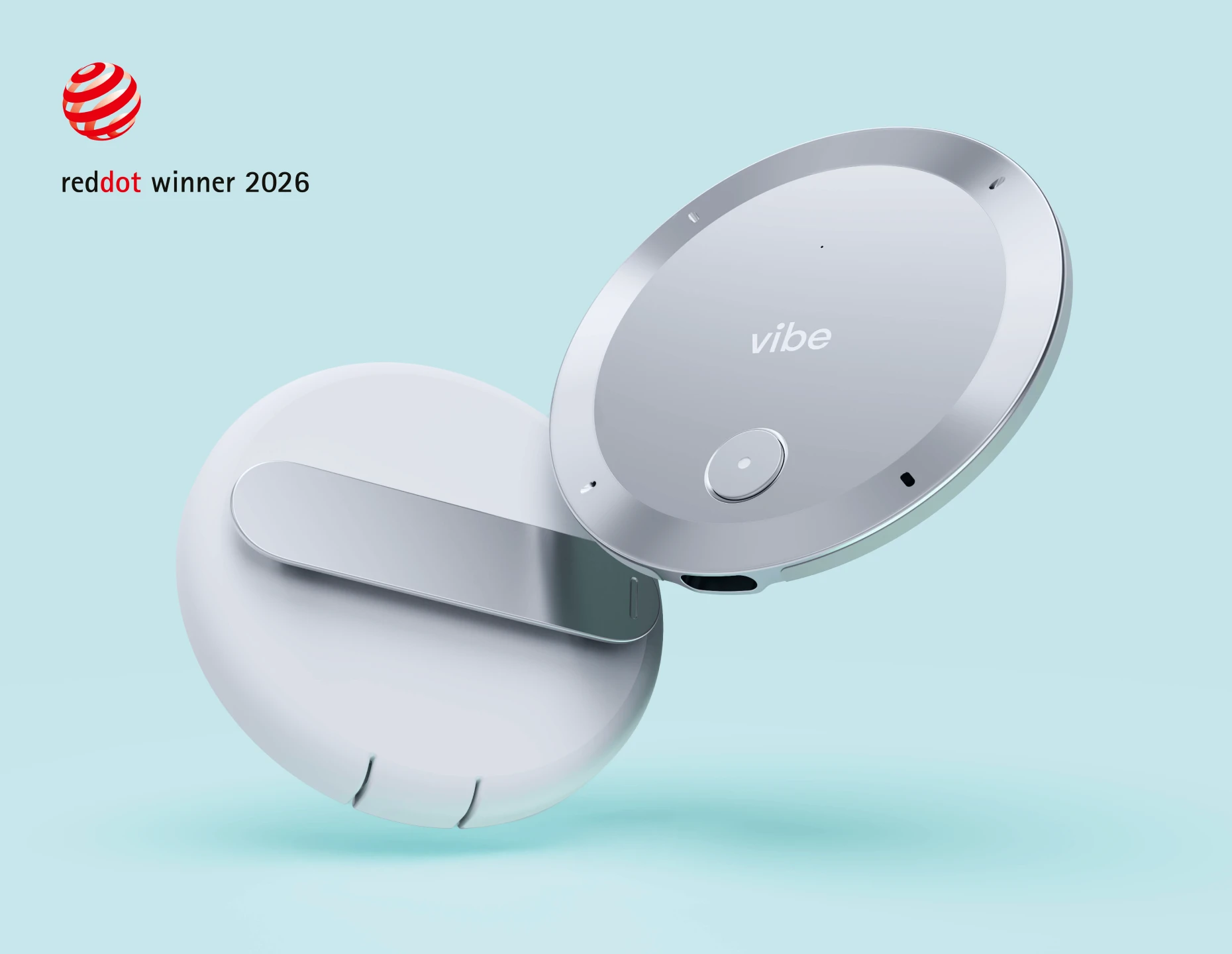

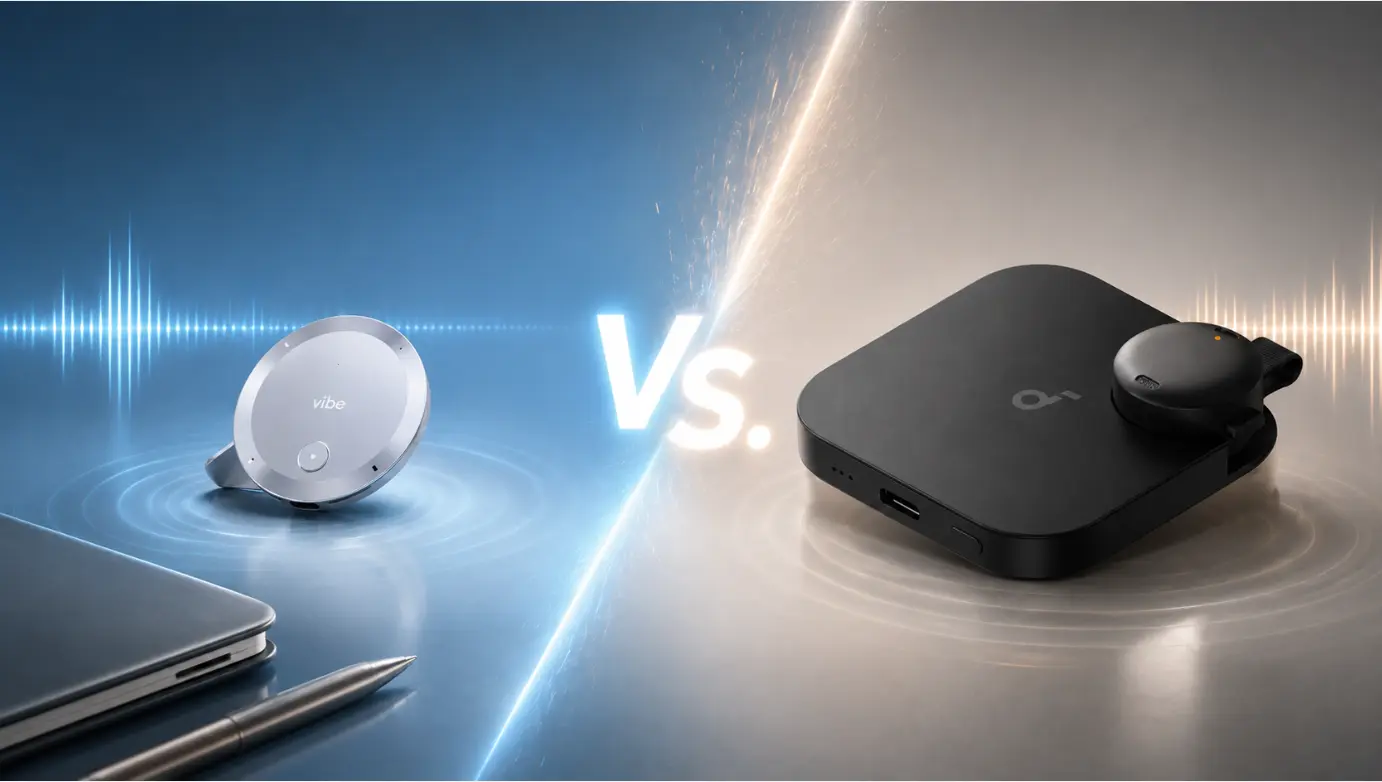
The Soundcore Work made a smart entrance into the AI recorder market: coin-sized, Anker-branded, and just capable enough to pull meeting-goers away from phone-based transcription apps. For casual use and quick in-person capture, it earns its spot.
But Soundcore’s constraints are real, and they surface fast. A dual-omni mic setup that struggles in noisier environments. An Apple-first design that creates friction for Android users—auto-launch and instant upload work seamlessly on iPhone, but Android users must manually enable background permissions. And an AI layer that resets after every session—useful for individual recaps, but unable to answer a question that spans weeks of recorded context.
If any of those gaps apply to your workflow, here’s how the field looks in 2026.
Quick Answer: Best Soundcore Work Alternatives at a Glance
-
Vibe Dot — Best overall, best for professionals with compliance needs
-
Plaud NotePin S — Best for meeting-heavy workflows and ecosystem maturity
-
ANYPIN Note Pod P1 — Best design-forward wearable with generous free tier
-
HiDock P1 — Best for Bluetooth call recording and hybrid workers
-
UMEVO Note Plus — Best value for subscription-averse buyers
-
iFLYTEK AI Recorder S6 — Best for multilingual teams and large-room capture
-
Krisp — Best software-only option for virtual-meeting teams
-
Omi — Best open-source pick for developers and budget buyers
How We Evaluated These Alternatives
Each product was assessed across five dimensions: audio capture quality in real-world conditions, AI processing depth (summary quality, cross-session intelligence), privacy and compliance posture, total cost of ownership over 12 months (hardware + subscription), and workflow fit — meaning how well the device matches specific use cases rather than spec-sheet maximums.
One lens that’s easy to miss: these are not all the same kind of product. Soundcore Work is a wearable clip recorder. Some alternatives here are desk-mounted call recorders, some are always-on ambient devices, some are software only. The right pick isn’t "better than Soundcore" in the abstract — it’s the right tool for the specific context where Soundcore falls short for you.
1. Vibe Dot — Best Overall Soundcore Alternative
Price: $199 (currently 20% off)
Best for: Professionals in regulated industries, anyone needing cross-session AI memory, teams with both in-person and virtual capture needs
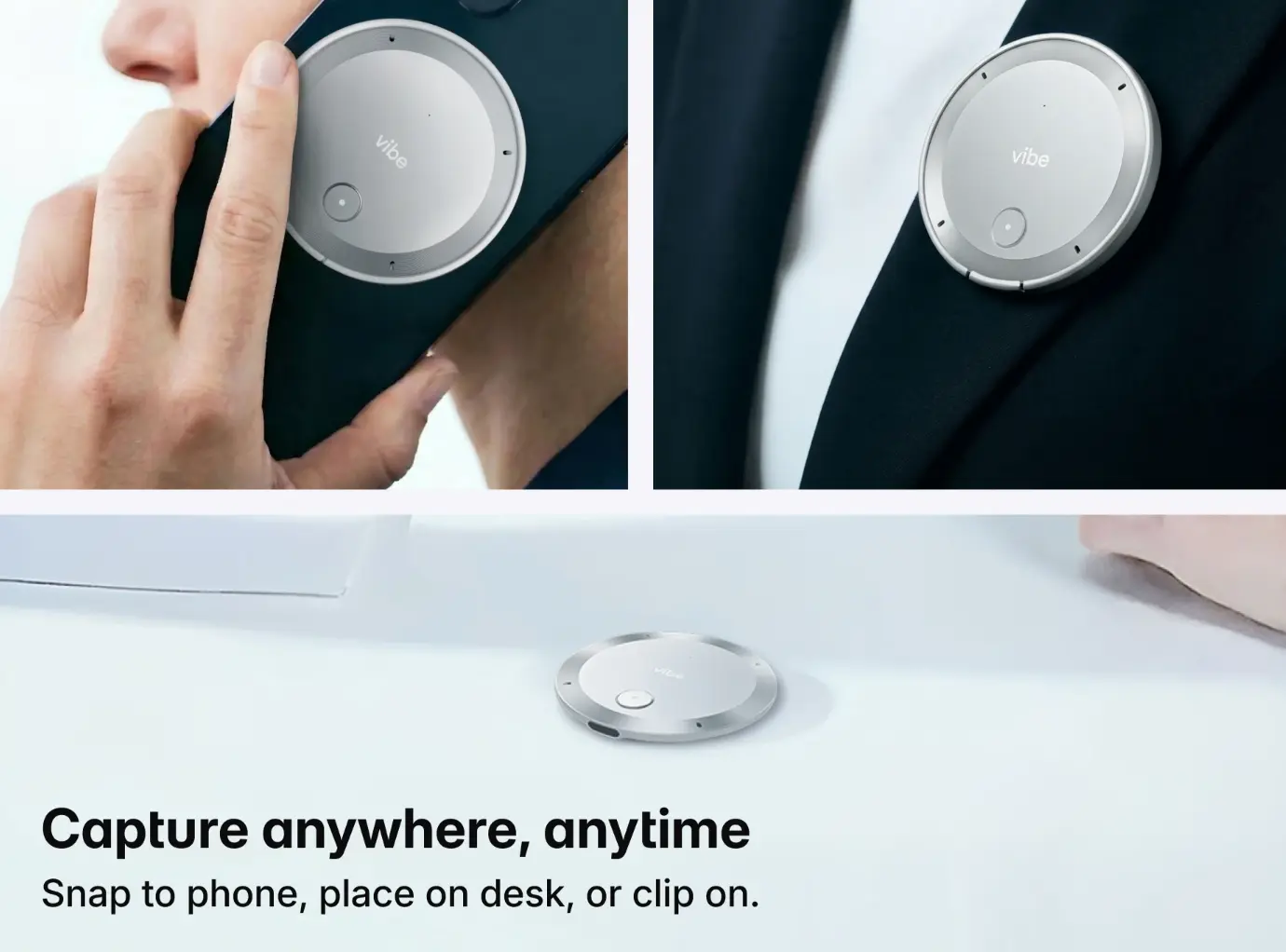
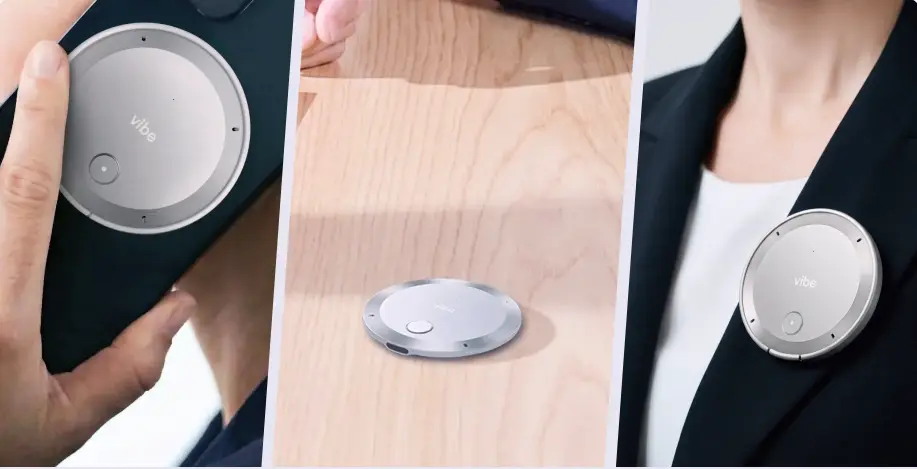 Vibe Dot AI recorder shown in three usage modes: held in hand, placed on a desk, and clipped to a jacket lapel
Where Soundcore Work is a session recorder — capture, transcribe, summarize, close — Vibe Dot is an intelligence layer that keeps building across every conversation you have.
The hardware case
Soundcore Work uses a dual-omni microphone array: it captures sound evenly from all directions, which sounds good on paper but means it’s equally good at capturing background noise as it is at capturing your voice. Vibe Dot uses a 5-microphone array that includes a dedicated bone-conduction mic — a physical sensor that reads vibrations from your skull, not just air pressure. In a loud café, open-plan office, or a conference hall with a lot of side conversations, Soundcore struggles; Vibe Dot’s bone-conduction component keeps your voice signal clean regardless of ambient noise.
The encryption story is also different. Soundcore Work deletes cloud audio after transcription and stores locally with AES-256 — reasonable, but entirely software-managed. Vibe Dot’s recordings are protected by a dedicated hardware encryption chip, meaning the data is physically unreadable without device-level authorization. For legal teams, healthcare professionals, or anyone in a NDAA-sensitive context, that’s a meaningful hardware commitment rather than a policy promise.
The compliance case
Vibe Dot ships with SOC 2, HIPAA, FERPA, and NDAA certification. Soundcore Work publishes none of these. If your work touches protected health information, student records, or government procurement rules, Vibe Dot is the only option in this comparison with the paperwork to match.
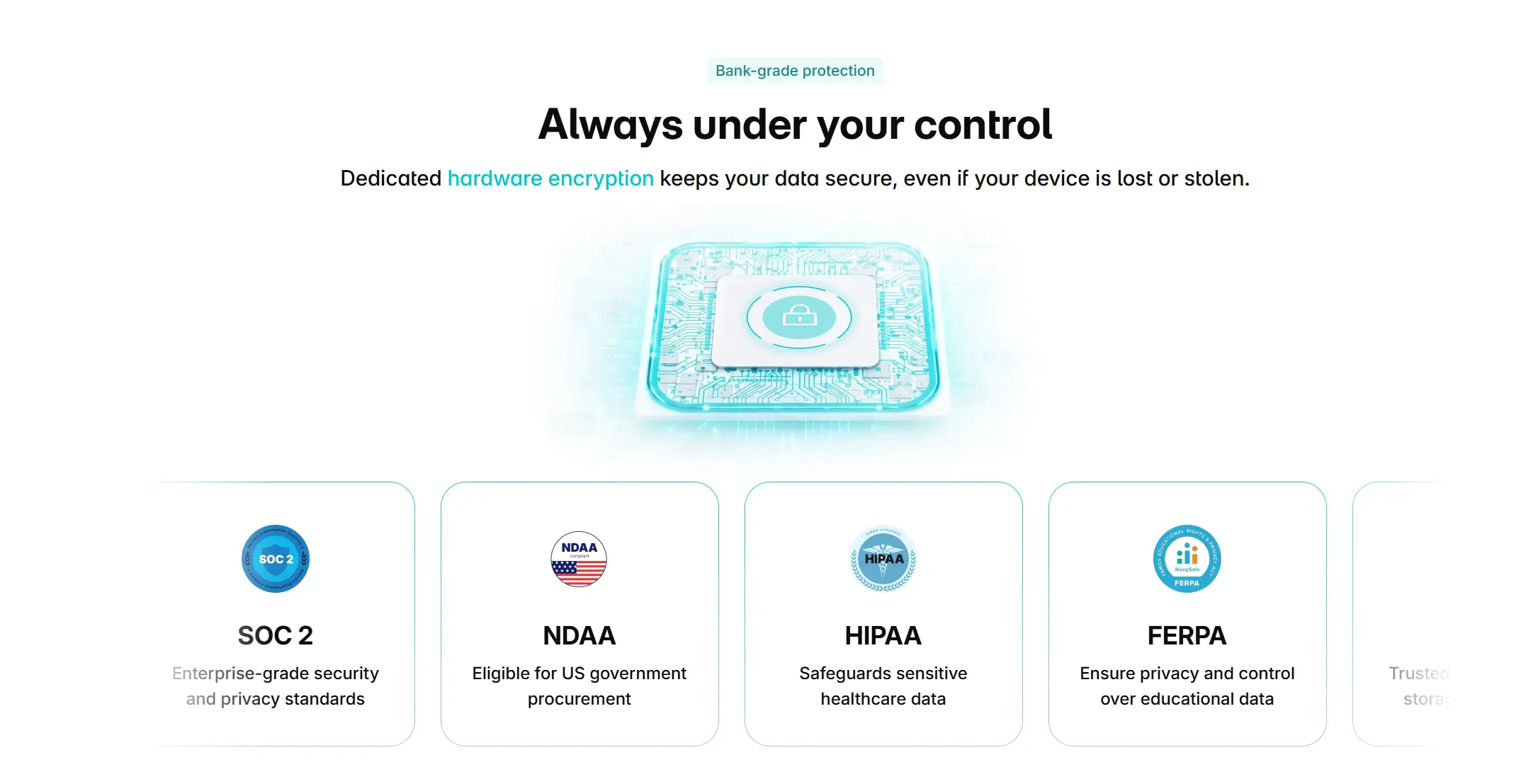 Vibe Dot security features showing hardware encryption chip illustration and SOC 2, NDAA, HIPAA, and FERPA compliance badges
The AI case
This is the sharpest difference. Soundcore produces a summary per session. Vibe Dot feeds every recording into Vibe AI’s Memory Graph — a persistent knowledge engine that links context across all your captured conversations, whether they happened this morning or three months ago. You can ask "What pricing objection did we hear most often across the Q2 client calls?" and get an answer synthesized from months of recordings, not a scroll through individual files. That’s a fundamentally different product category than a meeting summarizer.
Where to be realistic
Core recording, transcription, and summaries are free — a Vibe AI Pro plan is needed only for extended memory retention and high-volume agentic features.
2. Plaud NotePin S — Best for Meeting-Heavy Workflows
Price: $179
Best for: Professionals who attend back-to-back meetings and want the most mature summary and organization workflow in wearable hardware
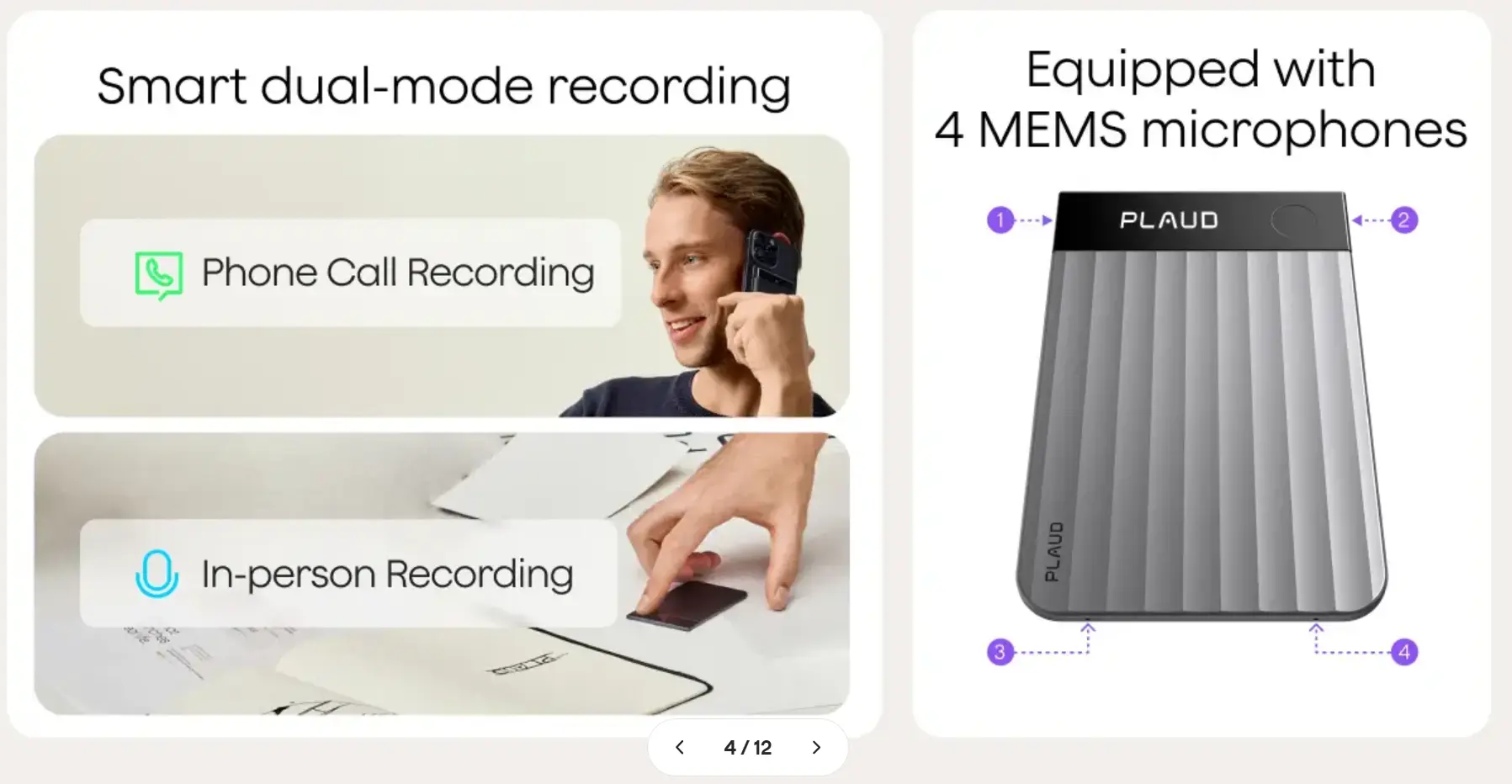 Plaud NotePin dual-mode recording modes and 4 MEMS microphone layout
Plaud has the longest track record in dedicated AI recorder hardware, and the NotePin S reflects that experience — four wearing modes, a tactile record button that removes the guesswork about whether recording has started, and a template library built up by a large user community over time.
The AI layer uses multi-LLM routing and the app’s organization tools are well-developed. For users who want a hardware recorder with minimal setup and a clear upgrade path, it’s a dependable choice.
The limits are also well-defined: no HIPAA or NDAA compliance, no memory that carries across sessions, and a Pro subscription at $8.33/month that adds to long-term cost. NotePin S records in-person only — phone calls aren’t supported — so it’s purpose-built for one context, not a unified capture layer.
Worth knowing: Plaud NotePin S ships with Apple Find My support. For something this easy to lose, that’s a practical feature worth naming.

3. ANYPIN Note Pod P1 — Best Design-Forward Wearable with Generous Free Tier
Price: ~$129–$149
Best for: Professionals who want a design-award-winning wearable with solid AI features and more free transcription than Soundcore offers
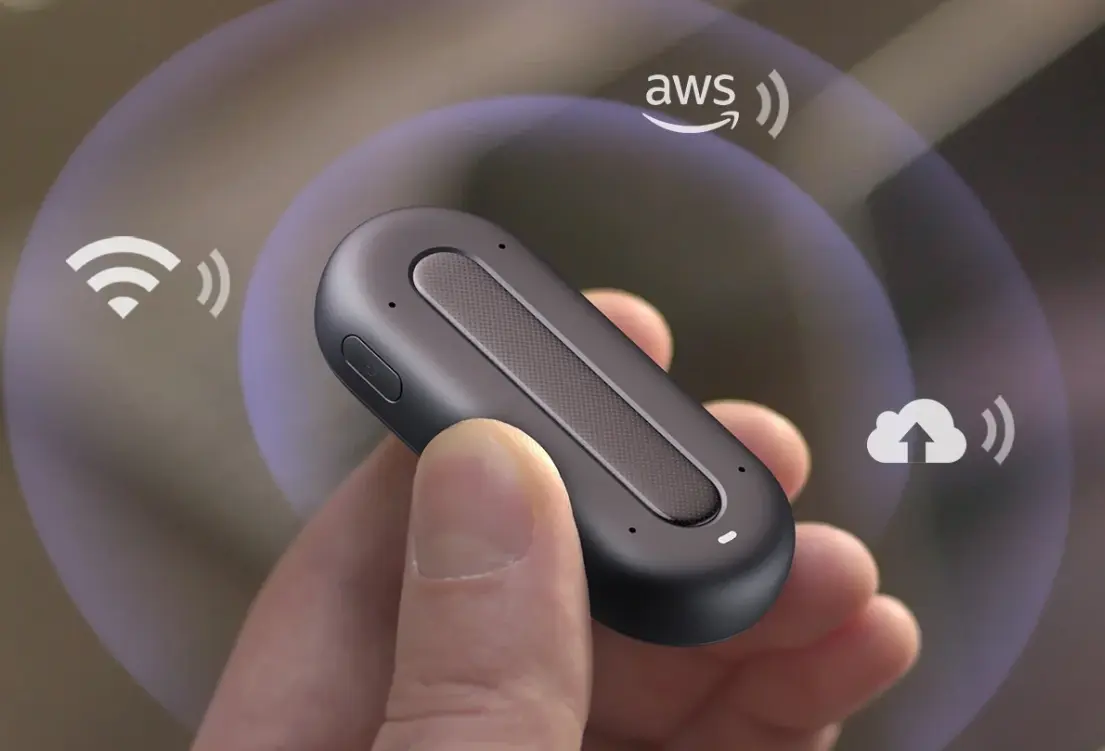 ANYPIN Note Pod P1 wearable AI recorder with cloud connectivity
The iFLYTEK-backed ANYPIN won the 2026 iF Design Award — one of the most credible industrial design honors in the category — which puts it in a different aesthetic tier than most AI recorders. It’s a wearable first, built to disappear into professional attire rather than announce itself as a gadget.
Specs worth noting: a 4-mic array with AI-driven noise reduction and speaker separation, 20 hours of continuous recording (versus Soundcore Work’s 8 on-device), 64GB of local storage, offline recording, and support for 120+ languages with GPT-5-powered transcription. The free tier includes 380 transcription minutes per month, meaningfully more than Soundcore’s 300 — and no subscription is required to access it. ANYPIN also carries SOC 2 Type I, ISO 27001, and ISO 27701 certifications, which gives it a stronger enterprise privacy story than Soundcore Work.
Calendar-aware recording is a standout software feature: ANYPIN can automatically trigger recording based on your schedule or location, so you don’t have to manually start capture before a meeting begins.
Where it sits relative to Vibe Dot: no cross-session memory, no bone-conduction mic, and the compliance stack — while real — doesn’t include HIPAA or NDAA. But as a pure wearable recorder with a better free tier and stronger design credentials than Soundcore Work, ANYPIN is a serious upgrade.
4. HiDock P1 — Best for Bluetooth Call Recording and Hybrid Workers
Price: ~$130–$255 depending on configuration
Best for: Professionals whose day splits between desk-based calls (Zoom, Teams, Meet) and in-person meetings, who want a single device to cover both without form-factor compromise
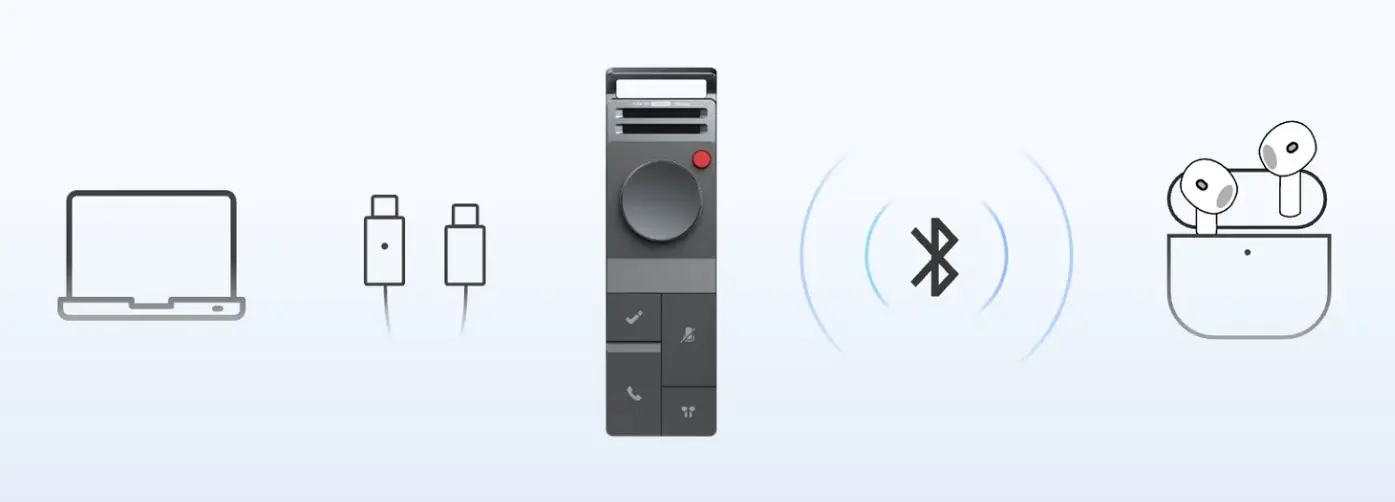 HiDock P1 AI recorder connectivity diagram with Bluetooth and USB support
HiDock P1 solves a problem no other device on this list addresses: it records both sides of a call directly through your Bluetooth earbuds. Using proprietary BlueCatch technology, the P1 intercepts the audio flowing between your phone and wireless earphones and captures a clean two-way recording — no contact mic against your phone chassis, no software permissions, no bot joining your call.
Three recording modes cover the range: Call Mode via Bluetooth for Zoom/Teams/phone calls, Room Mode via built-in dual ECM mics for in-person meetings, and Whisper Mode for quick personal voice memos. The same device handles all three without a mode-swap workaround.
For hybrid workers who spend mornings on video calls and afternoons in client meetings, that flexibility is genuinely useful in a way that a pure wearable clip like Soundcore Work isn’t. HiDock also offers a free transcription tier and 64GB of local storage.
The constraint: HiDock P1 is heavier and more desk-centric than a clip-on wearable, and the setup requires pairing your earbuds through the device rather than directly to your phone. For people who move frequently between environments, that friction adds up. But for the desk-plus-field hybrid use case, it’s the most complete single-device solution in 2026.
5. UMEVO Note Plus — Best Value for Subscription-Averse Buyers
Price: $149
Best for: Budget-conscious professionals who want genuine AI recorder capability without committing to a monthly subscription
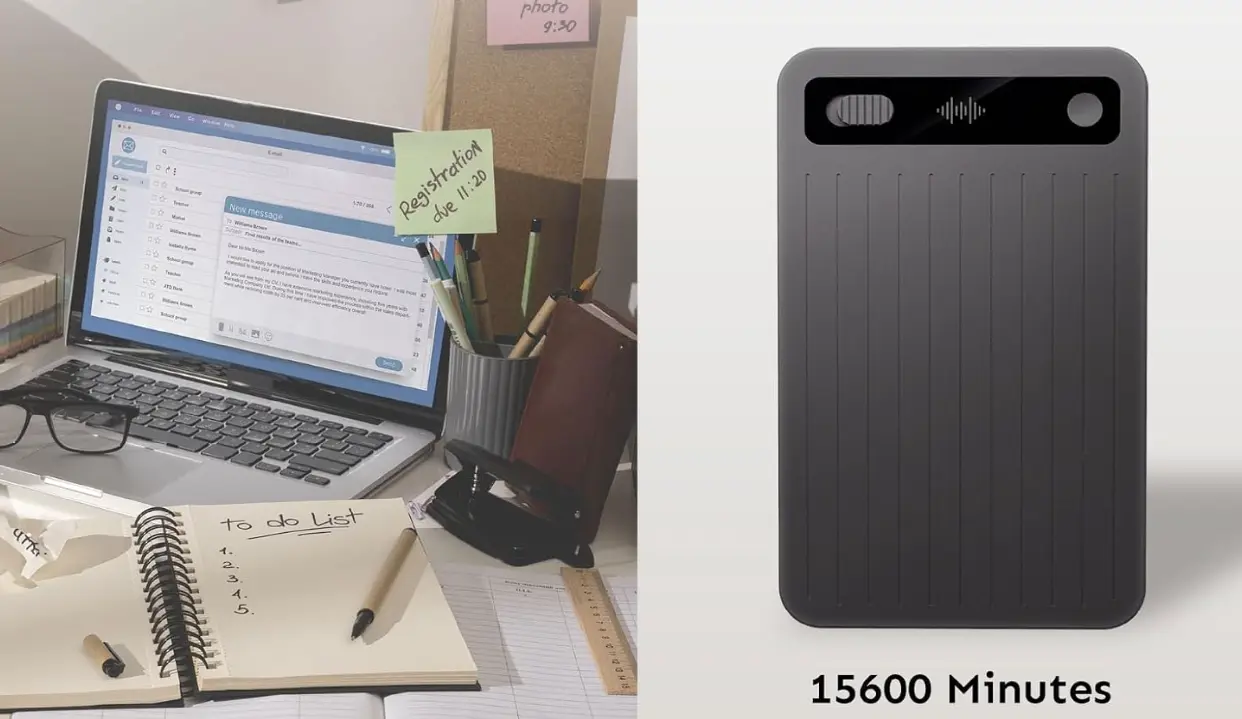 UMEVO Note Plus AI recorder with 15,600 minutes of transcription, no subscription required
The core pitch for UMEVO Note Plus is straightforward: buy the hardware once, get unlimited AI transcription for the first year at no extra cost. After year one, the free tier holds at 400 minutes per month — still more than Soundcore Work’s 300 — with paid plans available if needed.
Beyond the pricing story, the Note Plus has real hardware credentials: dual-mode recording that switches between air conduction for in-person meetings and vibration conduction for phone calls (the same physical contact mic approach Plaud Note Pro uses), 64GB storage, 40 hours of continuous recording, and support for 140 languages. The dual-mode capability is a meaningful differentiator — Soundcore Work and most wearables can’t record phone calls at all.
For professionals who are tired of subscription-first pricing models and want a device that earns its keep without ongoing fees, UMEVO Note Plus is the most cost-effective option in this comparison.
6. iFLYTEK AI Recorder S6 — Best for Multilingual Teams and Large-Room Capture
Price: $459–$469
Best for: Global teams, legal professionals, government users, and anyone who needs serious room-scale audio pickup and offline processing
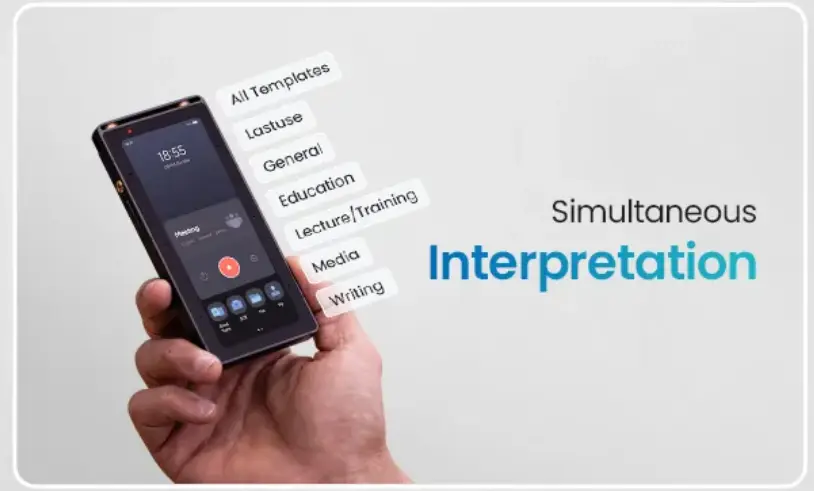 iFLYTEK AI recorder with multi-template recording and simultaneous interpretation
iFLYTEK makes AI speech technology for enterprise and government clients — the kind of organization where recordings can’t pass through a US cloud provider and transcription accuracy is a legal or compliance requirement, not a convenience.
The S6 is built around a 2+6 microphone array with 20-meter pickup range — useful in boardrooms, court proceedings, or large conference spaces where placing a device at the center of the table isn’t possible. It supports offline transcription in five languages, simultaneous interpretation, hardware encryption, and ships with a five-year Pro membership that changes the total cost calculus compared to Soundcore’s annual subscription model.
This is not a consumer device. It’s priced and specced for teams where recording fidelity, data sovereignty, and regulatory compliance aren’t negotiable. For those teams, no other device in this comparison comes close.
7. Krisp — Best Software-Only Option for Virtual-Meeting Teams
Price: Free tier available; Pro at $16/month
Best for: Teams whose meetings are entirely virtual, who want AI notes and noise cancellation without carrying hardware
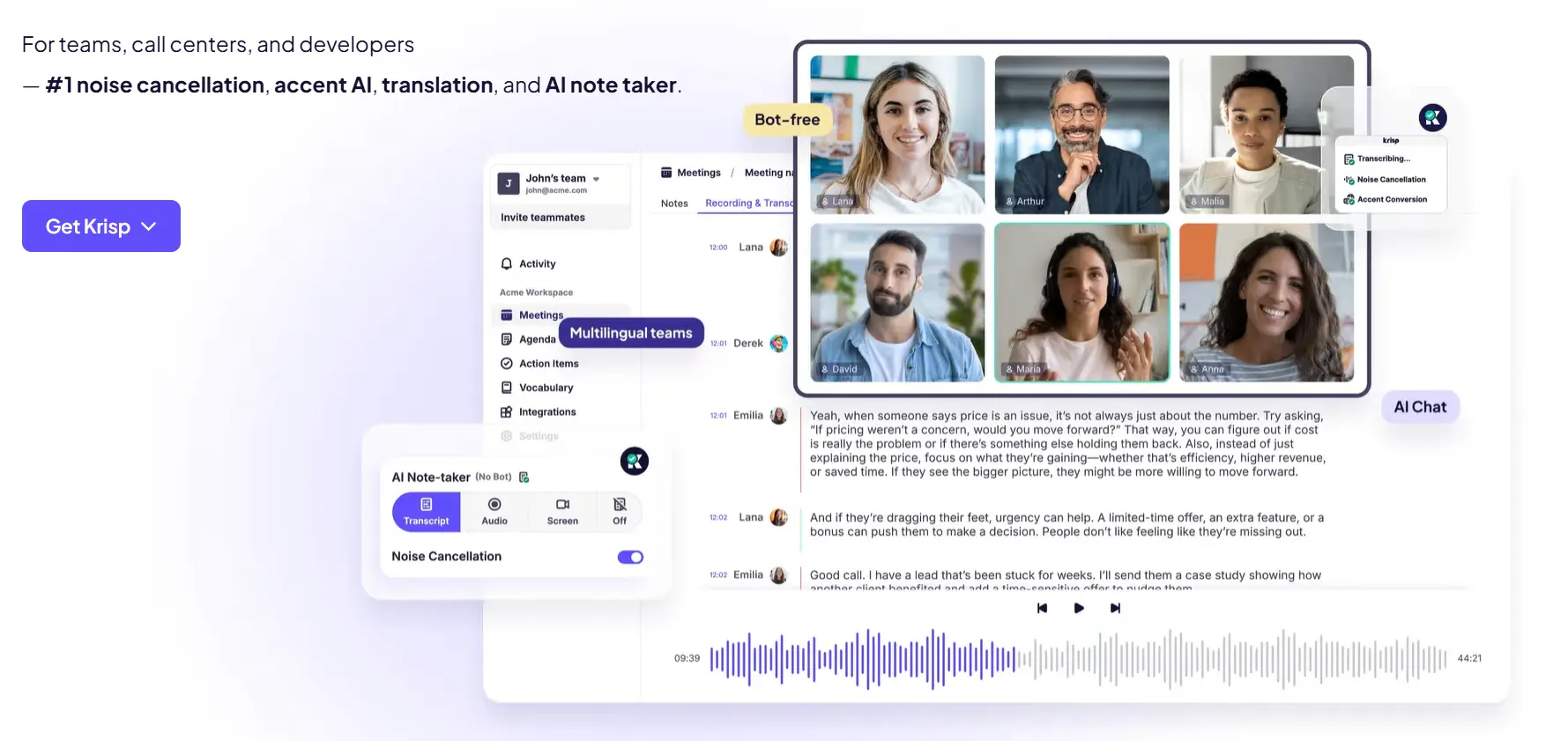 Krisp AI software with bot-free transcription, noise cancellation, and AI notes
If the gap with Soundcore Work is that you primarily need virtual meeting capture, the right answer isn’t better hardware — it’s no hardware at all.
Krisp sits at the intersection of noise cancellation software and AI meeting assistant: it joins Zoom, Teams, and Google Meet calls directly, delivers real-time transcription without a visible bot joining the call (a common friction point on client meetings), and provides AI summaries with action items and follow-ups. Its noise-cancellation layer also improves transcription quality in ways that any hardware recorder working through a microphone in a live meeting environment can’t match for virtual calls.
The hard constraint is the same as all software-only tools: Krisp captures nothing that doesn’t happen on a calendar. Site visits, hallway decisions, in-person client meetings, fieldwork — those conversations don’t exist to Krisp. If any meaningful portion of your work happens away from a screen, hardware is still the right layer, and Krisp is best as a complement rather than a replacement.
8. Omi — Best Open-Source Pick for Developers and Budget Buyers
Price: ~$89
Best for: Developers, students, and early adopters who want open-source flexibility, offline capability, and the lowest hardware entry point in the category
Omi is the cheapest dedicated AI recorder on this list, and it punches above its price on two dimensions: open-source architecture and unlimited on-device transcription with 1,200 free cloud minutes per month. The open-source community means customizable integrations, hackable pipelines, and a level of control over your own data that no closed-platform device can match.
 Omi open-source AI recorder worn as a necklace in a professional setting
The trade-offs are real: setup requires more technical comfort than any consumer device here, audio quality is below Plaud or Vibe Dot, and the reliability bar is below what most professionals would want for primary recording on important sessions. Omi is most useful as a low-commitment entry into the wearable AI recorder category, or as a secondary device for experimenters who want to build custom applications on top of recorded audio.
Soundcore Work Alternatives: Side-by-Side Comparison
|
Device |
Price |
Form Factor |
Battery |
Free Tier |
Compliance |
Cross-Session Memory |
|---|---|---|---|---|---|---|
|
Vibe Dot |
$199 |
Wearable clip |
30+ hrs |
300 min/mo |
SOC 2, HIPAA, NDAA, FERPA |
✓ (Memory Graph) |
|
Soundcore Work |
$159.99 |
Wearable clip |
8 hrs (32 w/ case) |
300 min/mo |
Not published |
✗ |
|
Plaud NotePin S |
$179 |
Wearable clip |
20 hrs |
300 min/mo |
ISO 27001, SOC 2 |
✗ |
|
ANYPIN Note Pod P1 |
~$129–149 |
Wearable clip |
20 hrs |
380 min/mo, no sub req |
SOC 2, ISO 27001, ISO 27701 |
✗ |
|
HiDock P1 |
~$130–255 |
Desk/portable dock |
8 hrs |
Free tier available |
Not published |
✗ |
|
UMEVO Note Plus |
$149 |
Card/clip |
40 hrs |
1 yr unlimited; 400 min/mo after |
Not published |
✗ |
|
iFLYTEK S6 |
$459–469 |
Handheld recorder |
16 hrs |
5-yr Pro included |
Hardware encryption |
✗ |
|
Krisp |
$0–$16/mo |
Software only |
N/A |
Free tier available |
SOC 2, GDPR |
✗ |
|
Omi |
~$89 |
Wearable pendant |
Not disclosed |
1,200 min/mo free |
Not published |
✗ |
Which Soundcore Alternative Is Right for You?
Choose Vibe Dot if: Your work mixes in-person and virtual conversations, you’re in healthcare, legal, education, or government, you want an AI layer that builds knowledge across sessions rather than resetting after each one, or you’ve hit Soundcore’s minute limits and want a model where core features are genuinely free.
Choose Plaud NotePin S if: You attend frequent structured meetings and want the most mature summary workflow in the wearable category, or you’re already in the Plaud ecosystem.
Choose ANYPIN Note Pod P1 if: You want better design credentials than Soundcore, a higher free transcription tier, stronger published privacy certifications, and longer battery life without a subscription requirement.
Choose HiDock P1 if: A significant portion of your meetings happen on Zoom, Teams, or phone calls through your earbuds, and you want a single device to capture both call audio and in-person conversations without managing two tools.
Choose UMEVO Note Plus if: Subscription fatigue is real for you and you want a capable dual-mode recorder (in-person + phone calls) at a competitive one-time price with genuinely generous first-year free transcription.
Choose iFLYTEK S6 if: You need enterprise-grade audio, offline processing, and data sovereignty — particularly in legal, government, or regulated environments where cloud dependency isn’t acceptable.
Choose Krisp if: Your important conversations are virtually all virtual — scheduled video calls on Zoom, Teams, or Google Meet — and you don’t want to carry or charge dedicated hardware.
Choose Omi if: Budget is the primary constraint, you’re comfortable with a more technical setup, and you want open-source flexibility or a low-commitment way to experiment with wearable AI recording.
Final Take
Soundcore Work’s appeal is real but narrow: it’s a well-designed, consumer-friendly wearable from a trusted hardware brand, at a price that doesn’t require much deliberation. For occasional use and light note-taking, it delivers.
The ceiling appears quickly for anyone with more demanding needs. The free transcription tier is thin. The compliance posture is absent. The AI layer treats every recording as a fresh start. And the form factor — like every other wearable on this list — can only capture what happens in front of its microphone, not the intelligence layer that connects recordings into something you can actually query.
Vibe Dot is the only device in this comparison that changes that last equation. The Memory Graph isn’t an incremental improvement on per-session summaries — it’s a different answer to the question of what a wearable AI recorder should actually do. Paired with the 5-mic professional audio array, hardware encryption, and a compliance stack that covers regulated industries, it’s the most complete step up from Soundcore Work for professionals who need more than a better transcription app.
Prices and specifications reflect vendor-published information as of August 2026. Confirm current pricing before purchasing.
FAQs
What is Soundcore Work and why are people looking for alternatives?
Soundcore Work (by Anker) is a coin-sized wearable AI voice recorder targeting professionals who want lightweight meeting transcription without a phone on the table. It clips to a collar, hangs on a lanyard, or attaches magnetically to a phone. The most common reasons people look for alternatives: the free tier’s 300 monthly transcription minutes are too low for regular use, no HIPAA or NDAA compliance certifications are published, the AI layer doesn’t retain context across sessions, and the Apple-centric design creates friction for Android users.
Is Vibe Dot a better wearable recorder than Soundcore Work?
For professional use cases, yes — across audio hardware, compliance, and AI depth. The 5-mic array with bone-conduction outperforms Soundcore’s dual-omni in noisy environments. The hardware encryption chip provides stronger data protection. SOC 2, HIPAA, NDAA, and FERPA compliance covers regulated industries that Soundcore doesn’t address. And the Vibe AI Memory Graph delivers cross-session intelligence that Soundcore’s session-scoped design can’t match.
Which Soundcore alternative is best if I also need to record phone calls?
Soundcore Work only captures in-person audio — it can’t record both sides of a phone call. For phone call recording, HiDock P1 (captures through Bluetooth earbuds via BlueCatch technology) and UMEVO Note Plus (uses vibration-conduction dual-mode recording) are both strong options. Plaud Note Pro also supports phone call recording, though the NotePin S does not.
Does Vibe Dot require a subscription?
No. Core recording, local storage, and basic AI summaries are free on Vibe Dot. A Vibe AI Pro plan is only needed for extended memory retention, custom summary templates, and high-volume agentic features. For most users, the free tier is fully functional — which is a meaningful contrast to Soundcore Work, where the $15.99/month subscription unlocks most of the AI value.
What’s the most affordable Soundcore alternative with good AI features?
Omi (~$89) is the lowest hardware entry point, with 1,200 free cloud transcription minutes per month. UMEVO Note Plus ($149) offers the best value-to-feature ratio for professional use: 40-hour battery, dual-mode recording for calls and in-person, and one full year of unlimited transcription included with the hardware purchase.
Is it legal to use a wearable AI recorder?
Recording laws vary by jurisdiction. In many US states, one-party consent applies — meaning you can record conversations you participate in. California, Illinois, Florida, and several others require all-party consent. Professional environments generally call for disclosure regardless of legal requirement. No device in this comparison changes the underlying legal rules.
What makes Vibe Dot different from every other recorder on this list?
Every other device in this comparison — including Soundcore Work, Plaud NotePin S, ANYPIN, and UMEVO — treats each recording as a standalone file to summarize and archive. Vibe Dot’s Memory Graph connects every recording into a persistent, queryable knowledge base. That means you can ask questions that span months of conversations, not just retrieve summaries of individual sessions. For professionals who want their recorder to function as an active intelligence layer rather than a transcription archive, that’s a categorically different capability.