
A construction project manager’s most consequential conversations rarely happen in a meeting room. They happen standing over a foundation pour. They happen walking a punch list or negotiating a change order beside a running excavator. None of those moments appears on a calendar.
AI note taking for construction has to work where construction actually happens. Meeting bots are excellent at a narrow job: they join scheduled video calls and take notes, and construction work does not happen there.
This post explains why calendar-bound tools fail on a jobsite and points to what captures those conversations instead: the wearable AI recorder.
Why Meeting Bots Stay on the Calendar
Meeting bots are calendar-bound by design. In 2025, the AI meeting assistant market reached $3.5 billion. Grand View Research projects $21.5 billion by 2033 (AI Meeting Assistant Market).
Every major tool in that category works the same way. For an office team, the trade is obvious: join a call, get a transcript, move on.
For instance, Otter, Fireflies, Read.ai, Zoom AI Companion, and Microsoft Copilot all join calls that already exist. They connect to Zoom, Microsoft Teams, or Google Meet. They listen and turn the call into a transcript with action items.
For a scheduled video call, however, that output is genuinely useful. A project manager skips manual notes and gets a searchable record in minutes.
But the whole category assumes a calendar event. The AI voice recorders built for meetings still revolve around an agenda, a fixed attendee list, and a join link. A field conversation has none of that.
In practice, nobody sends a calendar invite before a punch-list walkthrough. There is no join link for a change-order discussion shouted over an excavator. The bot sits idle, waiting for a call that never arrives.
What Happens When a Bot Tries the Jobsite
A live jobsite is the worst possible environment for speech recognition, and the numbers show it. In 2025, a systematic review of 29 studies found AI transcription error rates climb fast. They rise from 8.7% in clean, single-speaker dictation to above 50% in multi-speaker conversation (Ng et al., BMC Medical Informatics and Decision Making).
Indeed, construction combines every one of those failure conditions at once. Heavy equipment runs between 80 and 120 dB(A), per CDC / NIOSH, Heavy Construction Equipment Noise. OSHA sets a permissible exposure limit of 90 dBA over an 8-hour shift. That is the point where hearing protection becomes mandatory.
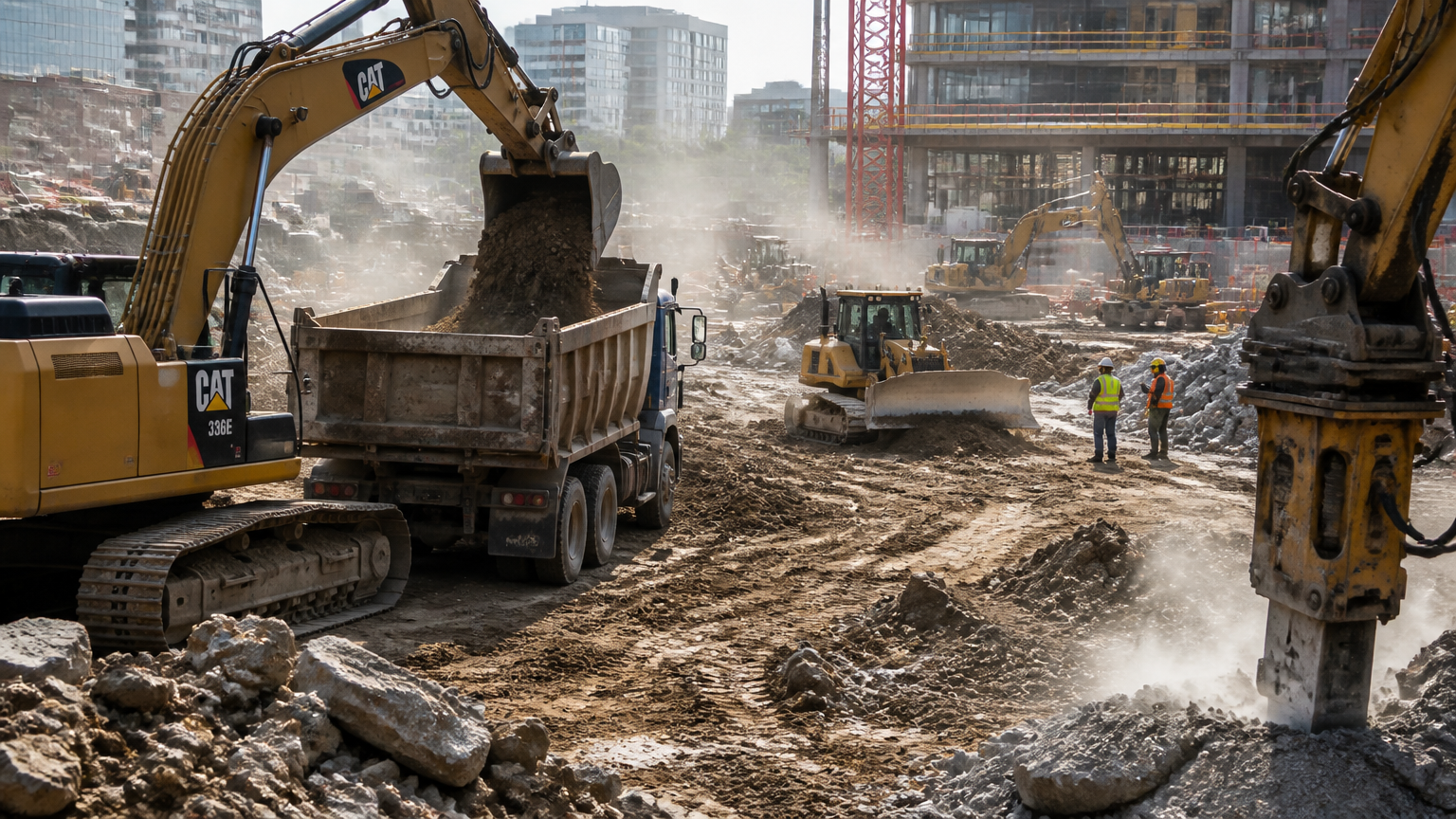 Heavy construction equipment operating on an active jobsite, workers in hard hats and hearing protection, dust and machinery in the background
Meanwhile, a crew wearing earplugs speaks in muffled, clipped sentences. A phone in a pocket adds distance and fabric rustle. Gloves make it hard to hold a device near the mouth.
A hard hat pushes a headset mic away from the lips. Several trades often talk over each other at once, which is exactly the multi-speaker condition that breaks transcription.
As a result, the transcript is full of gaps. At a 50% error rate, every other word is wrong or missing. A note that reads "move the duct" instead of "move the duct three feet north" is no small typo. It is a wrong instruction with a price tag attached.
The Dollar Cost of a Missed Field Conversation
A missed field conversation has a dollar cost, and the construction industry has measured it. The Construction Industry Institute puts rework at 2% to 20% of a project’s contract amount, with direct field rework averaging about 5%.
The path from conversation to cost is direct. A superintendent walks a mechanical room and agrees, verbally, to shift a duct three feet north. Neither side writes it down. The pour proceeds on the old layout, and the fix costs a crew two days. That is the shape rework takes on most active sites.
Miscommunication drives about 26% of rework, per FMI and PlanGrid, and it is the slice a conversation nobody recorded feeds directly. That undo is demolition, schedule slip, and labor spent twice across concrete, drywall, and MEP work. It is also the cost that a single well-timed note could have prevented.
The Shift: AI Note Taking That Captures the Person, Not the Calendar
If the calendar is the wrong place to look, the answer is to record the person instead. A wearable AI recorder clips to a shirt or snaps to a phone and follows the worker through the site. It captures every exchange the worker is part of, scheduled or not.
 A clip-on AI voice recorder attached to a work shirt collar, close-up with shallow depth of field, a jobsite blurred in the background
The category is growing fast. In 2025, the wearable AI market reached $48.82 billion. Fortune Business Insights projects $359.32 billion by 2034.
The idea that matters here is a recorder that lives on the person, not the platform.
A buyer’s comparison of the leading wearable AI recorders shows the category now covers dictation, calls, and ambient capture. Yet for construction, the job is harder than a quiet office call.
What Construction-Ready AI Note Taking Needs
Still, a recorder that works on a jobsite needs different hardware than one built for a conference room. The requirements are specific, and they map directly to the failure conditions described earlier.
The microphone has to survive loud, multi-speaker environments. A noise-resistant array helps, and a bone-conduction voice pickup unit matters more, because it reads vibrations from the wearer’s jaw rather than the air. That keeps the speaker’s own voice clean even when machinery drowns out a conventional mic.
Battery and storage have to outlast a full site day, with 30 or more hours of recording kept onboard. A jobsite often has weak signal, so a recorder that streams to the cloud fails exactly when it is needed most. Onboard storage sidesteps that entirely.
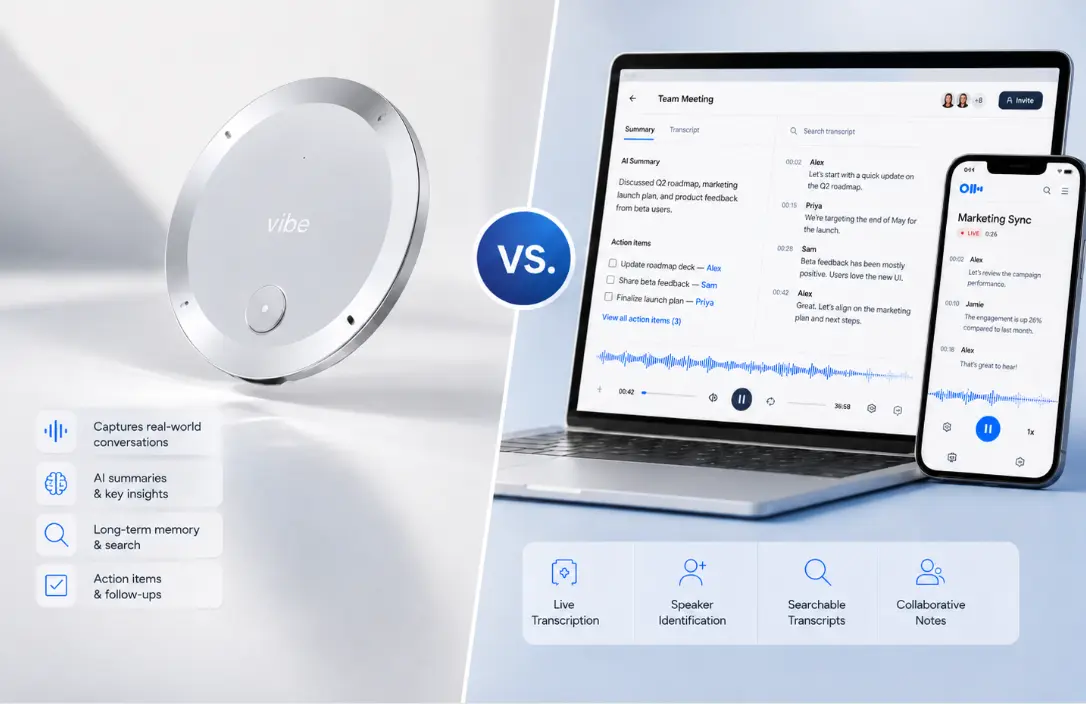
Compliance has to survive a lost device: encryption at rest and certifications that clear procurement. A side-by-side look at Vibe Dot versus Plaud shows how these choices change what a recorder can do in the field.
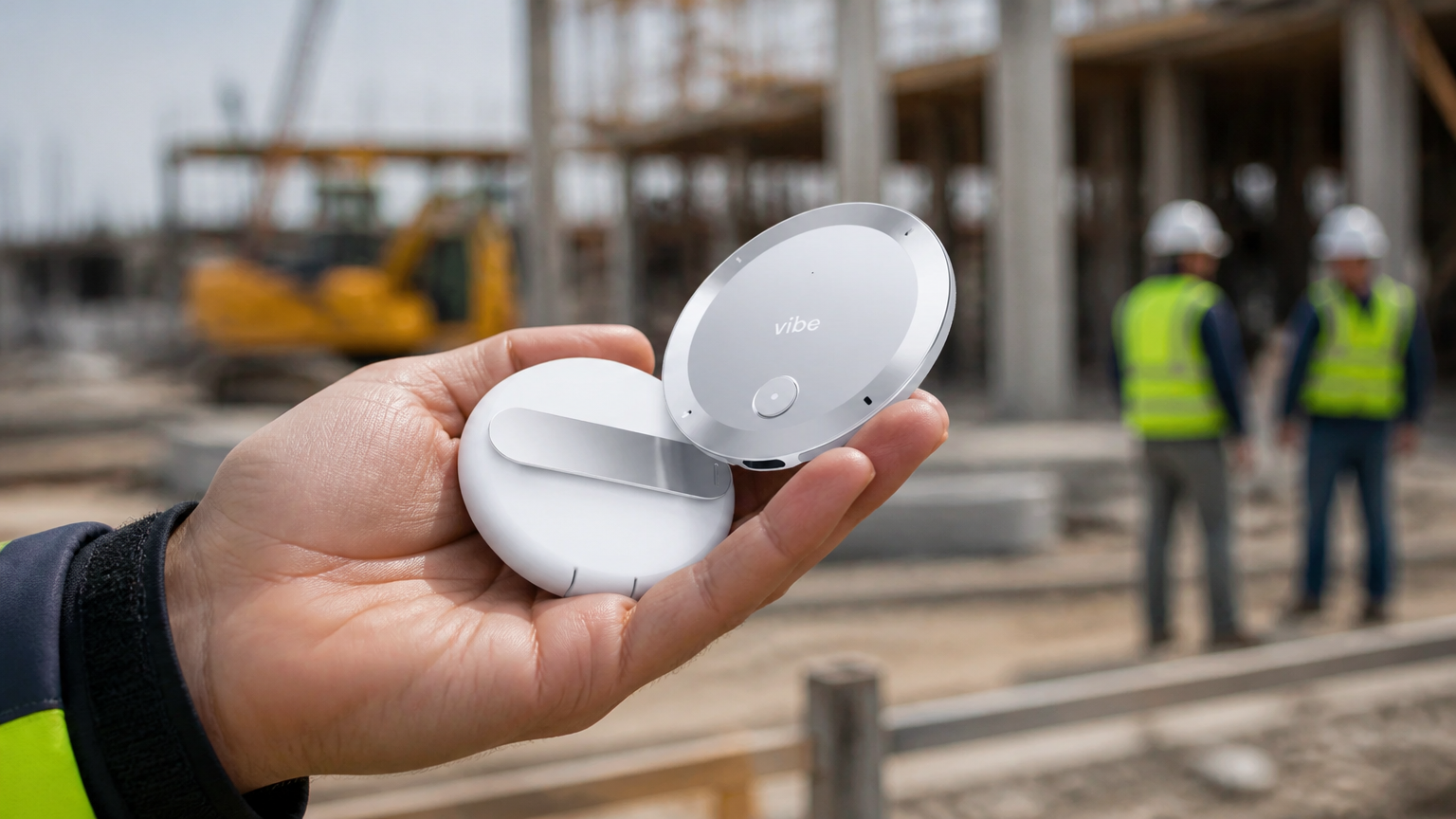
Vibe Dot: AI Note Taking for Construction, Off the Calendar
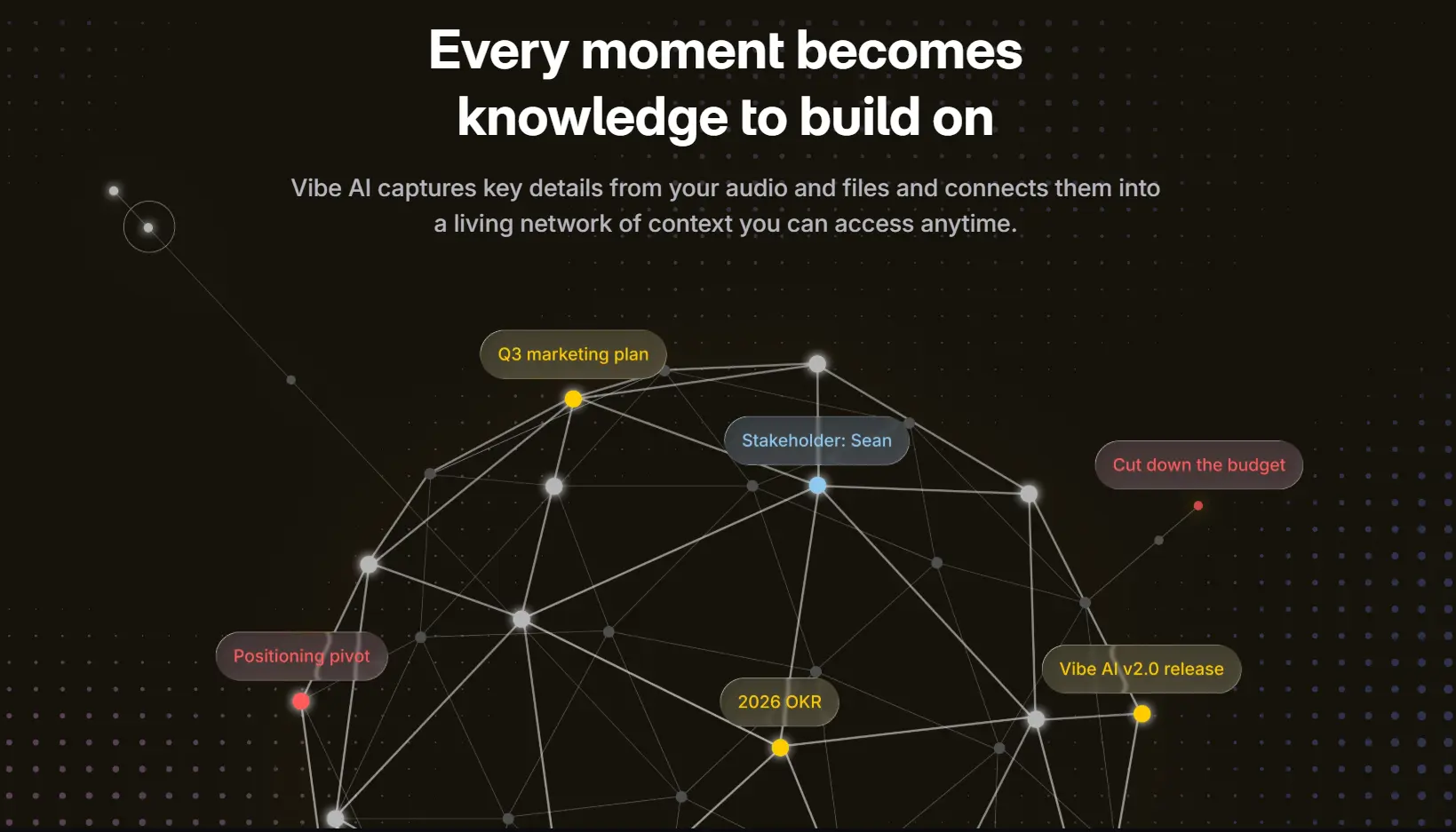
Vibe Dot is AI note taking for construction, built around the person rather than the schedule. The device clips to clothing, snaps to a phone, or sits on a desk, then records, transcribes, and distills conversations into action items. Every design choice targets the jobsite conditions that defeat a phone or a meeting bot.
On a punch-list walk, the recorder keeps one continuous thread: the client asks when the storefront glass lands, a sub flags a missing RFI answer, and the superintendent assigns each item an owner. None of it sat on a calendar, and all of it now has a written record.
The 5-mic array pairs four MEMS microphones with a bone-conduction voice pickup unit, so it reads the wearer’s own voice over heavy equipment. The 30-hour battery and 64GB of onboard storage keep it recording through a double shift without a mid-task cloud upload, holding up to days of audio at a time.
Recording runs on demand, or in an auto-capture standby that catches conversations as they happen. The starting price is $199.
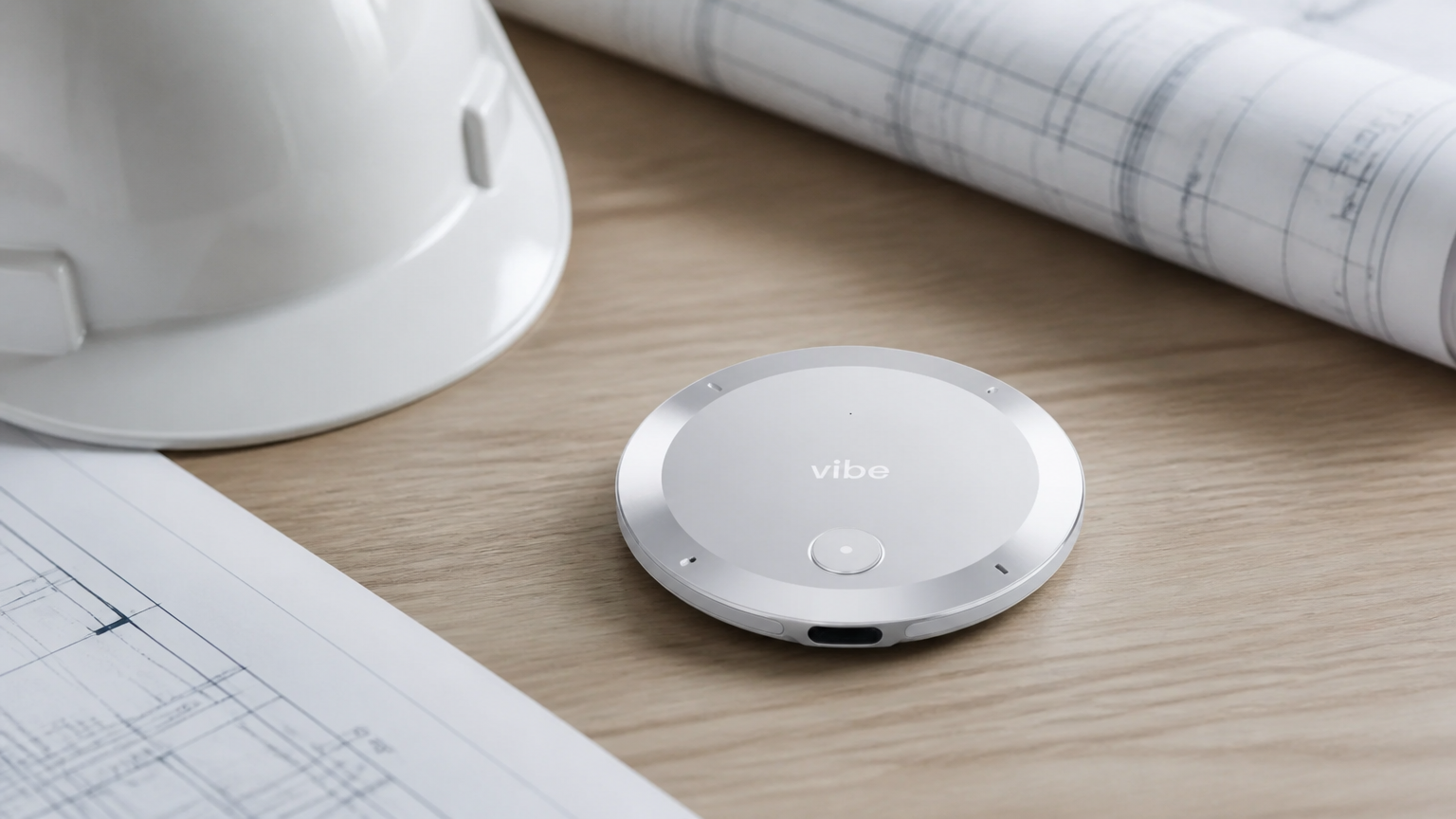 Vibe Dot wearable AI recorder resting on a workbench beside blueprints and a hard hat
On the compliance side, Vibe Dot carries a compliance stack of SOC 2, HIPAA, FERPA, NDAA, and TPM 2.0, with dedicated hardware encryption. The AI layer turns recordings into transcripts, structured summaries, and automatic action items. For a project manager on site all day, the value is simple: the conversation is captured wherever it happens.
Recording on a Jobsite Requires Consent Discipline
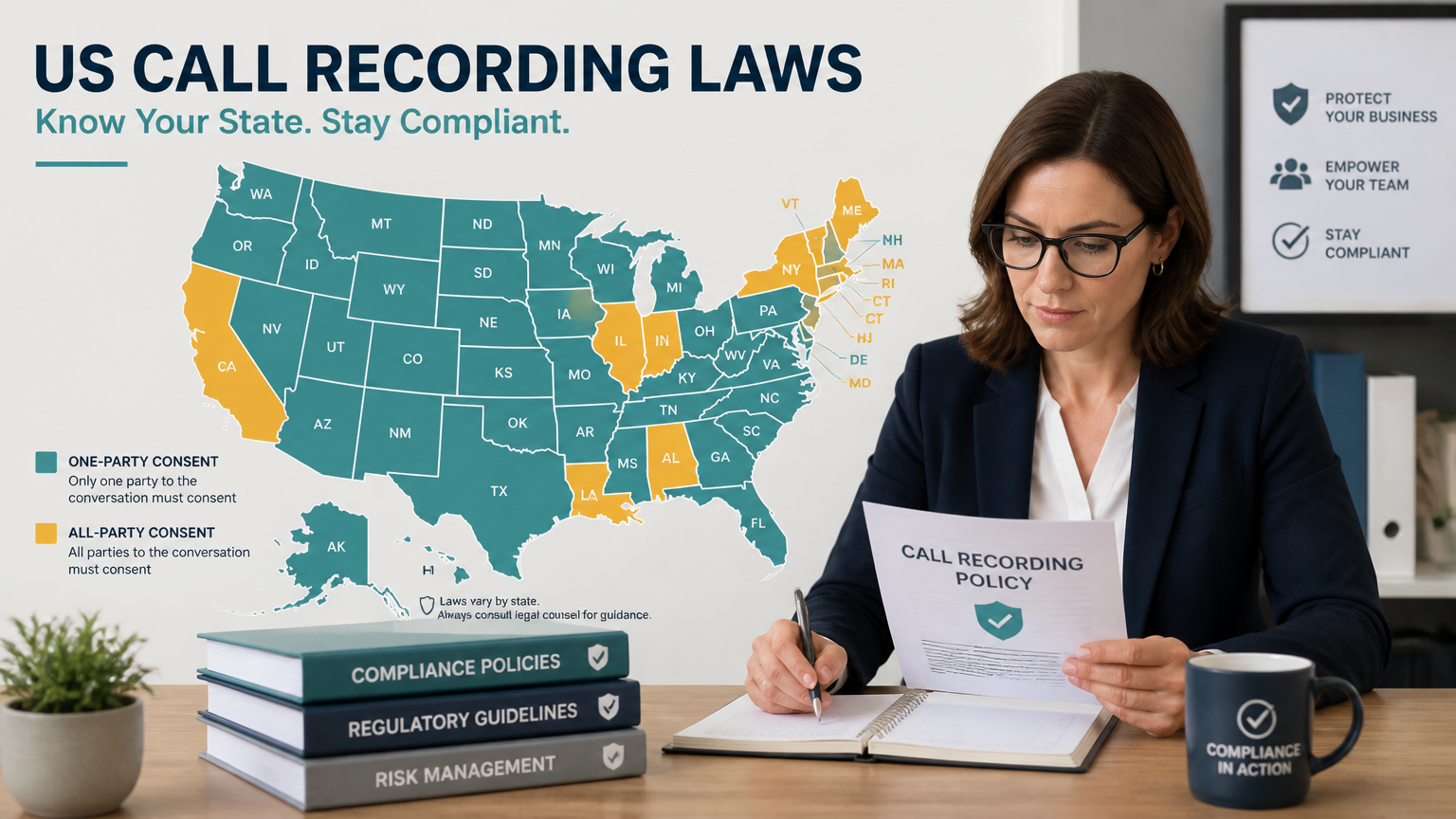
In eleven states, recording a jobsite conversation without every party’s consent is against the law. Subcontractors, inspectors, and clients all pass through the same space, so the question is not optional.
As of 2026, those states require all-party consent. The Reporters Committee for Freedom of the Press lists them: California, Delaware, Florida, Illinois, Maryland, Massachusetts, Michigan (for third parties), Montana, New Hampshire, Pennsylvania, and Washington. The federal default is one-party consent, meaning one participant can record without telling the others. State law overrides that default, so a crew working across state lines must know which rule applies.
So a jobsite-safe practice is to disclose at the start of a conversation. A short, spoken line, "this walkthrough is being recorded for the punch list," tells everyone present and removes ambiguity. It also turns the recorder into a shared tool rather than a hidden one. Posted signage at the trailer and a note on subcontractor agreements close the loop for people who arrive mid-conversation.
The Bottom Line
Construction decisions happen off the calendar, on the jobsite, in the noise. Meeting bots are excellent at scheduled calls, but they stop at the trailer door.
-
Meeting bots only join scheduled video calls. Field conversations have no join link.
-
On a jobsite, word error rates climb past 50%. Phone and bot transcripts fail exactly where the money is.
-
Rework runs 2% to 20% of contract value, averaging about 5%, with miscommunication behind a quarter of it.
-
A clip-on wearable recorder follows the worker, not the schedule.
-
Vibe Dot is built for this: a 5-mic array, 30-plus hour battery, 64GB onboard, and a full compliance stack.
FAQs
Do meeting bots work on construction sites?
No. Meeting bots join scheduled video calls, and a jobsite conversation has no calendar invite or join link. In 2025, Ng et al., BMC Medical Informatics and Decision Making found conversational error rates climb past 50%. So even a phone recording of a walkthrough produces a transcript full of gaps.
Can Otter record a construction site visit?
It can, in theory. Open the app and press record, and Otter will capture audio. But it was built for meetings, not for equipment at 80 to 120 dB(A), per CDC / NIOSH. A phone in a pocket, ear protection, and speaker distance still degrade the transcript.
What is the best way to capture a construction site visit conversation?
A wearable recorder that clips to clothing and follows the person, not the calendar. Look for a noise-resistant mic array with a bone-conduction pickup, onboard storage that works without signal, and a battery that lasts a full site day. The form factor is built for ambient, off-calendar capture rather than a calendar invite.
How should teams document a jobsite walkthrough?
Disclose first, then record. As of 2026, eleven states require all-party consent, per the Reporters Committee for Freedom of the Press. The stakes are real. The Construction Industry Institute puts rework at 2% to 20% of contract value, a cost that often starts as a conversation nobody recorded.