

 Professional taking meeting notes at a modern conference table, with a small wearable AI device visible on the table, team members in background, warm natural office lighting
A project manager finishes a client call, closes the laptop, and opens a blank document. The conversation covered three scope changes, two new action items, and a deadline shift. Twenty minutes later, the notes remain fragmented, and the manager cannot recall who agreed to what. Another meeting becomes necessary to clarify.
Bad meetings cost enterprise businesses an estimated $130 million per year in wasted time, avoidable downstream work, and tech failures, according to Jabra’s June 2026 research. Furthermore, 44% of action items never reach completion, per Fellow, 2025. The breakdown occurs after the meeting ends: without clear minutes, decisions dissolve and responsibilities drift.
A structured approach to capturing and distributing meeting minutes closes that gap. This guide explains what to include, when to prepare, how to capture what matters during the meeting, and how AI tools change the workflow for teams that need to stay present in the room.
- Effective meeting minutes cover six elements: date/time, attendees, agenda items, key discussions, decisions, and action items with owners and deadlines.
- Distribute minutes within 24 hours — only 22% of remote meetings achieve this, compared to 89% for teams using automated tools.
- AI recording tools let note-takers stay present in the conversation and draft from the transcript afterward, instead of transcribing in real time.
- Focus on decisions and action items during the meeting, not verbatim dialogue — minutes are a record of outcomes, not a transcript.
- Before the meeting: review the agenda, load a template, confirm attendee names — prep is what makes clean minutes fast.
Why Meeting Minutes Matter
Meeting minutes form a durable record of decisions and commitments. Without them, teams lose track of agreements, and the same conversations repeat. In 2025, Indegene and SpeakWize found that 70% of meeting content fades from memory within 24 hours without reinforcement.
The cost extends beyond forgotten details: decisions get relitigated, work gets duplicated, and stakeholders remain uninformed.
Structured minutes also create accountability. When action items carry named owners and deadlines, follow-through improves. The format itself shapes the outcome: organizations that adopt a shared minutes template consistently report stronger action-item follow-through than those relying on informal notes.
Minutes differ from informal notes. Notes serve as a personal capture aid; minutes function as a shared record. Notes track what stood out to one person; minutes document what the group agreed to.
This distinction matters for compliance, project handoffs, and any context where a third party might need to reconstruct what happened.
What Effective Meeting Minutes Include
Effective meeting minutes cover six essential elements: date, time, and location; attendees (present and absent); agenda items; key discussion points; decisions reached; and action items with owners and deadlines.
Each element serves a different reader. A project lead scanning for deadlines needs the action-item list. A stakeholder checking whether their concern received attention needs the discussion summary. A compliance reviewer needs the attendance record.
The list also draws a line between minutes and a transcript. Minutes are selective: they capture outcomes. A transcript captures everything said verbatim.
In most business contexts, a full transcript adds noise without value. The note-taker’s job is to distill, not to transcribe.
A simple checklist helps:
-
Date, time, and location (or video-conferencing link)
-
Attendees (present and absent)
-
Agenda items covered
-
Key discussion points (1–3 sentences per item)
-
Decisions reached (state the outcome, not the debate)
-
Action items (task, owner, deadline)
Here is what a brief, well-structured entry looks like in practice:
Notice what is absent: the names of everyone who spoke, the back-and-forth, and the specific dollar amounts discussed. The record captures the outcome and the next steps, nothing more.
Before the Meeting: Set Up for Success
 Note-taker preparing meeting template on laptop, agenda document visible, professional office setting with natural lighting
Note-takers who prepare before the meeting produce more complete minutes with less post-meeting cleanup. Preparation involves reviewing the agenda, loading a template, and confirming attendee names and roles. In 2025, Atlassian found that 72% of professionals say clear objectives drive effective meetings, and 67% rank a clear agenda as the most important element.
Yet only 37% of workplace meetings actively use agendas, per Flowtrace, 2025. This gap represents an opportunity.
A pre-meeting checklist streamlines the process:
-
Request or locate the agenda. If none exists, ask the meeting lead for the key topics.
-
Load a template. A consistent structure makes drafting faster and reading easier.
-
Confirm attendee names and roles. Misattributed comments create confusion and erode trust.
-
Clarify the meeting’s purpose. A decision meeting needs different notes than a status update or a brainstorm.
Preparation also means understanding the meeting’s context. A recurring team standup needs different minutes than a client kickoff or a board session. Governance-heavy settings may require formal language, signature lines, or specific retention rules. Ask ahead.
A project manager heading into a vendor negotiation, for example, might load a template and note the two open questions from the previous meeting, setup that takes five minutes and eliminates fifteen minutes of post-meeting reconstruction.
During the Meeting: Capture What Matters
The most common minute-taking failure is trying to transcribe everything. Verbatim capture slows the note-taker and produces a document no one reads. Minutes should focus on decisions and action items, not dialogue. The goal is a record of outcomes.
Flowtrace, a meeting analytics platform, reported that 92% of workers multitask during virtual meetings (2025). The split-attention problem is concrete: when the note-taker writes, they are not fully listening.
When they listen, they are not writing. Details get missed or garbled.
AI recording tools change the dynamic. Instead of capturing in real time, the note-taker records the conversation and drafts from the transcript afterward. According to AssemblyAI’s 2026 benchmark, leading speech-to-text models now reach 95–98% word accuracy on clean audio — precise enough for professional meeting documentation.
The AI Meeting Assistants market is projected to grow from $3.5 billion in 2025 to $34.28 billion by 2035, a 25.62% compound annual growth rate, according to Market Research Future (2026). Adoption is accelerating.
Software tools like Otter.ai and Fireflies.ai join scheduled video conferencing sessions as a bot. They capture audio and generate transcripts and summaries. These tools work well for meetings that happen on a calendar invite.
However, most important conversations happen outside scheduled calls. Client visits, site walks, hallway chats, and the debrief after the meeting officially ends, software-only tools cannot reach those moments.
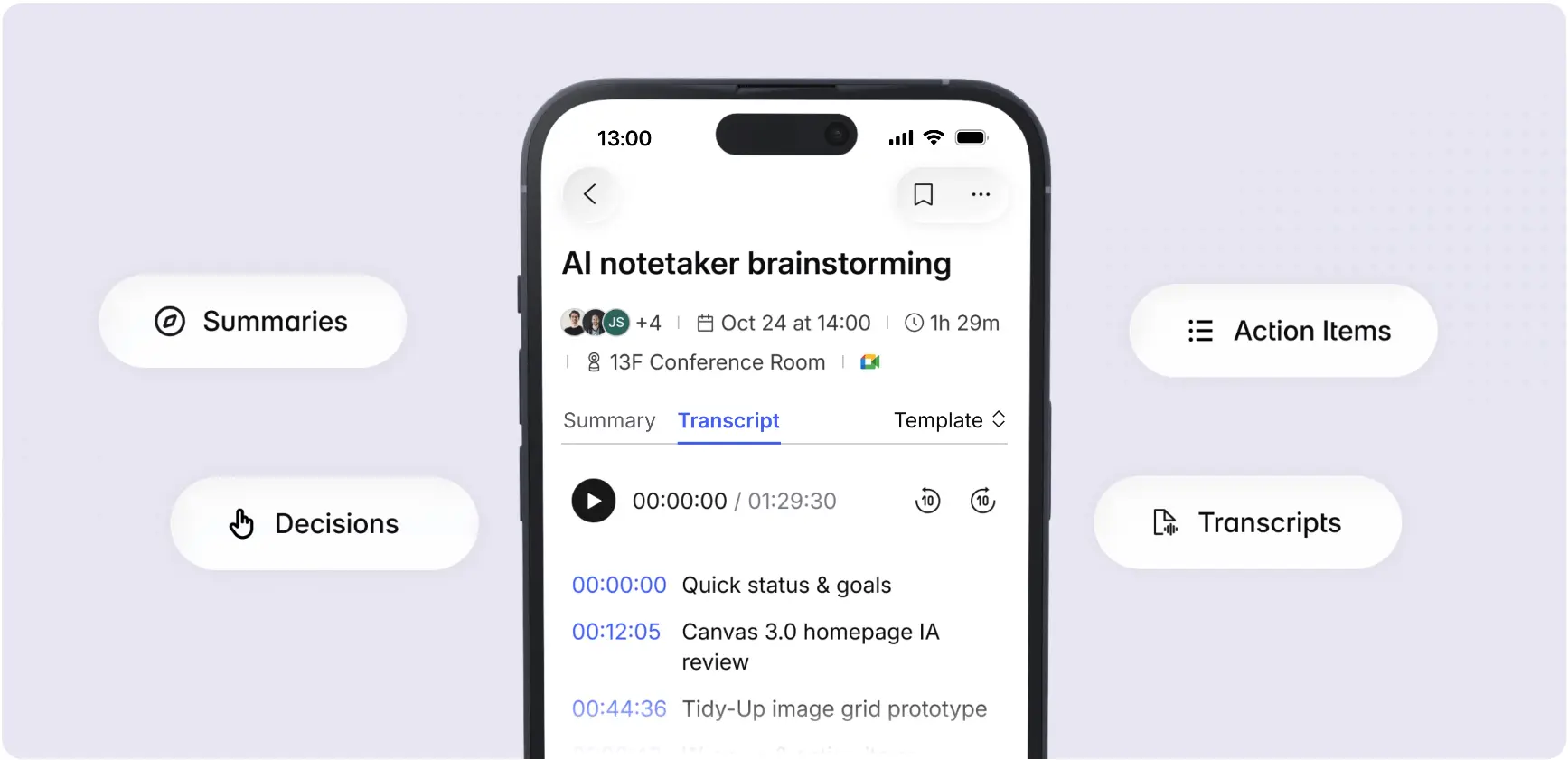
Vibe Dot is a portable AI recorder designed for those off-calendar conversations. It uses a five-microphone array to capture audio clearly in any setting, a client boardroom, a construction site walk, or the debrief after the formal meeting ends. The note-taker stays fully present in the conversation; minutes are drafted from the transcript afterward.
The distinction between software-only tools and hardware capture matters for professionals whose work happens away from a desk. Consultants, project managers, and client-facing teams often need to capture meetings that never touched a video platform. For a broader comparison of capture options, see this guide to wearable AI recorders.
During the meeting, whether using AI or taking notes manually, several practices help:
-
First, mark action items live. Use a symbol (★ or similar) to flag tasks, owners, and deadlines in the margin.
-
Second, note decisions, not debates. Capture the outcome, not the back-and-forth.
-
Third, ask for clarification in the moment. If a deadline or owner is unclear, speak up.

After the Meeting: Draft, Review, Distribute
Distributing a clean draft within 24 hours represents the single highest-leverage habit in minute-taking. Details fade quickly, recollections diverge, and the longer the delay, the more work it takes to reconstruct what happened. In 2025, Claryti found that only 22% of remote meetings result in written follow-up within 24 hours, compared to 31% for in-person meetings. Teams using automated meeting tools reach 89%, a four-fold improvement.
The post-meeting flow follows four steps:
-
First, draft quickly. If using AI, generate the transcript and summary, then edit for clarity and structure.
-
Second, review for accuracy. Confirm that action items have clear owners and deadlines. Check that decisions are stated plainly.
-
Third, send to attendees for review. A brief comment period (24–48 hours) catches errors before the record becomes final.
-
Fourth, store in an accessible location. Shared drives, project management tools, or a dedicated minutes archive all work well.
Storage matters. Minutes that live in one person’s inbox are not discoverable. A consistent naming convention (date-project-minutes) and a shared location make the record useful for future reference.

Common Mistakes to Avoid
The most common minute-taking failures are structural, not editorial.
-
Over-recording. Capturing every comment creates a document no one reads. Instead, focus on decisions and action items.
-
Passive voice. "It was decided that…" is weaker than "The team decided to…" Name the actor.
-
Missing action-item owners. A task without an owner is a task that will not happen. Every action item needs a single name attached.
-
No deadlines. A task without a deadline is a wish. Even a tentative due date creates accountability.
-
Late distribution. Minutes sent a week late have already been overtaken by events. The 24-hour rule exists for a reason.
Conclusion
Effective meeting minutes form a record of decisions and commitments. They clarify who is responsible for what, and by when. They reduce the need for follow-up meetings to rehash what was already discussed.
They also create a document that anyone can reference later to understand what happened.
The process is straightforward. Prepare before the meeting. Focus on decisions and action items during the meeting. Distribute within 24 hours after.
AI tools make the capture side easier, especially for teams juggling multiple high-stakes conversations. For a broader look at how AI fits into daily work, see this overview of AI productivity tools for hybrid teams. The discipline of structuring and reviewing the record remains human.
FAQs
What should be included in meeting minutes?
Meeting minutes should include six elements: date, time, and location; attendees (present and absent); agenda items; key discussion points; decisions reached; and action items with named owners and deadlines. Organizations that standardize on a shared template consistently report stronger follow-through than those using informal notes. Minutes differ from notes: they form a shared record, not a personal capture aid.
How long should meeting minutes be?
Meeting minutes should be long enough to capture decisions and action items, yet short enough to be read. For most business meetings, one to two pages suffice. The goal is a scannable record, not a transcript.
A 60-minute meeting rarely needs more than two pages of minutes. If the document runs longer, it may be capturing too much dialogue and not enough outcome.
How quickly should meeting minutes be distributed?
Meeting minutes should be distributed within 24 hours, while details remain fresh. In 2025, Claryti found that only 22% of remote meetings achieve this, compared to 89% for teams using automated tools. This gap represents a significant opportunity for improvement.
Who should write the meeting minutes?
The note-taker should be someone who can focus on capture, not someone driving the discussion. In client-facing meetings, a project manager or executive assistant often takes the role.
AI tools can assist, but a human should still review for clarity and accuracy. The note-taker bears responsibility for the record, not for the outcome of the meeting.