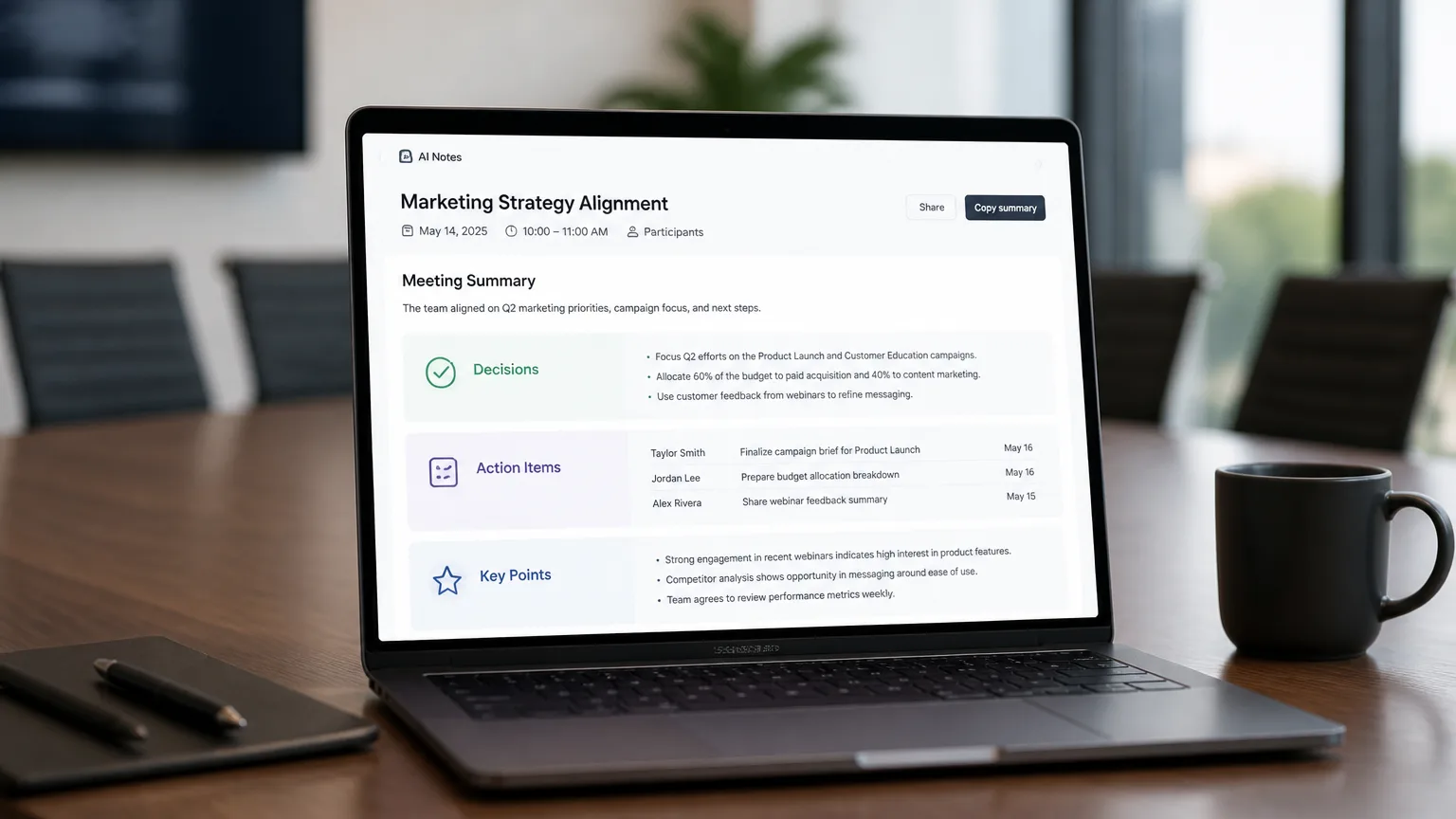

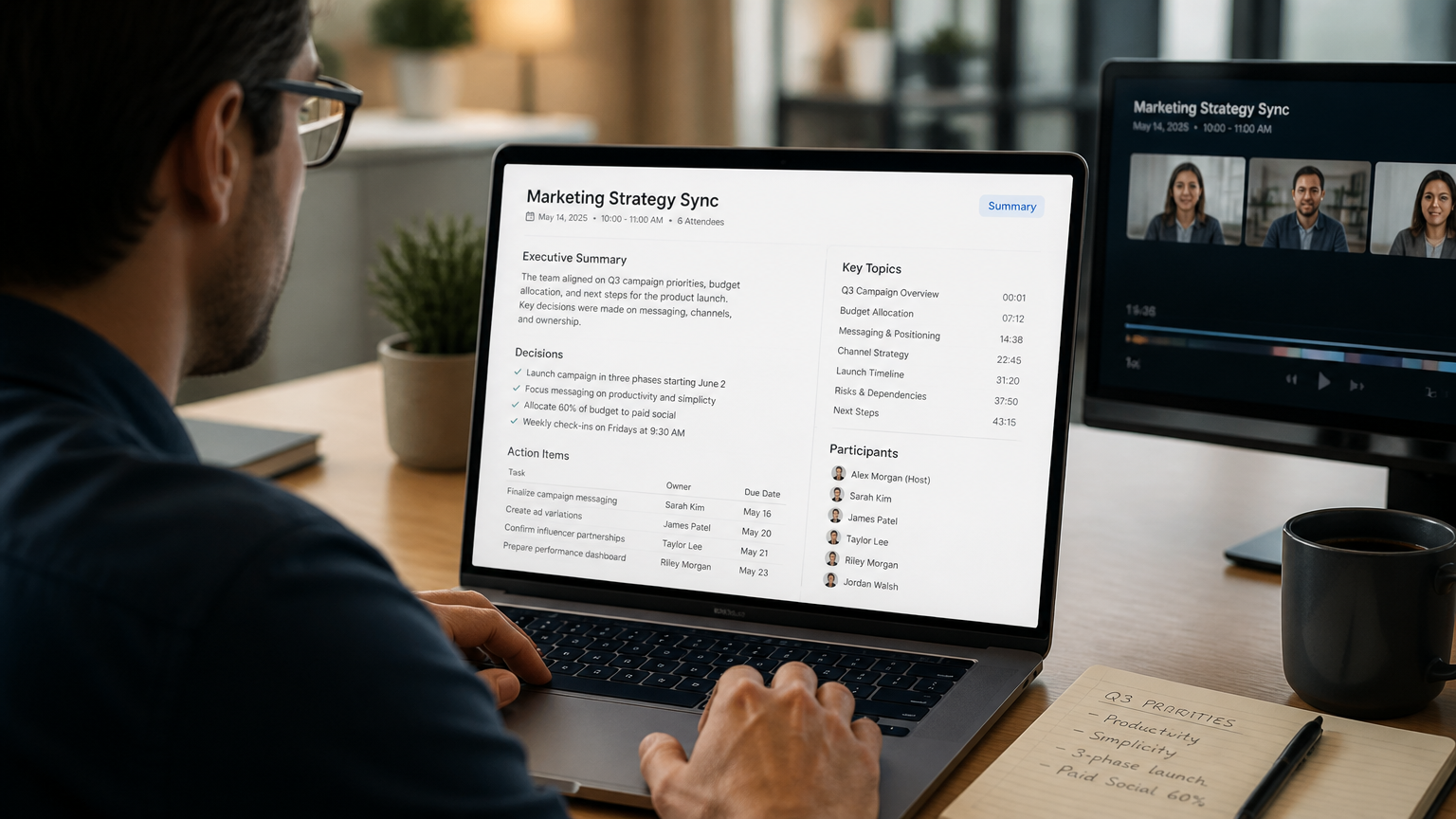
 A professional knowledge worker at a modern desk reviewing a structured document summary on a laptop screen, with a second screen showing a meeting recording timeline in the background. Warm office lighting with depth of field focus on the primary screen showing clean, organized content.
By the time most meeting attendees sit back at their desks, the details have already slipped. In 2026, Laxis’s State of Meetings 2026 survey found that 70% of meeting decisions are forgotten within 24 hours when teams share no follow-up summary.
An objective summary is the structural fix, a document that captures what matters without selective recall or interpretive slant. The human memory curve is unforgiving: 56% of new information is lost within one hour, confirmed by a 2015 PLOS ONE replication study by Murre and Dros. For large enterprises, the cost compounds. Jabra reported in 2026 that organizations lose up to $130 million annually from unnecessary meetings, technology failures, and unclear outcomes, according to a June 2026 Jabra report.
- An objective summary captures only facts present in the source, and any word that implies judgment makes it subjective.
- 70% of meeting decisions are forgotten within 24 hours without a written summary (Laxis, 2026).
- AI hallucination in summarization runs 4–19% depending on task type, with citation attribution as the highest-risk failure mode.
- A three-step QA pass (source-check, attribution-check, language-check) closes the gap AI tools leave open.
- Vibe AI applies customizable templates and links each summary back to the source recording for one-click verification.
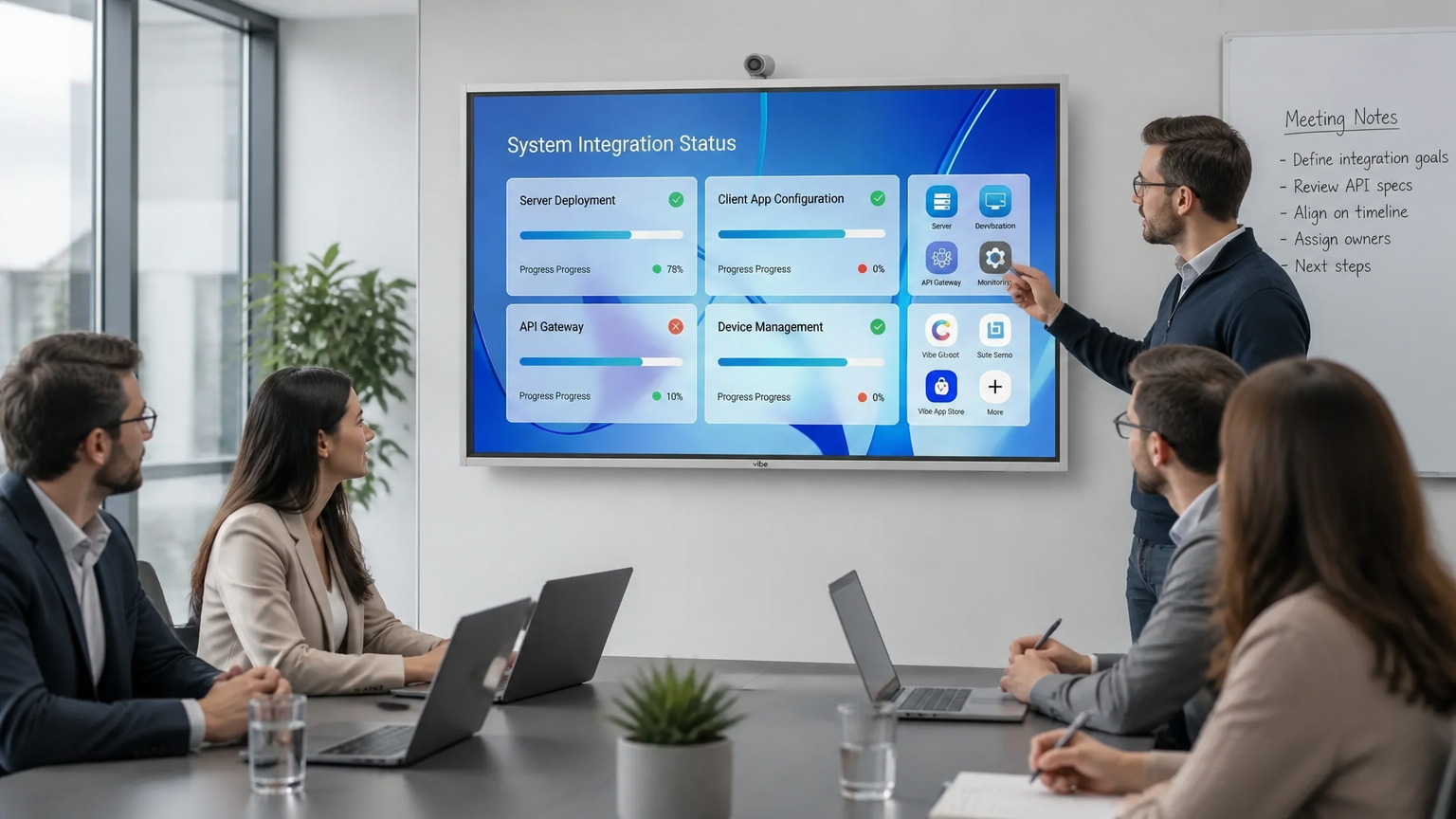 Vibe Board S1 smart whiteboard mounted in a modern conference room, displaying structured meeting notes on its large touchscreen. Clean professional environment with team members collaborating around a table.
What Is an Objective Summary?
An objective summary is a compressed account of a source document or event that contains only verifiable facts, excludes interpretation or opinion, and can be reproduced by a second reader given access to the same source material. The term applies across contexts. Meeting recaps, project status updates, research briefings, and executive summaries all qualify when they meet the standard.
For knowledge workers exploring AI-powered meeting notes, understanding what makes a summary truly objective is essential. The technology can only enforce a standard the human defines.
The defining property is not the tone of the writer but the verifiability of the output. A summary is objective only if a neutral second party, looking at the same meeting transcript, report, or recording, would extract the same set of facts. Personal takeaways and recommendations have a place, but they sit outside the objective summary proper, typically labeled as "Analysis" or "Next Steps" to keep the factual record clean.
The distinction matters in professional settings because subjective summaries carry hidden risk. A meeting summary that characterizes a decision as "controversial" or a proposal as "ambitious" has already folded judgment into the record. Those judgments may be accurate, but they are not facts, and they shift how downstream readers understand what happened. Taking effective meeting notes requires recognizing where the line falls between what happened and what the writer thinks about it.
Why Staying Objective Is Harder Than It Looks
Most professionals believe they write objective summaries. The evidence suggests otherwise. Three predictable failure modes show up across industries and experience levels.
The first is selective recall. Human memory prioritizes what the writer found salient, which rarely matches what the full group considered most important. Atlassian’s 2025 survey found that 78% of knowledge workers say they cannot get their work done because of meeting overload.
When cognitive bandwidth is compressed, the recap inherits the writer’s attention pattern, not the meeting’s actual weight distribution.
The second failure mode is framing language. Words carry implicit judgment even without explicit opinion verbs. A summary that describes a discussion as "heated" rather than "extended," or a proposal as "bold" rather than "new," has already colored the reader’s perception.
The factual content may be accurate. But the framing shapes interpretation. Consider the difference between "The team expressed concerns about the timeline" and "The team pushed back on the timeline." Both may describe the same moment, but the second carries a narrative thrust that the first avoids.
The third failure mode is what-gets-written-first bias. The first draft of a summary often reflects the order in which points emerged in the writer’s memory, not the logical or chronological structure of the source. Psychologists call this cognitive anchoring, first described by Tversky and Kahneman in their 1974 paper in Science, a well-documented bias in which initial information disproportionately shapes how subsequent details are weighed and recorded.
In professional contexts, it means the first item in a summary receives disproportionate attention simply because someone wrote it first. Later items get shorter, softer treatment, regardless of actual importance.
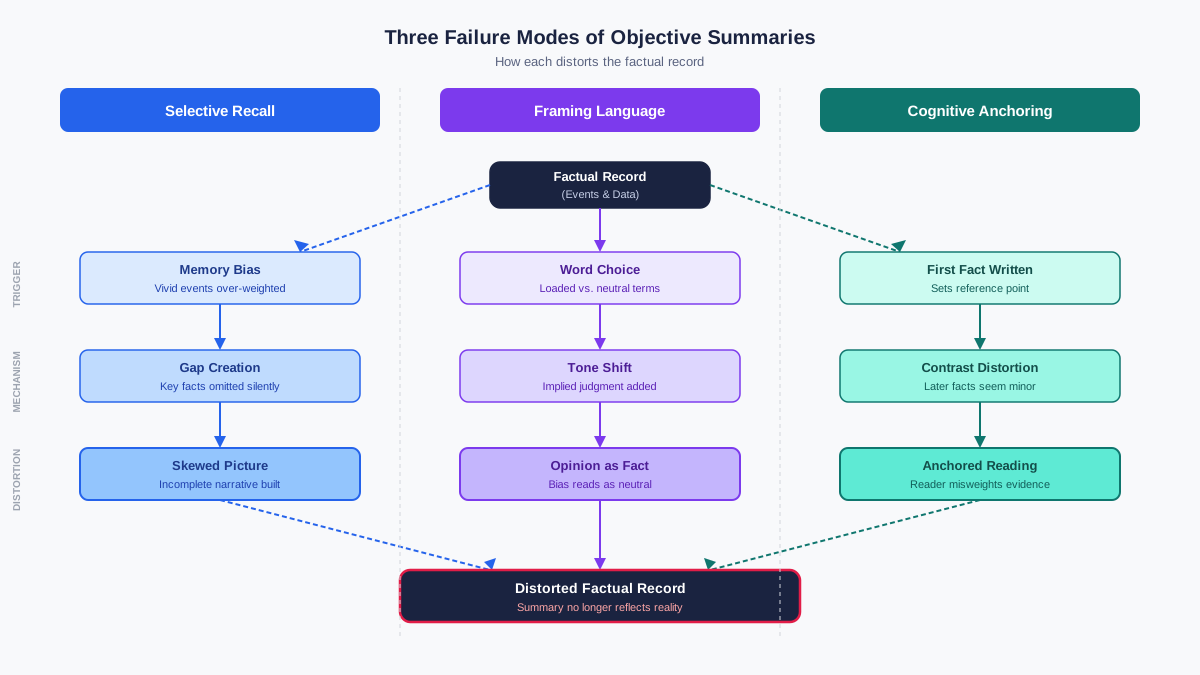 A flowchart diagram showing the three failure modes of objective summaries: selective recall (with branching paths of what writer noticed vs. what actually happened), framing language (showing neutral vs. loaded word choices), and cognitive anchoring (with timeline showing first items getting more attention than later ones).
How to Write an Objective Summary: A 5-Step Method
Step 1: Read with a neutral frame
Before writing, read or listen to the source material once without taking notes. The goal is to absorb the overall structure and identify the major sections, decisions, or themes. Avoid mentally categorizing items as "important" or "minor" during this pass. Premature prioritization introduces bias before a single word is written.
For a meeting recording, this means listening through without pausing to annotate. For a document, it means reading the full text before highlighting. The neutral frame protects against recency bias (giving undue weight to the last items) and primacy bias (treating the first items as most important).
Step 2: Extract facts, not interpretations
On the second pass, list every discrete fact: dates, names, decisions, numbers, explicit agreements, and action items with owners and deadlines. Exclude reactions, characterizations, and opinions attributed to participants.
A fact is something that can be verified against the source. "Sarah agreed to send the proposal by Friday" is a fact. "Sarah reluctantly agreed" is an interpretation of tone.
The Cornell note-taking method offers a useful discipline here: write factual notes in the main column and questions or cues in the margin. For an objective summary, stay in the main column. Anything that belongs in the margin belongs outside the summary proper.
Step 3: Use the source’s own structure
Organize the summary to match the source material’s logical flow. If a meeting covered three agenda items, the summary should follow that order. If a report has four sections, the summary should mirror them.
This is not rigid compliance but respect for provenance. Reordering content to emphasize certain points is itself an editorial choice, even when the individual facts are accurate.
When the source lacks clear structure, impose one that reflects the material’s natural divisions. Chronological order for events, thematic grouping for discussions, or consequential ordering (cause then effect) for decisions all work.
The key is consistency and transparency about the organizing principle applied.
Step 4: Apply the reproducibility test
Before finalizing, ask: would a second reader, given the same source, produce the same set of facts? This is the definitional test of objectivity.
If the summary includes claims that a neutral reader would not extract, those claims are interpretations, not facts. Move them to a separate section or remove them.
The test is not about matching word-for-word but about coverage and neutrality. Two objective summaries of the same meeting may phrase things differently, but they should identify the same decisions, the same action items, and the same key points of discussion.
If one summary highlights items the other omits, at least one has failed the reproducibility standard.
Step 5: Strip evaluative language
Review the draft for words that convey judgment. Common culprits include: important, significant, controversial, surprising, ambitious, concerning, promising, problematic, and unfortunately.
These words may feel natural, but they encode the writer’s assessment. Replace them with neutral alternatives or let the facts stand on their own. "The timeline was shortened from six weeks to four" is objective. "The timeline was aggressively shortened" is not.
The stripped version is not weaker writing. It is stronger documentation. Readers who need judgment can apply their own. The summary’s job is to supply the raw material, not the verdict.
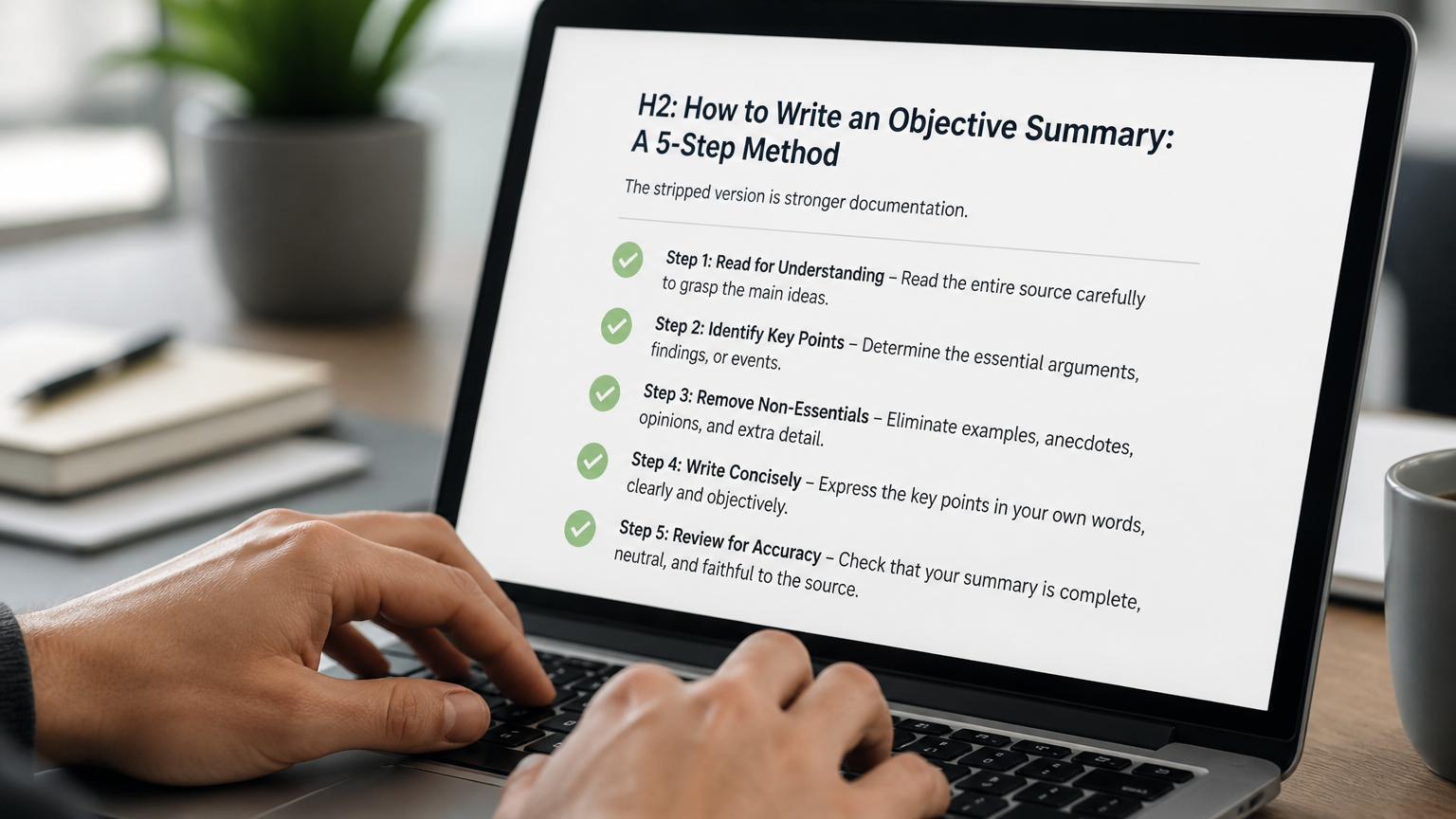 Close-up of hands typing on a laptop keyboard with a document on screen showing a clean, bulleted summary with checkmarks next to each verified fact. Soft focus on background, professional office setting.
Workplace Templates for Three Common Scenarios
Different professional contexts call for different summary structures. Three templates cover the majority of workplace needs: the meeting recap, the project status update, and the client briefing. Each template isolates the factual core while leaving room for follow-up analysis in clearly labeled sections.
Meeting recap template
|
Element |
Description |
Example |
|---|---|---|
|
Date and attendees |
When the meeting occurred and who participated |
July 27, 2026, Priya, Marcus, Elena, and the client team |
|
Decisions made |
Explicit agreements reached during the meeting |
Approved the revised budget allocation for Q3. Confirmed the launch date as September 15. |
|
Action items |
Tasks assigned, with owner and deadline |
Elena to finalize vendor contracts by August 5. Marcus to schedule QA review for August 10. |
|
Open questions |
Items discussed but not resolved |
Pricing tier for enterprise accounts. Final approval pending legal review. |
|
Next steps |
Scheduled follow-ups or next meeting |
Next check-in scheduled for August 3 at 2 PM. |
In 2026, Wundamail’s vendor survey reported by Speakwise found that 30% of employees do not complete actions agreed on during meetings due to poor recall. A structured meeting recap, distributed promptly, directly addresses this gap. Organizations using AI meeting transcription report 25% fewer meetings and 30% higher productivity, based on vendor-reported figures from multiple AI transcription providers.
Project status update template
|
Element |
Description |
Example |
|---|---|---|
|
Project name |
Identifier or title |
Website Redesign Phase 2 |
|
Period covered |
Timeframe for this update |
July 20–27, 2026 |
|
Milestones |
Completed deliverables this period |
Finalized information architecture. Completed wireframes for homepage and product pages. |
|
Status |
On track, at risk, or blocked |
On track |
|
Blockers |
Issues preventing progress |
Waiting for final brand guidelines from client. |
|
Next period goals |
Planned deliverables for next reporting cycle |
Begin high-fidelity mockups. Schedule usability testing sessions. |
|
Risks or concerns |
Potential issues that may impact timeline or quality |
Design resources may be redirected to urgent Q3 campaign. |
This format isolates factual progress from projections. Status is a single-word classification, not a narrative assessment.
Risks are stated as possibilities, not predictions.
Client briefing template
|
Element |
Description |
Example |
|---|---|---|
|
Client context |
Relevant background on the client or engagement |
Mid-size SaaS company preparing for Series B funding round |
|
Key finding |
The central fact or insight from the recent work |
Current customer acquisition cost is 23% above industry benchmark for this vertical |
|
Evidence |
Data points or observations supporting the finding |
CAC has increased from $127 to $156 over 18 months. Churn has remained stable at 4.2%. |
|
Implication |
What the finding means for the client’s situation |
Current burn rate is sustainable for 14 months at present CAC; funding runway could extend if CAC normalizes. |
|
Recommended next step |
Proposed action for the client to consider |
Conduct channel-level attribution analysis to isolate high- versus low-performing acquisition sources. |
The client briefing template keeps the analytical layer distinct from the factual base. The summary proper includes context, finding, evidence, and implication.
Recommendations are separated out, allowing the reader to evaluate the analysis against objective facts before engaging with the proposed action.

How AI Handles Objectivity, and Where It Falls Short
AI systems replicate the logic of objectivity well in structured tasks but fail in three ways: omission (under-representing minority views), framing drift (choosing words that convey implicit judgment), and citation fabrication (attributing claims to the wrong speaker or source).
In 2026, Digital Applied published a 5,000-prompt benchmark across frontier models, a self-published study without peer review, though one of the more granular public evaluations available. The study found hallucination rates between 4.2% and 19.1% depending on model, task family, and reasoning configuration.
Factual recall sits at the lower end when models use extended thinking. Citation accuracy represents the worst-performing task family. The same study found that citation accuracy averages 12.4% hallucination across models, with some models inventing DOIs, paper titles, and author names at rates between 6.8% and 19.1%.
The implications for workplace summaries are direct. A meeting summary that accurately captures decisions but misattributes a key concern to the wrong participant has failed the objectivity test. Attribution is part of the factual record.
Research on AI summarization quality shows a split by task type. A 2024 study published in the Annals of Family Medicine found that ChatGPT summaries of structured medical abstracts achieved median accuracy ratings of 92.5 out of 100 while reducing length by 70%. A separate 2025 analysis in AI & Society found hallucination rates reaching 91% in interpretive literature review contexts, where AI systems synthesized across sources rather than extracting from a single structured document. The gap between factual extraction and synthesis tasks is a categorical difference, not a minor variance.
For knowledge workers using AI tools, the takeaway is practical: AI summaries excel at compressing well-structured source material into shorter factual accounts. They struggle when the task requires judgment about which points matter, synthesis across disjointed discussions, or accurate attribution in complex multi-speaker environments. The technology is an accelerator for the mechanical aspects of summarization, not a replacement for the editorial judgment that objectivity requires.
A QA Checklist for AI-Generated Summaries
Treating an AI-generated summary as a first draft rather than a final product is the single most effective workflow adjustment. A three-step QA pass closes the gap the technology leaves open.
Step 1: Source-check
Read the summary against the original source material. Every factual claim in the summary must have a direct counterpart in the source. Mark each claim as verified or flagged. Pay particular attention to numbers, dates, and names, the specifics where AI systems most often drift.
Example: The summary states "The team agreed to a 15% budget increase." The meeting transcript shows a discussion of budget scenarios including 10%, 15%, and 20% options, but no explicit agreement was recorded. The claim is flagged as unverified.
Step 2: Attribution-check
For each claim tied to a person or document, verify that the attribution is correct. AI systems frequently conflate speakers in multi-party discussions, assigning a statement to whoever spoke most recently or most frequently. Check that each quoted or paraphrased position is linked to the actual origin.
Example: The summary attributes the concern about timeline to Elena. The transcript shows Marcus raised the concern, and Elena responded with a proposed adjustment. The attribution is corrected.
Step 3: Language-check
Review the summary for evaluative words that introduce judgment. AI systems trained on human prose absorb the same framing habits. Words like "unfortunately," "surprisingly," and "importantly" signal that the system has moved from extraction to interpretation. Remove or neutralize them.
Example: The summary describes a decision as "the most important outcome of the meeting." This is the AI’s assessment of priority, not a fact from the source. Rephrase as "The team identified this decision as the primary outcome."
Two techniques from the 2026 Digital Applied benchmark reduce AI summary errors substantially. Extended thinking, or high reasoning effort, cuts hallucination by 30–60% across task families. Retrieval grounding anchors output to specific passages in the source transcript and reduces citation hallucination by 75–90%.
When meetings are captured with a wearable AI recorder, the source-check step starts from a verbatim, timestamped transcript rather than recalled notes, which makes the verification pass faster and more complete.
For managers running KPI review meetings, the QA checklist is especially valuable. Decisions captured in those sessions carry downstream consequences for performance tracking, team expectations, and resource allocation. An unverified summary can propagate errors into the operational record.
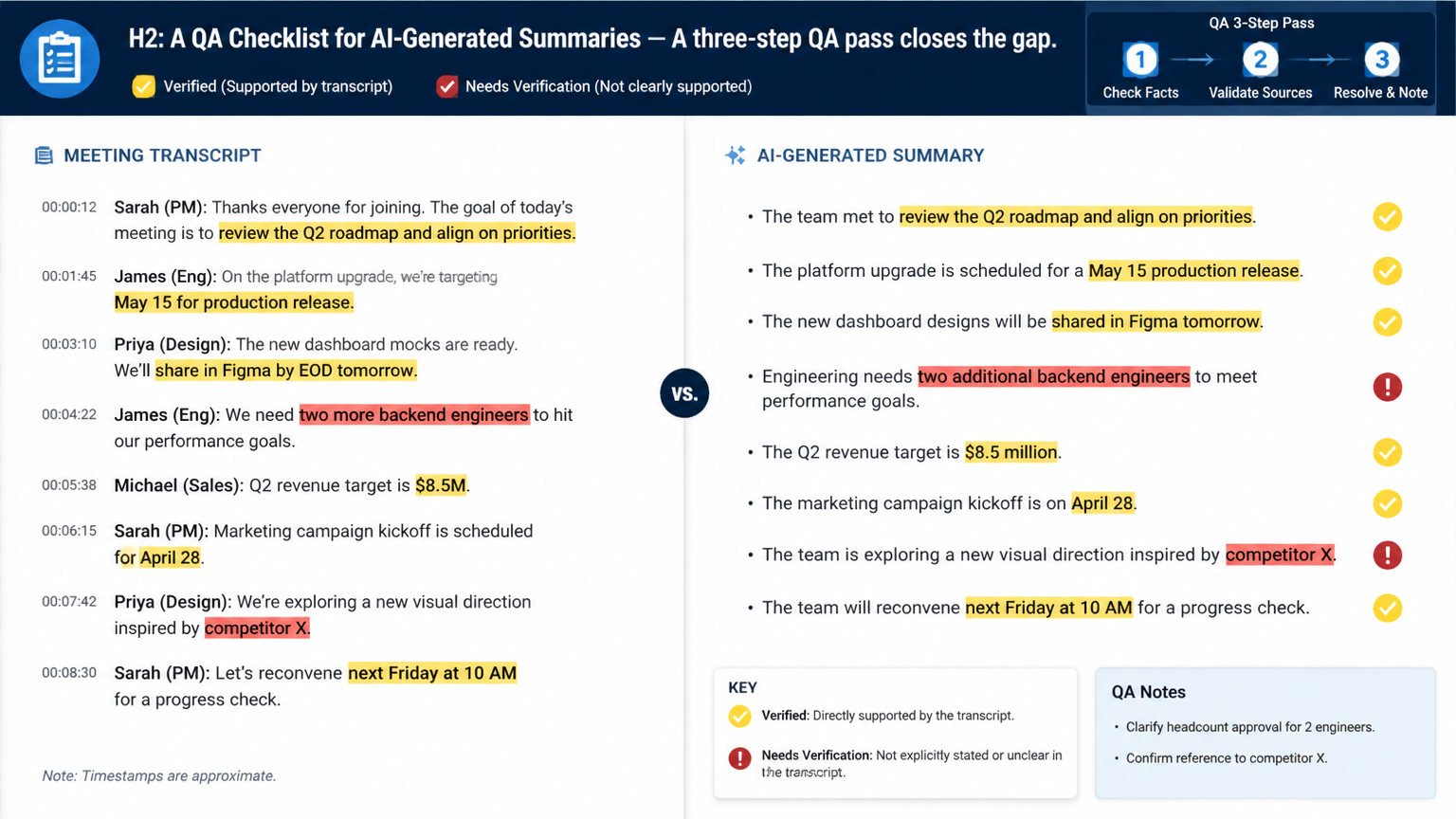 A split-screen view showing a meeting transcript on one side and an AI-generated summary on the other, with yellow highlight markers indicating verified facts and red markers flagging items needing verification.
Objective Summaries at Scale: What Vibe AI Does Differently
Vibe AI is designed around the same quality standard the 5-step method and QA checklist describe: objectivity as a testable output property, not a writer’s intent. Smart AI summaries apply customizable templates automatically, and each summary links back to the source recording for one-click fact verification.
For teams that need hands-free capture at the source, Vibe Dot feeds conversations directly into Vibe AI. The wearable AI recorder clips to clothing or sits on a desk, runs for 30+ hours on a single charge, and uses a 5-mic array that separates speakers automatically, which keeps attribution accurate from the moment recording starts.
Customizable templates allow teams to define the structure that fits their workflow: meeting recap, project update, client briefing, or a custom format unique to the organization. The template enforces consistency and reduces editorial choices that introduce slant at the drafting stage. Memory threads connect recaps across sessions, enabling Ask AI queries that reference past decisions without requiring the user to locate the original document.
Vibe AI’s internal product data shows teams spend an average of 5 hours per week on decision retrieval (no public methodology; based on product usage patterns). AI-assisted documentation that remains objectively accurate reduces that retrieval burden. The combination of structured templates and source-linked verification addresses both the mechanical efficiency of summary generation and the quality checkpoint that ensures reliability.
Vibe AI’s free Starter plan includes customizable templates and memory-thread functionality. Teams testing the workflow on live meetings report encountering exactly the QA issues this post describes: attribution drift, framing language, and occasional hallucinated claims that require human correction before distribution. The source-recording link makes that correction fast.
Conclusion
An objective summary captures facts, excludes interpretation, and passes the reproducibility test. The 5-step method provides the structure. Workplace templates give the format.
AI tools accelerate the drafting process but introduce predictable failure modes around attribution, framing, and hallucination. A three-step QA workflow closes the gap.
Vibe AI brings the full chain together: Smart AI summaries with customizable templates, memory threads for cross-session context, and source recording links that make verification immediate.
Try Vibe AI’s free Starter plan to generate meeting summaries with customizable templates and built-in verification against source recordings.
FAQs
What is an objective summary?
An objective summary is a compressed account of a source document or event that contains only verifiable facts, excludes interpretation or opinion, and can be reproduced by a second reader given the same source material. In 2026, Laxis found that 70% of meeting decisions are forgotten within 24 hours when no follow-up summary is shared, which makes the objective summary format essential for preserving institutional knowledge, per Laxis’s State of Meetings 2026.
How do you write an objective summary of a meeting?
Write an objective meeting summary by reading or listening through once without notes, extracting facts on a second pass, organizing the content to match the meeting’s structure, applying the reproducibility test, and stripping evaluative language. In 2026, teams using AI meeting transcription have reported fewer recurring status meetings and measurable productivity gains as summaries become more reliable and actionable.
What is the difference between an objective and subjective summary?
An objective summary contains only facts that can be verified against the source material, while a subjective summary includes interpretations, opinions, or judgments from the writer. The difference is whether a second reader, given the same source, would produce the same content. In 2025, Atlassian found that 78% of knowledge workers struggle with meeting overload, which increases the risk of subjective recaps driven by compressed attention, per Atlassian’s 2025 survey.
How do you make a summary unbiased?
Make a recap unbiased by applying the reproducibility test, which checks whether a second reader would extract the same facts from the source, and by removing evaluative words that signal judgment. In 2026, Digital Applied found that AI hallucination in summarization runs 4–19% depending on task type, which means even AI-generated drafts require human review for bias and accuracy, per Digital Applied’s April 2026 benchmark.
Can AI write an objective summary?
AI can write accurate summaries of structured source material, but AI hallucination in summarization runs 4–19% depending on task type, and citation accuracy is the worst-performing area at 12.4% average hallucination. AI summaries should be treated as drafts that require a QA pass for source-check, attribution-check, and language-check before distribution, according to Digital Applied’s April 2026 benchmark.