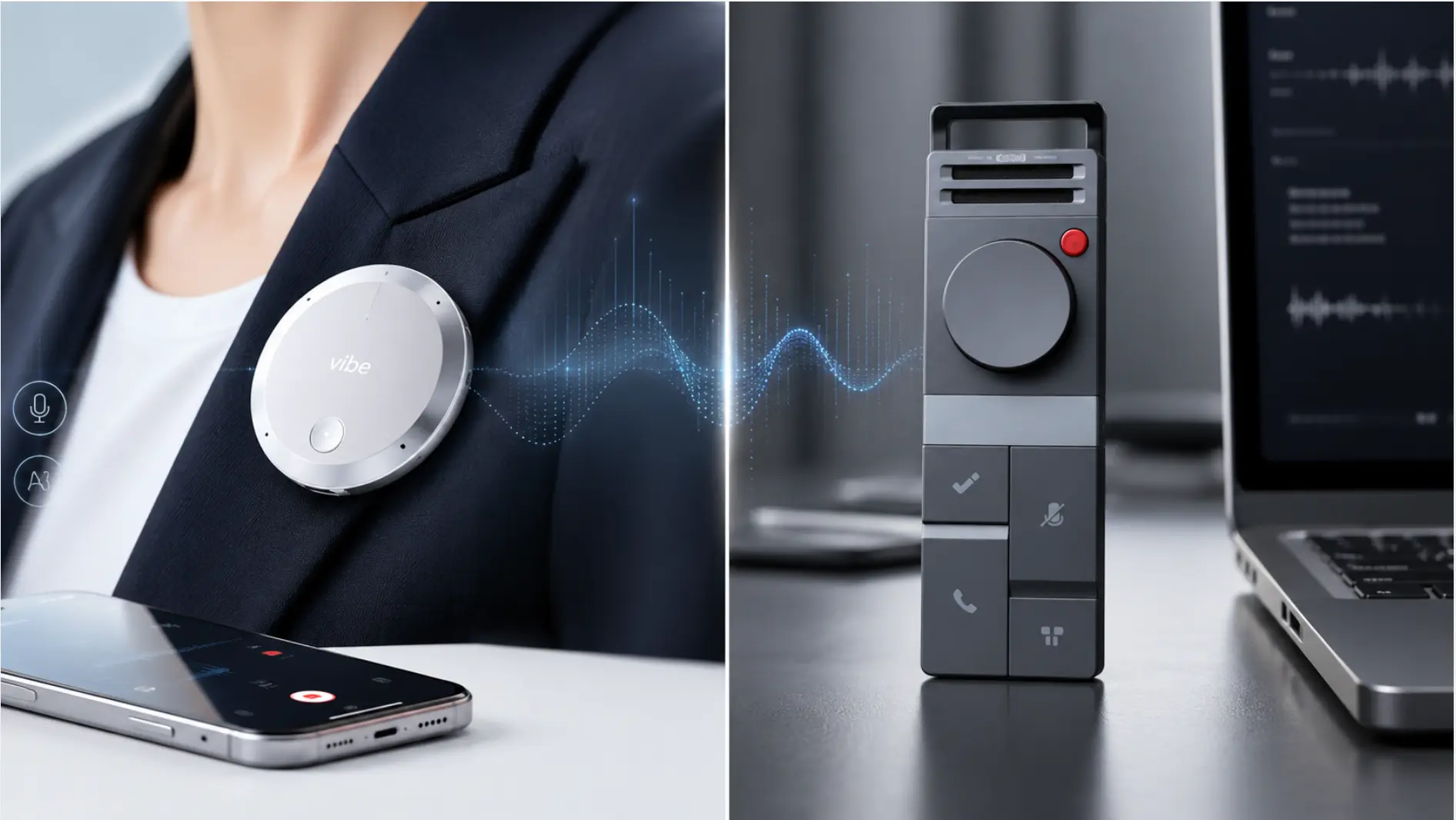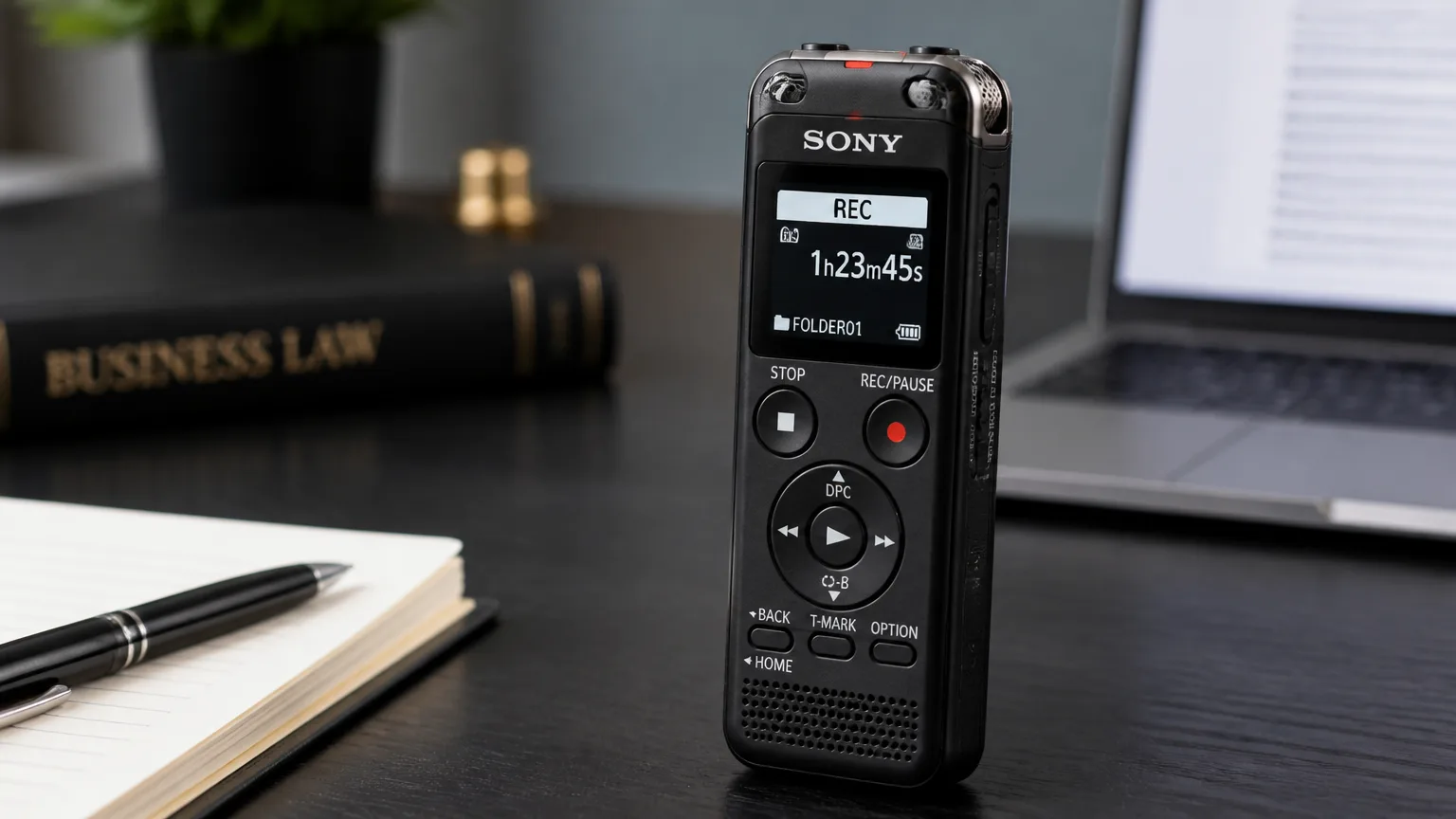

HiDock P1 earned attention for a genuinely clever idea: BlueCatch™, a technology that intercepts audio through your Bluetooth earphones to record both sides of a virtual call without adding a bot to the meeting. For desk-based professionals on constant Zoom and Teams calls, that’s a real problem solved.
But HiDock P1 isn’t the right fit for everyone. The 8-hour active battery limit kicks in exactly when BlueCatch is running — its defining feature. The HiNotes software platform has attracted criticism for reliability in third-party reviews, with PCWorld and XDA Developers both noting that physical recording buttons failed to trigger reliably during testing. And for anyone in healthcare, government, or education, HiDock’s GDPR-only compliance posture leaves a significant gap — there’s no published HIPAA, NDAA, or FERPA certification.
If any of those gaps matter to your workflow, this guide covers the five alternatives that are worth a serious look in 2026.
Quick Answer: Best HiDock Alternatives at a Glance
-
Vibe Dot — Best overall; strongest compliance + battery + AI platform
-
Plaud Note Pro — Best for phone call recording and language coverage
-
Soundcore Work — Best budget-conscious pick for multilingual teams
-
Omi — Best open-source option for privacy-first technical buyers
-
Pocket AI — Best for large-room capture on a midrange budget
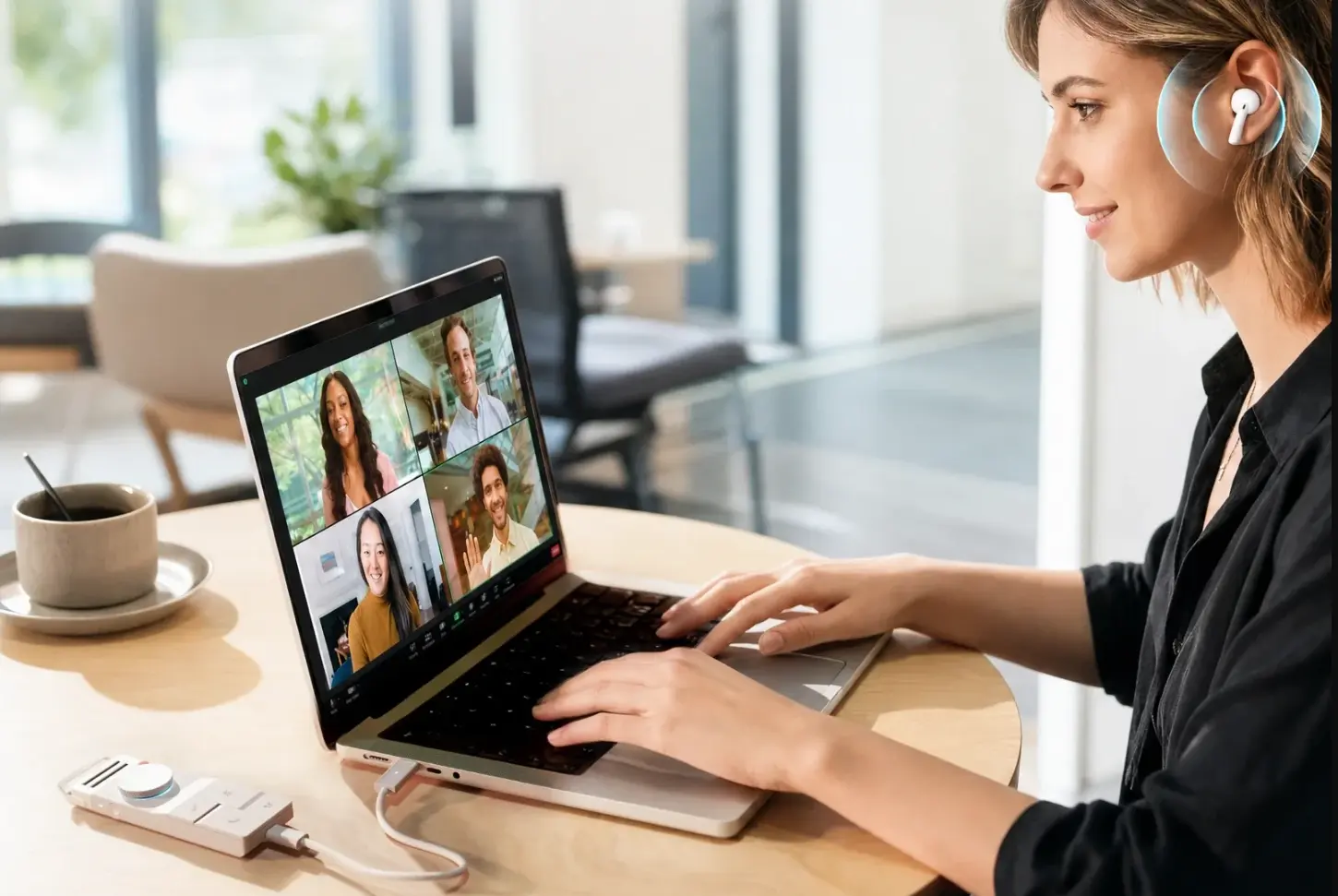 Woman on video call wearing earbuds, typing on laptop with four-person meeting grid, HiDock device connected on desk
Why People Look for HiDock Alternatives
Before getting into the picks, it helps to name the specific gaps that drive people away from HiDock:
Battery life in the mode that matters. HiDock P1’s defining feature — BlueCatch Bluetooth call recording — caps active recording time at approximately 8 hours according to independent testing. That’s workday-sufficient, but it requires nightly charging and makes full-day field use unreliable.
Software reliability concerns. HiNotes is a web app rather than a native application. Third-party reviewers at PCWorld described hardware-to-software integration as "not as tightly woven as I would hope," and reported being unable to trigger recordings via the device’s physical buttons. XDA Developers similarly found recording buttons failing to activate in multiple test sessions. Both products share the HiNotes platform, so this is a relevant signal for any HiDock purchase.
Compliance gaps for regulated industries. HiDock P1 carries GDPR compliance via Microsoft Azure cloud infrastructure — sufficient for European enterprise use, but not HIPAA, NDAA, or FERPA. Teams in healthcare, K–12 education, or government-adjacent roles typically can’t deploy it without additional vetting.
Desk-only form factor. HiDock P1 is optimized for a fixed workspace. At 72g and 5 × 1.5 × 0.6 inches, it doesn’t clip to clothing or travel easily. Professionals who move between client sites, fieldwork, and office desks need something more versatile.
How We Evaluated These Alternatives
Each device was assessed across five dimensions:
-
Audio capture quality — microphone array design, real-world pickup range, noise handling
-
Battery life — continuous active-recording runtime (not standby)
-
AI software depth — transcription quality, summary intelligence, cross-session memory
-
Privacy and compliance — published certifications by vertical
-
Portability and form factor — wearability beyond a desk setup
1. Vibe Dot — Best Overall HiDock Alternative
Price: $199 | AI Subscription: Free 300 min/mo; Pro $9/seat/mo; Max $29/seat/mo | Battery: 30+ hours continuous | Storage: 64GB onboard Compliance: SOC 2, HIPAA, NDAA, FERPA, TPM 2.0
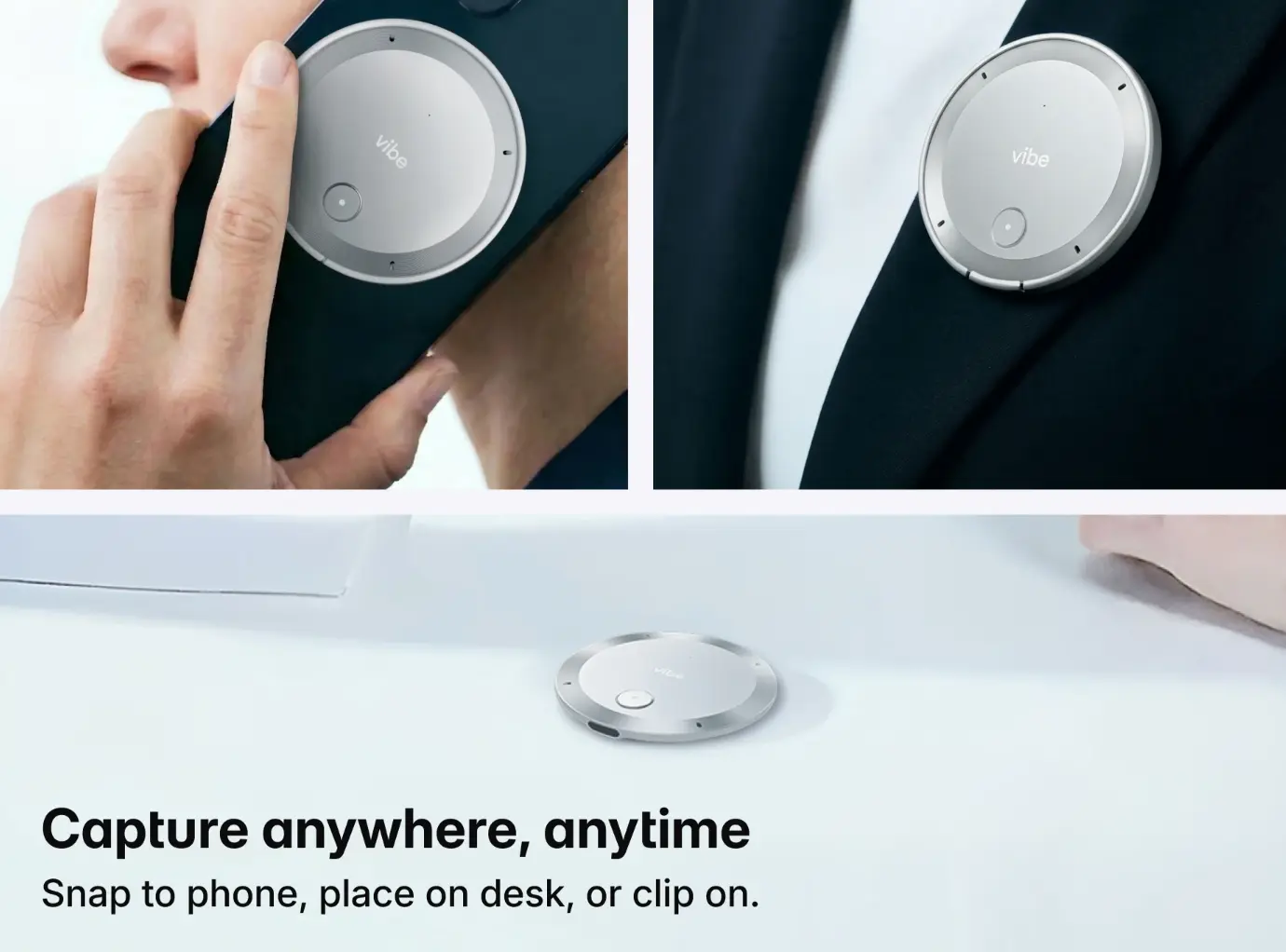
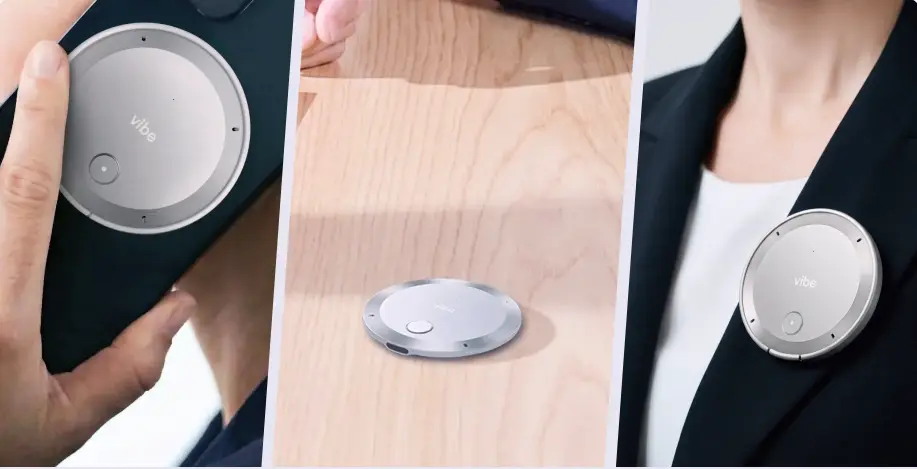 Vibe Dot worn as lapel clip, attached to iPhone MagSafe, and placed on desk — showing three wear modes
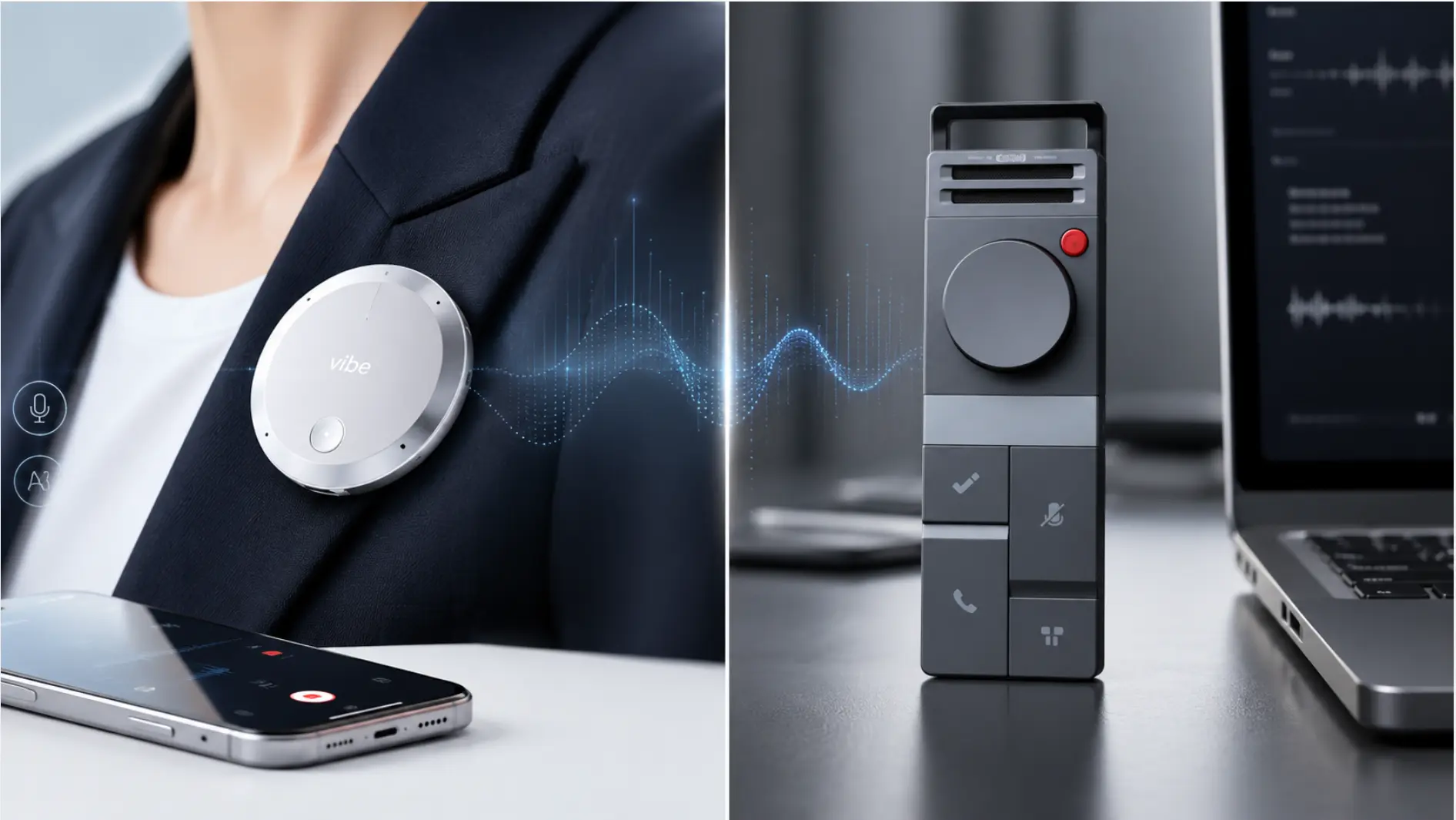
Vibe Dot is the strongest all-around HiDock P1 alternative for professionals whose work extends beyond a fixed desk. Where HiDock P1 solves one specific problem well (earphone-based call recording), Vibe Dot is built to handle the full spectrum of professional recording environments — in-person meetings, phone calls, virtual conferences, and spontaneous voice memos — without configuration changes between them.
Why Vibe Dot Leads
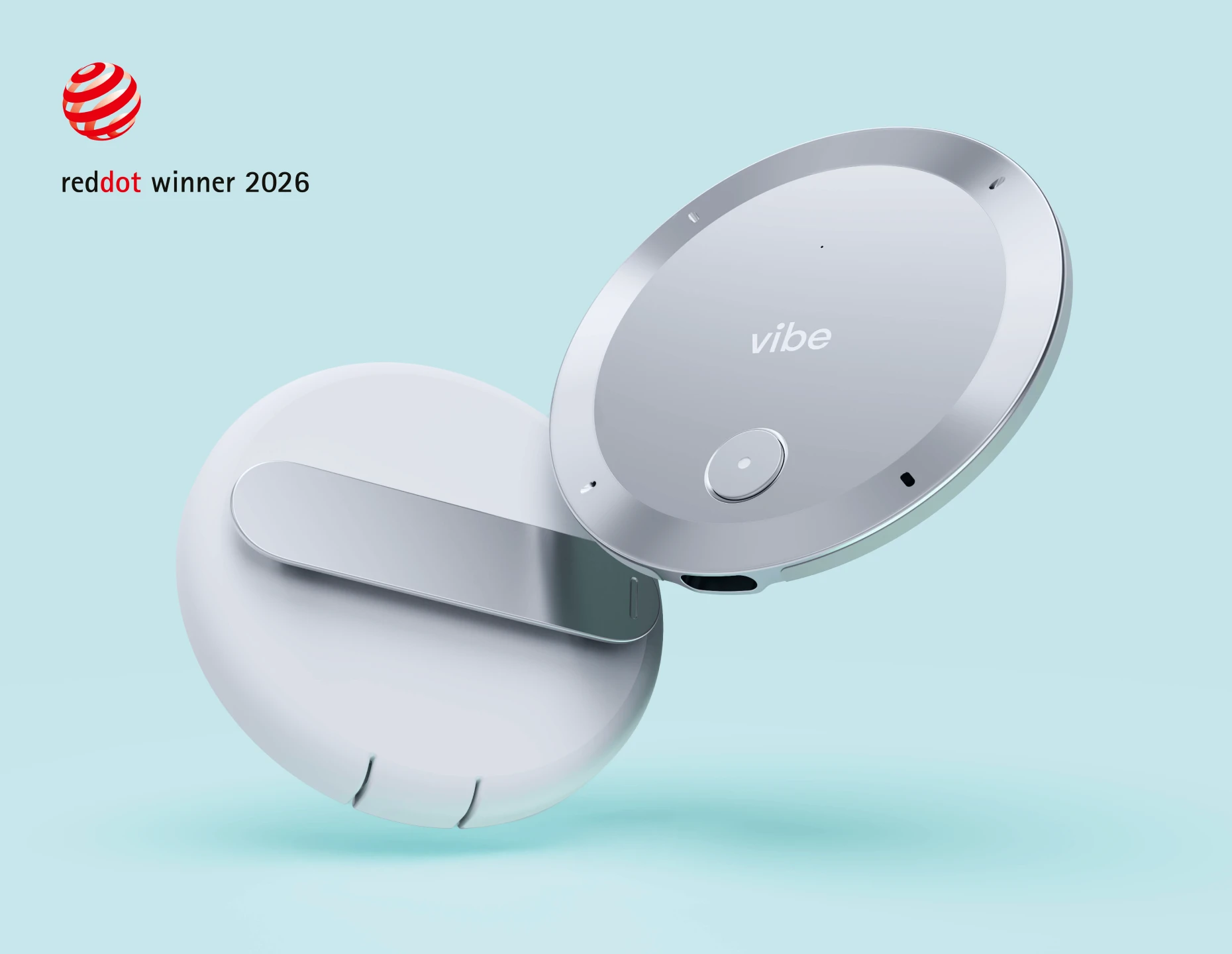
5-mic array with bone-conduction. HiDock P1 uses dual ECM microphones designed for controlled desk environments. Vibe Dot’s professional 5-microphone system — four high-fidelity MEMS air microphones plus a dedicated bone-conduction Voice Processing Unit — captures your voice through physical vibration rather than air pressure. In noisy environments like open offices, cafes, or client sites, the bone-conduction mic isolates your voice in a way dual ECM mics can’t replicate. With a 16-foot capture range, it also handles multi-speaker meetings without repositioning.
30+ hours of continuous recording. HiDock P1’s active BlueCatch mode limits recording to roughly 8 hours. Vibe Dot’s 30+ hour continuous runtime covers back-to-back meeting days, full-day workshops, and multi-site field visits without charging anxiety. For outside sales reps, consultants, and field teams — see our breakdown of AI recorders for sales — the battery gap is decisive.
Hardware-level encryption. HiDock P1 handles data security through Microsoft Azure cloud infrastructure (GDPR). Vibe Dot’s recordings are protected by a dedicated hardware encryption chip (TPM 2.0), meaning audio stored on the device is physically unreadable if the device is plugged into an unauthorized machine. This is a meaningful distinction for legal, medical, and government professionals — software encryption can be circumvented in ways hardware encryption cannot.
Full compliance stack. Vibe Dot carries SOC 2, HIPAA, NDAA, and FERPA certifications — the broadest compliance coverage of any device in this comparison. HiDock P1 does not publish HIPAA, NDAA, or FERPA certifications, limiting its eligibility for regulated-industry deployment.
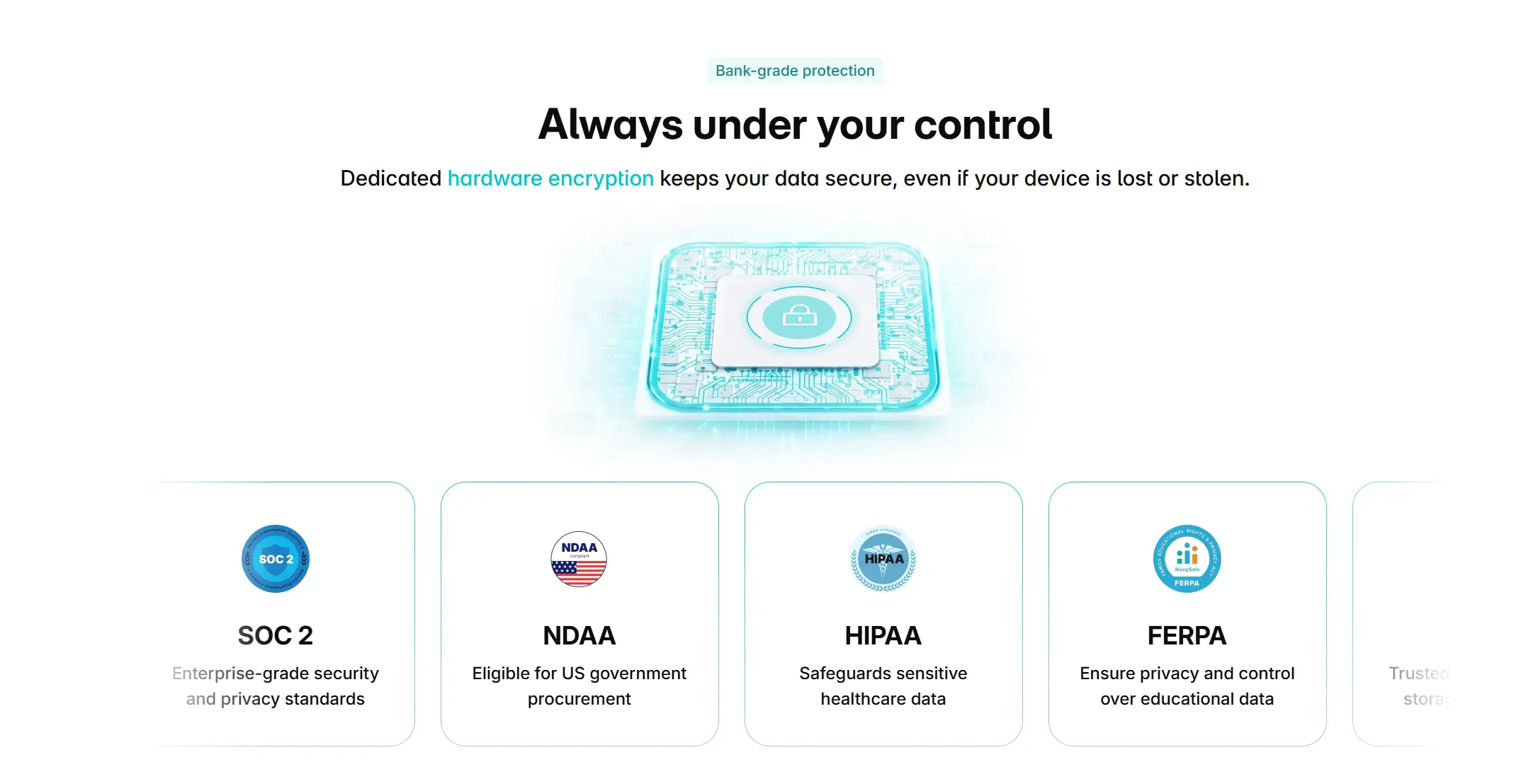 Hardware encryption chip with lock icon illustrating Vibe device's bank-grade data security
Vibe AI Memory Graph. HiNotes processes individual recordings and generates summaries. Vibe AI goes further: it builds a persistent Memory Graph — a cross-session knowledge layer that connects insights, decisions, and action items across all your recordings over time. You can ask "What were the key objections the client raised across our last four calls?" and get a direct answer from months of accumulated context. For professionals who accumulate recordings over weeks and months, this is the most meaningful platform-level difference.
Three purpose-built recording modes. Vibe Dot offers Spark (press-and-hold for spontaneous voice memos), Tap to Record (double-tap to start a formal meeting session, single-tap to mark key moments), and Auto Capture (voice-detection or schedule-based automatic recording). These cover different professional moments without switching apps or modes manually.
Where to Be Realistic
Vibe Dot’s free tier includes 300 minutes of AI transcription per month across nearly 200 languages. Advanced AI features — extended memory retention, deeper retrieval, agentic integrations — require a Vibe AI Pro plan at $9/seat/month. If your primary use case is simple call recording through Bluetooth earphones, HiDock P1’s free unlimited basic transcription has an edge at that specific use case.
2. Plaud Note Pro — Best for Phone Call Recording
Price: $189 | AI Subscription: Free 300 min/mo; Pro $8.33/mo (annual) or $17.99/mo | Battery: 30 hours continuous | Storage: 64GB Compliance: ISO 27001, ISO 27701, SOC II, HIPAA, GDPR
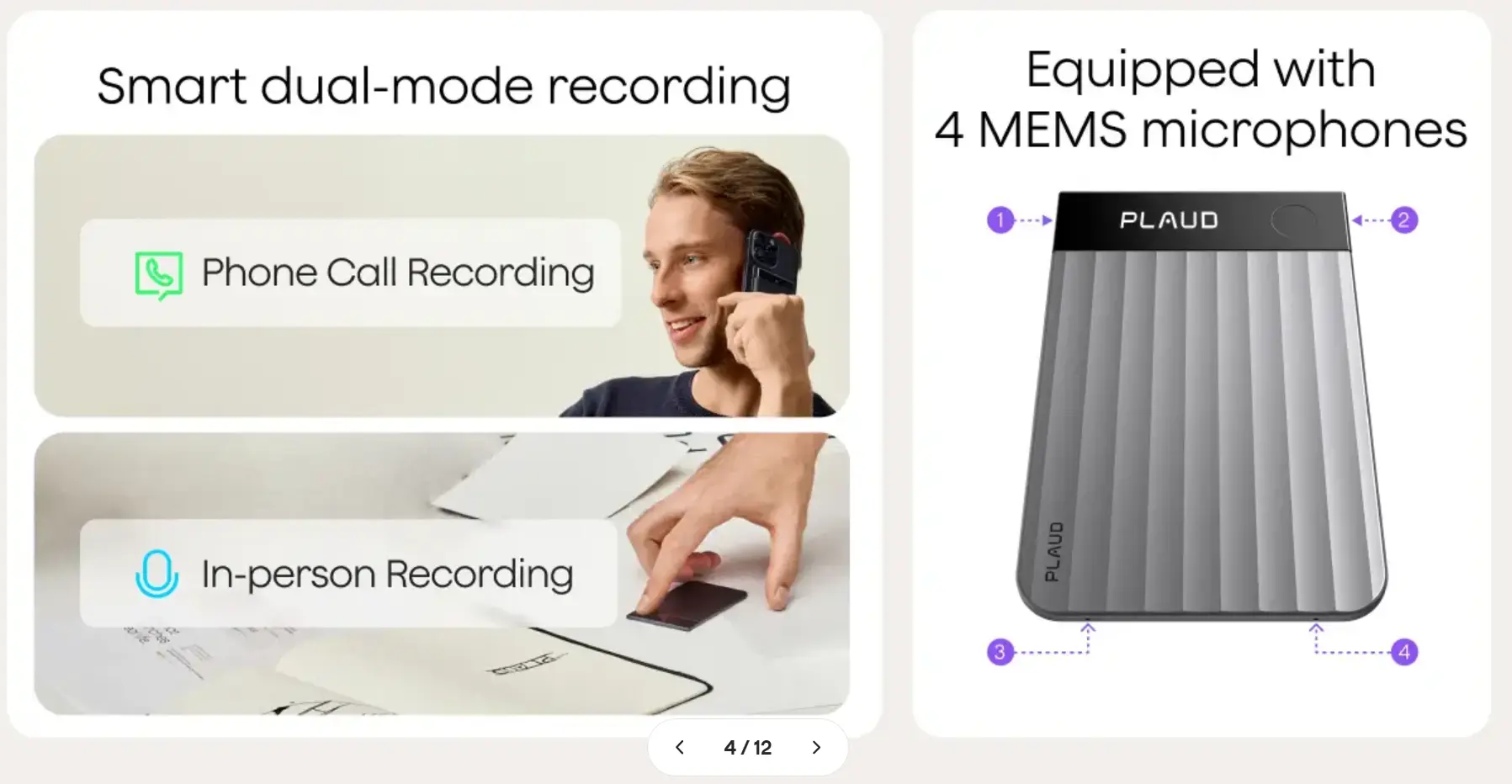 PLAUD recorder marketing slide promoted as supporting phone call and in-person recording with 4 MEMS microphones
Plaud is the most established name in dedicated AI recorder hardware, with over 2 million users across 170+ countries. The Note Pro’s ultra-thin card design (0.12 inches) attaches magnetically to the back of a phone and has a hardware switch that auto-detects phone calls versus in-person conversations — adjusting its capture mode accordingly. For professionals whose recording life is centered on phone calls and scheduled video meetings, this phone-native form factor is genuinely well-suited.
The 4 MEMS + 1 VPU microphone array covers a 16.4-foot range, and the battery supports 30 hours of continuous recording. Transcription supports 112 languages — the widest in this comparison. The AI platform runs on GPT-4o, Claude Sonnet, and Gemini variants.
Where Plaud falls short vs. HiDock’s use case: Plaud doesn’t have HiDock’s BlueCatch-style Bluetooth earphone routing — it captures calls by physically vibrating against your phone, not by intercepting Bluetooth audio. For earphone-native call recording, Plaud is not a like-for-like replacement.
Where Plaud wins vs. HiDock: 30-hour battery (vs. ~8 hours in BlueCatch mode), HIPAA compliance, and a significantly more mature app ecosystem.
For a detailed head-to-head with Vibe Dot, see our Vibe Dot vs. Plaud comparison.
3. Soundcore Work — Best for Multilingual Teams
Price: $159.99 | AI Subscription: Free 300 min/mo; Unlimited ~$19/mo | Battery: 8 hrs (device) / ~32 hrs with case | Languages: 150+ Compliance: AES-256, SOC 2 Type I, HIPAA standards alignment
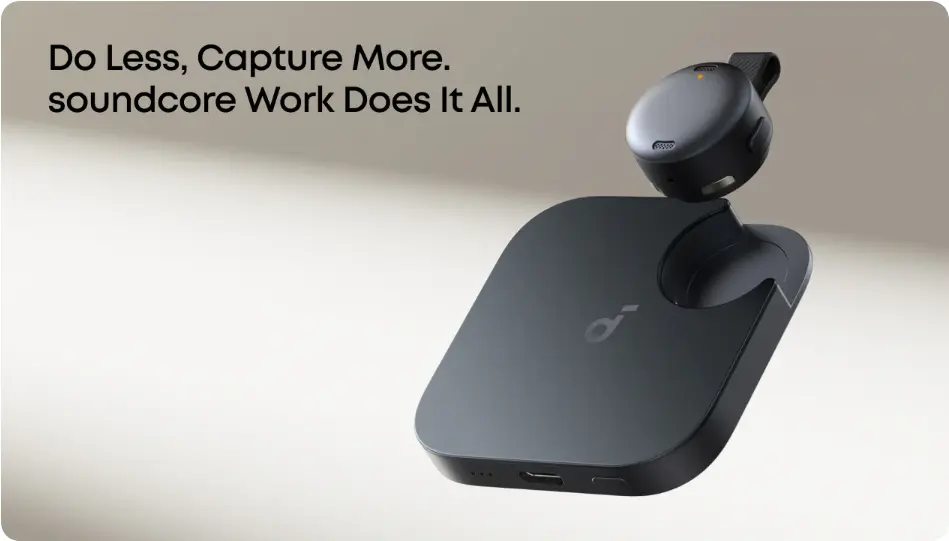 Soundcore Work AI earbud and charging dock, promoted as an all-in-one device for capturing meetings and calls
Soundcore Work (by Anker) is a coin-sized wearable recorder — 10 grams — that clips to clothing or sits on a desk. Its standout specification is language coverage: 150+ languages, the widest in this comparison. For teams that work across multiple languages or serve international clients, that breadth matters in ways that most recorders don’t address.
The security posture is above average for the price: AES-256 local encryption, SOC 2 Type I certification for the app layer, and Apple MFi certification. HIPAA standards alignment means it’s in the right territory for healthcare-adjacent use, though teams requiring a formal HIPAA BAA should verify scope directly.
The practical limitation is battery: 8 hours of active recording requires the charging case for all-day use. The 2-mic system also has limits in rooms with four or more speakers. But at $159.99 — lower than HiDock P1’s $169 — with no mandatory subscription for core transcription, the total cost of ownership over 12 months is competitive.
For a full breakdown of how Soundcore Work fits the wearable AI recorder category, see our best wearable AI recorders of 2026 roundup.
4. Omi — Best Open-Source Option
Price: $89 | AI Subscription: Free 1,200 min/mo; Unlimited $19/mo | Battery: 10–14 hours | Storage: Streams to phone (no onboard buffer) Compliance: SOC 2, HIPAA, AES-256-GCM at rest, TLS in transit
 Woman wearing omi AI pendant necklace while holding phone, promoted as a wearable meeting and conversation recorder
Omi is an open-source AI recorder pendant at $89 — the lowest hardware price among devices with published SOC 2 and HIPAA credentials. For technical teams and privacy-first buyers who want to own their transcription pipeline and data storage, no device in this comparison delivers more compliance-per-dollar.
The trade-off is the streaming architecture. Omi has no onboard storage buffer — audio streams to your phone via Bluetooth 5.1 in real time. If the Bluetooth connection drops during a meeting, you can lose the recording. In controlled desktop environments with stable connectivity, this is manageable. For field use, client sites with poor connectivity, or airplane-mode scenarios, it’s a genuine risk.
The 2-mic system is modest compared to Vibe Dot’s 5-mic array or Plaud’s 4+1 configuration. Speaker separation in rooms with four or more talkers may suffer.
Key correction from other reviews: Omi’s battery is 10–14 hours of active use, not "3 days" as sometimes reported. The 3-day figure is standby-only.
For buyers comparing Omi to other budget-accessible alternatives, see our top wearable AI recorders guide which covers Omi in a broader budget-tier context.
5. Pocket AI — Best for Large-Room Capture
Price: ~$99 | AI Subscription: Free tier available; Premium ~$18–19/mo | Battery: ~4 days | Storage: 64GB onboard + cloud Compliance: Encrypted onboard storage (no public SOC 2 or HIPAA disclosure)
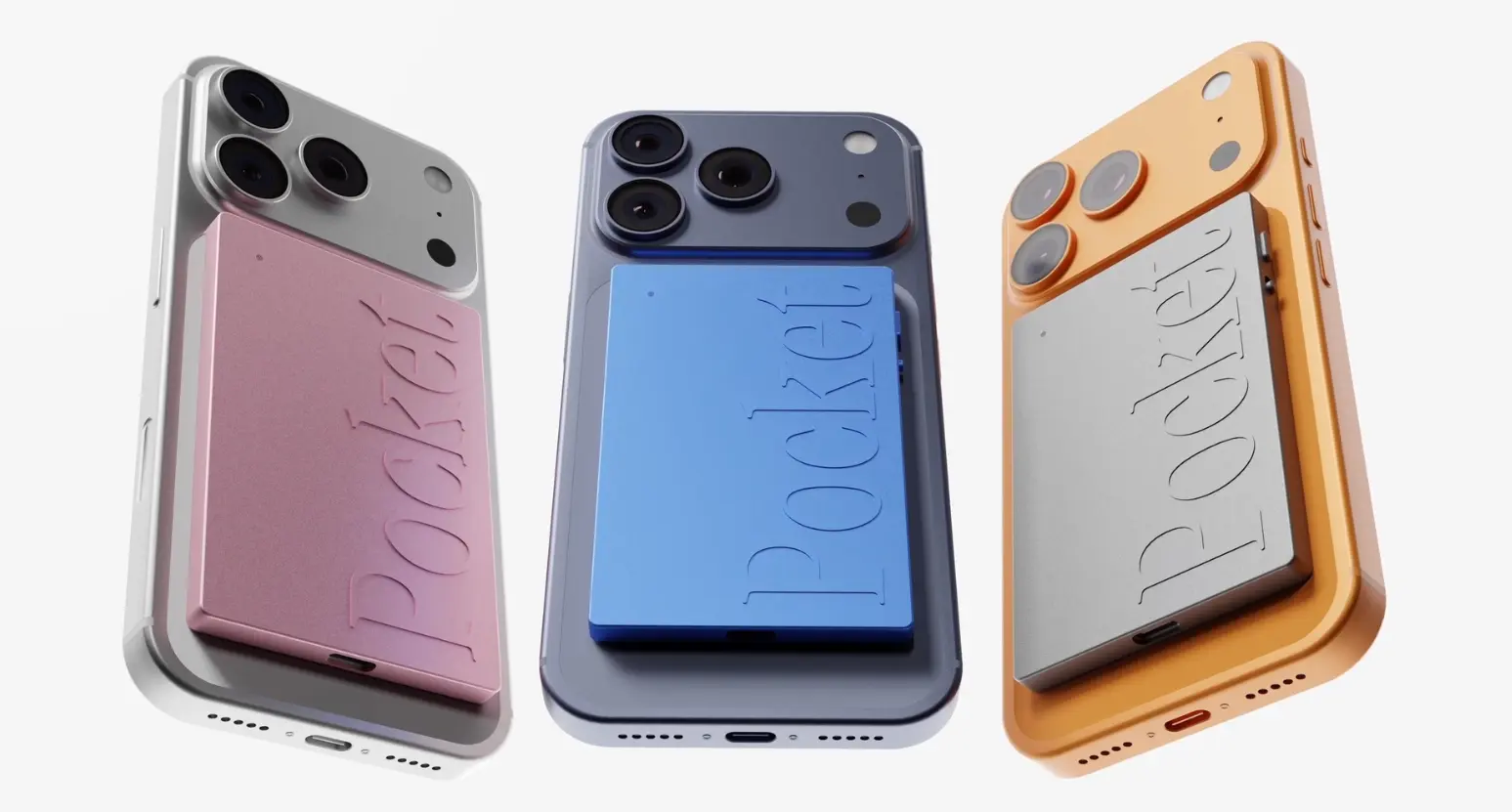 Pocket AI recording device shown in pink, blue, and orange, attached to back of smartphones like a case
Pocket AI’s standout specification is capture range: up to 49 feet (15 meters), the widest in this comparison. For large boardrooms, lecture halls, training sessions, and conference spaces where participants are dispersed, that range matters in ways that HiDock P1’s desk-optimized setup simply can’t address.
The 3-mic array (2 studio mics + 1 contact mic) is unconventional — the contact mic adds a secondary near-field acoustic path while the studio mics handle ambient pickup. The 4-day battery and offline transcription make it well-suited for field use and environments with unreliable connectivity.
The compliance picture is a significant limitation: Pocket AI does not publicly disclose SOC 2 or HIPAA certifications, which rules it out for regulated-industry deployment. Pricing has also been inconsistent across official channels — verify before purchasing.
For users primarily attracted to Pocket AI’s MagSafe-attach design and model-switching flexibility, our Pocket AI alternatives guide covers the full competitive landscape.
Side-by-Side Comparison
|
Vibe Dot |
Plaud Note Pro |
Soundcore Work |
Omi |
Pocket AI | |
|---|---|---|---|---|---|
|
Price |
$199 |
$189 |
$159.99 |
$89 |
~$99 |
|
Battery |
30+ hrs continuous |
30 hrs continuous |
8 hr / 32 hr w/case |
10–14 hrs |
~4 days |
|
Microphones |
5 (4 MEMS + 1 bone-conduction VPU) |
4 MEMS + 1 VPU |
2 |
2 |
3 |
|
Capture range |
16 ft |
16.4 ft |
Room-scale |
Room-scale |
49 ft |
|
Onboard storage |
64GB |
64GB |
On device |
❌ Streams only |
64GB |
|
Compliance |
SOC 2, HIPAA, NDAA, FERPA, TPM 2.0 |
ISO 27001, SOC II, HIPAA |
AES-256, SOC 2 Type I |
SOC 2, HIPAA |
Not disclosed |
|
Free transcription |
300 min/month |
300 min/month |
300 min/month |
1,200 min/month |
Free tier |
|
Cross-session AI memory |
✅ Vibe AI Memory Graph |
❌ |
❌ |
❌ |
❌ |
|
Languages |
~200 |
112 |
150+ |
Not specified |
Not specified |
|
Best for |
Best overall |
Phone calls |
Multilingual teams |
Open-source/budget |
Large-room capture |
Which HiDock Alternative Is Right for You?
Choose Vibe Dot if you need a device that works across in-person meetings, phone calls, and virtual conferences without configuration changes — especially if you work in a regulated industry or want AI that builds context across sessions rather than summarizing one recording at a time. It’s the only device here with HIPAA + NDAA + FERPA + hardware encryption in one package.
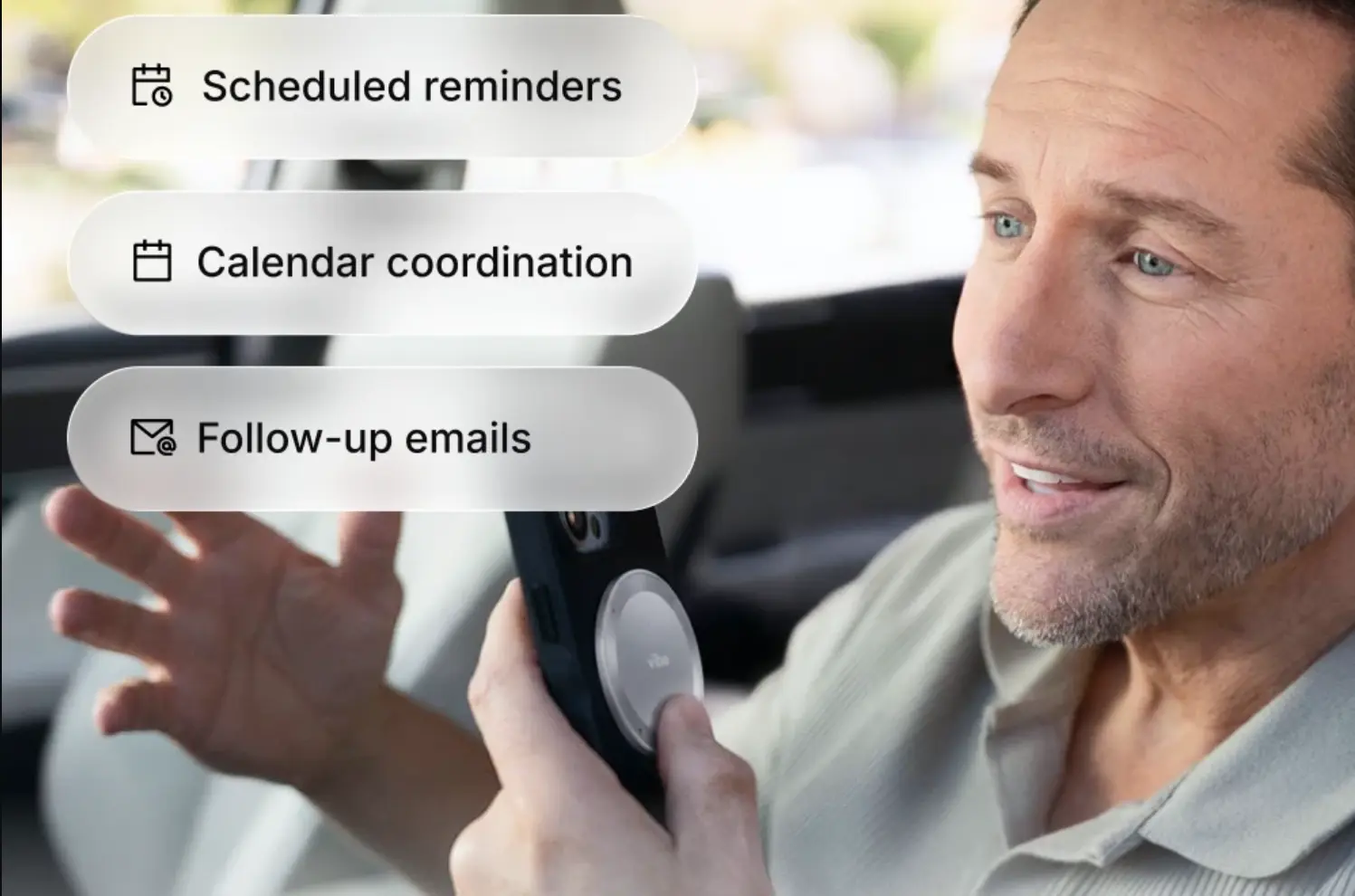 Vibe AI device attached to phone in car, man speaking with reminders, calendar, and follow-up email features shown
Choose Plaud Note Pro if phone call recording is your primary use case, you work across 112+ languages, or you want the most mature app ecosystem in the dedicated AI recorder category. It has a large installed base.
Choose Soundcore Work if you travel frequently across language boundaries and want strong basic security (AES-256, SOC 2 Type I) at a lower price than Vibe Dot or Plaud, and you’re comfortable charging the case nightly.
Choose Omi if you’re a developer or technical buyer who wants open-source architecture, full local-run capability, and SOC 2 / HIPAA credentials at the lowest hardware price — and you have stable connectivity during your recording sessions.
Choose Pocket AI if large-room ambient capture (up to 49 feet) is your primary requirement and compliance certifications are not a constraint. Good for lecture capture, training sessions, and open conference formats on a budget.
What HiDock P1 Does Better Than All of These
To be fair: no device in this list replicates HiDock P1’s BlueCatch approach. If your workflow is specifically "I’m always on Zoom through AirPods and I want seamless, bot-free recording through my existing earphones," HiDock P1 solves that elegantly and none of the alternatives above are a like-for-like replacement.
The tradeoffs to weigh are:
-
Whether 8 hours of active BlueCatch battery is enough for your day
-
Whether HiNotes’ web-app reliability is acceptable for professional use
-
Whether GDPR-level compliance covers your actual requirements
If all three answers are yes, HiDock P1 is probably still the right device for that specific use case. If any of them is no, the alternatives above offer a more complete package for the tradeoffs that matter to you.
The Bottom Line
HiDock P1 earns its place in the category for one specific use case: earphone-based virtual call recording at a fixed desk. If that describes your entire workflow, it’s worth serious consideration.
For everyone else — professionals who move between desks and client sites, teams in regulated industries, anyone who needs AI that connects recordings across sessions rather than processing them one at a time — the alternatives above offer a more complete package.
Vibe Dot leads the list because it closes the most gaps simultaneously: battery, compliance, mic quality, portability, and an AI platform that builds value across every recording rather than resetting with each session. For a detailed side-by-side against HiDock P1 specifically, see our Vibe Dot vs. HiDock P1 comparison.
Frequently Asked Questions
What is the best HiDock P1 alternative in 2026?
Vibe Dot is the strongest all-around HiDock P1 alternative for most professional use cases. Its 5-mic array (including bone-conduction), 30+ hour continuous battery, hardware encryption chip, and SOC 2/HIPAA/NDAA/FERPA compliance stack address the four most common gaps that drive users away from HiDock P1: limited battery in active BlueCatch mode, compliance requirements beyond GDPR, software reliability concerns, and the need for a device that works outside a fixed desk setup.
Does any HiDock alternative replicate BlueCatch earphone recording?
No device in this comparison uses the same Bluetooth-interception approach as HiDock’s BlueCatch™. Plaud Note Pro captures phone calls via physical vibration sensing against the phone body. The other alternatives use onboard microphones for ambient or proximity capture. If earphone-routed call recording is your non-negotiable requirement, HiDock P1 is still the only device with this specific capability.
Which HiDock alternative is best for healthcare professionals?
Vibe Dot. It carries HIPAA certification and a hardware-level encryption chip (TPM 2.0), both of which are meaningful requirements for clinical environments. Plaud Note Pro and Soundcore Work also carry HIPAA-adjacent claims — verify BAA availability with each vendor before deployment. HiDock P1 does not publish HIPAA compliance.
Can these alternatives record without an internet connection?
Vibe Dot, Plaud Note Pro, Soundcore Work, and Pocket AI all have onboard storage and can record locally without connectivity, syncing to cloud later. Omi has no onboard buffer and requires a live Bluetooth connection — a dropped connection during a meeting can mean lost audio.
How does Vibe Dot’s free tier compare to HiDock’s free tier?
HiDock P1’s free tier offers unlimited basic transcription, but outputs a single continuous text block without speaker identification. Vibe Dot’s free tier includes 300 minutes of AI transcription per month with full structured output — summaries, action items, and access to the Vibe AI Memory Graph for cross-session context. For light users, HiDock’s unlimited-minutes approach is more accessible. For professionals who need structured output and AI memory, Vibe Dot’s free tier delivers more actionable value within the monthly limit.
Is HiDock P1 good for field work or travel?
HiDock P1 is designed for desk-based use and is not optimized for field work. Its 8-hour active BlueCatch battery, larger form factor (72g, 5 × 1.5 × 0.6 inches), and desk-mount design make it better suited to a fixed workspace. Vibe Dot (30+ hours, 0.83 oz, magnetic clip) or Pocket AI (4-day battery, 64GB offline) are the stronger options for mobile professionals.