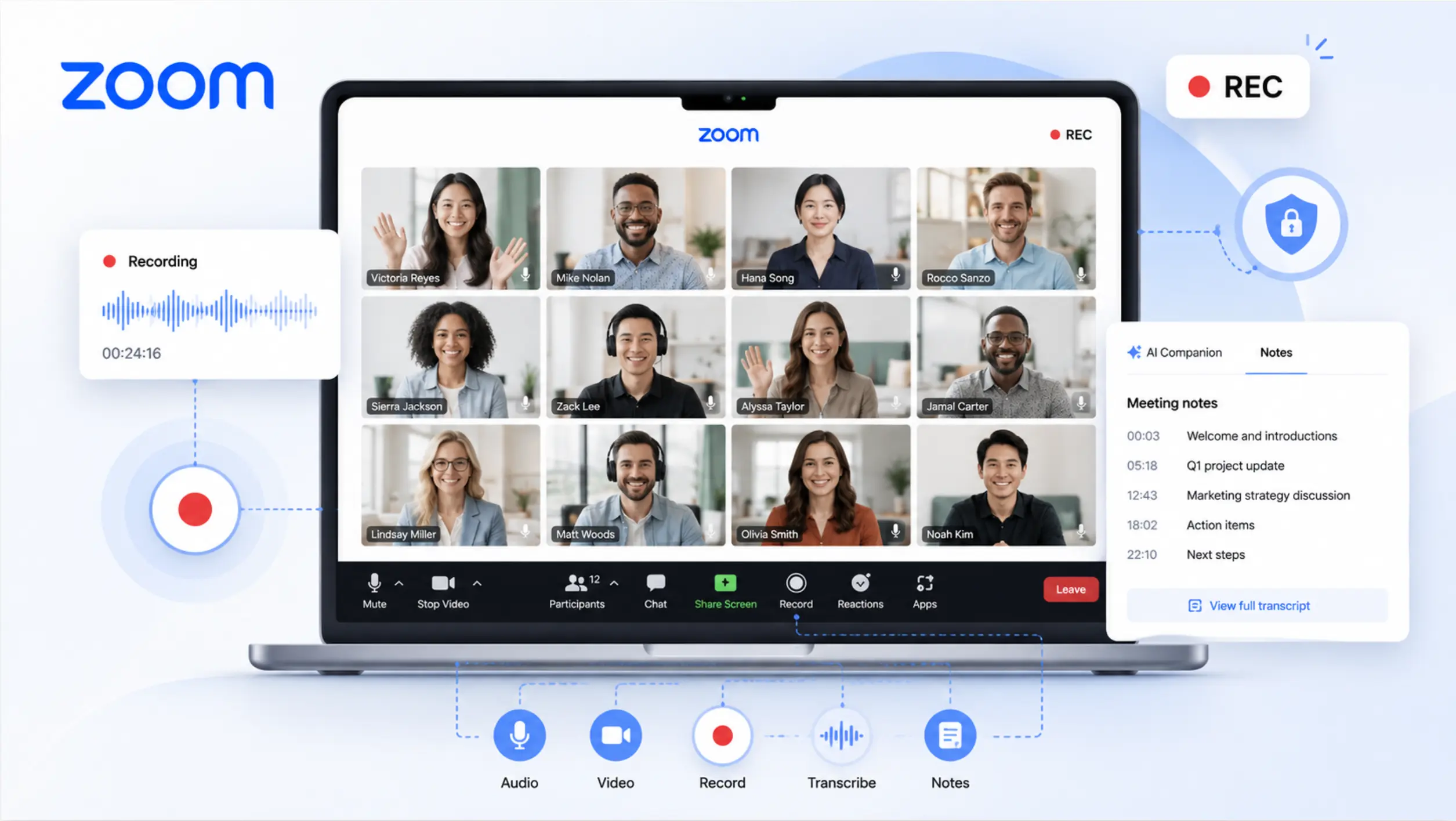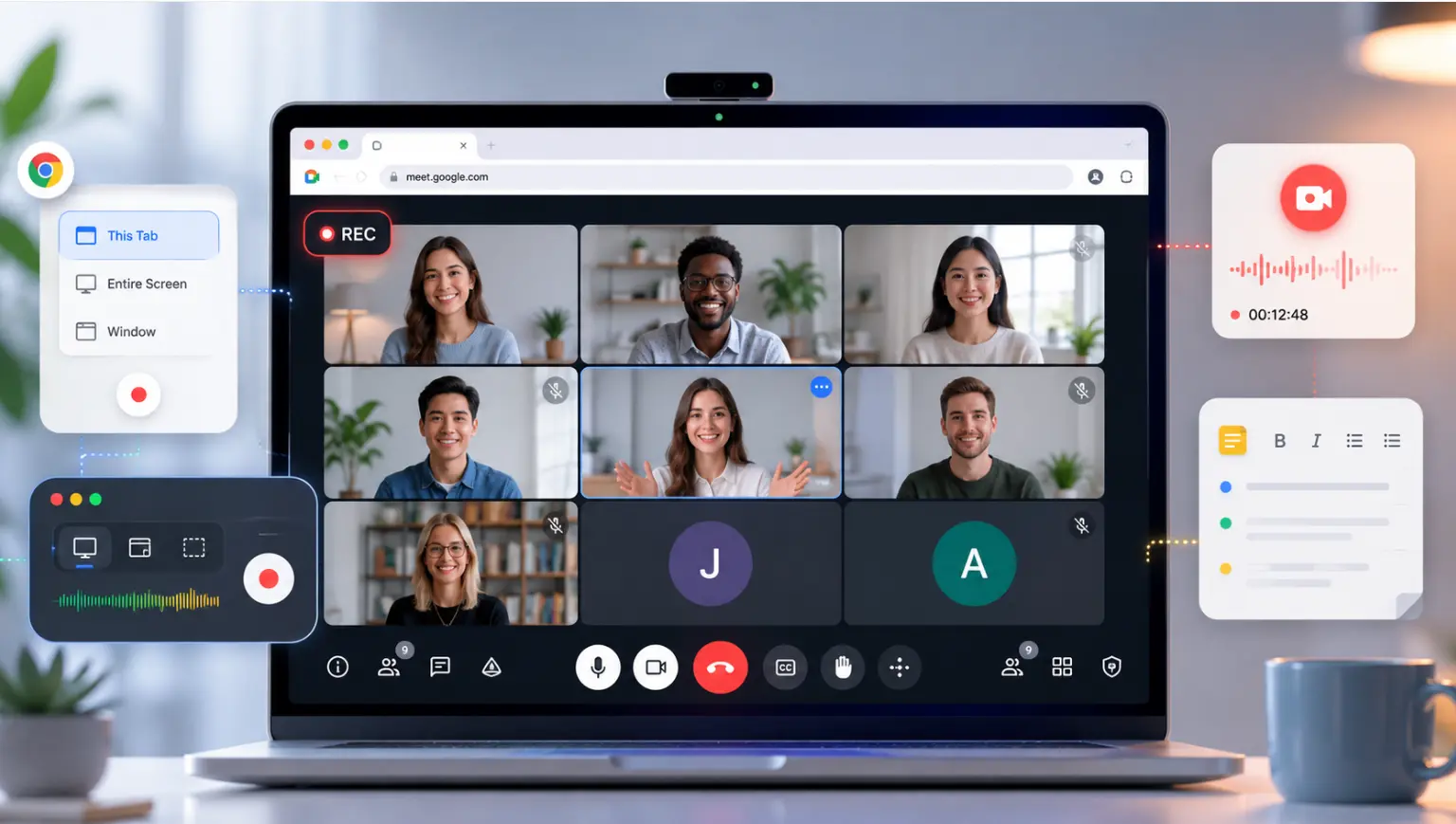

A corporate secretary deciding how to record a board meeting has two options: write minutes or run a recorder. Each answers a different question, and choosing wrong creates a legal or evidentiary problem. This guide walks through the decision, the consent rules, and the capture workflow, then shows how AI turns a recording into draft minutes and action items.
The stakes are real. As of 2025, more than 2.28 million business entities were domiciled in Delaware, including over two-thirds of the Fortune 500, according to the Delaware Division of Corporations. In that corporate form, Delaware courts hold directors to a duty-of-care standard enforced largely through the minute record, which is why an incomplete record is a legal risk, not a clerical one. For the written form itself, the companion guide on how to write effective meeting minutes covers formatting and approval.
How to Record a Board Meeting: Minutes, Audio, or Both
"Recording a board meeting" can mean two different things, and the choice changes everything downstream, from consent to retention. Written minutes are the official record of decisions and votes. An audio recording is the verbatim evidence of what was said. Many boards keep both: a written record for governance, and a recording as the raw material that makes the writing accurate.
The two artifacts serve different jobs. Minutes distill a three-hour meeting into a page of motions, votes, and resolutions. A recording preserves every word, including the dissent a director stated and the exact language of a motion before it was amended. When the two disagree, minutes carry the legal weight, but the recording is what lets you reconstruct why a decision was made.
|
Factor |
Written minutes |
Audio recording |
|---|---|---|
|
What it captures |
Decisions, votes, motions, resolutions |
The exact words spoken |
|
Legal role |
The official record of board action |
Supporting evidence |
|
Produced by |
Secretary or administrator |
A recorder or app running during the meeting |
|
Length |
A few summarized pages |
The full meeting, hour for hour |
|
Risk if missing |
Undocumented decisions and dissent |
No verbatim proof of what was said |
|
Best for |
Governance, audit, litigation |
Disputes, dissent capture, drafting minutes |
Audio is the exception, not the default. Many governance attorneys advise against routine board recordings because they create discoverable material and can chill candid discussion. A board that records should do so under a counsel-approved policy that names the meetings where audio is warranted: a contested vote, a fiduciary decision, a director’s named dissent, or a meeting where the exact wording of a resolution matters. For routine, uncontested meetings, minutes alone usually suffice.
Step 1: Confirm Consent Before You Record the Board Meeting
The plain-language rule is simple: always give written notice, and follow the strictest rule that applies. The Reporters Committee for Freedom of the Press identifies about 11 states that require all-party consent before you record a conversation, while federal law sets a one-party minimum nationwide. Before any recorder turns on, check which rule your state follows and what your bylaws say.
By contrast, the one-party default is simpler than it sounds. In most states, one participant who knows the recording is happening can consent on behalf of the room. The all-party states are stricter: every participant must be told. Four more states split the rule by medium, treating in-person recording and phone recording differently.
|
Category |
States |
|---|---|
|
All-party consent (11) |
California, Delaware, Florida, Illinois, Maryland, Massachusetts, Michigan, Montana, New Hampshire, Pennsylvania, Washington |
|
Split by medium (4) |
Connecticut, Missouri, Nevada, Oregon |
|
One-party default |
All remaining states, subject to a federal one-party minimum |
Consent matters beyond the statute. People speak differently when they know they are on the record. A 2025 study in the Proceedings on Privacy Enhancing Technologies found that participants are most wary when it is unclear how long a recording is stored or who it may be shared with. Clear, advance notice settles both questions, and it is reason enough to keep the recording out of executive session.
When a board meets across state lines by video, the safest path is to follow the strictest state among the participants.
Step 2: Prepare the Agenda, Notice, and Retention Policy
Most board-recording failures happen before the meeting starts. A clean agenda, a consent notice sent in advance, the right device, and a written retention policy prevent nearly all of them. Preparation is the cheapest part of the workflow and the most often skipped.
Four items are worth resolving ahead of time:
-
Agenda. Circulate it with the recording notice. The agenda tells the recorder what to flag: each motion, each vote, and each named dissent.
-
Consent notice. Tell participants in writing that the meeting will be recorded, how the recording will be used, and how long it will be kept. This satisfies consent law and settles expectations.
-
Device choice. Pick the recorder before the room fills. A dedicated device that sits on the table or clips to a lapel captures cleaner audio than a laptop microphone across the room.
-
Retention policy. Decide how long recordings live and who can access them before the meeting, not after.
Device choice matters less than most people assume, but it still matters. If a clip-on form factor appeals, what is a wearable AI recorder explains the device class a board secretary can wear discreetly.
Retention, however, is where boards most often lose the plot. A recording that lives forever on someone’s phone is a discovery risk, but deletion is not automatically safer. A standard policy pairs a short deletion window with a legal-hold override: the moment litigation, a subpoena, a whistleblower matter, or a regulatory inquiry is pending or reasonably anticipated, deletion stops and the recording is preserved. Assign one custodian, usually the corporate secretary, and store the file only in the approved board portal or records repository.
Step 3: Capture Board Actions and Dissents Verbatim
In 2025, a Memory & Cognition study asked 60 people to recall 60 conversations. Overhearers remembered less content than the speakers and often mis-attributed who said what. A secretary taking notes is an overhearer, which is exactly why audio keeps the record faithful.

During the meeting, the recorder has one job: capture the moments that will become the minutes. Those moments are specific: the exact wording of each motion, each vote by name or by count, and every dissent.
The minutes themselves stay disciplined. A good set records attendees and quorum, each motion and its vote result, recusals and conflicts of interest, and the materials presented. It summarizes deliberation at a high level rather than transcribing debate, and it names a dissent only where policy or counsel requires it. Attribute each dissent to the director who raised it: a dissent recorded by name is the strongest evidence a board considered a contrary view.
In practice, a secretary who tries to write all of this by hand in real time misses something. The fix is to let the recording carry the words and to use the note pad only for markers: the timestamp when a motion was made, the time when the vote was called, and any moment the chair flags as important.
After the meeting, the recording is the source, not the record. Minutes are still written, still reviewed, and still approved at the next meeting. The audio just makes that writing accurate.
Step 4: Turn the Recording Into Draft Minutes
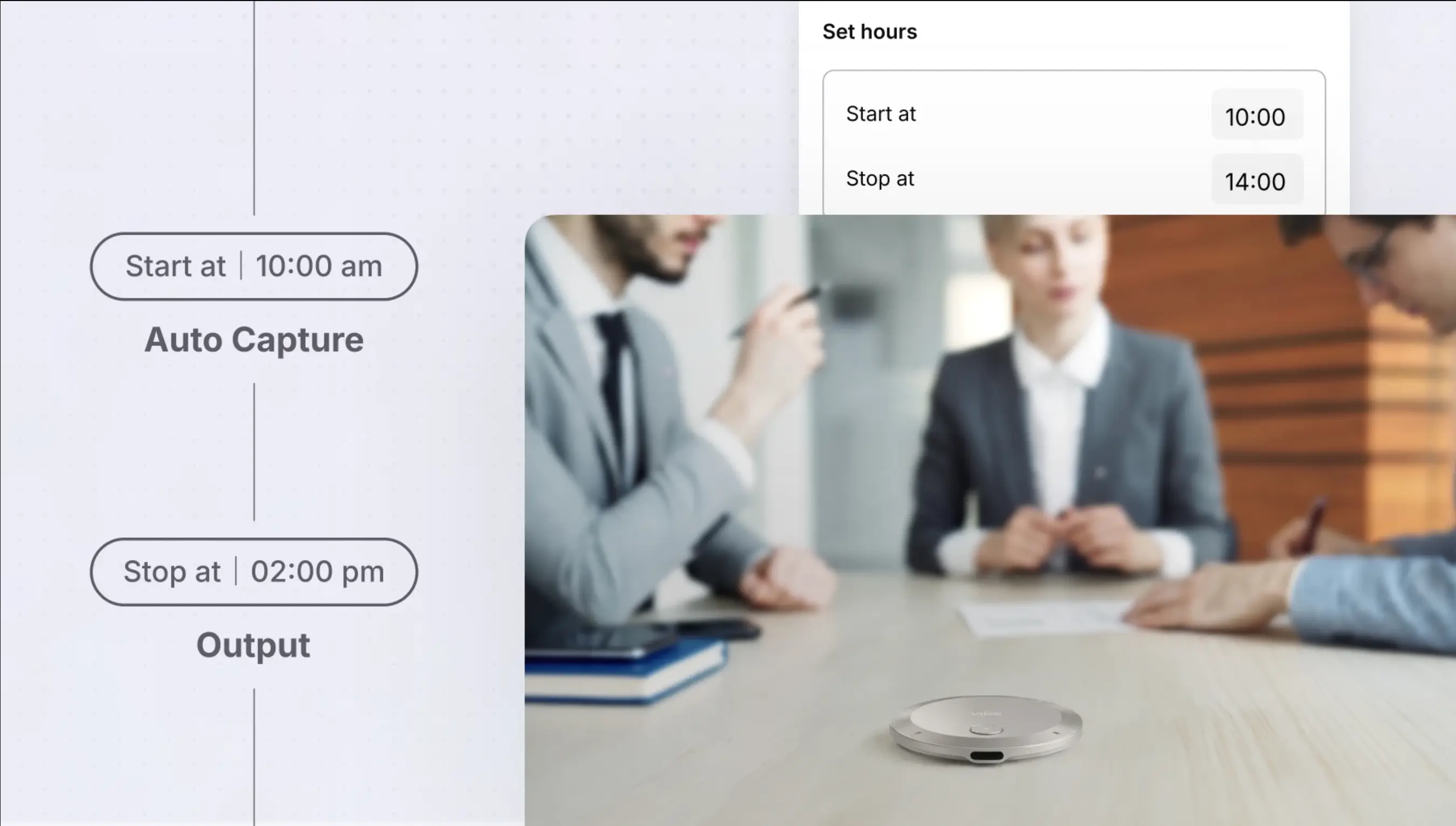
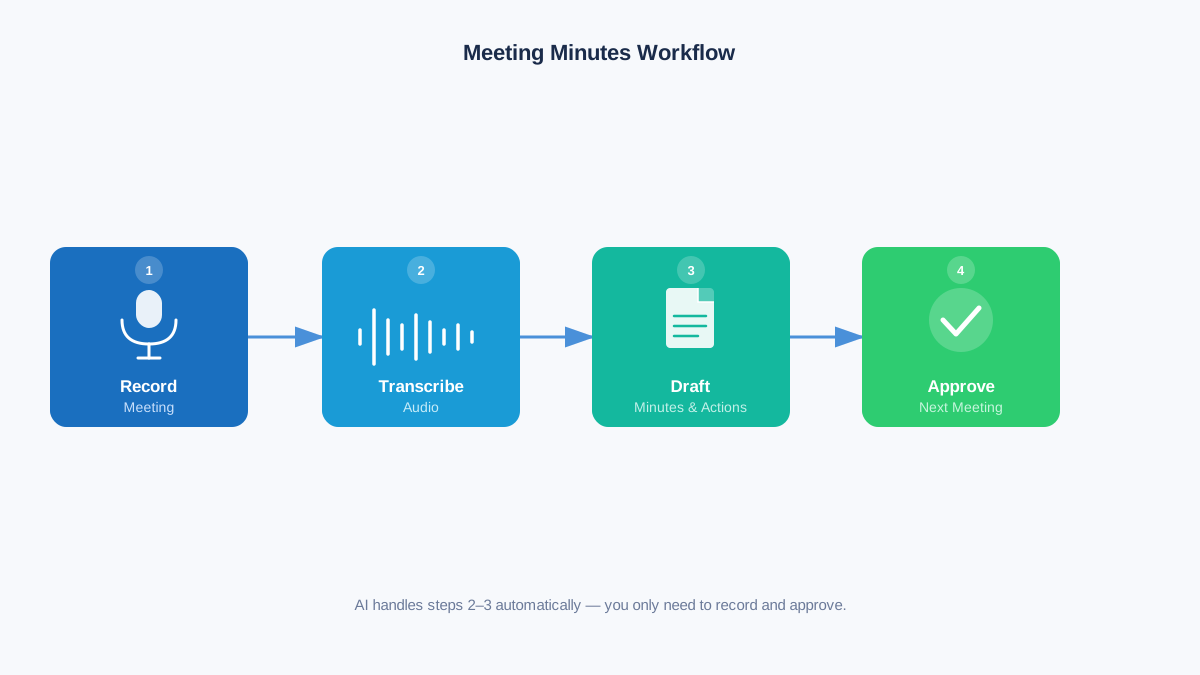 Four-stage workflow: record the meeting, transcribe the audio, draft minutes and action items, approve at the next meeting
An AI transcription tool turns a raw recording into a structured draft in three passes: it transcribes the audio, extracts each motion and vote, and tags action items with owners. Seventy-five percent of knowledge workers now use AI at work, according to Microsoft’s 2025 Work Trend Index, a survey of 31,000 workers across 31 countries.
In fact, the payoff shows up in hours. The same Work Trend Index finds that 60% of meetings are now ad hoc rather than scheduled, which makes a portable recorder more useful than a tool that only joins calendar calls. For a secretary who used to spend an evening reconstructing a meeting from notes, a transcript and summary do most of that work.
The category is well populated, and each tool fits a different setup. Otter and Fireflies run on a phone or laptop and produce live transcripts and summaries. Plaud is a thin AI recorder that pairs with an app.
For a board meeting around a table, purpose-built hardware matters more than a phone app. A dedicated recorder keeps the microphone close to the speakers and sits under a board-approved retention and access policy more cleanly than an app tied to a personal phone account. Vibe Dot is one such device: it clips to clothing or snaps to a phone and turns the conversation into a transcript, a summary, and action items. The guide to the best wearable AI recorders compares the options in the category.
Before board deliberations go into any AI transcription service, run the vendor due-diligence that board sensitivity demands: a data-processing agreement, a training opt-out so recordings are never used to train models, data residency, access controls and audit logs, and an export-and-delete path. Hardware encryption and a SOC 2 report are a start; they are not the whole answer.
In practice, the difference is concrete. A corporate secretary at a mid-cap manufacturing company, preparing for a contested vote on an acquisition, clipped a wearable recorder to her blazer and recorded the session. The transcription tool produced a draft that listed each motion, the vote count, and two named dissents, the record counsel later used to confirm the board had weighed the objection before voting. What once took an evening of reconstructing from handwritten notes became a 20-minute review pass against the transcript before the draft went out for approval.
The AI drafts; the human owns the record. A secretary still reviews every motion and vote against the transcript, edits the summary, and presents the minutes for approval at the next meeting. Automation shortens the draft, but it does not replace the approval step.
Mistakes That Undo a Board Record
Every step in the workflow above exists to prevent two failures: a capture that is wrong, and a board that stops trusting the process. Four mistakes produce them, and each is avoidable.
-
Verbatim-as-minutes. Pasting a transcript into the minute book is the most common error. Minutes summarize decisions; a transcript is evidence, not a record.
-
Missing consent. Recording without notice in an all-party state can void the recording’s value and create liability.
-
Lost dissent records. A dissent captured but never written into the minutes is invisible to an auditor or a court.
-
No retention or access control. A recording that lives forever, shared with anyone, is a discovery risk waiting to surface.
In short, each failure traces back to a decision that was skipped before the meeting. The consent check, the retention window, the plan for turning audio into minutes: all of them are cheaper to resolve on the front end than to fix after a dispute.
A Board Record Worth Defending
Recording a board meeting is a decision about evidence, not a preference about note-taking. The workflow is short and front-loaded: decide between minutes and audio, confirm consent, prepare the agenda and retention policy, capture motions and dissents, and turn the audio into draft minutes.
The point of the whole workflow is accuracy, not more documentation. Minutes remain the official record; the recording is what makes them faithful. A board that settles the consent question, writes a retention policy with a legal-hold override, and uses AI capture to turn audio into a draft gains the accuracy without the discoverability risk.
For boards that do record, a wearable recorder such as Vibe Dot clips to clothing or sits on the table and turns the conversation into a transcript, a summary, and action items. The recording does not replace the minutes. It makes the minutes accurate, which is the point of keeping the record at all.

FAQs
Can board meetings be recorded legally?
Yes, in most cases, but the rule depends on the state and the type of session. Public or open meetings often follow a different standard, while executive session and privileged discussion are off-limits under nearly every policy. The Reporters Committee for Freedom of the Press identifies about 11 all-party-consent states, with a one-party minimum nationwide. Check the statute, the bylaws, and the specific session before turning on a recorder.
Do you need consent to record a board meeting?
Yes. Give written notice in advance, and treat consent as more than a legal formality: people speak differently when they know a recorder is on. In all-party states every participant must be told, and a board may adopt a stricter rule than the statute, many boards require written consent even in one-party states. Bylaws, not the statute, control what the board itself may do.
What is the difference between recording a meeting and taking minutes?
The two records serve different moments in the same chain: minutes are the approved, official summary, while a recording is the raw evidence you consult to make that summary accurate. They follow different lifecycles too, minutes take effect only after approval at the next meeting, while a recording is evidence the moment it is saved. Many boards therefore keep a recording only until the minutes are approved, then delete it under the retention policy.
How do you turn a board meeting recording into minutes?
An AI note-taker transcribes the audio, then extracts motions, votes, and action items. The secretary reviews the draft against the transcript and edits it. A common cadence is to draft within 48 hours while recollections are fresh, circulate the draft to the chair for review, then approve it at the next meeting. Choose a tool with a training opt-out and an export-and-delete path, and confirm the transcript lands only in the board’s approved repository, not a personal app account.